
You’re probably here because you’ve got a record, a recruiter conversation coming up, and one question pounding in your head: can you join the Army with misdemeanors?
Here’s the blunt answer. Yes, sometimes. No, not always. A misdemeanor does not automatically kill your shot at the Army. But the word “misdemeanor” by itself tells me almost nothing. What matters is the number of offenses, whether anything is still pending, whether a waiver is required, and whether you can present yourself as someone worth the Army’s administrative effort.
That last part holds greater importance than is commonly understood. The formal rulebook matters. The recruiter standing across from you matters just as much. A lot of applicants don’t get rejected by the regulation first. They get screened out by a gatekeeper who decides they’re too much work, too much risk, or too sloppy to push forward.
If you want a useful answer, stop asking, “Do misdemeanors disqualify me?” Start asking, “How will a recruiter read my record, and what can I do to make this waiver case easy to defend?”
Table of Contents
- The Army’s First Filter The Recruiter
- Not All Misdemeanors Are Created Equal
- The Moral Waiver Your Path to Enlistment
- Building a Waiver Packet That Wins
- Career Ending Mistakes Before You Even Enlist
- Long Term Impact Security Clearances and Job Choices
- Frequently Asked Questions on Army Misdemeanor Waivers
- Can you join the Army with one misdemeanor
- Can you join the Army with multiple misdemeanors
- Can you join if charges are still pending
- Should you disclose an expunged or sealed misdemeanor
- Will a recruiter tell you the final answer
- Should you wait before applying
- Can a misdemeanor affect your Army job options later
- What if you were already in and now need to fix the record damage
The Army’s First Filter The Recruiter
Before the Army evaluates your paperwork, a recruiter evaluates you.
That recruiter is not your therapist, not your drinking buddy, and not your appeals court. Recruiters have limited time, real pressure, and a stack of applicants competing for attention. If your file looks messy, incomplete, evasive, or high-risk, plenty of recruiters will decide you’re not worth the trouble even if a legal path exists.

What the recruiter is really looking for
A recruiter is trying to answer a simple question: Are you a waiver-worthy applicant, or are you a future headache?
That means they’re sizing up more than your criminal history. They’re watching whether you take responsibility, whether your story stays consistent, whether you show up prepared, and whether they’ll have to drag every document out of you one painful step at a time.
A recruiter can’t erase your record. A recruiter can’t overrule a disqualifying condition. What they can do is decide whether to invest effort in building your case and moving it up the chain.
Here’s what usually helps:
- Bring complete paperwork: Court records, proof that fines were paid, proof probation ended, and anything showing the matter is closed.
- Speak plainly: Explain what happened, when it happened, and what changed since then.
- Show stability: Work history, school performance, volunteer work, and clean conduct after the offense all matter qualitatively.
- Act like an adult: If you sound defensive, bitter, or evasive, you look risky.
Practical rule: Your first job is not to impress the recruiter. Your first job is to make the recruiter’s decision easy.
Why some recruiters say no too fast
A lot of people hear “you can’t join” when it’s more accurate to say “I don’t want to work this file.”
This is the situation. Some recruiters are experienced and know how to handle moral-waiver cases. Some aren’t. Some will look at one misdemeanor and say, “Bring me the court papers.” Others will shut the conversation down because your record sounds complicated, recent, or poorly explained.
If a recruiter brushes you off, don’t argue like a fool in the parking lot. Tighten your package. Get your documents in order. Present the facts better. If needed, talk to another recruiter and ask sharper questions about waiver processing, not vague questions about whether they “think” you can get in.
Use this approach in the first meeting:
| What you should say | What you should avoid |
|---|---|
| “I have a misdemeanor from a closed case, and I brought the court documents.” | “It was no big deal.” |
| “I want to disclose everything accurately.” | “It was expunged, so I don’t need to mention it, right?” |
| “Tell me what documents you need for waiver review.” | “Can’t you just push it through?” |
If you want movement, act like someone they can put in front of command without embarrassment.
Not All Misdemeanors Are Created Equal
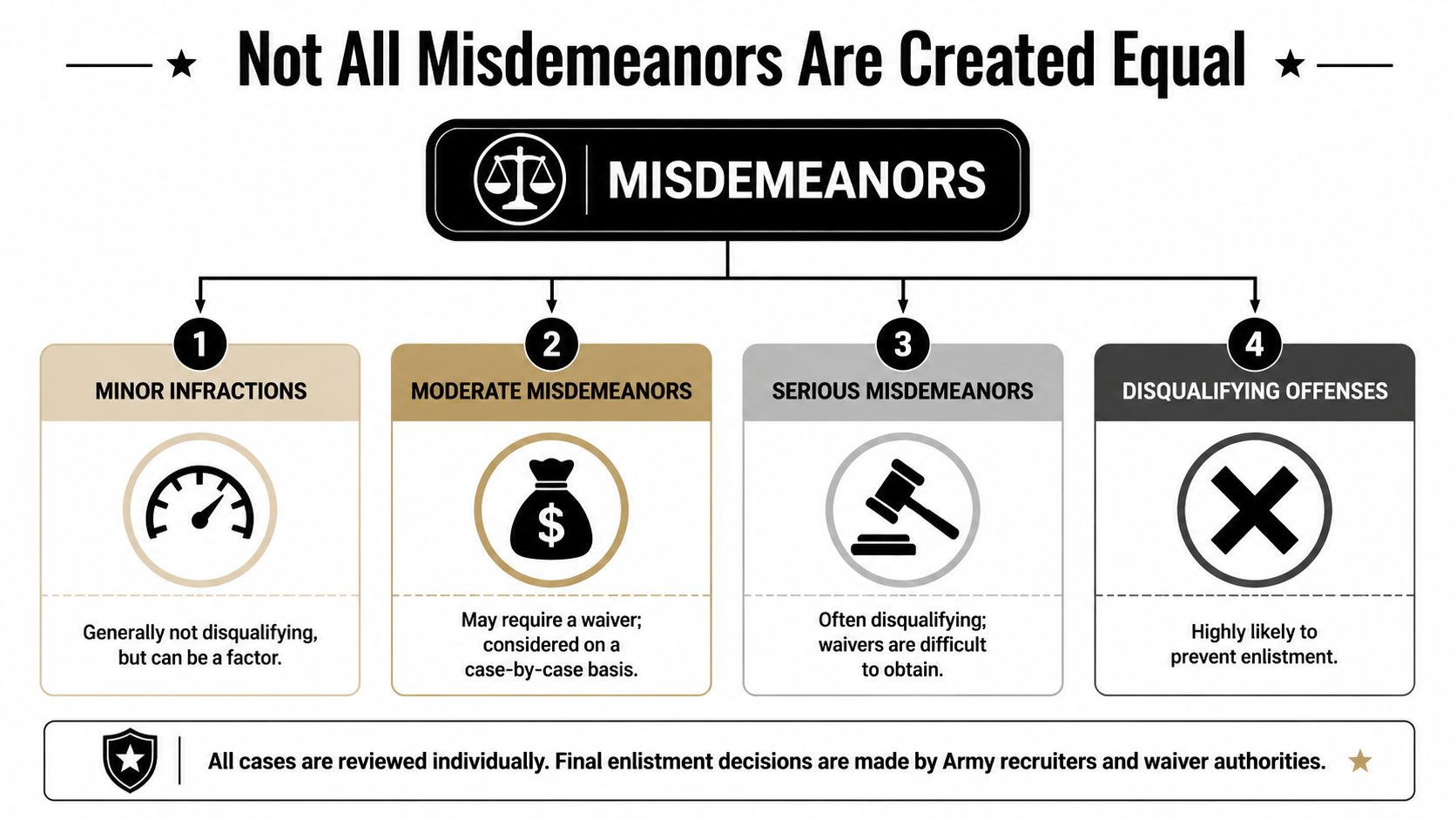
The civilian court system uses the word “misdemeanor.” The Army looks at the conduct behind it.
That distinction matters. Two people can both say, “I have a misdemeanor,” and one has a realistic path forward while the other is staring at a wall. The label doesn’t control the outcome. The underlying behavior does.
What the Army cares about
The first cut is usually practical, not philosophical. Was this a one-time lapse, or does your record show a pattern? Was the conduct minor, or did it suggest violence, dishonesty, substance abuse, or inability to follow rules?
A few examples make the point:
- Low-level conduct issues: Minor disorder, petty disruptions, or similar conduct may be easier to explain if they were isolated and old.
- Moderate concerns: Theft-related behavior, drug possession allegations, or alcohol-related misconduct usually trigger harder questions.
- Serious warning signs: Assaultive conduct, repeated offenses, or anything that suggests ongoing instability gets much tougher.
- Category killers: If the conduct creates a firearms problem or a deeper trust issue, the practical path narrows fast.
Charge, arrest, conviction, and disposition
Applicants get tripped up here constantly because they think dismissal means invisibility. It doesn’t.
You need to understand the difference between what happened in court and what the Army will ask you to disclose. An arrest is not the same thing as a conviction. A charge that was reduced is not the same thing as a clean slate. A sealed or expunged record is not a permission slip to keep quiet.
The fastest way to turn a manageable record into a fraudulent-enlistment problem is to hide part of it.
If you’re asking can you join the Army with misdemeanors, your safest operating rule is simple: disclose first, explain second.
Use this personal checklist before talking to a recruiter:
- List every police contact you remember, even if the case was dismissed.
- Match each event to a document so your memory doesn’t carry the whole load.
- Write a clean timeline with dates, outcomes, and what happened afterward.
- Fix inconsistencies now before someone else finds them later.
The Army can work with some bad facts. It has far less patience for dishonesty.
The Moral Waiver Your Path to Enlistment
You walk into the recruiting office with a misdemeanor record and expect a yes or no. That is not how this works. The recruiter is asking a harder question first: are you worth the time, paperwork, and command attention it takes to push a moral waiver.
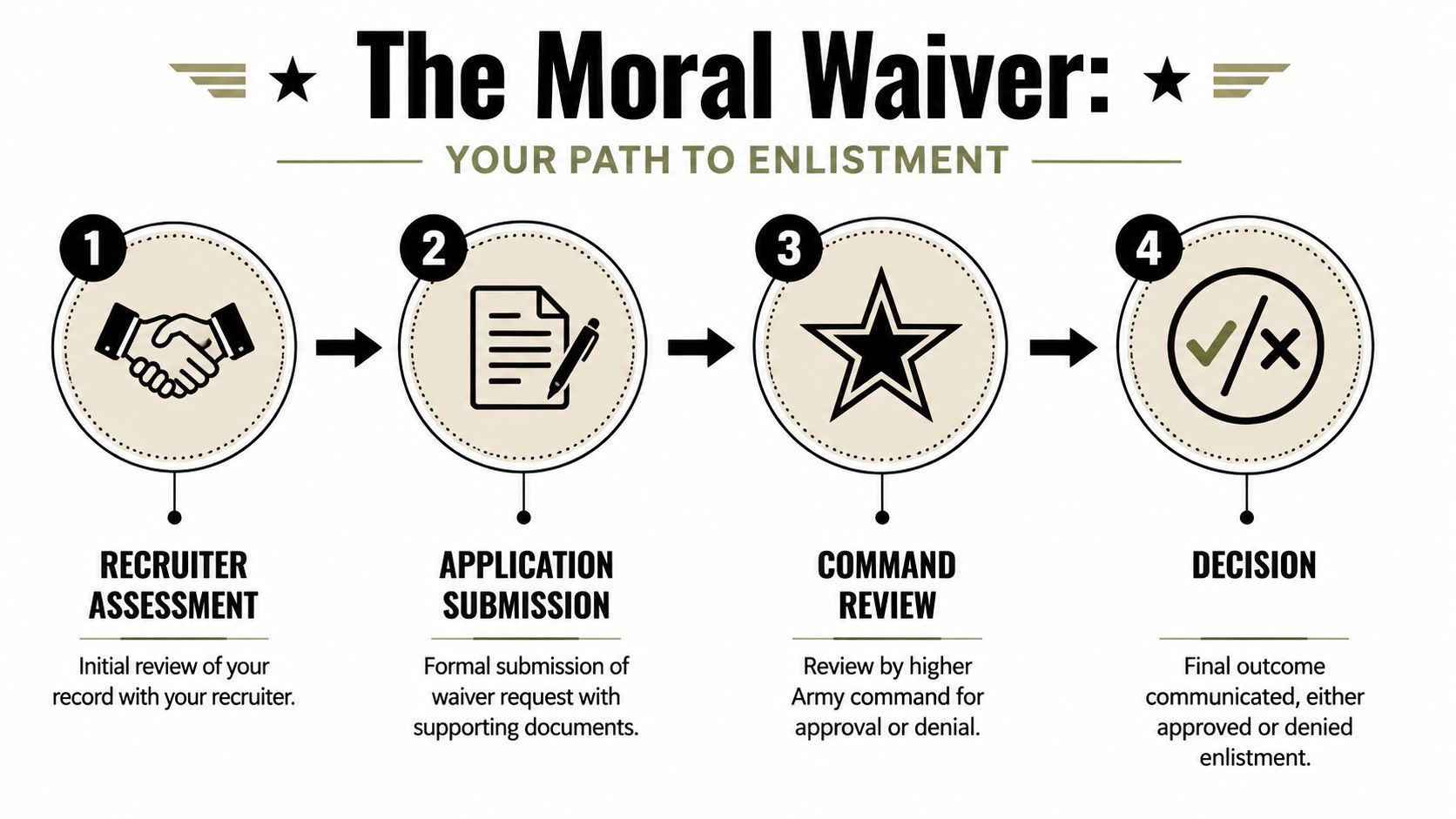
That is the function of a moral waiver. It is the Army’s formal process for deciding whether your past conduct is serious enough to require an exception, and whether you look reliable enough to approve anyway. Recruiters do not grant that exception. They build, or refuse to build, the case that goes up the chain.
What triggers a waiver
A waiver comes into play when your record cannot move through routine processing. The trigger can be the offense itself, the number of incidents, a messy court outcome, or a pattern that makes command question your judgment.
As noted earlier in the previously mentioned Army guidance, five or more misdemeanors is a disqualifying threshold, and pending charges stop the process until the case is fully resolved. Timing matters for another reason too. Waivers take time, and age limits do not pause while you sort out old cases or missing records.
The recruiter is reading your file through a risk lens. A single old offense with a clean finish can be packaged. Multiple incidents close together, probation problems, unpaid fines, or anything that looks unresolved makes your case expensive in recruiter time and hard to defend to command.
A separate perspective from this discussion of military waiver policy and criminal records reaches the same practical conclusion. The Army does not use one simple pass-fail rule for every misdemeanor record. It sorts applicants by seriousness, pattern, and overall trustworthiness.
How the process usually moves
The process is paperwork driven, and your recruiter is the first gatekeeper. If you want a real shot, stop selling your intentions and start proving your reliability.
A typical sequence looks like this:
Recruiter screening
The recruiter reviews the record, checks whether the case is waiver-eligible, and decides whether you look honest, organized, and worth sponsoring.File assembly
You provide court documents, proof that every condition was completed, and a statement that lines up with the records.Chain of command review
The packet goes to the approval authority. That reviewer usually knows you only through what is on paper and what the recruiter says about you.Decision or return for more information
The waiver is approved, denied, or sent back because something is missing, inconsistent, or unconvincing.
Here is the blunt truth. Recruiters are not looking for perfect people. They are looking for applicants they can defend. If your story changes, your documents are incomplete, or you act like the record should not matter, many recruiters will stop investing effort in you and move on to an easier contract.
So talk to the recruiter like someone asking for sponsorship, not sympathy. Bring a clean timeline. Answer the exact question asked. Admit the conduct without speeches or excuses. Make it easy for that recruiter to tell command, “This applicant had a problem, finished the court case, stayed clean, and is now low risk.”
Waivers get denied for bad facts. They also get denied because the applicant looked slippery, immature, or exhausting. From the recruiter’s side of the desk, that difference matters a lot.
Building a Waiver Packet That Wins
A strong waiver packet reads like a disciplined defense file. It doesn’t beg. It proves.
Most applicants sabotage themselves by writing emotional explanations and attaching random papers. That’s not a packet. That’s clutter. Your job is to give the reviewer a clean record of what happened, what you did to fix it, and why you’re a safer bet now than your history suggests.
What belongs in the packet
Start with the hard documents. Not screenshots. Not your aunt’s recollection. Official records.
At minimum, gather:
- Certified court paperwork: Charges, final disposition, sentence terms, and closure.
- Proof of completion: Paid fines, completed classes, ended probation, satisfied conditions.
- Identity-consistent records: Make sure names, dates of birth, and case numbers line up.
- Character materials: Employment records, school records, community references, and anything else showing maturity after the incident.
Then add a short supporting layer that helps the reader trust you.
| Document | Why it matters |
|---|---|
| Final court disposition | Proves the case outcome |
| Proof all terms were completed | Shows follow-through |
| Personal statement | Shows ownership and judgment |
| Letters of recommendation | Shows others trust you now |
What your statement should actually say
Here, people become their own worst enemy.
A good statement is calm, brief, factual, and accountable. A bad statement blames the police, blames the ex, blames alcohol, blames the judge, and ends with “that’s not who I am.” If you have to say that repeatedly, the packet already lost altitude.
Your statement should cover four things:
- What happened: Plain facts.
- What the court required: Show respect for the process.
- What you did afterward: School, work, treatment, volunteer work, stable conduct.
- Why service makes sense now: Not because you “need a second chance,” but because you’re prepared to meet standards.
Defense lawyer’s view: Ownership beats explanation. Explanation matters only after ownership is clear.
Letters of recommendation matter too, but only if they say something useful. A good letter comes from someone who knows your conduct over time. Employer. Supervisor. Coach. Clergy member. Teacher. Not a friend who writes that you’re “a great guy.”
Tell your references what the letter needs to address:
- How long they’ve known you
- What conduct they’ve observed
- Whether they trust you with responsibility
- Whether they’ve seen change since the offense
If your packet feels like a legal file built by an adult, it helps. If it feels like a last-minute school project, it hurts.
Career Ending Mistakes Before You Even Enlist
Most waiver denials don’t come out of nowhere. The applicant usually walked into them.
The ugliest mistake is lying. The second ugliest mistake is listening to someone who told you to lie by omission. “They probably won’t see it” is loser talk. “It was expunged” is not a strategy. “The recruiter said leave that out” can become your problem later, not theirs.
The lies that ruin people
If your record exists anywhere the government can find it, assume it will surface. Then act accordingly.
These are the mistakes that wreck enlistment chances:
- Hiding charges you think don’t count: Dismissed, sealed, reduced, old. None of that gives you a free pass to conceal.
- Minimizing the offense: Calling theft “a misunderstanding” or assault “just an argument” tells the reviewer you still don’t get it.
- Leaving paperwork incomplete: If you can’t prove the case is closed, you create doubt.
- Changing your story: Inconsistency reads like dishonesty.
- Pretending a recruiter can fix everything: A recruiter can submit. A recruiter cannot perform miracles.
People who later face disciplinary issues in uniform often make the same early mistake. They assume the system will “work with them” if they stay vague. That is fantasy. If you want a look at how fast military discipline can become formal trouble after enlistment, read this explanation of what an NJP in the military means.
The attitude problems that sink waiver cases
Some applicants have documents in order and still lose because they radiate bad judgment.
Here’s what recruiters and reviewers notice immediately:
Entitlement
If you act like the Army owes you a waiver, you look unfit for military culture.Excuse-making
A waiver request is not a closing argument about why everyone else was wrong.Sloppiness
Missing records, wrong dates, and half-answers tell the Army you’ll be a management problem.Impatience
Pushing for shortcuts makes you look unreliable.Immaturity
If your response to scrutiny is anger, sarcasm, or blame, your packet is speaking against you.
If you want trust, show discipline before you ever put on the uniform.
Long Term Impact Security Clearances and Job Choices
A recruiter may get you to the front door with a waiver and still know you are a bad fit for the jobs you want.
That is the part applicants miss. Enlistment eligibility and career flexibility are different questions. A misdemeanor that can be explained well enough for accession can still block jobs tied to sensitive information, weapons, money, law enforcement functions, or higher trust. From the recruiter’s side, that matters a lot. They are not just asking, “Can this person get in?” They are asking, “Will this person qualify for enough jobs to be worth the work?”

Getting in does not preserve every option
As noted earlier, the Army’s enlistment rules deal with entry screening. They do not promise you access to every MOS, every school, or every clearance-sensitive track after you sign.
If your offense suggests dishonesty, violence, substance abuse, or repeated bad judgment, expect narrower job choices. A recruiter sees that immediately because certain applicants become hard to place. If you walk in saying you only want an intelligence, signal, aviation, or other sensitive field, and your record cuts against that, the recruiter is going to measure your case by one hard question. Are you flexible, or are you going to waste their time?
Be smart here. Ask direct questions early:
- Which MOS options are realistically open with my record?
- Which jobs usually trigger tougher background review?
- Does my offense history create a problem for clearance-based specialties?
- If I get approved to enlist, what jobs are likely off the table?
Those questions do two things. They get you real information, and they show the recruiter you understand the difference between joining the Army and getting the Army career you pictured.
What to tell the recruiter about your goals
Do not pitch yourself as “willing to do anything” if that is false. Recruiters hear that line all the time. They trust specifics.
Tell them what jobs interest you, then ask whether your record makes those jobs unrealistic. If the answer is yes, press for the truth. Do not let anyone give you vague optimism just to move paperwork. A clean answer now is better than resentment later.
If you want the broadest range of future options, your file has to show stability after the offense. Closed cases, completed conditions, steady work, strong references, and no new trouble matter because they help the recruiter argue that the misdemeanor was an old problem, not your current identity.
Read the long game correctly
Your record does not disappear because you got through MEPS. If later conduct problems pile up, the Army will treat them as part of a pattern, not isolated bad luck. That can affect schools, promotions, assignments, and separation decisions. If you want to understand how post-enlistment misconduct can turn into forced separation, read this overview of an Army administrative discharge process.
Here is the blunt truth. If your goal is to serve, a misdemeanor may be survivable. If your goal is to serve in a narrow, high-trust specialty, your margin for error is much smaller. Go into the recruiter’s office knowing which fight you are trying to win.
Frequently Asked Questions on Army Misdemeanor Waivers
Can you join the Army with one misdemeanor
Sometimes, yes. One misdemeanor is not an automatic bar by itself. Important factors are what the offense was, whether the case is fully resolved, and whether the recruiter sees you as waiver-worthy.
Can you join the Army with multiple misdemeanors
Possibly, but the path gets tighter as the count rises. The Army’s stated threshold makes five or more misdemeanors disqualifying in enlistment screening, as noted earlier from the Army requirements page.
Can you join if charges are still pending
No. If the charges are still open, you’re not eligible until they’re resolved. That is a direct practical barrier, not a technicality.
Should you disclose an expunged or sealed misdemeanor
Yes. Keep it simple and disclose it. Trying to outsmart a federal background process is a bad plan.
Will a recruiter tell you the final answer
No. A recruiter can give an initial read and help package the case. The final call on a waiver is made higher up.
Should you wait before applying
If your case is still messy, yes. If documents are missing, conditions are unfinished, or your life still looks unstable, rushing hurts you. A cleaner file beats a fast file.
Can a misdemeanor affect your Army job options later
Yes. Entry and long-term opportunity are not the same thing. Some paths may narrow even if enlistment is approved.
What if you were already in and now need to fix the record damage
That becomes a different legal problem. If your service ended badly and you’re trying to repair the fallout, this guide on how to upgrade a military discharge is a useful starting point.
If you’ve got misdemeanors on your record, don’t walk into a recruiter’s office with half a story and a pocket full of hope. Walk in with documents, a clean timeline, and a strategy.
And if your history is complicated, get legal advice early. Waiting until after you’ve made inconsistent disclosures, omitted a case, or accepted a bad recruiter answer can turn a manageable problem into a permanent one. Your future in the Army can hinge on what you say, what you disclose, and how well you build the waiver case before anyone stamps the file “denied.”