A text from your First Sergeant. A voicemail from CID. An NCIS agent asking if you can “come in and clear a few things up.” That’s how UCMJ Article 120 – Sexual Assault cases usually start subtly. Then your life gets loud fast.
If you’re reading this because someone just accused you of sexual assault in the military, stop thinking this will sort itself out. It won’t. The people contacting you are not trying to understand you. They’re trying to lock your words into a statement, build a timeline around you, and decide whether to push your case toward a court-martial.
This is one of the most dangerous moments in your military career. Your next few decisions matter more than whatever explanation you think you can give on the phone.
Table of Contents
- The Knock on the Door Your Life Just Changed
- Decoding UCMJ Article 120 Offenses and Punishments
- From Investigation to Court-Martial The Timeline
- How the Government Builds Its Case Against You
- Career-Ending Mistakes to Avoid Immediately
- Strategic Defenses Against an Article 120 Charge
- Why Your Appointed Military Lawyer Is Not Enough
- Frequently Asked Questions on UCMJ Article 120
- Can I refuse to talk to CID, NCIS, OSI, or CGIS
- Do I have to give investigators my phone password
- What if the accuser wants to drop the complaint
- What is a Military Protective Order
- Will I go to jail if I’m charged under Article 120
- Can I get kicked out even if I’m acquitted
- Should I tell my commander my side
- How much does a civilian military defense lawyer cost
- Your Next Move Is Critical
The Knock on the Door Your Life Just Changed
You’re in the barracks, at work, driving home, or sitting at dinner when the message lands. “Call me.” “Come see me.” “Agents want to talk.” In your head, you’re already rehearsing how to explain what happened. That instinct is dangerous.
CID, NCIS, OSI, and CGIS don’t contact you because they’re undecided. They contact you because an allegation has already been made and they want evidence from the easiest source available. You.
Most service members make the same mistake in the first hour. They think silence looks guilty. It doesn’t. Talking looks helpful to you, but to an investigator it’s an opportunity. If your memory is imperfect, they call it inconsistency. If you try to be polite, they call it an admission. If you speculate, they treat it like fact.
What that first contact really means
The first contact usually means three things:
- An allegation exists: Somebody has already given enough information to get law enforcement involved.
- You are behind: The accuser may already have support, guidance, and time to shape a statement.
- The record is starting: Every word you say from this point can become evidence.
Practical rule: If an investigator wants your “side,” your side is already in danger.
What you should do in the first hour
Your first move is not to explain. Your first move is to shut the case down from your mouth.
- Say little: Be respectful, but don’t answer substantive questions.
- Ask for counsel: A UCMJ lawyer needs to get involved before your statement becomes the backbone of the prosecution.
- Preserve your phone: Don’t delete anything. Don’t edit anything. Don’t “clean up” texts.
- Stop discussing the allegation: Not with your squad leader, not with your roommate, not with your ex.
This is not a misunderstanding phase. This is the opening move of a criminal case.
Decoding UCMJ Article 120 Offenses and Punishments

UCMJ Article 120 – Sexual Assault is where the government starts sorting your case into a theory they can sell to a commander, a panel, or a military judge. That theory matters more than the label you use in your own head. If you keep telling yourself this was a misunderstanding, while investigators are framing it as incapacity, lack of consent, or abusive sexual contact, you are already behind.
What Article 120 covers
Under 10 U.S.C. § 920, Article 120 covers rape, sexual assault, aggravated sexual contact, abusive sexual contact, and related misconduct. The statute reaches far beyond cases involving obvious force. Prosecutors often build these cases around alcohol, sleep, blackout claims, claimed impairment, shifting memory, and whether the complaining witness could legally consent.
That is the trap.
A service member hears “sexual assault” and thinks the case turns on violence. The government often needs something else entirely. It needs a story that the other person did not agree, could not agree, or was too impaired to agree. Once investigators lock onto that theory, they start collecting texts, witness impressions, timeline gaps, ride-share records, barracks access logs, and your own words to support it. If you want a practical view of how strong defense teams handle that stage, read how experienced military investigation counsel attack the case early.
Why the punishment structure changes your decisions
The punishment exposure under Article 120 is severe, and commanders know it. Rape or rape of a child can bring death or another punishment a court-martial may direct. Sexual assault can bring up to 30 years of confinement. Aggravated sexual contact can bring up to 20 years. Abusive sexual contact can bring up to 7 years. Indecent exposure can bring up to 1 year.
Here is the practical version:
| Offense category | Maximum exposure under Article 120 |
|---|---|
| Rape or rape of a child | Death or another punishment a court-martial may direct |
| Sexual assault | Up to 30 years’ confinement |
| Aggravated sexual contact | Up to 20 years’ confinement |
| Abusive sexual contact | Up to 7 years’ confinement |
| Indecent exposure | Up to 1 year |
Do not make the rookie mistake of focusing only on the top charge. Prosecutors do not need the worst label to destroy your record. A “lower” Article 120 charge can still mean confinement, sex-offender consequences, a punitive discharge, and a career that ends in disgrace.
Your defense has to start with the government’s likely theory, not your preferred version of events. If the case centers on consent, intoxication, or credibility, treat that as the battlefield now. That is where Article 120 cases are won or lost.
From Investigation to Court-Martial The Timeline
Article 120 cases move through a recognizable machine. Once you understand the sequence, you can stop reacting blindly and start defending yourself intelligently.
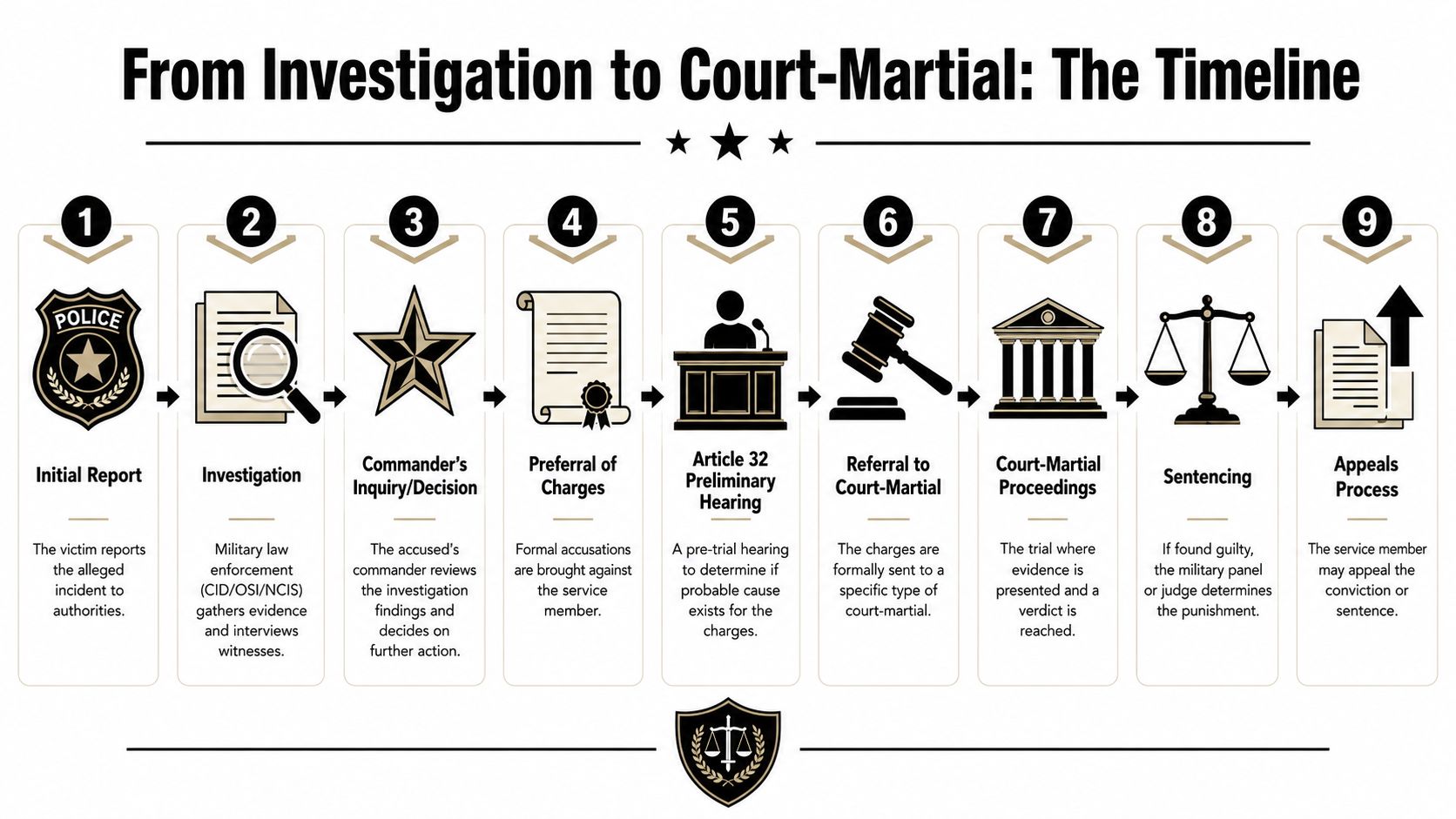
The military handles a large volume of sexual assault reporting. In Fiscal Year 2024, the Department of Defense received 8,195 reports of sexual assault involving Service members, and 5,169 were Unrestricted Reports, meaning they triggered official investigation and command involvement, according to the FY 2024 DoD SAPR annual report. That matters because once your case enters the unrestricted pipeline, it becomes a command and law enforcement problem, not a private dispute.
What usually happens first
The front end of the case often looks informal. It isn’t.
An allegation is made
That report may go through law enforcement, command, or SAPR channels.Investigators start gathering evidence
They collect messages, interview witnesses, and decide whether to approach you.You get contacted for an interview
This is the trap point. They may act casual. The interview is still evidence collection.
A lot of service members lose the case here. They talk too much, consent to searches too easily, or try to sound cooperative without realizing they’re building the government’s exhibit list.
The investigation phase is where strong defense lawyers can still shape the battlefield, before the government hardens its theory. For a practical look at that stage, see how experienced counsel approach the military investigation phase.
When the case turns formal
Once investigators finish their package, things can accelerate.
- Command review: Your commander and prosecutors review the file.
- Preferral of charges: Formal charges are signed.
- Article 32 hearing: This is a preliminary hearing in serious cases. It is not the trial, but it matters.
- Referral to court-martial: The case gets sent to a specific court-martial.
- Trial, sentencing, and possible appeal: If the government pushes through, the full machinery is now running.
What your defense should be doing at each stage
A serious defense is active from day one.
| Stage | What the government wants | What your defense should be doing |
|---|---|---|
| Initial contact | A statement from you | Shut down questioning and preserve evidence |
| Investigation | A clean narrative with supporting digital proof | Find missing context, witnesses, and timeline problems |
| Charging decision | Enough to justify moving forward | Attack weak assumptions before they harden |
| Article 32 | A smooth path to trial | Expose contradictions and lock witnesses into testimony |
| Pretrial | Limit your options | File motions, challenge evidence, prepare experts if needed |
Service members who wait until referral to get serious are usually late. By then, the government has already had months to organize the story.
How the Government Builds Its Case Against You
Most Article 120 prosecutions are not built like TV crime cases. They’re built from fragments. A text thread. A late-night ride. A memory gap. A witness who saw drinking. A statement you gave when you thought honesty alone would save you.

If you want to understand your danger, study the government’s theory, not your own memory of the night.
Consent is rarely the whole fight
Under the Hawaii National Guard summary of Article 120, an offense can occur if the accused knows or reasonably should know the other person is asleep, unconscious, or unable to consent due to impairment by a drug or intoxicant. That is where many modern cases live.
The legal battlefield is often not “did sex happen?” It is “was the other person legally capable of consenting?” Prosecutors know this. They take ordinary facts and try to convert them into incapacity evidence.
Typical government building blocks include:
- Alcohol evidence: Drinks consumed, bar tabs, party photos, slurred speech, stumbling, vomiting, memory gaps.
- Selective texts: Messages before or after the event that can be framed as guilt, apology, pressure, or consciousness of wrongdoing.
- Behavior framing: They may argue that confusion after the event proves non-consent.
- Your own words: Even a statement like “we were both drunk” can become a prosecution theme.
If you need a clearer picture of who these investigators are and how they operate across branches, review this breakdown of CID, NCIS, OSI, and CGIS.
Credibility wins or loses these cases
These cases are often decided by whose story sounds cleaner, steadier, and more believable under pressure. That’s why investigators spend so much time polishing one side’s narrative and pinning yours down early.
A weak Article 120 case can still get charged if the government thinks your words fill the gaps.
Your defense lawyer should be asking questions the government hopes nobody asks:
- Did the complaining witness give the same account every time?
- Who spoke to them before they made the formal report?
- What messages exist before, during, and after the alleged incident?
- What facts show impairment, and what facts show functioning?
- Did investigators ignore evidence that cuts the other way?
The prosecution’s advantage is not perfect proof. It’s momentum. You break that momentum by exposing assumptions before they become “facts” in a courtroom.
Career-Ending Mistakes to Avoid Immediately
Panic makes people sloppy. Sloppy gets people convicted.
The biggest damage in Article 120 cases often happens before charges. It happens when the accused tries to fix things alone.
The mistakes that destroy defenses
Talking to investigators to “clear it up”
This is the classic mistake. You cannot out-explain a trained investigator in their own interview room.Handing over your phone casually
Phones hold location data, private messages, photos, app histories, and contact patterns. Don’t make search decisions without counsel.Deleting messages or social media
Even if your reason is embarrassment, it can look like obstruction or consciousness of guilt.Contacting the accuser
An apology, an angry text, a request to talk, or a message sent through a friend can all become evidence.Telling command everything
Your commander is not your defense lawyer. Leadership discussions often become reportable facts or witness material.Talking to friends in your unit
Today’s support conversation becomes tomorrow’s sworn statement.Ignoring no-contact orders or restrictions
A separate bad decision can make you look reckless even if the underlying allegation is weak.
What to do instead
Use a short rule set and stick to it.
- Say less than you want to say
- Save everything exactly as it is
- Write a private timeline for your attorney
- Identify witnesses quickly
- Follow orders carefully, even if you plan to challenge them
Don’t mistake motion for strategy. A lot of accused service members are busy for a week and helpful to the government the entire time.
Strategic Defenses Against an Article 120 Charge
A real defense is not “I denied it.” A real defense is a disciplined attack on proof, timing, memory, motive, and investigative shortcuts.

One fact changes the entire strategy. There is no statute of limitations for trial by court-martial for sexual assault offenses under the UCMJ, which means old allegations can be charged years later and makes early preservation of texts, location history, social media, and witness memory critical, as explained in this Article 120 sentencing and defense guide.
Start with evidence before it disappears
The first job is preservation. Not storytelling. Not outrage. Preservation.
Build a defense file immediately:
- Messages: Texts, DMs, dating app chats, screenshots
- Location proof: Ride receipts, maps history, access logs if available
- Witness list: People who saw behavior before and after
- Social media: Posts, tags, comments, stories
- Timeline notes: A private chronology for counsel
A sharp defense often wins because the timeline is stronger than the accusation. If the complaining witness says they were incapacitated, but the digital record shows coherent behavior, movement, communication, or planning, that matters.
Attack the government case where it is weakest
Most Article 120 cases have vulnerable points. Your lawyer should identify them fast.
Some defenses focus on credibility. Others focus on consent evidence, mistake of fact, impaired memory, or investigative bias. Sometimes the strongest move is not proving what happened. It’s proving that the government cannot reliably prove what it claims happened.
Here’s what experienced court-martial attorneys often test first:
| Target area | Why it matters |
|---|---|
| Timeline contradictions | Bad timelines destroy confidence in the accusation |
| Incapacity claims | Drinking is not automatically legal incapacity |
| Digital evidence gaps | Missing or ignored messages can change the whole case |
| Witness omissions | Investigators often skip people who complicate the narrative |
| Statement problems | Poor interviews and selective summaries create attack points |
The defense mindset that actually works
You are not trying to “tell your truth” in the abstract. You are building reasonable doubt with disciplined proof.
That may mean:
- showing that key memories were reconstructed later
- showing that the complaining witness’s behavior conflicts with claimed incapacity
- showing that investigators ignored exculpatory context
- showing that your statement was taken before you understood the allegation
- showing that the government’s theory asks the panel to guess
That is how Article 120 cases are beaten. Not with emotion. With structure.
Why Your Appointed Military Lawyer Is Not Enough
You are entitled to military defense counsel. Use them. But don’t confuse entitlement with sufficiency.
In a serious UCMJ Article 120 – Sexual Assault case, the issue isn’t whether your appointed lawyer cares. Many do. The issue is whether your defense has enough independence, time, and specialized pressure-tested judgment for a case that can end your career and follow you for life.
The problem is not effort
Article 120 cases are labor-heavy. They require witness work, digital evidence review, motion practice, aggressive cross-examination planning, and collateral consequence strategy. Appointed counsel often carry demanding caseloads and rotate through assignments. That’s the structural problem.
A conviction under Article 120 can reach far beyond confinement and discharge. According to the DON SAPRO training supplement, it can trigger permanent loss of security clearance, firearm rights, and veteran benefits, and create a permanent criminal record affecting future federal employment. A lawyer handling your case has to defend not just the trial, but the wreckage that can follow it.
You need a defense built around your life
Civilian military defense lawyers bring one thing the system cannot appoint for you. Independence.
A seasoned civilian counsel is not evaluating your case as another file in the office. They work for you alone. They can coordinate with detailed military counsel, push harder on experts, dig deeper into digital proof, and shape a strategy around court-martial risk plus administrative and clearance fallout.
Then talk to multiple attorneys and compare how they think, not just what they charge.
The right lawyer doesn’t just ask what happened. The right lawyer asks what the government can actually prove, what they missed, and what disappears if nobody acts now.
Frequently Asked Questions on UCMJ Article 120
Can I refuse to talk to CID, NCIS, OSI, or CGIS
Yes. You should invoke your right to counsel and stop answering substantive questions. Being polite is fine. Being interviewed without a lawyer is not.
Do I have to give investigators my phone password
Do not make that decision on your own. Phone access can expose huge amounts of personal and case-related data. Get legal advice before consenting to any search or request to access your device.
What if the accuser wants to drop the complaint
That does not automatically end the case. Once command and prosecutors are involved, they can keep pushing if they think they can prove the allegation.
What is a Military Protective Order
It is a command order that can restrict contact, movement, housing, and communication. You should obey it exactly while your lawyer evaluates whether and how to challenge it.
Will I go to jail if I’m charged under Article 120
Not everyone charged is convicted, and not every case ends in confinement. But the exposure is severe enough that you must treat the risk as real from the first call.
Can I get kicked out even if I’m acquitted
Yes. Administrative action can continue even after an acquittal. That’s one reason your defense must account for command action, records, and career consequences, not just the trial itself.
Should I tell my commander my side
Usually no. Command is not a protected space for you. Statements to leadership can travel fast and harden into evidence.
How much does a civilian military defense lawyer cost
Fees vary widely by experience, scope, travel, experts, and trial posture. Ask every attorney exactly what is included, who does the work, and how they handle investigations, hearings, and trial preparation.
Your Next Move Is Critical
If you’re under investigation for UCMJ Article 120 – Sexual Assault, time is not on your side. The government is already building its case. Stay silent, preserve evidence, and get experienced civilian military defense counsel involved immediately. Waiting is a decision, and it is usually a bad one.