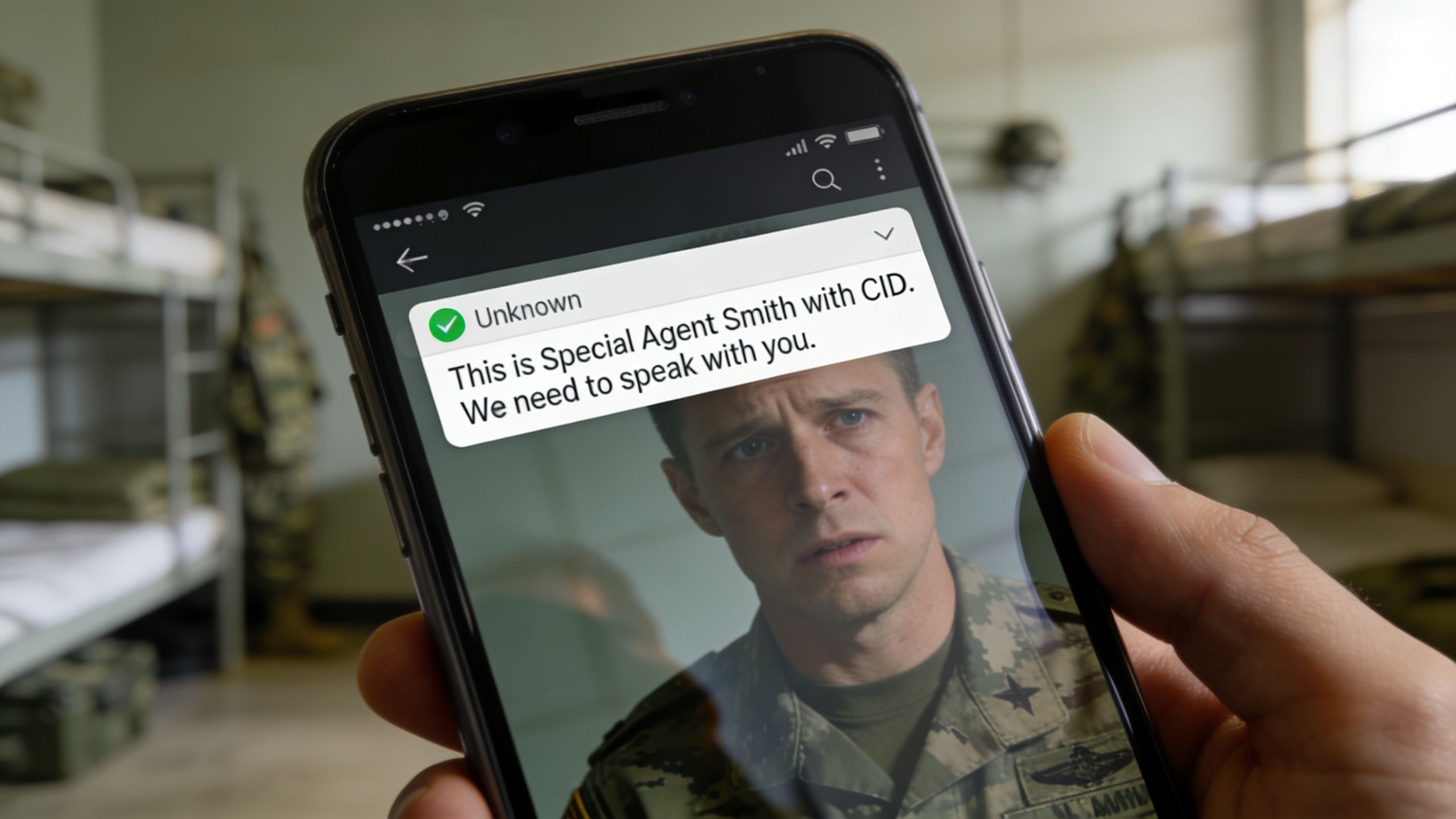
Your phone lights up with a message from a number you don’t know. It says a military investigator needs to speak with you. Or your First Sergeant tells you the commander wants you in the office right now. In that moment, your routine stops and the machine starts moving against you.
If this accusation involves UCMJ Article 93a – Prohibited Activities with Military Recruit or Trainee, you need to understand one thing immediately. This is not a misunderstanding your command will calmly sort out. This is the kind of allegation commands treat as a scandal threat, a discipline problem, and a public example all at once.
Good service members make fatal mistakes in the first few hours. They try to explain. They trust a supervisor. They hand over context that gets turned into admissions. By the time they realize what’s happening, investigators have already framed the case around abuse of trust, command has already assumed the worst, and the service member is playing defense from a hole.
Table of Contents
- Your Career is on Red Alert The Moment You Are Accused
- What is UCMJ Article 93a Actually Prohibiting
- How the Government Builds a Case to Convict You
- Strategic Defenses Where These Cases Are Won or Lost
- Maximum Punishments and Career-Ending Consequences
- Your First Call Is Your Best Defense Why Civilian Counsel is Non-Negotiable
- Frequently Asked Questions
Your Career is on Red Alert The Moment You Are Accused
The first mistake is thinking you still have time. You usually don’t.
By the time CID, NCIS, OSI, or CGIS reaches out, people have already talked. Screenshots may already be circulating. A commander may already be worried about optics. A supervisor may already be trying to distance the unit from you. In these cases, command rarely acts like a neutral fact-finder. Command acts like an institution trying to contain damage.
What that first contact really means
An accusation under UCMJ Article 93a – Prohibited Activities with Military Recruit or Trainee hits differently because it carries built-in moral weight. If the allegation involves a recruit, trainee, applicant, or delayed-entry enlistee, the command hears “abuse of trust” before it hears “proof.”
That is why early action matters more here than in many other military cases.
Practical rule: The moment you learn you’re under investigation, stop explaining and start defending.
This offense is relatively new. It became effective on January 1, 2019, and Congress codified it at 10 U.S.C. § 893a as part of military justice reforms. The law also removes consent as a defense, reflecting a policy choice to treat these relationships as coercive by nature in the training and recruiting environment, as explained in this Article 93a overview of the post-2019 military justice reforms.
Why command politics matter immediately
These cases are often driven as much by fear as by facts. A commander doesn’t want to be the one accused of going soft on a training or recruiting allegation. A senior enlisted leader doesn’t want to look like they ignored warning signs. An investigator doesn’t want to close a case that later becomes an IG complaint or media problem.
That pressure shapes everything:
- Your unit may isolate you fast. Reassignment, no-contact orders, suspension from duties, or quiet removal from a leadership role can happen before the evidence is fully tested.
- People around you may protect themselves first. Peers and supervisors often say what is safest for them, not what is fairest to you.
- Your own words become ammunition. A well-meaning explanation can be cut into admissions about contact, timing, knowledge, or authority.
You need to treat the first day like the first day of trial preparation, because that’s exactly what it is.
What is UCMJ Article 93a Actually Prohibiting
Forget the lazy label of “fraternization.” That shortcut causes service members to underestimate the threat.
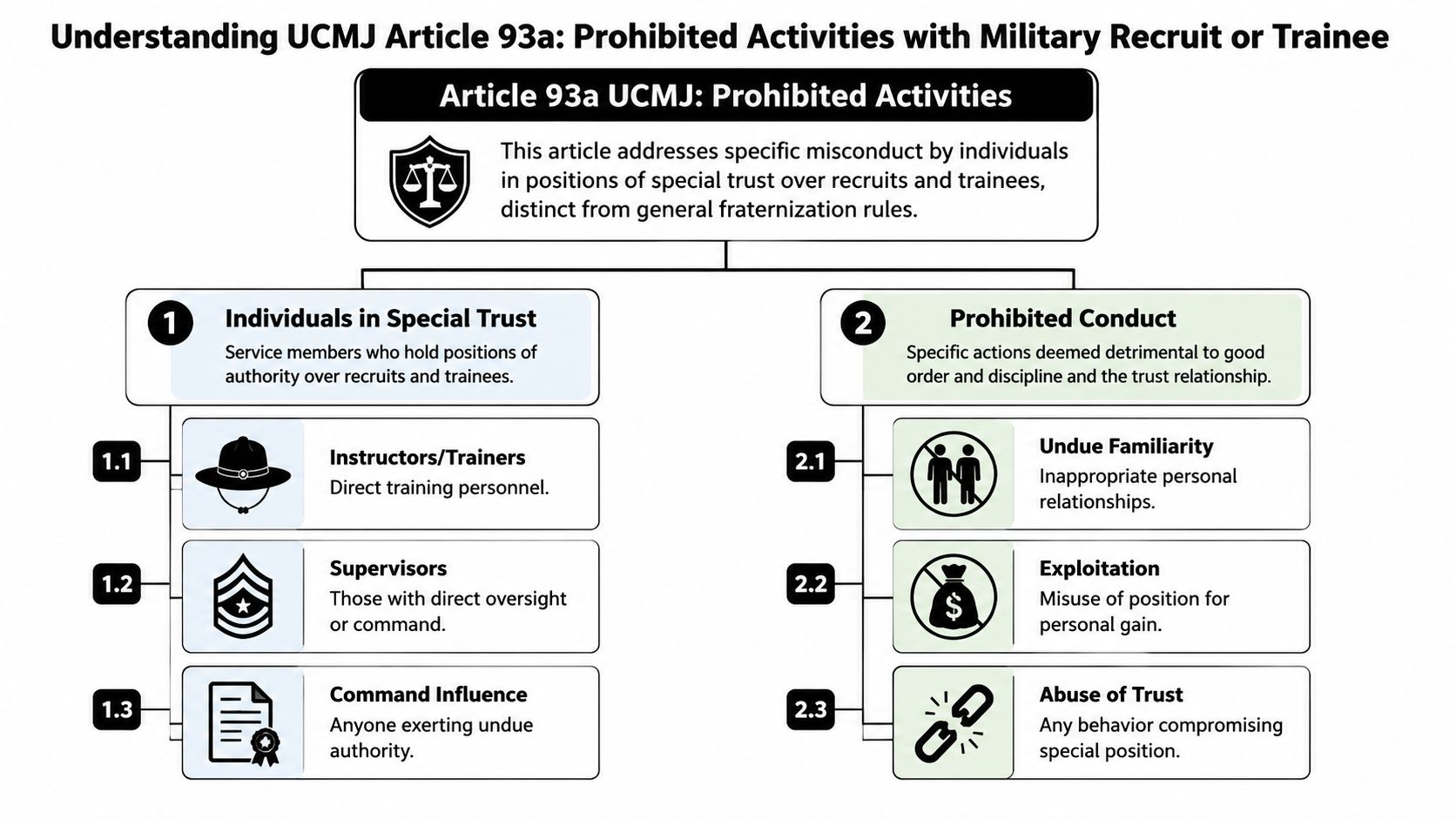
Article 93a is a specialized offense built around a particular kind of relationship. It is aimed at people the military sees as holding a position of special trust over those in the accession or training pipeline.
This is not just fraternization by another name
Fraternization cases often turn on broader questions of good order, discipline, custom, and prejudice to the service. Article 93a is narrower and more technical. That matters, because technical charges create technical defenses.
The government cannot prove its case by showing that your behavior looked bad. It must place you within the statute first. If it cannot do that, the charge has a problem from the start.
The two lanes the government uses
Article 93a has two distinct liability theories, not one general catchall. One theory covers abuse of a training leadership position over a specially protected junior member. The other covers abuse of a recruiter position involving an applicant for service or a delayed-entry enlistee. The government must first prove you were in one of those qualifying roles, which is why this analysis of the two Article 93a liability theories and the role element matters so much.
In plain English, the prosecution has to answer questions like these:
- Were you in a qualifying training role? Instructor, cadre member, drill-type authority, or another recognized training leadership position.
- Were you acting as a recruiter? Not just someone who knew an applicant, but someone in the statutory recruiting role.
- Was the other person in a protected status at that time? That point is not background detail. It is central.
Why consent will not save you
Many accused service members sabotage themselves at this stage. They say, “It was mutual,” or “She agreed,” or “He pursued me first.” In a normal human conversation, that sounds important. Under Article 93a, it often isn’t.
The law was built to take that argument off the table in these protected relationships. If the government proves the role, proves the status, and proves prohibited conduct in that window, your claim that it was consensual does not rescue you.
The military built this offense around power imbalance, not romance.
That does not mean every accusation is true. It does mean your defense cannot rest on “but it was consensual.” Smart defense work goes after role, status, timing, proof, and context.
Here is the blunt version:
| Issue | Why it matters |
|---|---|
| Your position | If you were not in the right training or recruiting role, Article 93a may be the wrong charge |
| Their status | The alleged person must fall within the protected category during the relevant period |
| Timing | A relationship outside the protected window can change the legal analysis |
| Conduct proof | The government still has to prove what actually happened |
| Context | Selective screenshots and assumptions can distort the case |
How the Government Builds a Case to Convict You
Article 93a cases are built backwards. Investigators often start with the accusation, then gather pieces that make it fit the charge. They are not sitting around wondering whether there might be an innocent explanation. They are looking for a file a prosecutor can present cleanly.
They start with your role not the facts
The government’s first objective is usually simple. Lock you into the “special trust” label.
That means investigators gather assignment orders, rosters, duty schedules, training calendars, command charts, counseling records, recruiter paperwork, and emails that place you near the alleged victim in a recognized role. They want a neat answer to the most important threshold question. Were you in the kind of position Article 93a covers?
If they can say yes, the rest of the case becomes easier to sell.
Common building blocks include:
- Orders and official assignments that show you were attached to a training unit or recruiting function
- Schedules and rosters used to argue you had access, authority, or supervisory influence
- Witness statements from peers or subordinates describing how the unit worked in practice
- Policy documents used to frame your role as one of special trust, even when your actual authority was limited
For a practical overview of how the major military investigative agencies operate, read this guide on CID, NCIS, OSI, and CGIS investigations.
Digital evidence becomes the center of gravity
Once investigators think they can prove your role, they go hunting through communications. Phones, messaging apps, social media, email, photos, call logs, and location-related data all become potential exhibits.
A lot of Article 93a cases become screenshot cases. That sounds weak, but don’t get comfortable. Screenshots can still wreck careers when they’re stripped of context and presented to command as proof of grooming, favoritism, secrecy, or personal familiarity.
What they often look for:
- Direct messages after hours
- Nickname use or joking tone
- Deleted threads or partial threads
- Photos or reactions that look personal
- Messages arranging in-person contact
- Statements suggesting secrecy
The interview is a trap not a conversation
Then comes the part most service members mishandle. The interview request.
Investigators may act casual. They may tell you they already know most of the facts. They may claim they just want to hear your side. They may suggest that asking for a lawyer makes you look guilty. None of that helps you.
If investigators had enough to clear you, they wouldn’t need your interview. They want statements that fill gaps in their proof.
They don’t need a full confession. They need a few admissions they can stitch together:
- You knew the person.
- You knew their status.
- You communicated privately.
- You were alone together.
- You recognized your role.
That is often enough to turn a shaky allegation into a charging theory.
Your command may also push you to “cooperate” because they say honesty helps. In reality, honesty without strategy is usually just self-delivery. In Article 93a cases, especially, a badly framed truthful statement can be more damaging than silence.
Strategic Defenses Where These Cases Are Won or Lost

The government likes Article 93a because the accusation sounds ugly. But ugly allegations are not the same thing as strong cases.
A seasoned civilian military defense lawyer doesn’t start by arguing emotions. Start by breaking the statutory machinery. The best target in many Article 93a cases is the same one commanders and investigators gloss over. The special trust element.
Attack the special trust element first
Command politics often creates sloppy charging decisions in these situations. Someone may have been senior, present, known, or influential without fitting the legal role Article 93a requires.
That is not a minor distinction. It is the front gate.
A real defense analysis drills into:
- Official duty position during the exact timeframe
- Whether assignment orders match the government narrative
- Whether your authority was direct, indirect, temporary, or assumed
- Whether the alleged person was under your recruiting or training umbrella
- Whether command is stretching facts to fit a “zero tolerance” story
A shared workspace is not enough. Casual interaction is not enough. General seniority is not enough. If the government cannot prove the qualifying role, the Article 93a theory starts falling apart.
For more on how experienced counsel attack weak cases before charges harden, review this breakdown of winning during the military investigation phase.
Break the timeline apart
The second pressure point is timing.
Article 93a is tied to protected status and protected relationships during a specific window. That means the calendar matters more than people think. Gather every message, leave record, school date, transfer date, training completion date, delayed-entry paperwork date, and roster change.
Many cases that look fatal in a command brief become defensible once the dates are forced into order.
Questions that matter:
- Did the alleged communication start before the person entered the protected pipeline?
- Did the relationship begin after they left that status?
- Was your role active at that time, or had it changed?
- Is command blending separate periods together to make the story look worse?
Force the full context into the record
The government prefers fragments. Defense wins with context.
That means we don’t just review the screenshot a complainant gave the investigator. Go after the entire thread. Examine the tone before and after the selected message. Test whether other witnesses contradict the accusation. Examine whether someone had a motive to exaggerate, redirect blame, or protect their own standing.
Practical defense steps often include:
- Preserving all communications immediately
- Building a clean private timeline for counsel
- Identifying witnesses the government ignored
- Testing whether statements changed over time
- Reviewing whether command influence infected the investigation
These cases are won by disciplined reconstruction, not by outrage. The side with the cleaner timeline and the better understanding of the role element usually controls the case.
Maximum Punishments and Career-Ending Consequences
If you are hoping this will stay “administrative,” you are gambling with terrible odds. Even before trial, an Article 93a allegation can knock you out of trusted duties, leadership tracks, special assignments, and promotion momentum.
If it ends in conviction, the damage expands far beyond the uniform.
What a conviction can cost you
This guide won’t pad the answer with fake numbers or dramatic guesses. The point is simple. A conviction under UCMJ Article 93a – Prohibited Activities with Military Recruit or Trainee can bring severe criminal punishment and lasting personal damage.
Here is the cleanest way to think about it.
| Punishment | Maximum Possible Consequence |
|---|---|
| Confinement | Possible loss of liberty through a court-martial sentence |
| Punitive discharge | Possible separation under a punitive discharge authorized by court-martial |
| Reduction in grade | Possible drop to the lowest enlisted grade if adjudged |
| Forfeitures | Possible loss of pay through adjudged or automatic financial consequences |
| Federal conviction | Permanent criminal record consequences beyond military service |
That table doesn’t capture the full blast radius. It just captures the courtroom piece.
Why even an uncharged case can still destroy a career
Many service members focus only on jail. That is too narrow.
An Article 93a allegation can also trigger outcomes such as:
- Relief from duty
- Loss of instructor or recruiter status
- Career-killing evaluations
- Adverse administrative action
- Separation processing
- Damage to clearance, reputation, and future employment
Your family feels this too. Income instability, public shame inside the military community, sudden transfers, and loss of long-term plans hit hard. Waiting to “see what command does” is not a strategy. It is surrender by delay.
Your First Call Is Your Best Defense Why Civilian Counsel is Non-Negotiable
Military defense counsel can be dedicated and capable. Some are excellent. But serious Article 93a cases usually demand more than good intentions and system familiarity.
They demand independence, speed, and a defense built from the first contact forward.
Military counsel and civilian counsel are not the same asset
A detailed military defense lawyer works inside the institution. A strong civilian military defense lawyer works for you alone. That difference matters when the command climate is charged and the allegation is politically sensitive.
What experienced civilian counsel brings to a case like this:
- Independence from command pressure
- Focused experience with court-martial defense strategy
- Immediate parallel investigation
- Willingness to challenge investigators early
- A narrower client loyalty that never gets diluted
If you’re weighing that decision, this guide on how to select the right military defense lawyer is worth reading before you make your next move.
What you should do today
If you think you are under investigation, do these things in this order:
- Say nothing substantive to investigators. Not by text, not by phone, not in person.
- Do not try to clean up your phone. Deleting material can create new problems.
- Write a private timeline for your lawyer. Dates, places, assignments, witnesses, messages.
- Preserve names of witnesses and records.
- Hire experienced civilian counsel fast.
The early hours of an Article 93a case often decide whether the government controls the narrative or whether your defense does.
You do not get points for cooperating blindly. You do not get rewarded for being easy to interview. You protect yourself by being disciplined, legally advised, and strategically aggressive.
Frequently Asked Questions
Can I refuse to talk to CID NCIS OSI or CGIS
Yes. You should exercise your rights and speak with counsel before any interview. In these cases, “just explain it” is usually a terrible idea.
Does consent matter in an Article 93a case
No. As noted earlier, consent is not a defense under this offense. That is why your defense must focus on the role element, timing, status, and proof.
What if I was not actually the person’s recruiter or trainer
That can be a major defense issue. Article 93a is role-specific. If the government cannot prove you fit the qualifying role, the charge may be vulnerable.
Can text messages alone be used against me
Yes. They are often central to the case. But isolated screenshots can also be misleading, incomplete, and highly contestable when the full thread and timeline come out.
Will I go to jail if I am charged
Not every charge ends in confinement, but this is a serious court-martial-level allegation and should be treated that way from day one.
Do I need a lawyer before charges are preferred
Absolutely. Some of the most important defense work happens before charges are preferred, while witness memories are fresh and before investigators lock the file.
If you are under investigation for UCMJ Article 93a – Prohibited Activities with Military Recruit or Trainee, act now. Don’t talk your way into a case the government still has to prove. Don’t assume command will be fair. Don’t wait until charges are filed and the damage is already done.
Get experienced civilian defense counsel involved immediately. If you need a place to start comparing options, use this guide to choosing a military defense lawyer to identify civilian military defense lawyers who focus on court-martial and UCMJ defense. Your career, freedom, and family’s future may turn on what you do next.