
One call from CID, NCIS, OSI, or CGIS can split your life into two parts. Before the allegation, and after it. You were doing your job, planning your next move, thinking about promotion, retirement, or getting home. Then an investigator calls. Or your commander tells you to report. Or you get handed paperwork and told it’s “just an interview.”
It’s not just an interview. It’s the opening move in a system that can take your rank, your pay, your retirement, your clearance, your reputation, and your freedom.
Most service members lose time at the exact moment they need speed. They talk because they think silence looks guilty. They trust the chain of command because they’ve been trained to. They wait because they think a misunderstanding will clear itself up. That delay is often the first major mistake.
Hiring court martial defense lawyers is not a shopping decision. It’s a combat decision. You are choosing the person who will test the evidence, challenge the investigators, attack the weak points in the government’s case, and stand between you and a conviction. If you choose badly, the damage can be permanent.
Table of Contents
- Your Career and Freedom Are on the Line
- Military-Appointed vs Civilian Defense Counsel
- Identifying Experienced Court-Martial Lawyers
- The Attorney Interview A Strategic Checklist
- Fatal Errors Service Members Make When Facing Charges
- Frequently Asked Questions and Your First Call
Your Career and Freedom Are on the Line
You get the call. The investigator sounds calm. Your command sounds vague. Somebody tells you they “just want your side.” Your spouse asks whether this is serious. You want to believe it’s a misunderstanding.
That belief gets people hurt.
The Army’s military justice system processed 281 basic courts-martial referrals in FY24, resulting in 121 convictions and only 13 acquittals, for an acquittal rate of roughly 4.6%, according to the FY24 military justice report. Those numbers should end any fantasy that the system will naturally sort things out in your favor.
If you need a basic orientation to the process, read these court-martial basics and then get focused on your own case. General information helps. Delay does not.
The first hours matter most
What happens early usually shapes everything that follows. Investigators decide what story they’re building. Command starts forming opinions. Witnesses talk. Phones get searched. Texts are taken out of context. A “small” inconsistency becomes a credibility problem.
Practical rule: If you’re under investigation, your first job is to stop making the government’s case easier.
That means no statement without counsel. No apology text. No “clarifying” email. No trying to explain things to a first sergeant, commander, or investigator because you think honesty alone will save you.
Service members often assume innocence is enough. It isn’t. Strategy matters more than outrage. Facts matter, but only if somebody knows how to develop them, protect them, and present them.
What this means for you right now
You are not overreacting if you feel panic. That reaction is normal. What matters is what you do next.
Do these things immediately:
- Get quiet: Stop talking about the facts with investigators, coworkers, supervisors, and even well-meaning friends.
- Preserve evidence: Save texts, emails, social media messages, call logs, photos, travel records, and anything else that could later matter.
- Identify witnesses: Write down names before memories shift and people coordinate stories.
- Call experienced counsel: Not tomorrow. Now.
A court-martial case doesn’t become serious when charges are preferred. It becomes serious when the government starts building it.
Military-Appointed vs Civilian Defense Counsel
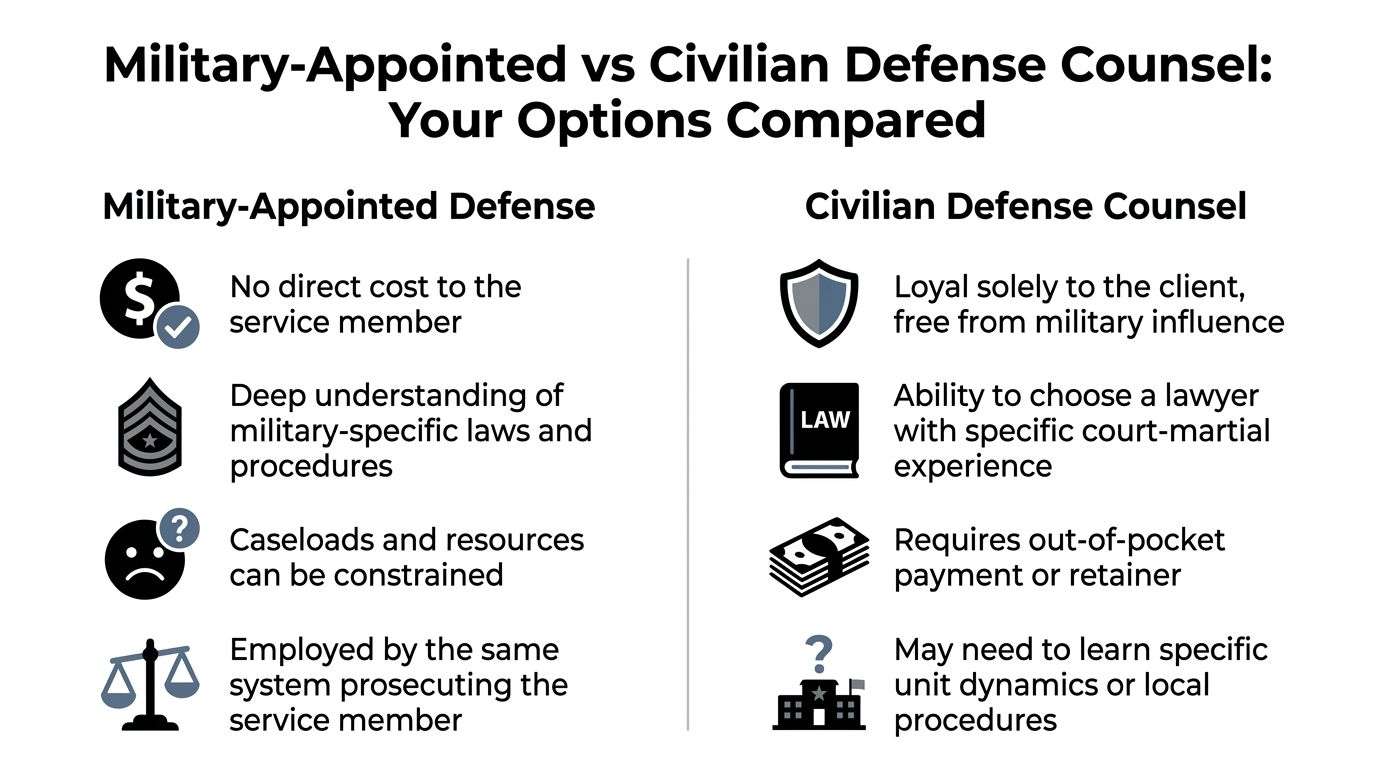
The wrong way to think about this choice is “free lawyer versus paid lawyer.” The right way is “standard issue representation versus specialized firepower.”
Military-appointed counsel can be dedicated and capable. Some are excellent. But serious allegations require a hard look at structural reality, not wishful thinking.
Court-martial defense lawyers are often outnumbered 5 to 1 by prosecution attorneys, and that same source notes the Army FY24 acquittal rate was about 4.6%, which shows the kind of environment the defense has to fight through in real cases.
What military counsel usually brings
Military defense counsel usually understand the UCMJ process, local procedures, and the personalities on a base. That matters. They also come at no direct cost to you.
But that’s not the end of the analysis.
A military lawyer is still operating inside the same overall institution prosecuting you. Even when that lawyer works hard, the system around that lawyer has its own limits. Caseload pressure is real. Time is finite. Experience varies wildly from one counsel to the next.
Some military lawyers have strong trial instincts. Others are still learning in live-fire conditions. Your case is not the place for somebody else’s learning curve.
Why civilian counsel changes the fight
A strong civilian court-martial attorney works for one person only. You.
That independence matters in witness interviews, command-facing strategy, expert consultation, pretrial negotiation, motion practice, panel selection, and trial posture. Civilian counsel also gives you the ability to choose based on actual case type, actual contested trial history, and actual reputation in military justice.
The issue isn’t whether your appointed counsel is a good person. The issue is whether your defense team has the depth, time, and trial scars your case demands.
The best setup in many serious cases is a coordinated team. You keep military-appointed counsel and add experienced civilian defense counsel. That gives you more eyes on discovery, more pressure on the government, and a better chance of finding the flaw that changes the case.
A blunt side-by-side view
| Factor | Military-appointed counsel | Civilian defense counsel |
|---|---|---|
| Cost | No direct fee to the service member | Paid by the client |
| Choice | Limited. You get assigned counsel | You choose the lawyer |
| Independence | Works within the military system | Loyal solely to the client |
| Experience range | Can vary significantly | You can target true specialists |
| Resources and time | May be constrained by workload | Depends on the firm you hire |
| Fit for high-stakes cases | Sometimes strong, sometimes not enough | Often best when highly specialized |
If your case involves confinement exposure, sex offense allegations, officer misconduct, violence, fraud, drugs, child-related allegations, digital evidence, or a security clearance threat, don’t treat civilian counsel as optional. Treat it as part of survival.
Identifying Experienced Court-Martial Lawyers
Most lawyers market themselves well. That tells you almost nothing.
You are not looking for a polished website. You are looking for a lawyer who has spent years in the trenches of military justice, knows how to dismantle a government theory, and can explain a case strategy without hiding behind slogans.

One useful starting point is learning how experienced counsel win cases during the military investigation phase. The point is simple. Strong lawyers don’t wait for trial. They start shaping the battlefield early.
Start with practice focus, not branding
Ask what percentage of the lawyer’s practice is devoted to military justice and court-martial defense. If military law is just one tab on a broad criminal-defense website, keep moving.
An experienced UCMJ lawyer should be able to answer concrete questions such as:
- What kinds of military cases do you handle most often: Article 120, 128, 112a, officer misconduct, false official statement, child-related allegations, fraud, appeals.
- How often do you appear in courts-martial: You want somebody who lives in this system, not somebody who visits it occasionally.
- Do you handle cases across branches and locations: A lawyer who has worked across the Army, Navy, Air Force, Marine Corps, and Coast Guard usually has broader pattern recognition.
Be skeptical of generic claims like “aggressive representation” or “we fight for you.” Every lawyer says that. Ask for specifics.
Look for contested trial depth
Credentials matter less than repetitions under pressure. Trial experience is not the same as years licensed. A lawyer can have a long resume and still lack meaningful contested court-martial depth.
What you want is experience in hearings, motions, witness cross-examination, expert challenges, and panel cases. A lawyer who mostly negotiates pleas is not the same as a lawyer who can try a hard case in front of a military judge or panel.
Here are the signals I’d take seriously:
- Dedicated military justice practice: Not dabbling. Not occasional.
- Substantial trial history: Especially contested cases, not just administrative work.
- Appellate familiarity: Trial lawyers make better records when they understand appeals.
- Clear communication: If they cannot explain strategy plainly, they may not understand it adequately.
- Command of military-specific issues: Article 32 hearings, unlawful command influence, forensic evidence, digital extraction, protective orders, panel dynamics.
Check how they think under pressure
An experienced court-martial defense lawyer doesn’t just recite credentials. That lawyer spots pressure points fast.
Good lawyers describe their biography. Great lawyers identify weaknesses in your case before the call ends.
Listen for questions about witnesses, digital evidence, prior statements, timeline problems, command interference, consent issues, motive to fabricate, intoxication, forensic handling, and text-message context. That tells you how they think.
It also helps to check whether the lawyer has written, taught, or spoken on military justice topics. That doesn’t win cases by itself, but it can show seriousness and sustained focus. The same goes for long-term practice depth. A lawyer with many years concentrated in military justice has usually seen enough patterns to recognize danger earlier.
The key point is this. Don’t hire the lawyer with the prettiest pitch. Hire the one with the clearest battle plan.
The Attorney Interview A Strategic Checklist
Your consultation is not a meet-and-greet. It’s a field interview. You are gathering intelligence.
Too many service members ask soft questions and get soft answers. “Do you handle military cases?” “Have you done this before?” “What do you charge?” Those questions are too easy. Every lawyer knows how to answer them.
Use this guide to choosing the right military defense lawyer as a starting point, then ask harder questions that expose real depth.
Questions that expose real experience
Start with this one: How many contested courts-martial like mine have you handled?
Not “military cases.” Not “criminal matters.” Cases like yours.
Then ask: What are the first three weaknesses you would examine in my case?
A serious lawyer should talk about evidence, witnesses, digital records, statements, command action, and procedural flaws. If the answer is vague, the strategy is vague.
Next: Who will work the file?
Some firms sell the senior name and hand the work to somebody else. Get names. Get roles. Know who will review discovery, draft motions, and show up in court.
Ask about witness work: Do you personally prepare for cross-examination, and how do you approach a complaining witness or lead investigator?
A strong answer should sound practical, not theatrical.
How to judge the answers
One of the most overlooked pressure points is panel selection under RCM 912. In Article 120 cases, panels with over 40% female members show a 25% higher conviction rate, according to defense analytics discussed in this jury selection discussion. A real trial lawyer should have a developed strategy for voir dire and challenging biased members based on evidence, not instinct.
That leads to a better interview question: How do you handle panel selection in a sensitive allegation case?
If the answer is “I just trust my instincts,” keep looking. If the lawyer starts discussing member questionnaires, rank dynamics, prior experiences, language choices, and challenge-for-cause issues, you’re talking to somebody who understands the stakes.
Ask these as well:
- What do you do if CID or NCIS already has my statement: A strong lawyer talks about damage control, suppression issues, corroboration, and context.
- How early do you bring in experts: A serious answer addresses need, timing, and how experts shape case theory.
- How do you approach Article 32 strategy: You want a lawyer who sees it as a tool, not a formality.
- What makes you advise a client to fight versus negotiate: Listen for judgment, not bravado.
A weak lawyer promises outcomes. A strong lawyer promises preparation, pressure, and hard strategic choices based on the evidence.
What fees should tell you
Fees are part of the interview, but not the heart of it.
You are paying for time, judgment, preparation, investigation, legal writing, witness development, travel, expert coordination, and trial execution. If a fee sounds suspiciously low, ask what is missing. Travel? Motions? Additional hearing days? Witness interviews? Trial prep hours?
Red flags include:
- Rushed consults: They don’t ask enough facts to give meaningful guidance.
- Guaranteed results: No serious trial lawyer guarantees an acquittal.
- No clear work plan: If they can’t explain scope, they can’t manage the case.
- Bargain pricing with vague coverage: Cheap can become catastrophic fast.
Choose the lawyer whose answers show discipline, not just confidence.
Fatal Errors Service Members Make When Facing Charges
Most bad outcomes start with avoidable mistakes. Not bad luck. Mistakes.

The mistakes that wreck defenses
The first is talking to investigators without counsel. Service members do this because they think only guilty people ask for a lawyer. Wrong. Investigators are trained to collect statements, not rescue careers.
The second is trusting command to “handle it internally.” Command may care about order and optics long before it cares about your defense. Your chain of command is not your legal strategy team.
Third, people wait too long to hire counsel. They act after preferral, after a search, after adverse paperwork, after witnesses have been interviewed, after text threads have been framed by the government. By then, the defense is reacting instead of shaping the case.
Fourth, they think innocence is enough. It isn’t. If your timeline is sloppy, your witnesses are unprepared, your digital evidence is incomplete, or your statement hurts you, truth alone won’t carry the day.
Fifth, they hire based on price. That usually means they’re buying less work, less time, and less scrutiny of the evidence. In a court-martial, that’s a dangerous shortcut.
What disciplined clients do instead
The clients who help their own defense do a few things well:
- They shut up early: They stop making admissions, explanations, and emotional texts.
- They preserve records: Screenshots, messages, travel logs, photos, and names get saved before they disappear.
- They follow instructions: They don’t freelance with witnesses or command.
- They treat every step as consequential: Search authorizations, interviews, phone requests, protective orders, and counseling statements all matter.
- They choose experience over comfort: They hire the lawyer who can fight, not the one who merely sounds reassuring.
Most court-martial damage happens before trial. That’s why disciplined early action beats desperate late action.
Your case can still be defended after mistakes. That happens often. But every preventable error narrows your options.
Frequently Asked Questions and Your First Call
Straight answers to common questions
Can I refuse to talk to CID, NCIS, OSI, or CGIS?
You should speak with counsel before answering questions. That is basic self-protection, not an admission of guilt.
Do I need a lawyer before charges are preferred?
Yes. Early intervention can affect statements, searches, witness handling, command posture, and whether weak allegations harden into a formal case.
Can a civilian lawyer defend me overseas?
Yes. Many civilian court-martial attorneys handle cases at installations outside the continental United States. The key issue is whether that lawyer has the experience and logistics to do it well.
What happens at an Article 32 hearing?
It is a critical stage for testing evidence, preserving issues, and evaluating the government’s theory. It should never be treated as a paperwork exercise.
What if I’m already convicted and need an appeal?
Appeals turn on the trial record. Success usually depends on identifying legal mistakes, command influence, evidentiary errors, or procedural violations. Although military appellate defense is guaranteed, it is often under-resourced, and specialized civilian appellate firms report overturning 15% to 25% of flawed trials, as described in this Senate-linked review of post-trial military justice issues.
Will I go to jail?
That depends on the charges, evidence, forum, and how your case is defended. What you should take from that uncertainty is urgency, not false comfort.
Your next move
If you are under investigation, if charges are pending, or if your family is trying to figure out who to trust, stop waiting for clarity to arrive on its own. It won’t.
Call experienced court martial defense lawyers now. Interview more than one. Ask hard questions. Demand a strategy, not a slogan. If you need a place to compare serious civilian options, use this guide to choosing a military defense lawyer to identify attorneys with focused military justice credentials and then speak to them directly.
Your career is on the line. Your freedom may be on the line. The worst move is doing nothing.
If investigators have contacted you, if command has started asking questions, or if a court-martial is even being mentioned, act today. Get counsel. Protect the evidence. Stop talking. Make the most important call of your military career before the government gets any further ahead.