Military police knock. Your first sergeant calls and tells you to report immediately. Someone says there was a complaint at the barracks, a scene at a bar, a confrontation with MPs, a loud argument off base. Then you hear the phrase UCMJ Article 134 Disorderly Conduct and think it sounds minor.
That mistake ruins careers.
Service members sometimes treat this charge like a noise complaint. Then they talk to command, hand over their phone, apologize in writing, accept an Article 15 to “make it go away,” and wake up months later facing separation, lost rank, or a federal conviction. Article 134 is broad on purpose. Prosecutors use it when they want options. Commands use it when they want advantage.
The tactical problem is bigger than commonly understood. In many cases, the government uses disorderly conduct as a catch-all when the facts don’t cleanly support something else, especially assault under Article 128. That ambiguity can hurt you if you react emotionally. It can also help you if your lawyer knows how to attack the charging theory early.
Table of Contents
- Facing an Article 134 Charge Your Career Is On The Line
- What the UCMJ Says About Disorderly Conduct
- How a Bar Fight Becomes a Federal Conviction
- Strategic Defenses for Article 134 Charges
- From Investigation to Court-Martial A Timeline
- Common Mistakes That Can Cost You Everything
- Why Your Appointed Military Lawyer May Not Be Enough
- Urgent Questions About UCMJ Article 134
Facing an Article 134 Charge Your Career Is On The Line
The usual start is ugly and fast. A sergeant tells you to come in. Security forces already have statements. Somebody claims you were drunk, loud, threatening, disrespectful, or out of control. By the time you hear about it, command may already have decided you’re the problem.
Here’s what service members get wrong. They think disorderly conduct means low-level misconduct. In reality, it is a flexible prosecution tool. If the government believes your conduct hurt discipline or embarrassed the service, Article 134 gives them room to push hard. Sometimes they use it to punish rowdy behavior. Sometimes they use it to salvage a weak case that doesn’t fit neatly elsewhere.
That distinction matters because your next move sets the tone for everything that follows. If you start “explaining,” you usually fill gaps in their case. If you start apologizing, you may hand them admissions they could not prove on their own. If you trust command to sort it out informally, you may learn too late that the paperwork path is turning into a criminal path.
What this looks like in real life
A service member gets into a late-night argument outside housing. No serious injury. Witnesses disagree about who started it. Civilian police or MPs show up. The command doesn’t like the optics. Instead of cleanly charging assault, prosecutors may use UCMJ Article 134 Disorderly Conduct because it gives them a broader theory and a lower proof burden on the conduct itself, if they can establish the required military impact.
Practical rule: The moment you learn you are under investigation, stop trying to manage the story yourself. Invoke your rights and get counsel involved before the command narrative hardens.
You are not in a misunderstanding. You are in a case.
What the UCMJ Says About Disorderly Conduct
A prosecutor reaches for Article 134 when the facts are ugly but the cleaner charge is harder to prove. That is the first thing to understand. Disorderly conduct often shows up when the government wants room to argue optics, disruption, embarrassment, and military impact without committing to a tighter offense such as assault under Article 128.

Article 134 is the General Article
Article 134 is the General Article. It covers misconduct the government says harmed discipline or discredited the service even when no more specific punitive article fits cleanly. If you need a broader overview of how that system works, read this guide to the UCMJ system and military justice.
For a disorderly conduct conviction, the government generally must prove beyond a reasonable doubt:
- You engaged in the alleged conduct
- The conduct was disorderly
- Under the circumstances, the conduct either prejudiced good order and discipline or was of a nature to bring discredit upon the armed forces
That third piece is where these cases are won or lost.
Prosecutors like disorderly conduct because it gives them options. If witness accounts clash on who touched whom first, if injury is minor, or if the assault theory is shaky, Article 134 lets them shift the fight away from a precise act and toward a broader story about disturbance, embarrassment, or command impact. A good defense lawyer pushes the case back toward precision. What exactly happened? Who saw it? What military function was disrupted? What public audience, if any, saw conduct that supposedly discredited the service?
The fight is usually over the terminal element
The main point of contention is usually not whether someone was loud, drunk, rude, or involved in a scene. The battle is whether the government can prove the required military impact. Command language like “bad for morale” or “looked bad” is not enough by itself. They need evidence, not irritation.
That gives the defense a clear target:
- Force the government to define the disruption. Who was affected, how, and in what concrete way?
- Separate ugly facts from criminal facts. Public embarrassment is not automatic proof of prejudice to good order and discipline.
- Test the service-discredit theory hard. Off-base conduct with little public visibility is a weaker Article 134 case than prosecutors want you to believe.
- Expose charge selection. If the government avoided Article 128 because the facts do not cleanly support assault, that weakness matters.
A lot of these cases sound dangerous in a command brief and far less convincing under cross-examination.
The strategic point is simple. Assault charges usually require the government to prove a more specific act. Disorderly conduct lets them stay vague. Your lawyer should not let them stay vague. An experienced military defense lawyer uses that ambiguity against the prosecution, limits the story to provable facts, and attacks the terminal element until the case shrinks or breaks.
How a Bar Fight Becomes a Federal Conviction
Most disorderly conduct cases don’t begin with a dramatic legal theory. They begin with alcohol, anger, humiliation, and bad decisions made in public. A shouting match outside the E-club. A barracks disturbance. A confrontation with civilian police. A domestic argument that spills into a parking lot. Once law enforcement is involved, the military system starts converting a messy night into a record.
Common fact patterns that trigger charges
The command usually looks at context first, not fairness. If the event happened in uniform, in public, in front of subordinates, or involved MPs, prosecutors can argue the conduct had more military significance. If there was property damage, injury, or a prior history, the government gets more aggressive.
That’s why one incident gets handled with counseling or NJP while another moves toward court-martial. The facts matter, but so do the optics.
Common scenarios include:
- Bar and club incidents: yelling, pushing, broken glasses, refusal to leave
- Barracks or housing disputes: loud late-night arguments, threats, intoxicated disruption
- Police confrontations: arguing with MPs or civilian officers during detention or questioning
- Road rage or parking lot scenes: especially when other service members or civilians witness it
Maximum punishments for Article 134 disorderly conduct
The punishment exposure is not uniform. The maximum punishment depends on the charged theory. According to this Article 134 disorderly conduct punishment guide, basic cases are limited to 1 month confinement and forfeiture of two-thirds pay for 1 month, service-discrediting cases can reach 4 months confinement, and drunk and disorderly conduct can carry 3 to 6 months confinement with forfeiture of two-thirds pay for 3 to 6 months.
| Offense Type | Max Confinement | Max Forfeiture of Pay |
|---|---|---|
| Basic disorderly conduct | 1 month | Two-thirds pay for 1 month |
| Service-discrediting disorderly conduct | 4 months | Corresponding forfeiture |
| Drunk and disorderly conduct | 3 to 6 months | Two-thirds pay for 3 to 6 months |
That table is the legal exposure. It is not the whole problem.
If the government pushes the case into a court-martial and wins, the conviction itself can outlast the sentence. That’s when a stupid night becomes a professional and personal disaster.
Strategic Defenses for Article 134 Charges
The strongest defense in many of these cases is not “my client did nothing.” It is “the government charged this case the way it did because it could not prove the more serious theory cleanly.”

Why prosecutors like this charge
Prosecutors use disorderly conduct as a catch-all because catch-alls are comfortable. If they have a shaky assault case, conflicting witness accounts, mutual combat facts, weak injury evidence, or a complainant who overstates what happened, Article 134 gives them another lane. They can stop arguing over specific intent or a precise act and start arguing that your overall behavior was disruptive and bad for the service.
That is where many defense lawyers miss the core fight. They defend the embarrassment. They should be attacking the legal fit.
A critical defense angle is challenging a prosecutor’s use of disorderly conduct as a downgrade from a more serious offense like assault. Recent CAAF-related analysis has highlighted convictions vacated for improper application where prosecutors failed to prove direct prejudice beyond vague morale claims, as discussed in this analysis of Article 134 disorderly conduct and drunkenness defenses.
Where experienced defense lawyers attack
Look for pressure points immediately:
- Terminal element weakness: Did anyone suffer a direct military impact, or is command just using buzzwords?
- Bodycam and surveillance gaps: Does video show disorder, or only confusion after the fact?
- Witness contamination: Did people compare stories before writing statements?
- Provocation: Who escalated first?
- Charge mismatch: Is this really an Article 128 case the government couldn’t prove?
If the government can’t prove assault, it doesn’t automatically get a free conviction for disorderly conduct.
That distinction is tactical gold. If the prosecution’s theory keeps shifting between “he assaulted someone” and “fine, then he was disorderly,” the defense can expose that indecision. Panels notice when the government is throwing a net because it lacks a spear.
Why the assault comparison matters
Suppose there was a shove during a chaotic argument. If the evidence clearly proves an unlawful strike, prosecutors should own that and charge assault. If they hesitate and fall back to Article 134, your lawyer should ask why. Was there self-defense evidence? Mutual provocation? Contradictory statements? No clear aggressor?
That is not a technicality. That is the case.
A seasoned civilian military defense lawyer uses the overlap between Articles 128 and 134 to force uncomfortable choices on the government. Either prove the serious offense you hinted at, or admit this is a weaker, more ambiguous event than command wants the panel to believe.
From Investigation to Court-Martial A Timeline
Most service members make bad decisions because they don’t understand where they are in the process. They think the interview is informal. They think preferral is final. They think an Article 32 is just paperwork. Wrong on all three.
What happens first
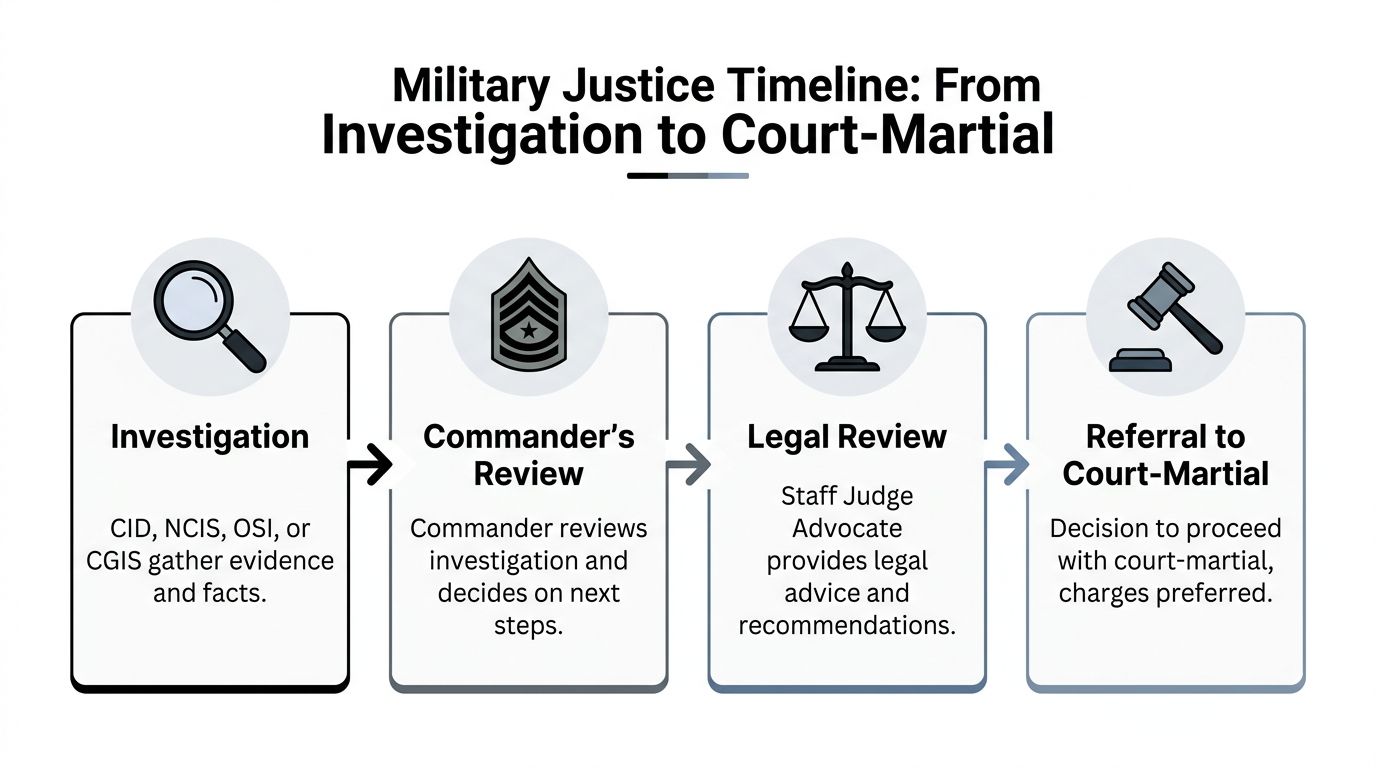
If CID, NCIS, OSI, or CGIS is involved, understand their role clearly. They gather evidence for the government. They are not there to hear you out and clear this up. Your first job is simple: invoke your right to remain silent and ask for a lawyer.
The sequence usually starts like this:
Investigation begins
Statements, reports, texts, bodycam, surveillance, and command input start shaping the file.Command review
Your commander looks at the incident through discipline, optics, and unit impact.Legal review
The Staff Judge Advocate advises command on forum and charging options.Charges preferred
The allegation becomes formal.
For a broader breakdown of the process, read this court-martial basics guide.
What happens after charges are preferred
If the case is headed toward a general court-martial, an Article 32 preliminary hearing may become your first major opportunity to expose weaknesses. A good defense lawyer uses it to test witnesses, lock in testimony, and identify holes in the government’s theory before trial.
After that, the case may be referred to a summary, special, or general court-martial. Then the actual litigation starts.
- Motions practice: suppression issues, charging defects, evidentiary fights
- Witness preparation: not just for your side, but for how to dismantle theirs
- Forum decisions: judge alone or panel can be a critical strategic question
- Sentencing preparation: if needed, mitigation must be built early, not overnight
The investigation phase decides more cases than most service members realize. Early silence is not weakness. It is damage control.
Appeals exist, but appeals are not a substitute for a real defense at the front end. The best win is still avoiding a bad record before it is created.
Common Mistakes That Can Cost You Everything
It usually starts the same way. A night out goes sideways, somebody reports “disorderly conduct,” and command treats the label like a holding pen while prosecutors decide whether to keep it there or push for something uglier. That gray area is where service members do the most damage to themselves.
Article 134 disorderly conduct is often a catch all. Prosecutors use it when the facts are messy, the witnesses conflict, or the conduct sounds bad but does not cleanly fit a more serious charge like assault under Article 128. Your defense lawyer should use that same ambiguity against them. If you make the mistakes below, you erase that advantage and hand the government a cleaner case.
Five common unforced errors
Talking to investigators is still the fastest way to strengthen a weak file. In a disorderly conduct case, the government often lacks a clean theory at the start. They need your words to sort out whether this stays an Article 134 allegation or becomes something more serious. If you describe grabbing someone, squaring up, shoving past a bouncer, or “just trying to scare him,” you may have supplied the facts they needed to argue assault instead of general misconduct.
Trying to explain it to command causes the same problem. Command is assessing discipline, unit optics, and whether you sound salvageable. They are not filtering your words for criminal exposure. A statement like “I was drunk and mouthed off” may sound minor to you. In the file, it becomes an admission that helps prove prejudice to good order and discipline.
Consenting to searches expands the battlefield. Phones are the worst example. A simple disorderly conduct allegation can turn into a case about threats, intoxication, fraternization, obstruction, or a completely different offense once investigators start reading texts, photos, group chats, and deleted message logs.
Treating Article 15 as the easy exit is another major mistake. Sometimes nonjudicial punishment is the right answer. Sometimes it is the government’s way of closing a shaky case before your lawyer can expose how weak it is. If the allegation is vague, witness accounts are inconsistent, or the government picked Article 134 because it could not prove assault cleanly, accepting quick punishment may give away your best chance to challenge the facts.
Waiting to get outside counsel involved lets prosecutors define the incident before anyone pushes back. In these cases, labels harden fast. “Loud and intoxicated” becomes “threatening.” “Chaotic argument” becomes “physical confrontation.” Once the command packet adopts that language, undoing it gets harder.
Here is the short list I give clients:
- Say nothing about the incident to investigators, supervisors, first sergeants, or well-meaning peers
- Do not send texts trying to clean it up or align stories with friends
- Preserve your evidence immediately including screenshots, receipts, names, timeline notes, and any video leads
- Do not consent to searches of your phone, room, car, or accounts
- Get a defense strategy early while the government is still deciding whether this is a vague Article 134 case or a chargeable assault theory
One bad statement can turn an ambiguous accusation into a prosecutable narrative. In an Article 134 disorderly conduct case, ambiguity is often your best defense position. Protect it.
Why Your Appointed Military Lawyer May Not Be Enough
You are entitled to a military defense lawyer. Use that resource. But don’t confuse entitlement with sufficiency.
The difference is independence and focus
Many appointed counsel work hard and care immensely. That is not the issue. The issue is bandwidth, repetition, and independence. A serious UCMJ Article 134 Disorderly Conduct case often requires fast factual development, aggressive witness work, strategic negotiation, and trial-level confidence in attacking the government’s theory. Not every appointed lawyer is in a position to deliver all of that at the level your case may require.
A seasoned civilian military defense lawyer brings different advantages:
- Independent judgment: no career pressure from the same institution prosecuting you
- Focused practice: court-martial and UCMJ defense, not a rotating assignment
- Broader trial perspective: especially important when a “minor” charge has major collateral consequences
- More control over strategy: early intervention, mitigation development, and expert coordination
If you’re trying to evaluate representation, start with this guide on how to choose the right military defense lawyer.
The right comparison is not “free versus paid.” The right comparison is “assigned counsel alone versus a defense built to survive a federal prosecution and the career fallout that follows it.”
Urgent Questions About UCMJ Article 134
Direct answers you need right now
Can I refuse an Article 15 for disorderly conduct?
Yes. In many situations, you can refuse non-judicial punishment and demand trial by court-martial. That is a strategic decision, not a macho one. Make it with counsel after reviewing the evidence.
Does it matter if the incident happened off base and in civilian clothes?
Yes and no. The location helps the defense in some cases, but it does not automatically protect you. If the government claims the conduct was service-discrediting, it may still prosecute.
Will a court-martial conviction for disorderly conduct affect civilian life?
Yes. A conviction at a special or general court-martial can follow you long after you leave the service.
What if the incident involved a shove or brief fight?
That’s exactly where legal strategy matters. Your lawyer should examine whether the government is using disorderly conduct as a fallback because the assault theory is weak.
Should I give a statement to “clear things up”?
No. Not before speaking with counsel.
Do I need a civilian lawyer immediately?
If you are under investigation, facing NJP, or hearing that command is considering charges, yes. Early action creates options. Delay destroys them.
Can these cases be beaten?
Yes. But not by hoping command will be fair.
If you are facing UCMJ Article 134 Disorderly Conduct, act like your career is under direct attack, because it is. Say less. Preserve evidence. Refuse the urge to explain. Get a defense strategy in place before command turns a chaotic incident into a permanent record.
If you need to compare experienced civilian military defense lawyers quickly, use this guide to choosing a military defense lawyer to identify attorneys who focus on court-martial and UCMJ defense. Then start making calls today. Your rank, record, and future may depend on what you do next.