
You're sitting in legal or personnel with a notice in your hand, and someone's expecting a signature. The command wants you separated. Your chief says it's straightforward. It isn't.
The Navy administrative separation process can end your career, cut your benefits, and follow you into civilian hiring and security clearance reviews, all without a court-martial or a criminal conviction. The first choices you make, especially whether to elect a board, shape everything that follows. Don't sign anything until you understand what that signature gives up and what it exposes.
Table of Contents
- Notification or Board Procedure Compared
- How to Move Through the Navy Separation Process
- Deadlines, Clocks and Career Impacts
- Your Rights at an Administrative Separation Board
- Discharge Characterizations and What Each One Costs
- Reentry Codes and How to Appeal After Separation
- Confirm Your Election Before the Deadline
Notification or Board Procedure Compared
A notification notice may leave you with no board, while a board election gives you a formal hearing and a chance to contest the record. The procedure determines both your hearing rights and the maximum characterization you may face.
The Two Enlisted Procedures
For enlisted Sailors, the Navy Enlisted Administrative Separations briefing describes board eligibility after 6 or more years of total active and reserve service, or when the command seeks an under other than honorable characterization.
| Procedure | Worst possible characterization | Board right | Typical fit |
|---|---|---|---|
| Notification Procedure | General (Under Honorable Conditions) | Only with 6 or more years of total active and/or reserve service at notification | Cases where a General discharge is the worst realistic outcome |
| Administrative Board Procedure | Other Than Honorable may be recommended | Member may elect a board regardless of years served | Cases where characterization is contested or OTH is possible |
The choice carries a real trade-off. Notification Procedure caps the possible characterization at General, but a Sailor who does not meet the service threshold may have no board. Administrative Board Procedure gives you a formal hearing to challenge the allegations, present evidence, argue for retention, and contest characterization. It also exposes you to an OTH recommendation.
A board gives you a formal chance to fight the record. It also removes the General-discharge ceiling.
What to Check on Your Notice First
Before you make an election, check the paperwork for three things:
- Procedure named: Does the notice specify Notification Procedure or Administrative Board Procedure?
- Years counted: Does the service computation include your total active and reserve service at the time of notification?
- Characterization listed: What is the maximum adverse characterization identified in the notice?
If those details do not align, pause before signing and clarify the discrepancy. A board evaluates whether separation is warranted and recommends a characterization; it does not impose criminal punishment. Your election determines whether you have that formal opportunity to contest the case, so treat it as a strategic decision, not routine paperwork.
How to Move Through the Navy Separation Process
The sequence below shows where a case moves from command action to final decision, and where Sailors lose ground by assuming someone else is protecting them.
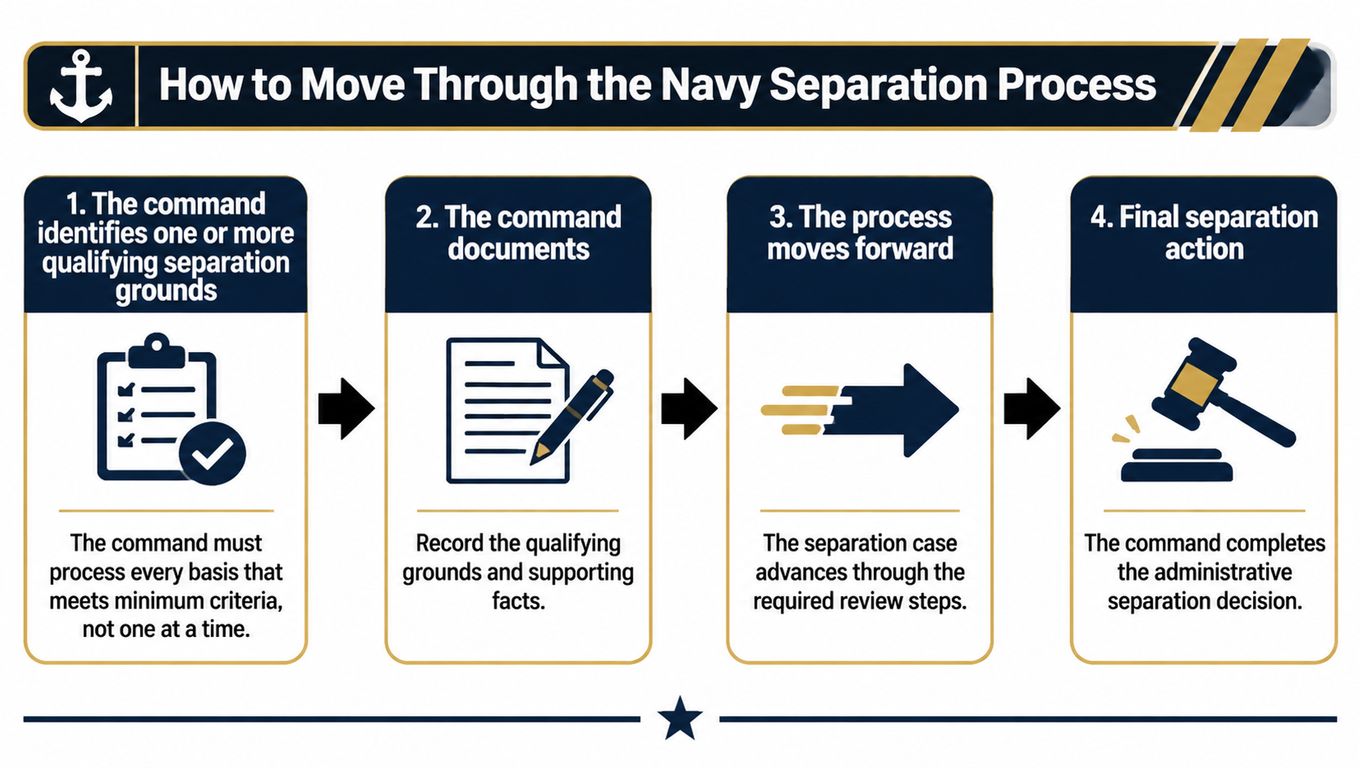
According to MILPERSMAN 1910-230 on ADSEP processing, a case follows a structured sequence from command identification of grounds through final action by the separation authority, and the response deadline must be at least 30 days after delivery of the notice. Work through it in order.
The Six Steps
The command identifies separation grounds: Navy policy requires commands to process all reasons for which minimum criteria are met, not one basis at a time. That rule lets the separation authority select the most appropriate basis and prevents serial, incomplete processing. If a second basis appears later, ask why it wasn't processed from the start.
The command documents your complete military record: Evals, counseling chits, NJP results, investigation reports, and service history all go into the package. Get your own complete copy early. You can't challenge a record you haven't read.
You receive notice on NAVPERS 1910/31: The notice must explain the proposed reasons for separation and state the rights that apply to you. Read every ground cited, including any basis you didn't expect. Sailors often focus on the one allegation they know about and miss a second basis that carries the case.
You consult counsel and submit matters: This is your initial review window, and it's short. Use it to build a written response, gather documents, and identify witnesses while they're still reachable. Waiting until the last week is the most common unforced error in the entire Navy administrative separation process.
A board convenes if required or elected: The board makes findings on each alleged basis and recommends retention, separation, or suspension. Waiving a board without understanding your characterization exposure is how Sailors trade away their only evidentiary hearing for nothing in return.
The separation authority takes final action: The command's recommendation is not the outcome. The separation authority reviews the record independently and may approve, disapprove, or direct further action. Your written submissions matter even after a board, because a different decision maker reads the full package.
The video below walks through how these stages connect in practice, so you can see where your own case currently sits.
What to Have in Hand Before the Window Closes
Before your response date arrives, you should hold two things. First, a complete copy of your record, not the excerpts the command chose to highlight. Second, a written list of every ground cited in the notice, matched against the documents the command claims support each one.
Don't let anyone quote you a success percentage for fighting ADSEP. Navy materials don't establish a reliable universal win rate for members opposing separation, so anyone promising odds is guessing. What wins cases isn't a statistic. It's a record that's complete, evidence that's tested before the hearing, and a response filed on time.
Deadlines, Clocks and Career Impacts
When an ADSEP notice arrives, the response clock is already running. The date you receive it matters: under DoD Instruction 1332.14 on enlisted administrative separations, the notice must identify the separation basis and supporting circumstances, explain your rights, and allow at least 30 days from delivery before the response date.
For cases where you are entitled to a board, notice is delivered personally or by registered or certified mail with return receipt requested. If you refuse to acknowledge personal delivery, the delivering official documents service with a sworn affidavit. Refusing to sign does not stop the clock.
The Clocks That Govern Your Case
| Stage | Rule or goal | What it means for you |
|---|---|---|
| Notice response period | At least 30 days from delivery | The response period runs from delivery, not from when you read the notice |
| Election of board | Deadline stated in the notice | Record the election deadline as soon as you receive the notice |
| Processing without a board | Navy internal processing goal runs from notification | It is a goal, not a deadline that bars separation if missed |
| Processing with a board | Navy internal processing goal runs from notification | Board scheduling may extend processing beyond the goal |
| Transfer, reenlistment, advancement | Generally unavailable until processing completes | Plan career decisions around the pending case |
The 30-day response period is the controlling clock to track. Internal processing goals run from notification, not delivery. They are not jurisdictional deadlines, and missing a goal does not dismiss the case or improve your characterization automatically. Confirm any current processing goal against the governing Navy instruction rather than treating it as a deadline that will decide your case.
The Career Freeze Nobody Warns You About
While ADSEP processing is pending, you are generally ineligible for transfer, reenlistment, or advancement until the case is complete. That can affect orders, exam cycles, and family planning before the separation authority makes a decision.
On the day you receive the notice, calendar the 30-day response period and every election deadline stated in it. Ask the command in writing to confirm the dates it has recorded. If its dates differ from yours, raise the discrepancy with counsel promptly.
Your Rights at an Administrative Separation Board
A board is not a criminal trial and it imposes no punishment. Don't walk in expecting court-martial rules. The government must prove each alleged basis by a preponderance of the evidence, which means more likely than not. That's a far lower bar than proof beyond a reasonable doubt, and it changes how you build a defense.
The Board's Three Jobs
According to MILPERSMAN 1910-516 on administrative board procedures, the board must make findings of fact for each alleged basis and recommend retention, separation, or suspension. If it recommends separation, it selects exactly one characterization from Entry-Level Separation, Honorable, General, or Under Other Than Honorable Conditions, depending on your status and the governing authority.
That structure gives you three separate fights, and you can win them independently.
- Findings fight: Did the government prove each basis, or only some of them?
- Retention fight: Even if a basis is proven, should you be separated at all?
- Characterization fight: If separation follows, what's the fairest description of your overall service?
Preparation rule: Build a separate argument for each of the three decisions. A board that finds one basis proven can still recommend retention, and a board set on separation can still recommend an Honorable.
Rights You Can Actually Use
You have the right to consult civilian counsel at your own expense, examine the record against you, challenge witnesses and documents, present your own witnesses and statements, and submit matters for the board's consideration. Detailed military counsel will be available, but detailed counsel often carry heavy caseloads and rotate assignments. Experienced civilian military defense lawyers practice UCMJ and separation defense as a career, control their caseload, and answer to you rather than to a command structure. Our guide to administrative separation boards breaks down how board representation works in practice.
Say a Sailor with seven years of service faces a pattern of misconduct basis built on a series of counseling entries and one NJP. A real defense doesn't argue that he's a good Sailor in the abstract. It assembles his performance evaluations across that whole period, his complete service record, and witnesses who can speak to specific dates and specific conduct, including supervisors from commands where he performed well. Vague character letters lose to dated documents. Specific evidence creates doubt about whether a pattern exists.
Testing the Government Case Before the Hearing
Before the board convenes, pressure test three things. Confirm your service computation is correct, because it controls your board eligibility. Check whether the command processed every basis that meets minimum criteria, because a shifting basis list signals a weak package. Confirm that each alleged act has dates and a documentary foundation, because the government still has to prove its case, even at a preponderance standard.
Don't treat the hearing as the end. The board's recommendation isn't final. The separation authority reviews the record and takes final action, so the record you build at the board keeps working after the members leave the room. Every document you enter and every objection you preserve is read again by the person who decides.
Discharge Characterizations and What Each One Costs
The characterization on your discharge, not the label of the alleged misconduct, drives your benefits and your future. Two Sailors separated for the same basis can walk away with completely different lives based on one line on the DD Form 214.
What Each Characterization Means
| Characterization | Typical trigger | VA benefit effect | Reentry effect |
|---|---|---|---|
| Honorable | Service met standards overall | Full benefit access in the usual case | Usually no reentry bar from the characterization itself |
| General (Under Honorable Conditions) | Significant misconduct or below standard service short of OTH | Generally preserves VA eligibility | Set by the reentry code assigned |
| Other Than Honorable (OTH) | Serious misconduct, available only on board procedure | Limits benefits, VA character of discharge determination required | Often paired with a restrictive reentry code |
| Entry-Level Separation | Applicable early service cases | Limited benefit eligibility | Set by the reentry code on the separation documents, confirm before separation |
An Honorable discharge preserves full access to VA healthcare, education benefits, and home loan programs in the usual case, and it carries no stigma with civilian employers. A General discharge generally preserves VA eligibility but leaves a less favorable record that employers and agencies will ask about, and certain education benefits may not survive it. It's the least favorable outcome available under Notification Procedure, which is exactly why that cap has real value.
An OTH is a different category of harm. It limits benefits and forces you into a VA character of discharge determination before the VA decides what, if anything, you can receive. It surfaces on background checks and narrows employment for years. Our breakdown of Other Than Honorable discharge benefits explains what that determination involves. Entry-Level Separation applies only in applicable early service cases, so confirm with counsel whether it's even in play before you spend effort arguing about it.
How a Characterization Survives a Hearing You Thought You Won
Under MILPERSMAN 1910-710 on separation authority action, the government must prove the separation basis by a preponderance of the evidence, and the separation authority may approve a board recommendation the evidence supports after reviewing the record and applicable procedural protections. That pre-decision review includes checking certain deployment related medical or survey requirements.
Understand what that means. If the board finds a basis proven by that low standard and recommends a characterization the record supports, the separation authority can approve it even if you felt the hearing went your way. Feeling heard is not the same as winning the findings.
Check your notice for the maximum characterization named. Then ask, in writing, what each possible outcome means for your security clearance and civilian employment, and get the answer before you elect a procedure. The characterization fight is where the Navy administrative separation process does its lasting damage, and it's the fight Sailors prepare for least.
Reentry Codes and How to Appeal After Separation
Your characterization tells one part of the story. Your reentry code tells the rest, and it's printed on your DD Form 214 where recruiters and many employers look first. The separation authority assigns the code as part of final action, so it isn't an afterthought. It's part of the decision.
The Codes You're Most Likely to See
| Reentry code | Meaning for future enlistment |
|---|---|
| RE-1 | Eligible for reenlistment without waiver |
| RE-3 | Reentry generally requires a waiver |
| RE-4 | Reentry generally barred |
An RE-1 keeps the door open. An RE-3 means a recruiter will need a waiver approved before you can come back, which is possible but never guaranteed. An RE-4 generally closes reenlistment entirely. The same characterization can pair with different practical outcomes depending on the code assigned, so don't stop reading at the characterization block.
Confirm the exact code and characterization on both your separation notice and your DD Form 214 before you're separated. Ask whether a different code is available while the separation authority still holds the case. Correcting a code before final action is a conversation. Correcting it afterward is an application process measured in months.
The Two Review Routes After Discharge
If the discharge is already final, you have two main avenues.
- Discharge Review Board: Reviews the propriety and equity of your discharge, generally on requests filed within 15 years of discharge using DD Form 293. This is the route for arguing the characterization itself should be upgraded.
- Board for Correction of Naval Records: Corrects errors or injustices in your naval record, generally requiring filing within 3 years of discovering the error using DD Form 149, with waiver of that window possible in the interest of justice.
Our walkthrough of how to upgrade a military discharge covers how to choose between these boards and what evidence each one expects.
Neither board is a substitute for a timely, well built response to your original notice.
That's the point Sailors miss. A review board years later reads the record that exists. If you waived your board, submitted nothing, and let the command's package stand unchallenged, that's the record the reviewer sees. A strong record built at the start, witnesses identified, documents entered, objections preserved, is what gives a later reviewer something to act on. Fighting well now is also how you protect an appeal you hope you'll never need.
Confirm Your Election Before the Deadline
Everything converges on one signature, and the days before your response date are when you either protect yourself or give the protection away. Work this checklist in order.
- Pull the notice: Confirm the procedure named, every ground cited, and the maximum characterization you face.
- Request your complete service record: Get a written list of every ground, and match each one to the documents behind it.
- Weigh the board decision with clear eyes: Set the characterization exposure of a board against the strength of evidence you can realistically build by the deadline. A board you can't prepare for is exposure without advantage.
- Ask counsel specific questions: What can the board recommend in your case? Which witnesses are realistic? What do the government's documents show? How will characterization likely be argued?
An election or waiver is a strategic decision, not paperwork. Don't let an administrative deadline or a reassuring conversation in the passageway make it for you.
When you compare civilian court-martial attorneys and separation defense counsel, ask how many court-martial and administrative board cases each has tried, how they'll communicate with you, and whether their strategy fits your record. When you compare lawyers, years of focused military law experience matter, especially sustained UCMJ and court-martial practice, so ask each lawyer how long they have practiced military law. That depth matters because board advocacy is learned in hearing rooms, not from a pamphlet.
Do not sign an election or waiver until counsel has reviewed both the notice and the complete record. That single step can't wait, and it can't be undone. Your career is on the line, and the signature is the point of no return.
If you've received a separation notice, don't wait for the deadline to force your hand. Compare experienced civilian UCMJ lawyers now, while your election is still yours to make and your record can still be built. Bring your NAVPERS 1910/31 and your service record to a confidential consultation, get the trade-offs explained in plain English, and make the board decision with your eyes open.