
Unlawful command influence is Article 37’s ban on improper command pressure on a court-martial, divided into actual influence that affects the case and apparent influence that would make a fully informed observer significantly doubt its fairness. Neither requires a commander to announce an order to convict before defense counsel should investigate.
You’ve heard the commander already considers you guilty. A witness who agreed to help has stopped answering. Your spouse wants to know whether the hearing is real or whether everyone is just waiting to carry out a decision already made.
Those concerns deserve more than reassurance. When your career, confinement exposure, and reputation are at stake, document the pressure and get it to defense counsel, rather than confronting the commander or trying to prove the case yourself.
Table of Contents
- What Unlawful Command Influence Means Under Article 37
- How Courts Test Unlawful Command Influence
- Command Conduct That Creates a UCI Problem
- How to Raise Unlawful Command Influence
- Mistakes That Sink a Strong UCI Issue
- Unlawful Command Influence FAQs
- Get Independent Counsel Before the Record Closes
What Unlawful Command Influence Means Under Article 37
Unlawful command influence, or UCI, concerns improper interference with military justice, not a commander you dislike. The question is whether someone used military authority or unauthorized means to interfere with an independent decision, a participant’s duties, or a witness’s willingness to participate.
The Congressional Research Service’s explanation of unlawful command influence identifies its statutory foundation as Article 37(a), UCMJ, codified at 10 U.S.C. § 837(a), distinguishes actual from apparent UCI, and recounts the Court of Appeals for the Armed Forces’ description of UCI as the “mortal enemy of military justice.”
That language reflects a basic problem: rank carries consequences. A subordinate may hear a senior officer’s preference as a career instruction, even when the officer never uses the word order.
What the prohibition reaches
The text of Article 37 prohibits specified command criticism of the court, members, military judge, or counsel concerning their adjudicative functions, witness deterrence, and coercion or unauthorized influence over judicial decisions, while preserving legitimate military-justice education and neutral discussion of offenses.
For an accused, the distinction is concrete. A commander can explain how military justice works. A commander cannot turn that instruction into a demand that participants deliver the preferred result in your case.
Actual UCI focuses on improper manipulation that harms the fair handling or disposition of proceedings. Apparent UCI focuses on whether an objective observer, fully informed of the circumstances, would significantly doubt fairness.
Don’t confuse an appearance concern with an automatic right to reversal. Counsel must assess the governing statutory requirements, including prejudice requirements applicable to findings or sentence, rather than promise relief based on disturbing appearances alone.
Two legal categories and where pressure lands
Actual and apparent describe the legal concern. Accusatory and adjudicative describe where the pressure hits. The same communication can raise more than one concern.
| Category | Where it lands | What the defense shows | Usual effect |
|---|---|---|---|
| Actual UCI | Investigation, referral, findings, or sentence | Facts showing improper manipulation that affected fair handling or disposition | Rebuttable presumption of prejudice once properly raised under the applicable framework |
| Apparent UCI | Any stage where observer confidence is at stake | Circumstances giving an objective, fully informed observer significant doubt about fairness | Strain on legitimacy that can still require a remedy, subject to governing law |
| Accusatory pressure | Investigation, preferral, or referral | Command influence aimed at a particular case before findings | Can taint preferral or referral and later strategy |
| Adjudicative pressure | Military judge, members, counsel, findings, or sentence | Criticism, threats, or steering of judicial or advocacy roles | Can affect findings, sentence, or who may stay on the case |
A useful defense assessment starts with specific questions:
- Statutory category: Was this witness deterrence, criticism of protected functions, coercion, or another unauthorized attempt to influence?
- Exposed participant: Who received the message, and what responsibility did that person have in your case?
- Timing and authority: Did the statement precede referral, witness interviews, member selection, or sentencing? What authority did the speaker hold?
- Policy or result: Was the message neutral instruction, or was it advocacy for a particular disposition or punishment?
Consider a commander who says misconduct allegations must be investigated thoroughly. Compare that with a commander warning that anyone supporting this accused should reconsider their future in the unit. The second statement gives counsel a specific interference problem to investigate, not merely an unpleasant command climate.
Practical rule: Record what was said before arguing about what it legally means.
Write down the speaker, audience, exact words, and date today. Identify whether you heard the statement yourself or learned it from someone else. A commander may not order a conviction or dictate the court’s punishment.
How Courts Test Unlawful Command Influence
A properly supported UCI allegation can change who must answer the difficult questions. The defense must do more than accuse the command of unfairness, but it doesn’t need a confession from a panel member that rank controlled the verdict.
In United States v. Johnson, the Court of Appeals for the Armed Forces described a rebuttable presumption of prejudice when UCI or its appearance is supported by evidence, explained the government’s beyond-a-reasonable-doubt response, and distinguished clear-error review of factual findings from de novo review of the legal question.
In plain English, the judge first needs a factual foundation. Who spoke? What did they say? Who heard it? How could it reach this case?
Defense first, government response
The process begins with evidence, not a demand that the government disprove every rumor.

Once the issue is properly raised, the government may have to establish that the alleged facts didn’t occur, didn’t constitute unlawful influence, or didn’t prejudice the proceedings. The precise analysis must fit the claim and governing law.
The practical significance of decisions such as Johnson and United States v. Gore is that courts examine interference with the process, not just secret instructions about a verdict. Witness availability, command communications, and the independence of decision-makers deserve scrutiny.
The real fight is often the factual foundation
Suppose a witness says, “I can’t get involved anymore.” Standing alone, that leaves unanswered questions. A declaration explaining that a supervisor threatened an evaluation consequence after learning about the defense interview gives the judge something concrete to resolve.
Experienced court-martial attorneys therefore distinguish among:
- An inference: The witness became reluctant after a command briefing.
- A supported connection: The witness identifies what the briefing said and explains why it changed their willingness to help.
- A missing link: Nobody has established that the witness or decision-maker received the alleged message.
A hallway complaint doesn’t substitute for evidence presented to the judge.
For families unfamiliar with the procedural stages, understanding court-martial basics helps identify which decisions are approaching and which participants may have been exposed.
The strategic objective isn’t to label every command action unlawful. It’s to establish a record that requires a specific government response and a reasoned judicial ruling.
Command Conduct That Creates a UCI Problem
A general tells the staff judge advocate that your case belongs at a general court-martial before investigators finish collecting evidence. Nobody mentions a verdict. The statement may still create pressure if it reaches someone responsible for a decision that must remain independent.
Pressure can begin in an office conversation rather than a courtroom.
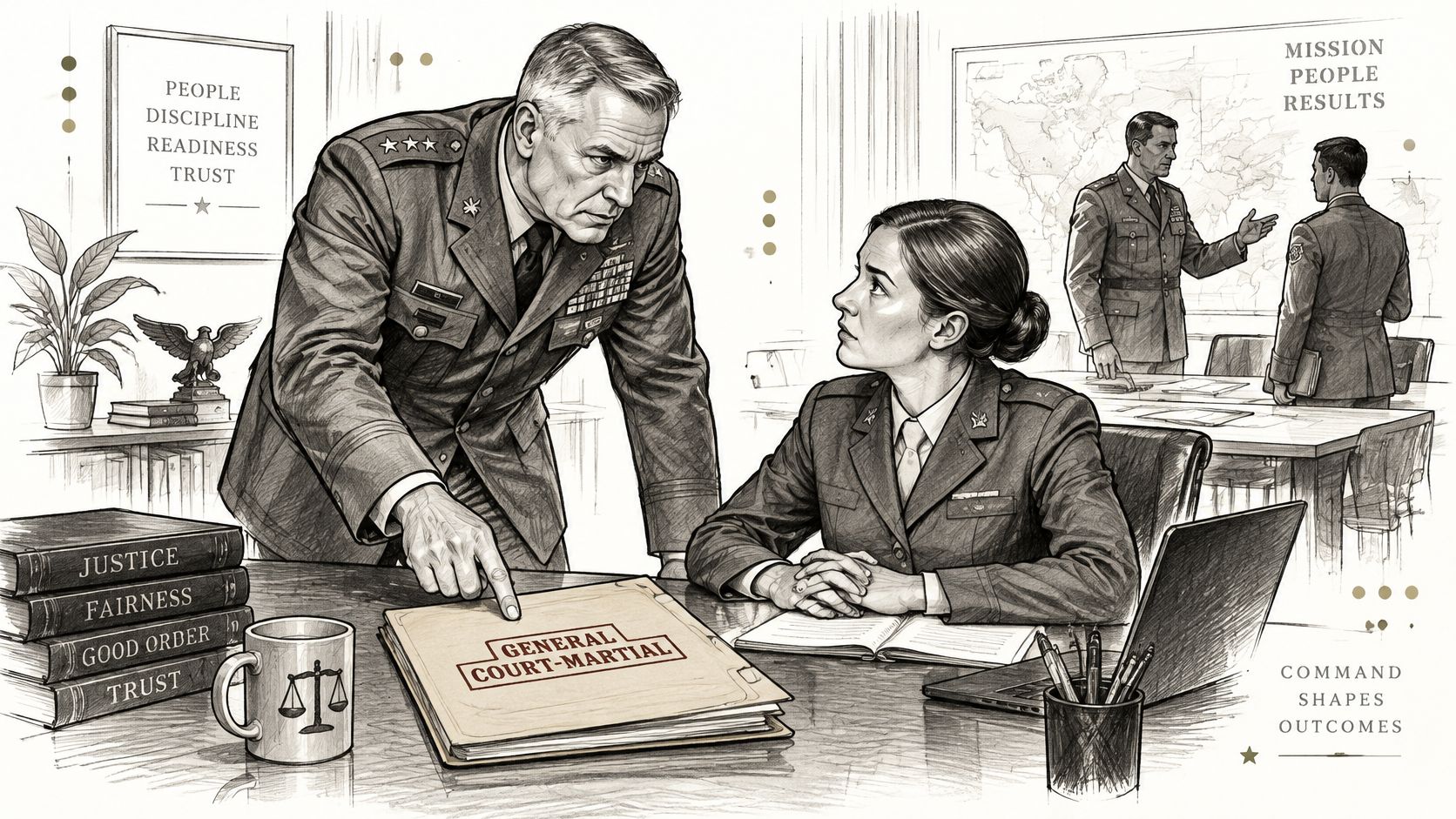
The key questions are who retained a genuine choice and what happened after the conversation. Counsel should examine the surrounding correspondence and actions, not rely on a later assurance that everyone understood their responsibilities.
Career pressure without an explicit order
Watch for pressure that affects people’s careers or access to the defense:
- The evaluation warning: A commander tells the unit that people who testify for the accused will be remembered when evaluations are written. Counsel should investigate whether the warning deterred witnesses and seek independent accounts of the briefing.
- The all-hands accusation: An email assumes guilt while prospective members remain eligible to serve. Counsel should establish who received it and prepare focused questions for members.
- The disappearing witness: A favorable witness is moved, restricted, or given adverse paperwork after agreeing to speak with the defense. The timing warrants investigation, but timing alone does not prove retaliation.
- The administrative threat: Someone links an award, counseling statement, or threatened GOMOR to how a participant handles the case. Preserve evidence of that connection.
Ordinary supervision remains lawful. A documented operational need for reassignment differs from a move intended to prevent defense access. Counsel needs the stated reason, relevant records, and sequence of events.
Prosecutorial independence doesn’t remove every risk
Moving prosecutorial authority away from commanders does not remove command control over assignments, workplace access, evaluations, or unit messaging. Those channels can still carry pressure without saying anything about a verdict.
Appellate decisions have addressed remedial command conduct, trial-counsel strategy, and waiver in Article 37 disputes. The statutory text prohibits unlawful command influence and addresses remedial action.
A corrective order also deserves scrutiny. What did it change? Who received it? Did it restore witness access, or impose new restrictions under the label of fixing the problem?
A supported UCI issue can affect member challenges, witness litigation, sentencing preparation, or appellate preservation, even when dismissal is unlikely. Record the specific conduct and its career or case-related consequence.
How to Raise Unlawful Command Influence
Build a record a judge can resolve, not a grievance someone can dismiss as frustration. Your role is to preserve information lawfully and give counsel an accurate account. Counsel’s role is to select the legal theory, seek discovery, and litigate relief.
The Supreme Court’s discussion in Weiss v. United States explains complementary safeguards, including Article 26 restrictions on command involvement in judicial performance reporting and Article 98 punishment for knowing and intentional noncompliance with Article 37.
Preserve first, then litigate
Start with a contemporaneous record.
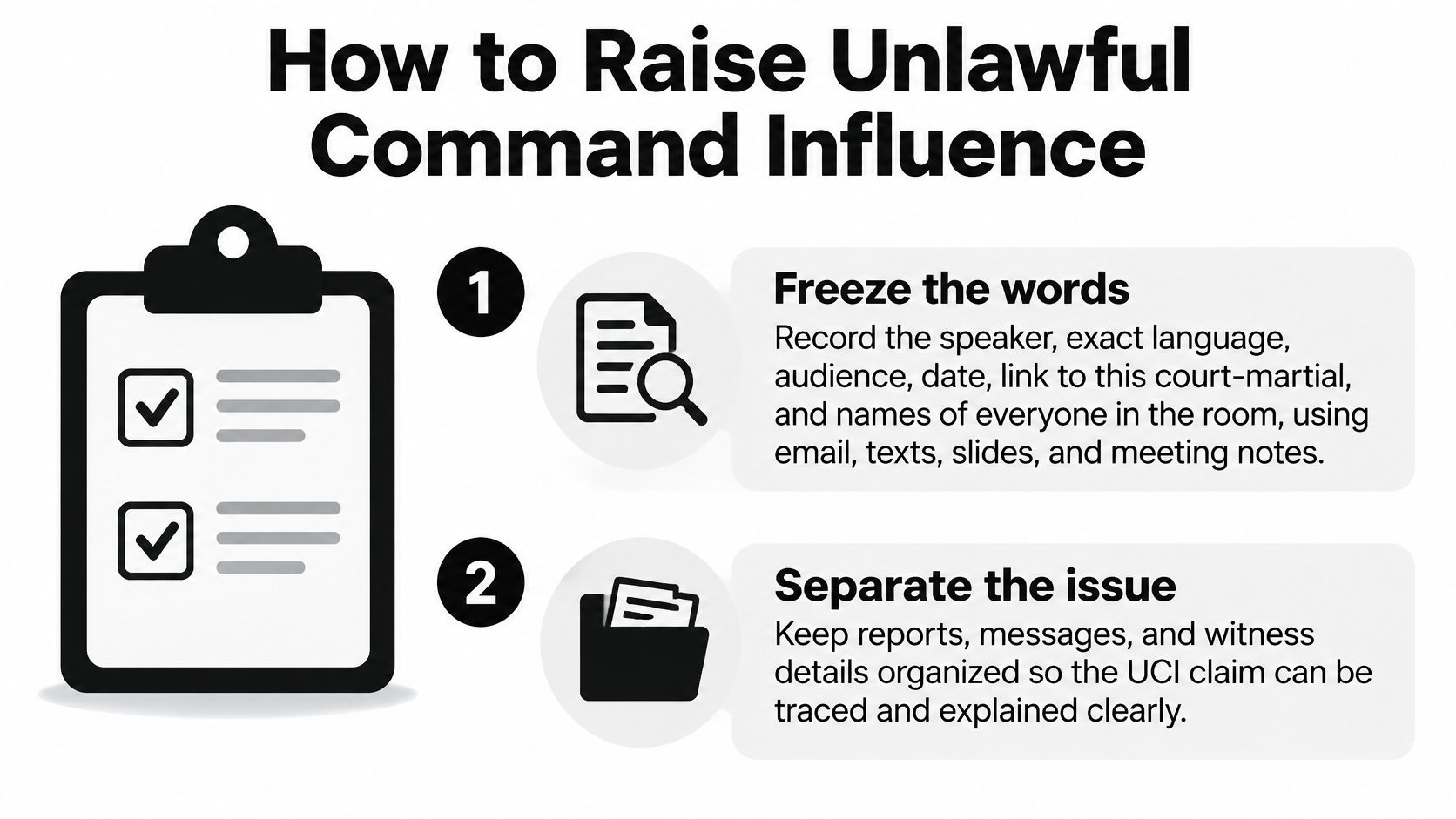
Freeze the words. Record the speaker, language, audience, date, location, connection to your case, and everyone present. Preserve original emails, texts, slides, and meeting notes because paraphrases invite disputes. Don’t label reconstructed language an exact quotation or forward restricted material to unauthorized accounts.
Separate direct pressure from indirect influence. Put comments to members or a convening authority in one part of the timeline. Put evaluation threats, witness-access restrictions, and assignment consequences in another. This helps counsel trace the mechanism; a single accusation of toxic leadership obscures it.
Have counsel request a defined process. A written motion should identify the factual dispute, requested discovery, relevant declarations, and need for a hearing. The reason is accountability: the judge needs identifiable questions to answer. An informal complaint may leave no usable ruling.
Match requested relief to the harm. Identify what would restore independence or remove the taint. Asking only for dismissal can overlook useful alternatives. Don’t assume the existence of pressure automatically establishes entitlement to any particular remedy.
Preserve the ruling and implementation. Counsel should secure findings, clarify unresolved requests, and verify that ordered protections occur. A favorable statement from the bench isn’t enough if the witness remains unavailable. Waiver, forfeiture, and incomplete records can obstruct later review.
Remedy matched to the proven harm
These are potential requests, not automatic results or a fixed hierarchy. Seek the narrowest effective cure, while preserving stronger relief when lesser measures cannot work.
| Remedy | Harm it fits | Typical trigger |
|---|---|---|
| Curative instruction | Limited taint from a single remark | Isolated comment reaching members |
| Recuse or replace the military judge | Judicial conflict or command-controlled evaluation | Judge’s rating tied to command or a personal conflict |
| Disqualify the convening authority | Conflicted referral or disposition decision | Direct comments on the case by the convening authority |
| Seat a new panel | Members exposed to command messaging | Briefing or all-hands aimed at the accused |
| Exclude tainted evidence | Evidence shaped under pressure | Witness moved or restricted to shape testimony |
| Adjust the sentence | Sentence affected by command climate | Command statement about punishment |
| Dismiss the charges | Pervasive influence that cannot be cured | Continuing pressure on the process |
Don’t assume a CID, NCIS, OSI, or CGIS investigation will independently develop your command-influence defense. Give counsel witness lists, denied-access details, and communications showing who knew what.
The practical work described in defense strategy during military investigations matters here: seek missing material before an incomplete account becomes the accepted account.
Mistakes That Sink a Strong UCI Issue
The most damaging mistake is trying to explain command unfairness to investigators without first speaking with counsel. You may think you’re reporting misconduct. You may instead provide statements about the underlying allegations, expose your strategy, and create contradictions.
Credibility is everything. An accurate account with acknowledged gaps is more useful than an embellished account that collapses under questioning.
Choices that cost you leverage
- Talking your way toward a remedy: Discussing the case with investigators or command can produce admissions rather than relief. Take the facts to counsel first.
- Trusting command to document its own mistake: A private assurance that the problem is fixed may leave the original statement and its audience unrecorded.
- Waiting until after findings: Delay can leave counsel with unavailable witnesses, missing messages, and procedural disputes instead of a developed trial record.
- Demanding a written order to convict: This overlooks pressure communicated through witness handling, career consequences, or expectations about disposition.
- Failing to identify the audience: Without names, counsel may be unable to establish who received the message or whether it reached a relevant participant.
- Mentioning the issue once and abandoning it: An unresolved allegation may never produce findings, an enforceable remedy, or a meaningful appellate record.
- Treating dismissal as the only worthwhile outcome: Rejecting targeted relief can mean overlooking protection for witnesses, a better-screened panel, or an independent decision-maker.
- Ignoring parallel administrative actions: An Article 15, separation, or GOMOR may contain relevant evidence of pressure, even though not every administrative dispute is itself a court-martial UCI claim.
Don’t turn witnesses into advocates
Families can also damage useful evidence by coordinating accounts. Don’t circulate a proposed version of the briefing and ask everyone to agree. Give counsel the names and let witnesses describe what they independently remember.
Preserve original messages. Don’t coach recollections, delete embarrassing context, or ask a witness to strengthen their language.
Stop discussing the command climate with coworkers, investigators, or social-media audiences. Discuss the substance with counsel, who can decide what should be disclosed, to whom, and through what process.
Unlawful Command Influence FAQs
Is every harsh comment from a commander unlawful command influence?
No. Harshness alone doesn’t establish unlawful interference. Counsel needs the statement’s context, its audience, and its connection to a protected participant or decision in your case.
What must the defense show to raise UCI?
The defense needs facts supported by evidence, not speculation about what senior leaders probably wanted. Give your lawyer original communications and witnesses with personal knowledge so the allegation can be presented through the appropriate procedure.
Can a commander order a conviction?
No. A commander cannot lawfully direct the court to convict or impose a particular punishment. If someone claims that such an order exists, tell counsel who made the claim and distinguish firsthand knowledge from rumor.
Can I refuse to talk to CID about the command climate?
If investigators seek to question you as a suspect, invoke your right to remain silent and request counsel. Don’t assume a conversation is harmless because it begins with command conduct rather than the alleged offense, and don’t lie or obstruct an investigation.
Does UCI always lead to dismissal?
No. A judge may consider targeted measures rather than ending the prosecution. Your lawyer should explain what harm the evidence establishes, which remedy addresses it, and what remains unresolved after that remedy.
Is a hallway complaint enough?
Don’t rely on it. Tell defense counsel promptly and provide the supporting material so counsel can raise the issue formally when appropriate. Reporting your concern to a supervisor isn’t the same as obtaining a judicial ruling.
When do I need a lawyer?
Before an interview or substantive command conversation about the case. Early advice helps you avoid creating additional evidence problems while preserving the pressure allegation.
Bring counsel a short intake package:
- Timeline: Events in order, separating firsthand observations from secondhand information.
- Original material: Messages, memoranda, briefing details, and related paperwork lawfully available to you.
- Witness information: Names, roles, contact details, and what each person may know.
- Upcoming events: Interviews, hearings, counseling sessions, or other deadlines already communicated to you.
Get Independent Counsel Before the Record Closes
Detailed military defense counsel can be skilled, committed advocates. They have professional duties of independence and aren’t the commander’s lawyers. Civilian representation shouldn’t be sold by pretending otherwise.
The reason to consider civilian military defense lawyers is deliberate selection and additional capability. You can evaluate a lawyer’s focused experience, contested-trial work, availability, and proposed strategy before retaining them. A civilian lawyer can work with detailed counsel rather than replace useful knowledge and preparation.
Evaluate the lawyer, not the sales pitch
Ask how counsel would investigate the alleged pressure, which records they would seek, and how they would protect reluctant witnesses. Discovery and compulsory process require legal grounds and, where necessary, judicial action. No lawyer can promise unlimited access or guaranteed dismissal.
Use criteria for selecting a military defense lawyer to compare substantive qualifications:
- Sustained practice: Focused UCMJ and court-martial experience, not merely past military service.
- Relevant trial work: Contested cases with comparable allegations and consequences.
- Professional credibility: Teaching, substantive writing, peer reputation, and leadership in defense organizations.
- A concrete plan: Who handles the case, how counsel communicates, and what preservation work begins immediately.
When you compare lawyers, weigh sustained military law practice and dedicated court-martial work. Experience remains a comparison factor, not a guarantee.
Interview more than one UCMJ lawyer and compare strategy, communication, and fit.
If you’re under investigation, approaching an Article 32 hearing, or already facing referred charges, contact independent court-martial counsel now. Bring your timeline, original messages, witness names, and upcoming deadlines. Don’t wait for another all-hands briefing or counseling session. Your career, liberty, and discharge consequences deserve a defense built before the record closes.