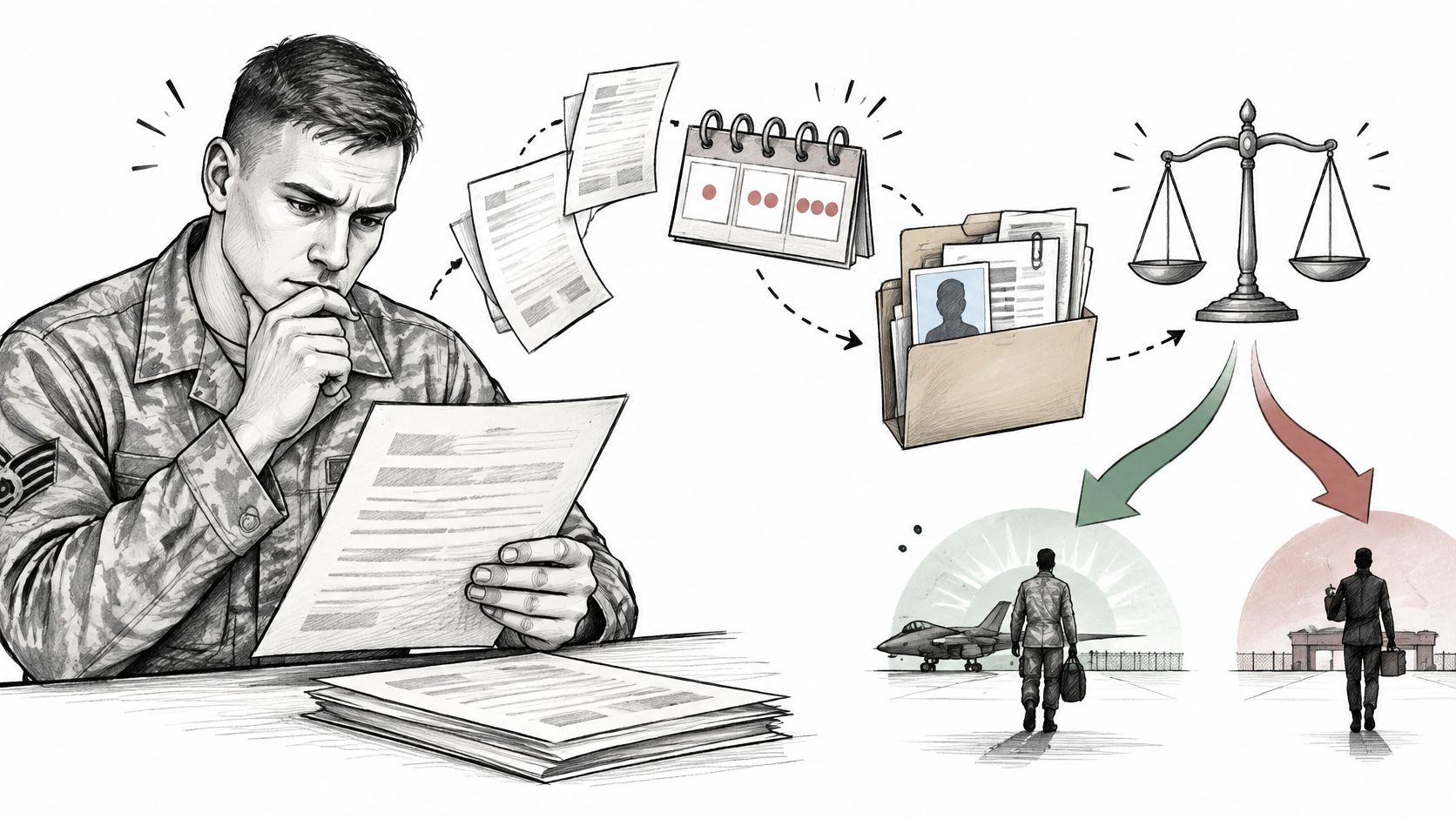
You opened a letter you did not expect. Your commander is proposing to end your Air Force career without a court-martial, without a conviction, and without a day in confinement. That letter is an administrative separation, and the response clock is already running.
Families hear “it is not a criminal case” and relax. Don’t. The same facts can support both a UCMJ action and a personnel action. The words that land on your DD Form 214 decide veterans’ benefits, civilian hiring, and whether a later board will even reopen the file. An administrative separation Air Force case is a timed election, not a briefing.
Read the proposed basis. Read the least favorable characterization the commander may recommend. Then decide, with counsel, what you will submit and whether a board is yours to elect. Waiting for the squadron to “work it out” is how people lose the record.
Table of Contents
- What an Air Force Administrative Separation Changes
- What DAFI 36-3211 Lets a Commander Use
- How an Air Force Separation Case Moves From Notice to Decision
- Who Gets an Administrative Discharge Board
- What Each Discharge Characterization Costs You
- Appeal and Upgrade Options After an Adverse Discharge
- Errors That Hand the Command an Easy Win
- Call Counsel Before the Three-Day Clock Expires
What an Air Force Administrative Separation Changes
An administrative separation is a personnel action. It is not a court-martial sentence, even when the underlying conduct could support both. Nobody has to convict you for the Air Force to end your enlistment, rewrite your characterization, and send you home with a discharge that follows you into every background check.
The instruction that runs involuntary enlisted cases is DAFI 36-3211. It covers the Regular Air Force, the Air National Guard, and the Air Force Reserve. The written notification opens the file. The DD Form 214 records the characterization when you leave. Those two documents, plus the separation authority’s decision memo, are the paper trail that matters more than hallway rumors.
The discharge picture, not the rumor
Force-wide numbers show why the label on your notification is the fight. A Government Accountability Office review reported Air Force discharge totals from calendar year 2002 through March 2024: 666,989 honorable, 48,150 general under honorable conditions, 4,195 under other than honorable conditions, 3,529 bad-conduct, 685 dishonorable or dismissal, and 49,323 uncharacterized.
In 2023 the same review counted 30,191 honorable discharges (88 percent), 1,751 general (5 percent), 320 under other than honorable conditions (1 percent), 79 bad-conduct, 44 dishonorable or dismissal, and 1,738 uncharacterized (5 percent). For the first quarter of 2024 it counted 8,478 honorable (86 percent), 598 general (6 percent), and 689 uncharacterized (7 percent).
| Characterization | 2002 through March 2024 | 2023 count | 2023 share |
|---|---|---|---|
| Honorable | 666,989 | 30,191 | 88% |
| General under honorable conditions | 48,150 | 1,751 | 5% |
| Under other than honorable conditions | 4,195 | 320 | 1% |
| Uncharacterized | 49,323 | 1,738 | 5% |
Bad-conduct and dishonorable results are court-martial punishments. They do not belong in the administrative rows above. An administrative separation ordinarily produces an honorable, general, other-than-honorable, or uncharacterized or entry-level result.
Those percentages describe the force, not your packet. The number that controls your case is the least favorable characterization already named in the notification. If that line says under other than honorable conditions, treat it as the outcome the command is willing to recommend, not as a scare tactic.
What DAFI 36-3211 Lets a Commander Use
A separation notice names the ground the command says you violated and the characterization it may recommend. Your first task is to test whether the cited ground fits the alleged conduct. DAFI 36-3211 sets out authorized separation bases, including misconduct, performance deficiencies, and failure to meet standards.
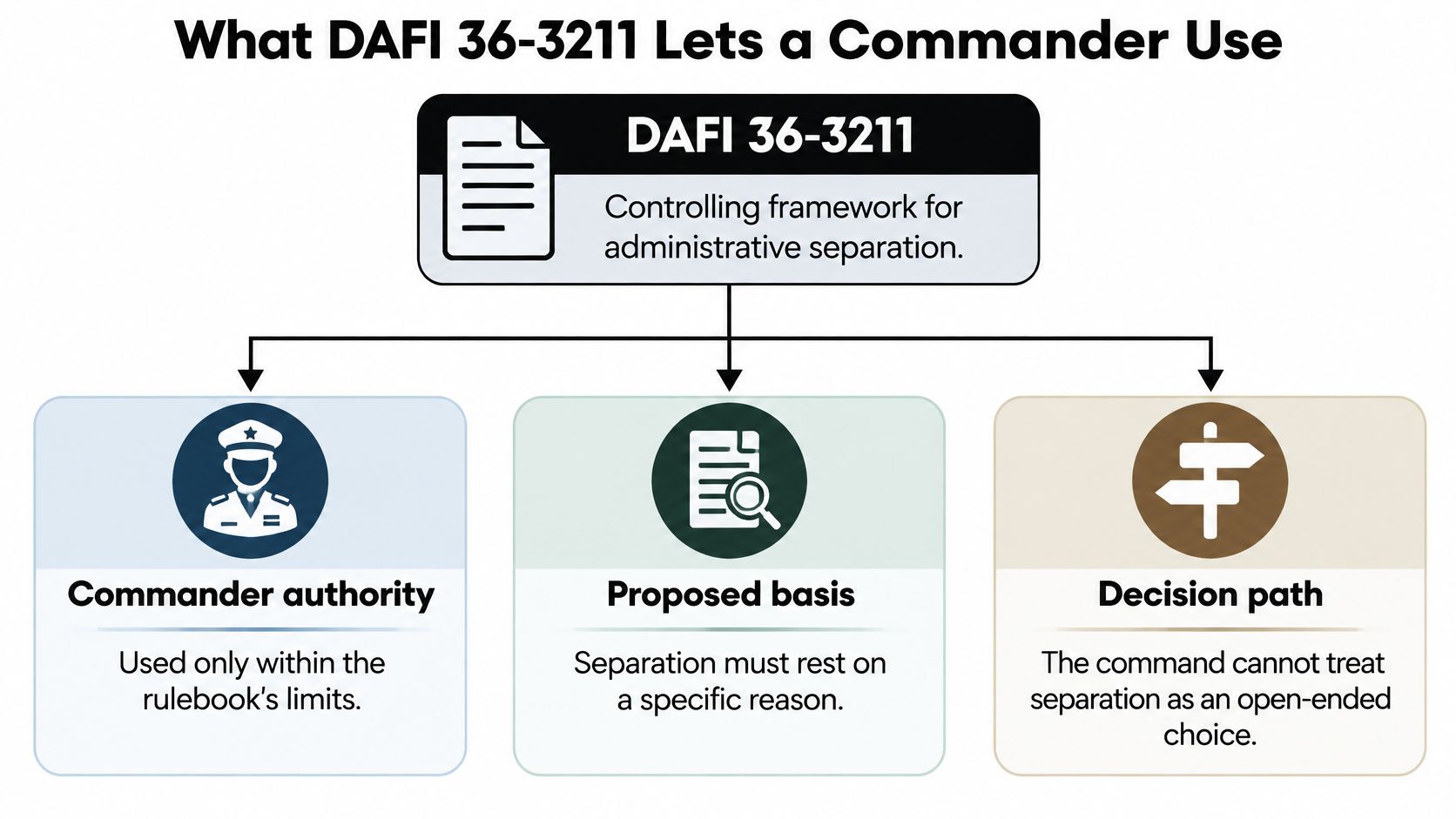
For active-duty enlisted cases, Chapter 7 of DAFI 36-3211 is a starting point for reviewing the substantive grounds. Reserve and Guard cases also require close attention to component, duty status, and applicable procedures. A weekend drill incident is not automatically an active-duty separation case. The package must identify the basis and process that apply to the member’s status.
Three tests on every package
Review the case on three separate questions before preparing a response.
Basis fit. Does the alleged conduct meet the cited paragraph, or is the command stretching a personality conflict, a failed fitness test, or a single incident into a separation ground it does not satisfy?
Notice and evidence. Did you receive the documents that will go to the separation authority? Classified material may be summarized, but the allegation still needs enough detail for you to respond.
Characterization support. Does the record support the proposed label, or does the recommendation rely on command irritation rather than documented conduct?
Suppose an Airman receives notice for minor misconduct. The file contains mostly “exceeds expectations” evaluations, a deployment, and one counseling. The basis question is whether the incident meets the cited paragraph. The characterization question is whether the record supports the proposed label. They are separate arguments: a strong record does not erase a valid separation basis, and a weak basis does not settle characterization.
Get the complete package when the notification arrives. Compare every attachment with the stated ground before submitting a response. A missing evaluation or misstated date can undermine the command’s account of the case.
How an Air Force Separation Case Moves From Notice to Decision
The sequence is short, and each step forces a decision. Most cases use notification procedures. Board procedures apply only in specified circumstances, including when you are an E-5 or above, have six or more years of service, or the commander is pursuing an Under Other Than Honorable Conditions characterization, as the Air Force legal handbook confirms.
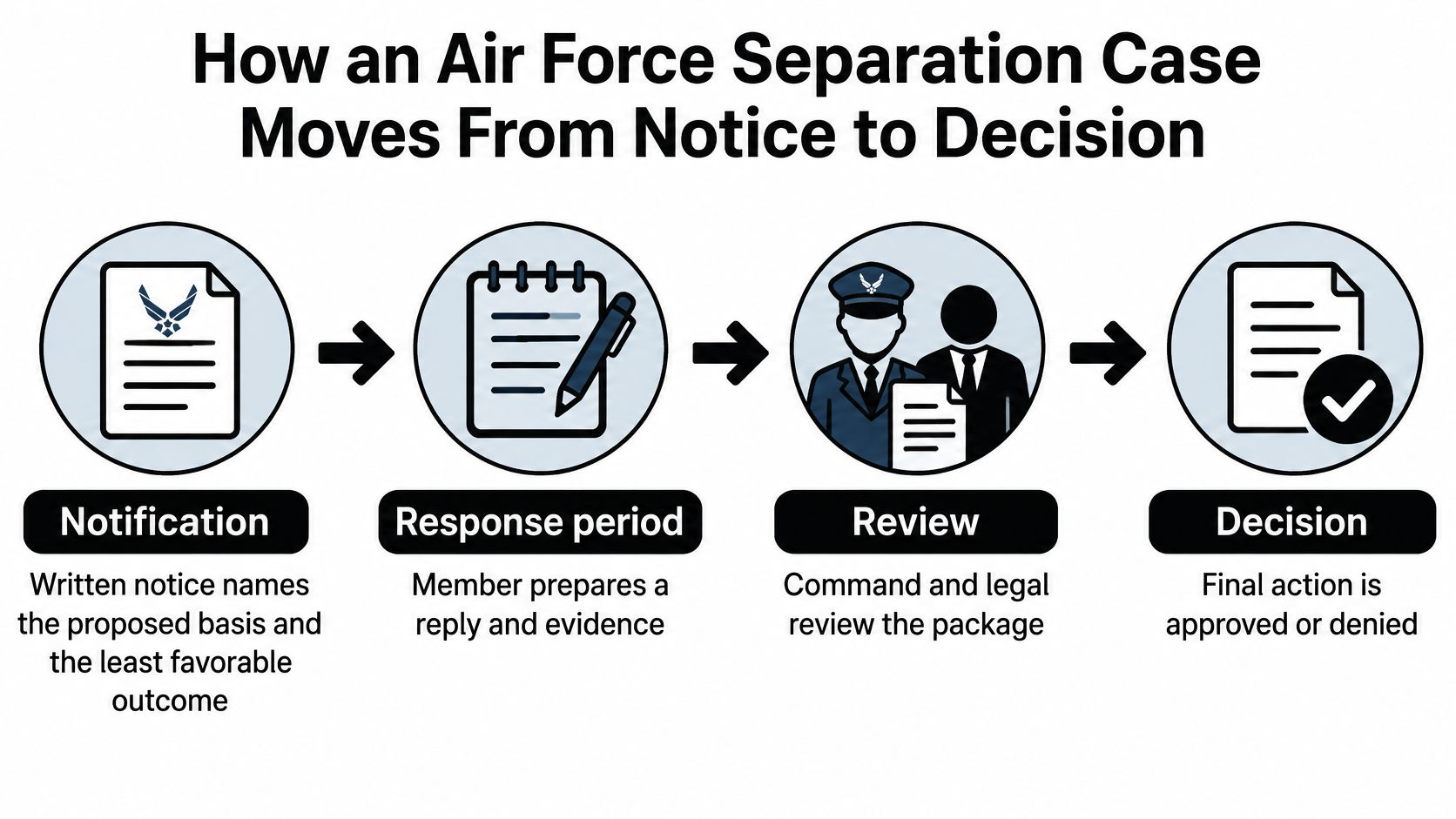
Notification. The action starts with written notice naming the proposed basis and the least favorable characterization the commander may recommend. Read the cited paragraph of DAFI 36-3211 against the facts, not against the tone of the letter. Decision: is the cited ground the conduct you committed?
Calendar the response now. Under the notification procedure you have three duty days to submit matters. Silence leaves the separation authority with the command file alone. Decision: with counsel, elect or preserve a board before you sign any waiver.
Audit the package. Demand every document that will go forward. Look for undisclosed attachments, inaccurate summaries, missing favorable evaluations, and a wrong service-time count. Decision: list every defect in writing, because a verbal complaint to the first sergeant disappears.
Build the response around the whole person. Address the allegations, then the record: performance reports, awards, deployment or combat history, medical issues, rehabilitation, and what discharge would cost you and your family. Decision: lead with facts that contradict the basis, not with an apology that admits it.
If you elect a board, prepare three questions. Is the basis proved? Should separation occur? How should service be characterized? Witnesses and exhibits should answer those, not retell your career in the abstract.
The separation authority decides after the package or the board. A recommendation is not a final order. Check the decision memo line by line against the record you submitted.
If the result is adverse, collect records while the case is still open. Performance reports, medical files, and witness contact information are far easier to gather before people PCS and systems close the account.
Practical rule: A late response is not a small mistake. It hands the separation authority a one-sided file and a clean reason to adopt the command’s characterization.
Who Gets an Administrative Discharge Board
Most Air Force cases run on notification procedures, so a board is the exception and it has to be triggered. Do not assume you have a hearing because the allegation feels serious. Grade, total service, or the characterization the commander wants are what create the right.
The Department of the Air Force rules in DAFI 36-3211 identify three triggers: you are in pay grade E-5 or higher, you have six or more years of total active and reserve service, or the commander recommends an Under Other Than Honorable Conditions characterization.
| Path | Main trigger | Response window | What the member can do |
|---|---|---|---|
| Notification procedure | No board trigger; most cases | 3 duty days | Written matters on facts, service record, and characterization |
| Board for grade | E-5 or above | Elect or waive after counsel review | Live fact-finding plus retention and characterization evidence |
| Board for service length | 6 or more years total active and reserve service | Elect or waive after counsel review | Contest the basis with witnesses, documents, and testimony |
| Board for characterization | Commander recommends Under Other Than Honorable Conditions | Elect or waive after counsel review | Challenge an OTH and argue for retention or a better characterization |
What the hearing actually is
A board is not a criminal trial and not a court-martial. It is a fact-finding body. It hears admissible evidence and recommends whether the basis is proved, whether you should be separated, and how service should be characterized. You can contest allegations with testimony, documents, witnesses, and counsel, and you can put retention and mitigation evidence in front of people who vote.
Waiving that right surrenders a live challenge to the facts. The election belongs after counsel has read the notification, the evidence, and the likely characterization. Calculate grade and total active-plus-reserve time from official records before you elect or waive anything. A miscounted service total or a wrong grade can erase a board you were entitled to have.
If you are weighing whether to demand the hearing, read how administrative separation boards run before you sign a waiver to “get it over with.”
What Each Discharge Characterization Costs You
Characterization is what your family feels after the ceremony. Under DAFI 36-3211, the usual administrative results are honorable, general under honorable conditions, under other than honorable conditions, and entry-level separation. A Board for Correction of Military Records decision applying that instruction draws the lines this way.
Status is generally fixed on the date separation notification is initiated. Entry-level status ordinarily covers the first 180 days of continuous active service, or the first 180 days after a break exceeding 92 days. In that window the normal description is an entry-level separation, not a conventional characterization, unless a limited exception authorizes and warrants an other-than-honorable result.
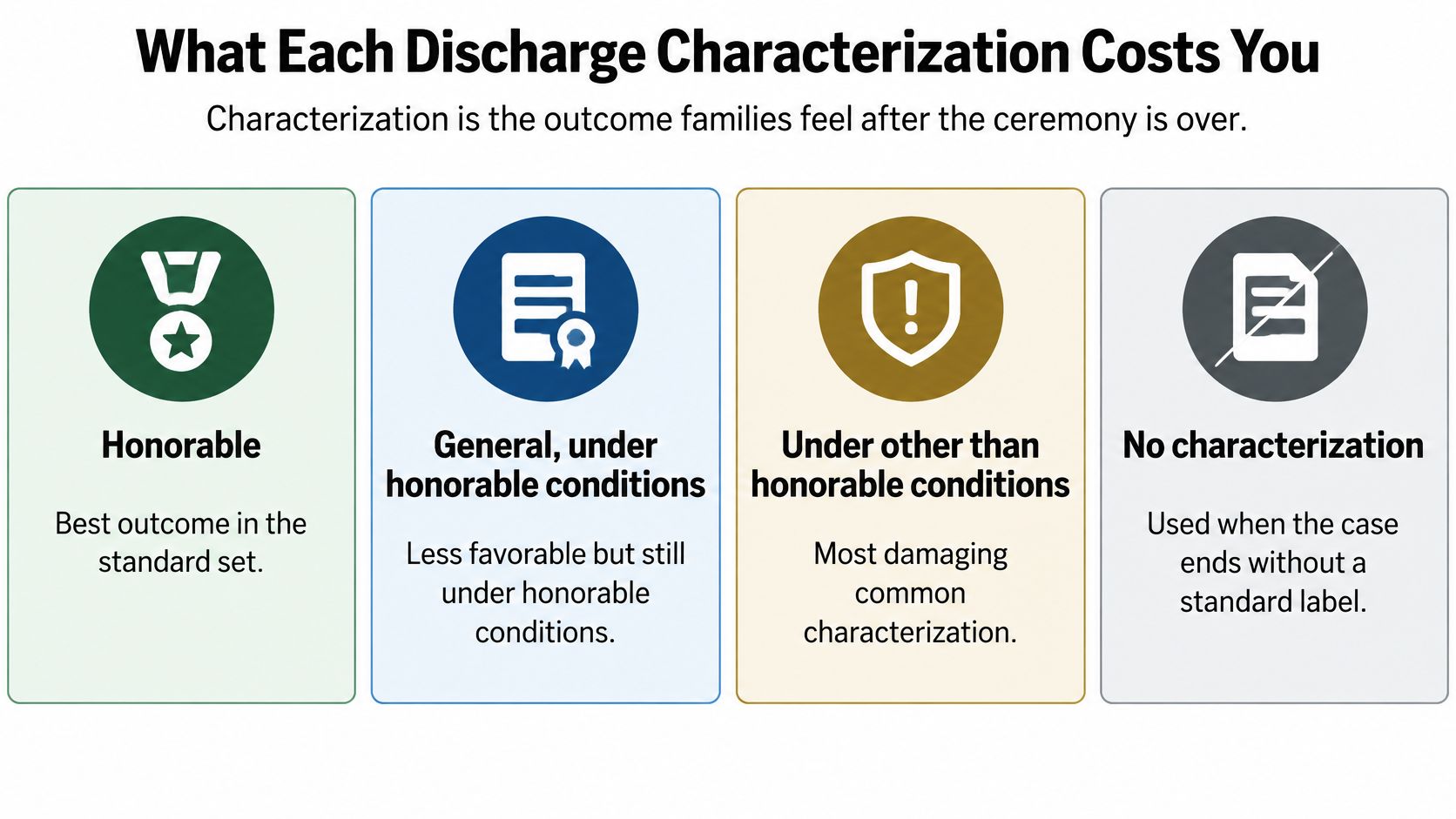
Past that window, an honorable characterization generally requires service that meets Air Force standards. A general characterization is tied to significant negative conduct or performance that outweighs otherwise positive service. An other-than-honorable characterization requires a significant departure from expected conduct, and it comes with safeguards: a board opportunity, or a request for discharge in lieu of trial by court-martial.
| Characterization | Standard or trigger | Practical consequence |
|---|---|---|
| Honorable | Service meets Air Force standards | Strongest outcome for later benefits, hiring, and review |
| General under honorable conditions | Significant negative conduct or performance outweighs otherwise positive service | Weaker record; benefits and review depend on the words on the DD Form 214 |
| Under other than honorable conditions | Significant departure from expected conduct; requires board or discharge-in-lieu-of-trial safeguards | Most damaging administrative label; contest it first |
| Entry-level separation | First 180 days of continuous active service, or first 180 days after a break over 92 days | Normal description is entry-level, not conventional; OTH only by limited exception |
Veterans’ benefits, federal and civilian hiring, security-clearance risk, and later review all turn on the words on the DD Form 214. Benefit rules are not identical for every person, so do not let a supervisor tell you a general discharge “is basically honorable.” Employers and agencies read the form, not the pep talk. The stakes of an other than honorable discharge are why that label has to be fought first, not cleaned up years later.
Two Airmen, same minor-misconduct allegation. One puts the full record in front of the authority and leaves with an honorable result and retention still on the table. The other submits nothing, and the file supports separation under other than honorable conditions. Same facts. Different election.
Argue retention, and in the alternative argue the best characterization the record will support. Do not pick one and abandon the other.
Appeal and Upgrade Options After an Adverse Discharge
Assume the first decision can be wrong, and build the second fight from the file the command already created. Two federal review routes matter after an administrative separation.
Discharge Review Board. This board reviews the characterization and the reason for discharge, and it can change the characterization within its authority. Filing windows and eligibility rules apply, so calendar the deadline as soon as the DD Form 214 is in hand. A characterization-only problem belongs here first.
Board for Correction of Military Records. This board corrects an error or an injustice in the record, including the basis, the process, and the characterization. Use it when the defect goes beyond the label. A decision memo that misstates dates, omits submitted evidence, or applies the wrong basis is itself a correction target.
Records to lock down now
Gather these while people and systems still have them:
- Performance reports and awards, including the ones the command left out of the original package.
- Medical records that show a condition behind the conduct, not a stack of unrelated clinic visits.
- The notification, the full package that went forward, and the separation decision memo.
A later petition should name each error, cite the document that proves it, and argue the best supported characterization in the alternative. Emotion does not correct a record. The defects you found during the original response are the same defects that support the upgrade. Start with a clear map of how to upgrade a military discharge before the filing window gets comfortable and then closes.
Errors That Hand the Command an Easy Win
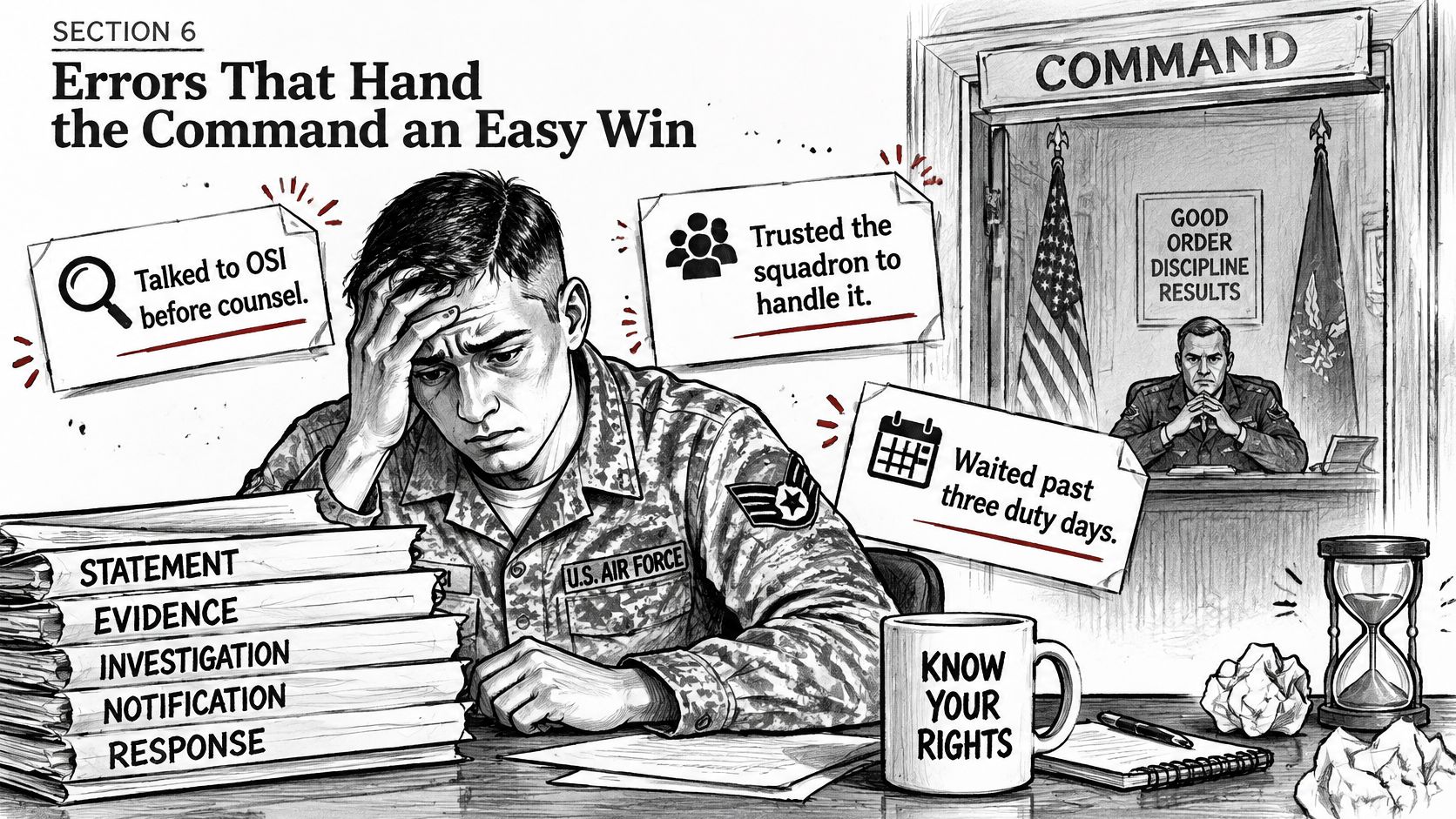
The command does not need a perfect case if you forfeit the rights that would have tested it. These are the mistakes that do that.
Talking to OSI or the commander before counsel reads the allegation. Your explanation becomes their exhibit.
Trusting the squadron to handle it. The same chain that initiated the action does not become your advocate because a shirt sounds sympathetic.
Hiring a lawyer after the three duty days. The separation authority may already have only the command file.
Assuming there is no evidence because nobody has been charged. Administrative cases run on counselings, statements, and fitness records, not on a criminal information.
Waiving a board to get it over with. You just gave up live fact-finding.
Submitting only a short apology. That admits the basis and says nothing about retention or characterization.
Ignoring medical or mental-health records that explain the conduct.
Treating a retention package as optional when the instruction gives the command a choice between processing and retention.
What counsel actually hunts
Government files often overcharge a basis, lean on incomplete witness statements, omit favorable evaluations, misstate dates, or recommend an other-than-honorable characterization the record cannot carry. Credibility cuts both ways. A thin command narrative loses force when the documents contradict it.
The 2026 shaving-profile guidance is a current example of a threshold people treat as automatic. Department of the Air Force guidance says that when a member accumulates more than 12 months of medical shaving profiles inside a 24-month period beginning 1 February 2026, commanders initiate discharge processing or submit a retention package. It is not an automatic discharge. Retention is case by case and looks at performance, unit manning, specialized training, and the cost and time to replace you. Verify every profile date and medical basis, challenge a bad day-count, and build the retention package before the command treats the threshold as met. DAFI 36-3211 still governs that processing.
Tonight, pull seven items into one folder: the notification, the cited basis, the proposed characterization, your grade, your total active and reserve service, medical records, and evaluations. If any one of those is missing, you are not ready to elect or waive anything.
Call Counsel Before the Three-Day Clock Expires
Area defense counsel are real lawyers. They also carry a caseload, work inside the military justice system, and may not be the person you want running a board, a parallel OSI investigation, and a later records fight at the same time. That is a workload problem, not an insult.
Civilian court-martial attorneys and a UCMJ lawyer who concentrates on military defense are not assigned by the command. You can retain them early, and you can choose them for board and trial experience rather than for whoever is on the duty roster. Serious administrative separation Air Force cases belong in that category when an other-than-honorable characterization, a board, a security clearance, or a companion criminal investigation is in play.
Early action matters because the notification response window is three duty days, and because witnesses, medical records, and evaluations are easier to lock down before the decision memo is signed. Compare civilian military defense lawyers, then vet credentials, trial experience, and communication style with each candidate yourself. A listing does not guarantee a result. Speak with more than one lawyer before you choose.
If a notification is already in your hand, an investigation is open, or a commander is talking about separation, do not wait for the next briefing. Call counsel today, before the three duty days expire and the separation authority decides your career, your discharge words, and the benefits that follow from a one-sided file.