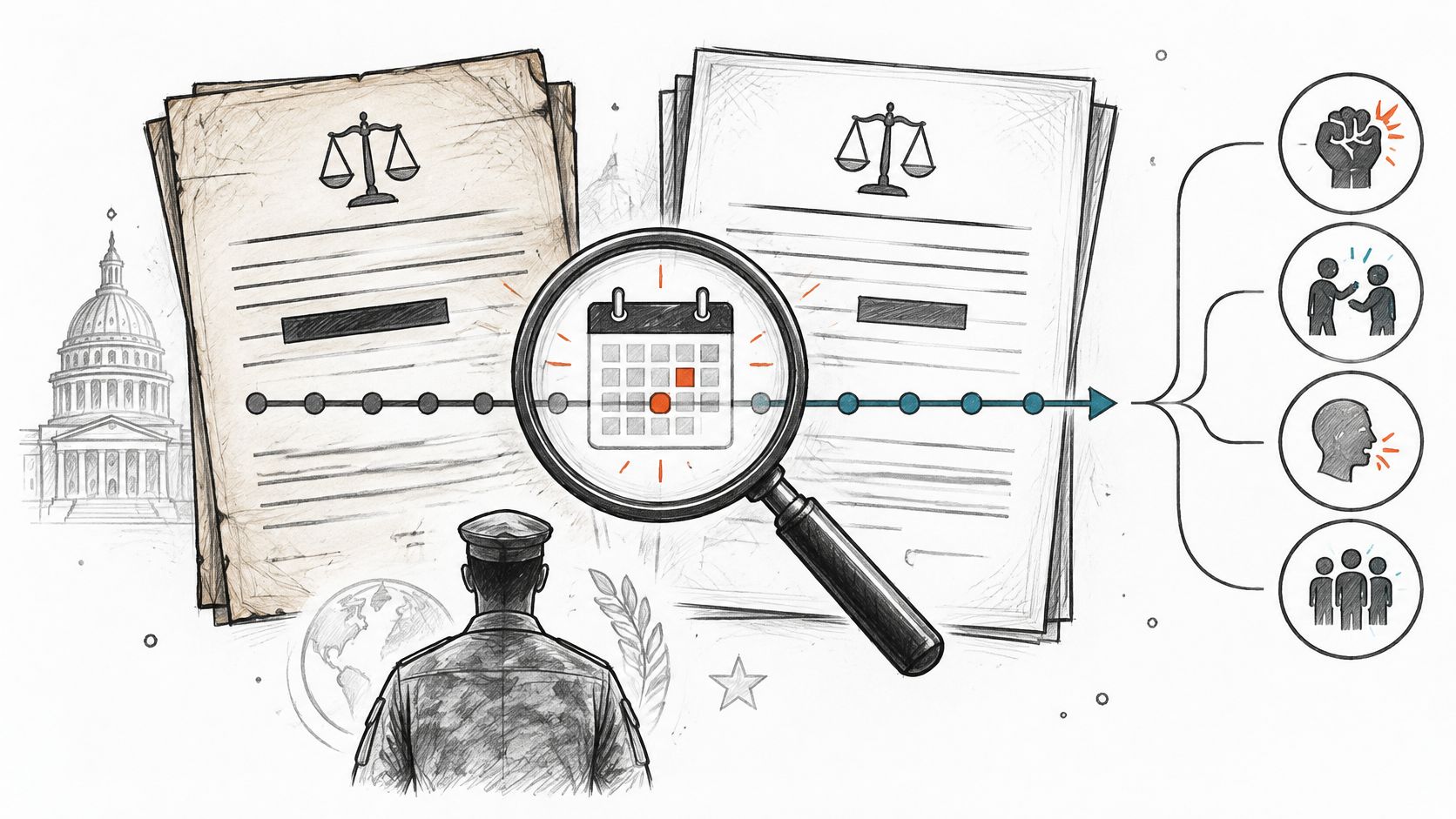
“Just explain what happened” is dangerous advice when you’re facing an Article 128 UCMJ allegation. So is reading a generic assault definition and assuming you understand the charge. Before you discuss a shove, a missed punch, or an alleged choke, your lawyer needs to identify which statutory version, subdivision, and charging theory apply to the alleged conduct.
That distinction affects what the government must prove and how your defense should respond. Your career, freedom, and reputation deserve more than an internet summary that mixes older aggravated-assault language with today’s statute.
Table of Contents
- Which Article 128 Text Governs the Charge
- What Prosecutors Must Prove for Each Theory
- How the Charge Sheet Changes the Stakes
- How an Assault Investigation Is Built
- Four Assault Fact Patterns and the Real Issue
- Mistakes That Hand Over the Case and How to Choose Counsel
- Questions Readers Search Before Their First Interview
- If You Are Under Investigation, Act Today
Which Article 128 Text Governs the Charge
The mistake that wastes valuable preparation time is simple: a family reads an assault guide while the charge sheet alleges a different offense. Article 128 isn’t one interchangeable battery charge. A defense built around whether someone suffered an injury can miss the actual allegation entirely.
The current Article 128 statute and amendment history distinguish ordinary assault under subsection (a), aggravated assault under subsection (b), and assault with intent to commit specified offenses under subsection (c), while the pre-2019 aggravated-assault language addressed force likely to produce death or grievous bodily harm and intentional grievous bodily harm. Don’t treat those formulations as synonyms.
Which Article 128 theory matches the allegation
Use this comparison to identify the issue, not to decide guilt or calculate a sentence.
| Theory | Controlling language | What is really alleged | Verify first |
|---|---|---|---|
| Pre-2019 aggravated assault | Force likely to produce death or grievous bodily harm, or intentional grievous bodily harm | An older theory governing alleged pre-change conduct | Offense date and applicable Manual |
| 128(a) attempt | Unlawful attempt to do bodily harm | Intent plus conduct short of completed harm | Whether contact is actually claimed |
| 128(a) offer | Unlawful offer to do bodily harm | A demonstration of force creating reasonable fear of immediate harm | Whether the allegation rests on words alone |
| 128(a) battery | Bodily harm done unlawfully with force or violence | Completed physical contact | Consent, accident, or lawful authority |
| 128(b) weapon | Dangerous weapon with intent to cause bodily harm | The object as used, plus intent to injure | How the object was used |
| 128(b) injury | Substantial or grievous bodily harm during an assault | A legally significant injury result | Medical records and the injury definition |
| 128(b) strangulation | Assault by strangulation or suffocation | A particular mechanism of assault | Whether the described act supports that mechanism |
| 128(c) specified intent | Assault with intent to commit a listed offense | An assault plus further criminal intent | Which intended offense is alleged |
The specified offenses include murder, voluntary manslaughter, rape, sexual assault, rape of a child, sexual assault of a child, robbery, arson, burglary, and kidnapping. A defense lawyer must identify the particular intended offense rather than treating subsection (c) as a generic enhancement.
Establish the governing text before discussing strategy
Take these steps with counsel:
- Copy the allegation exactly. Preserve the alleged date, complete specification, subdivision, and any amendments.
- Match the date to the law. If the specification spans a statutory change, flag that issue immediately.
- Identify the applicable Manual. Counsel should verify the Manual for Courts-Martial provisions, implementing amendments, and effective-date rules governing that conduct.
Practical rule: The date starts the legal analysis. The charge title doesn’t finish it.
Don’t assume the newest Manual automatically governs every issue in an older case. Equally, don’t accept an outdated website’s punishment chart as advice about a current specification.
What Prosecutors Must Prove for Each Theory
Start with the elements, not the accusation’s emotional force. The government must establish the charged offense beyond a reasonable doubt, and a persuasive account of an argument isn’t a substitute for proof of each required element.
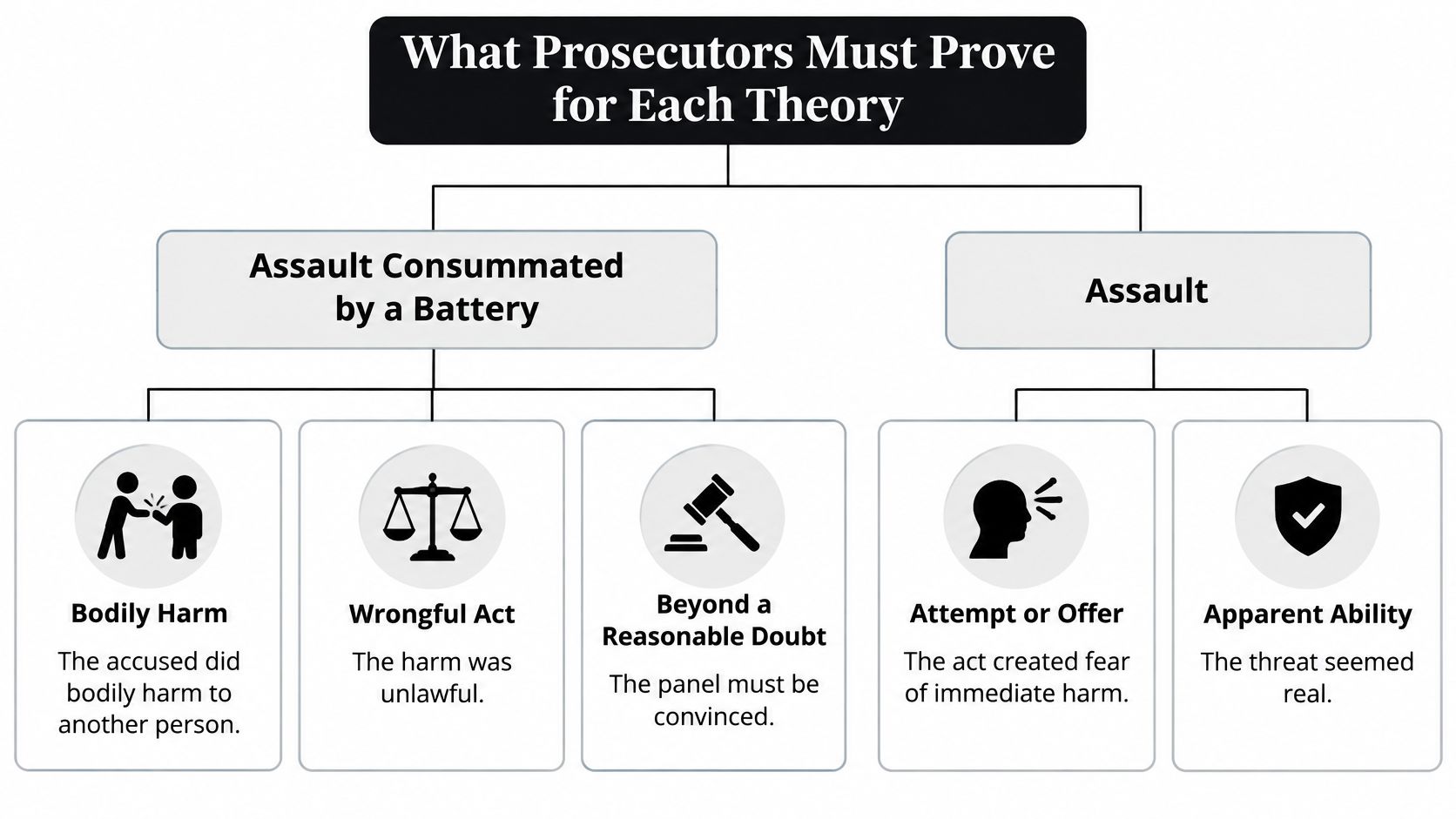
An Army Court of Criminal Appeals decision identifies the elements of assault consummated by a battery as bodily harm to another person, unlawfulness, and the infliction of that harm with force or violence. That structure gives the defense a concrete set of questions.
The visual offers an overview, but keep force or violence on your written element checklist and analyze attempts separately from offers.
Completed contact does not settle unlawfulness
Bodily harm can involve slight contact. A lack of major injury therefore doesn’t answer whether a battery occurred.
The stronger question may be why the contact happened and whether it was unlawful. Counsel should examine consent within a lawful activity, accident, self-defense, defense of another, and lawful authority. Each requires supporting facts, not merely a label.
Authorized training contact, for example, calls for examination of the exercise, instructions, permitted techniques, and what occurred. Calling something training doesn’t excuse excessive force, just as calling something a fight doesn’t establish who used unlawful force.
Attempts, offers, and aggravated allegations need separate proof
An attempt focuses on intent to cause bodily harm and an overt act beyond preparation. The intended blow need not land, and the analysis isn’t whether the other person felt afraid.
An offer focuses on an unlawful demonstration of force creating reasonable apprehension of immediate bodily harm. Counsel should examine what the person perceived, the surrounding circumstances, and apparent ability. Angry language alone shouldn’t be converted into proof of every required fact.
The aggravated theories require further precision:
- Dangerous weapon. Examine the object’s actual use and the alleged intent to cause bodily harm. An object’s name doesn’t establish its dangerousness in the incident.
- Substantial or grievous injury. Compare the medical evidence with the applicable legal definition. A police summary isn’t a medical classification.
- Strangulation or suffocation. Reconstruct the alleged mechanism. The absence of a lasting visible mark doesn’t by itself resolve whether the act occurred.
For subsection (c), identify the evidence establishing the further intent to commit the specified offense. Proof of unwanted contact doesn’t automatically establish an intent to commit rape, robbery, or another listed crime.
Give counsel an element-by-element evidence map: witness, photograph, recording, medical finding, and disputed inference. An unsupported element deserves attention, but remember that testimony itself is evidence. The defense must evaluate its reliability rather than dismiss it because no camera recorded the event.
How the Charge Sheet Changes the Stakes
A charge sheet states the government’s legal theory. It isn’t a neutral description of a confrontation. Read the verbs, alleged injury, object, intent language, and relationship between specifications.
Under Article 128’s official statutory text, assault includes attempted, offered, and completed bodily harm, with separate aggravated and specified-intent categories, and punishment is as a court-martial may direct. There is no responsible universal maximum sentence for “Article 128.”
Demand a specification-specific exposure assessment
Before any plea discussion, counsel should identify the applicable Manual punishment provision and effective-date rules, then account for the chosen forum and applicable sentencing framework. An older offense can raise questions that a current online punishment chart won’t answer.
A weak aggravated allegation doesn’t necessarily eliminate exposure for unlawful contact. Counsel must assess whether a lesser offense is legally available and supported by the evidence, rather than promising that defeating the weapon or injury allegation ends the case.
Ask for answers in separate categories:
- Charged offense exposure. What punishment is authorized for this specification in this forum?
- Lesser-offense exposure. What finding could remain if the aggravated allegation fails?
- Administrative exposure. Could command pursue separation or other career action independently?
- Collateral consequences. Which possible outcome creates firearm, clearance, registration, or employment concerns?
Sexual-intent allegations require particular care. An Article 128(c) specification isn’t interchangeable with an Article 120 or Article 120b charge. If prosecutors add a separate sexual offense, counsel must evaluate its distinct proof requirements and consequences.
Compare forums by consequences
Article 15 nonjudicial punishment isn’t a federal criminal conviction, but it can affect promotion and prompt further administrative or clearance scrutiny. Don’t confuse a noncriminal forum with a harmless outcome.
A summary court-martial has narrower powers and a distinct legal status. Don’t rely on a blanket statement that every summary disposition has identical conviction consequences for every civilian purpose.
Special and general courts-martial can carry criminal-conviction consequences, confinement exposure, and, where authorized, punitive discharge exposure. The particular forum and offense matter.
Ask counsel what the government can still prove if its most serious allegation fails, and which consequences attach to that remaining finding.
Discharge characterization, security-clearance review, and firearm restrictions require individual analysis. Registration exposure likewise cannot be decided from the word assault alone. A short plea hearing can produce consequences that last much longer than the punishment imposed.
How an Assault Investigation Is Built
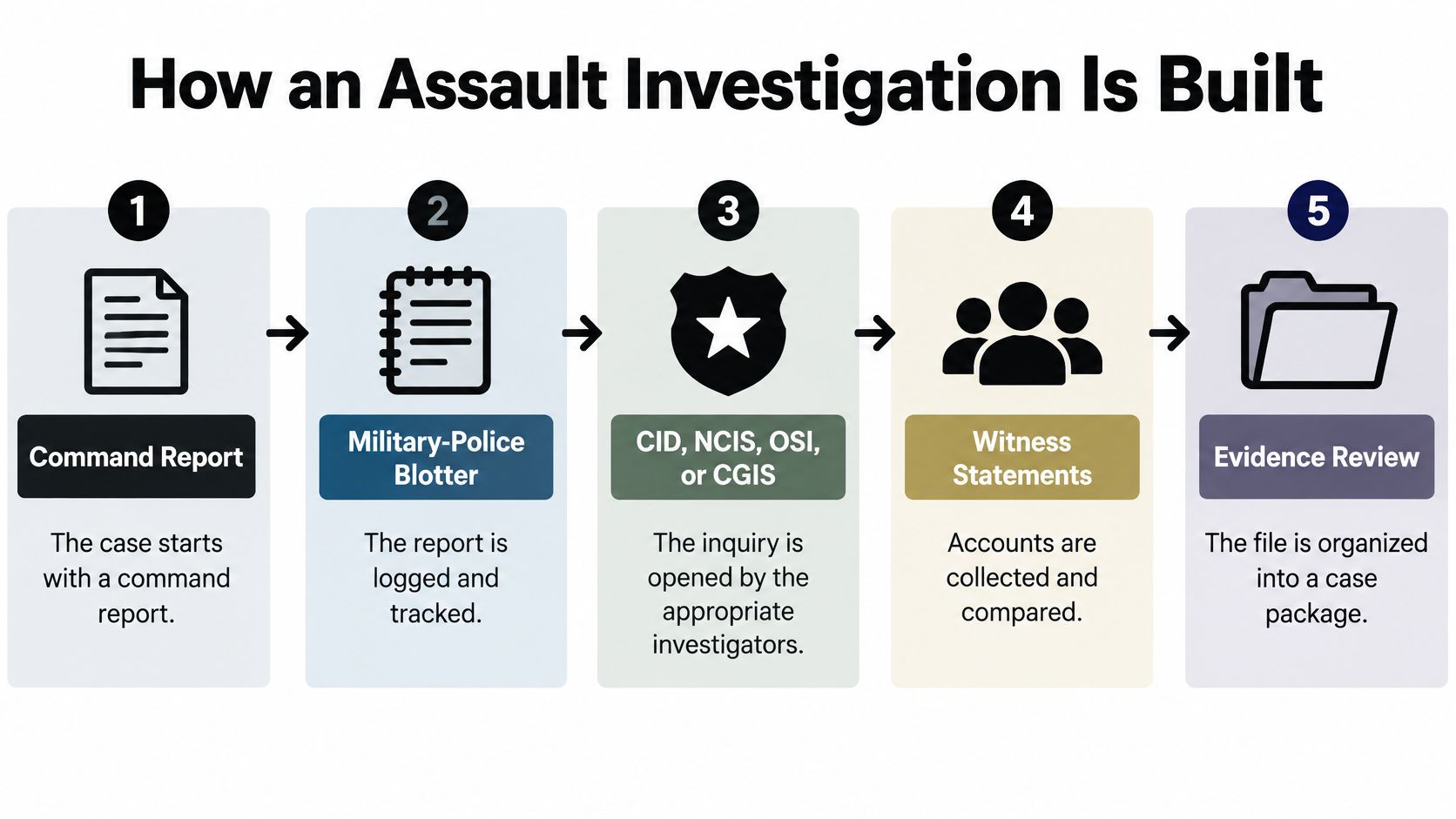
Don’t treat an investigator’s invitation to give your side as a confidential problem-solving session. CID, NCIS, OSI, or CGIS agents collect information that prosecutors and command may use against you. Their account of the incident isn’t a substitute for a defense investigation.
The graphic summarizes common investigative components, not a mandatory sequence in every case.
Follow the evidence from report to charging review
The initial report frames the allegation. A command report, military-police entry, or direct complaint may introduce a weapon, injury, or strangulation label before anyone tests it. Counsel should obtain the earliest available account and distinguish the speaker’s actual words from later summaries.
Investigators seek the member’s account. When applicable, Article 31(b) requires rights warnings during official questioning of a suspect. Don’t debate the warning’s technical application in the interview room. State that you want to remain silent and consult a lawyer, then stop discussing the incident.
Agents collect physical and digital material. Photographs, medical examinations, scene measurements, messages, doorbell recordings, and barracks cameras can support or contradict the account. A selected screenshot may omit the exchange that explains it. Counsel should pursue complete threads and preservation of recordings before routine deletion.
Witness accounts become the case narrative. Identify what each witness personally saw, their vantage point, lighting, intoxication, and discussions with others. Similar wording can reflect shared experience or later contamination. Don’t assume either without examining the interview history.
Command considers charges and referral. On a general court-martial path, an Article 32 preliminary hearing ordinarily follows preferral before referral, subject to applicable exceptions or waiver. It addresses preliminary charging issues and recommendations, not final guilt.
Look for mismatches, not magic defenses
A defense lawyer should compare the alleged sequence against independent anchors: timestamps, access records, emergency calls, photographs, and contemporaneous messages. A delayed report isn’t automatically false. A fresh photograph doesn’t establish who caused the injury.
The useful question is whether the evidence supports this account, this mechanism, and this charged theory. An intoxicated witness may still be credible, but counsel needs to know what that witness could perceive.
The practical discussion of defense work during the military investigation phase can help families understand why waiting for charges sacrifices preparation time.
Don’t consent to a phone download or provide a written narrative before legal advice. Declining consent doesn’t authorize resisting a lawful search, and preserving evidence means keeping material intact, not deleting embarrassing messages.
Four Assault Fact Patterns and the Real Issue
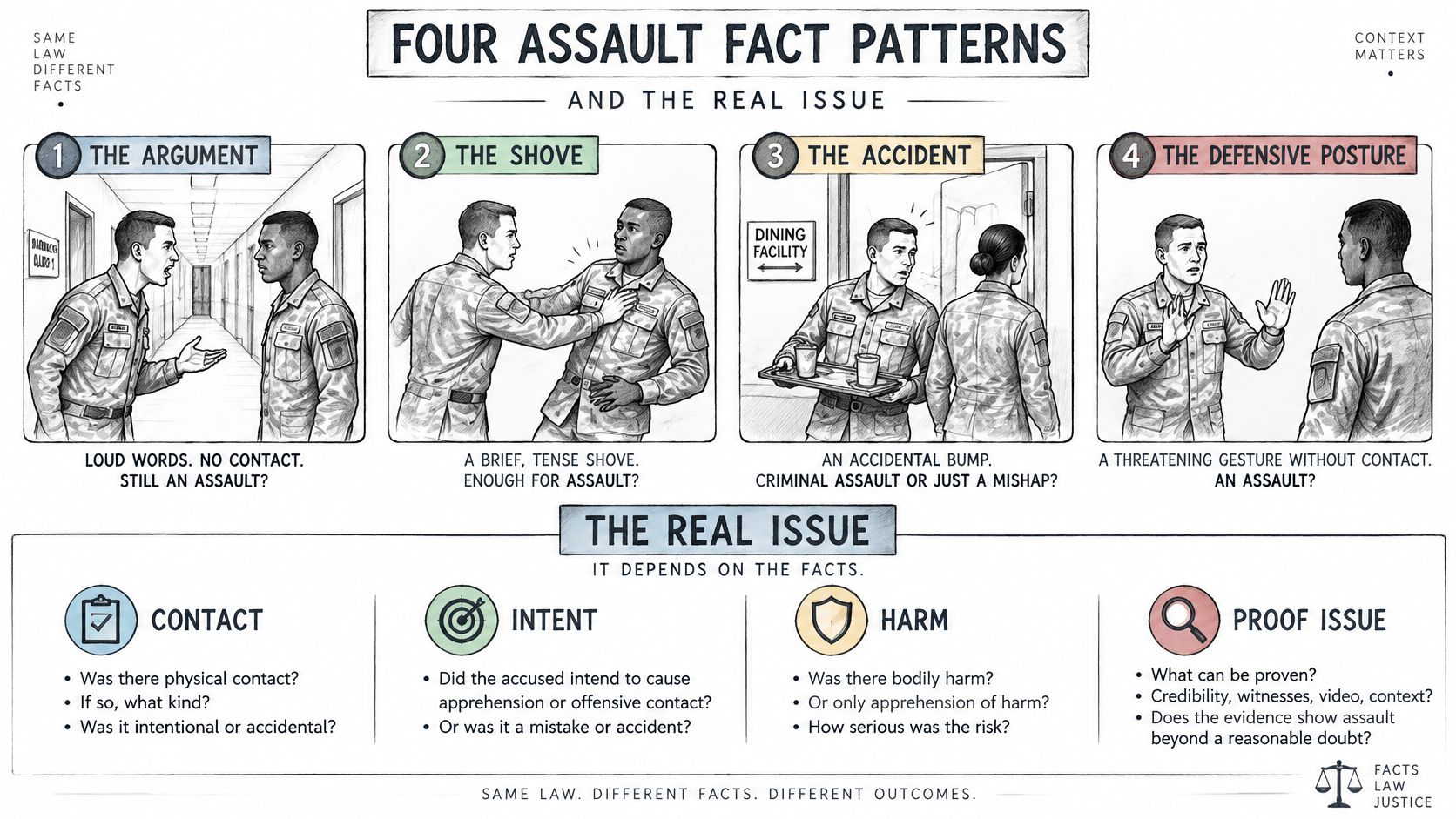
These hypotheticals illustrate charging problems. They aren’t reported cases, and none predicts an outcome.
The visual separates familiar incidents by the factual issue counsel must investigate.
A barracks shove followed by a fall
During an argument, a service member pushes another person, who falls against furniture. Counsel starts with the completed contact, its justification, and the injury evidence rather than accepting an aggravated label.
Who initiated physical force matters. Mutual participation doesn’t create a blanket consent defense, and a fall doesn’t automatically transform the floor into a dangerous weapon. The decisive issue is the legal character of the force used.
A bottle swung in a parking lot
Someone swings a bottle during a confrontation and misses or makes glancing contact. Prosecutors may pursue a dangerous-weapon theory, but counsel needs the trajectory, distance, grip, surrounding movements, and available video.
An asserted effort to escape needs factual support. Wanting to get away doesn’t necessarily negate an intent to cause bodily harm. The disputed issue is what the person intended and how the bottle was used.
A video can supplement the discussion, but it cannot evaluate the facts of an individual allegation.
A domestic argument described as choking
One person reports pressure around the neck. Counsel should obtain the earliest description, emergency-call account, medical findings, and any photographs rather than starting with a later investigator’s label.
Hand placement, pressure, duration, breathing, voice changes, and the witness’s actual observations deserve careful examination. The issue is the alleged mechanism, not whether someone used the word choke.
A grab characterized as attempted sexual violence
During an argument, one person grabs the other’s arm or clothing. Prosecutors interpret the act as the beginning of a sexual assault and consider a specified-intent charge or separate sexual-offense allegation.
Counsel examines statements, positioning, surrounding acts, and contemporaneous communications. Anger, a breakup, and an effort to prevent departure aren’t interchangeable with sexual intent, though any may supply context. The contested issue is the intent supported by the whole event.
For each scenario, assemble the earliest statement, medical record, and contemporaneous messages. Don’t ask witnesses to adopt your interpretation.
Mistakes That Hand Over the Case and How to Choose Counsel
Being innocent doesn’t make every response safe. A service member can create damaging evidence while trying to appear cooperative, reassure a spouse, or persuade command to move on.
Avoid preventable evidence problems
- Explaining intent without counsel. An improvised interview can supply the government’s clearest account of what you meant to do.
- Sending an apology. A message intended to calm the situation may be presented as an admission. Don’t contact the complainant to repair the case.
- Approving an unrestricted phone search. Consent can expose unrelated conversations and context agents didn’t previously possess. Get advice before deciding.
- Using friends as intermediaries. Asking someone to persuade the complainant to withdraw can create allegations of pressure or interference.
- Posting your version online. Comments, reactions, and deleted posts can become credibility evidence.
- Relying on command reassurance. A first sergeant’s confidence that matters will settle down isn’t a defense strategy or a charging guarantee.
- Assuming no serious injury means no case. That assumption ignores the actual theory prosecutors may pursue.
- Accepting a quick plea without consequence mapping. Require an explanation of administrative, clearance, firearm, and other applicable effects.
- Waiting for preferral. By then, recordings may be gone and witnesses may have discussed the incident extensively.
A defense lawyer can work with difficult facts. Unnecessary statements and destroyed evidence create additional problems.
Compare lawyers by their actual work
Detailed military defense counsel is provided without charge and can be excellent. That lawyer represents the accused, not the commander’s prosecution interests. Don’t mistake military status for disloyalty to the client.
Civilian court-martial attorneys are privately retained and can bring sustained practice experience, additional preparation capacity, and continuity. Those advantages must be verified in the individual lawyer, not assumed from a civilian business card.
Military detailed counsel and civilian counsel compared
| Factor | Detailed military counsel | Civilian court-martial counsel |
|---|---|---|
| Who pays | Provided at no charge to the member | Private fee paid by the member or family |
| Position | Serves inside the military justice system with defense obligations to the client | Outside the military chain of command and independent of the convening authority |
| How the case is staffed | Detailed representation, potentially alongside retained counsel | Retained for the matter and able to work beside detailed counsel |
| When the difference matters most | Early advice and representation within the assigned matter | Additional experience and resources for contested weapon, strangulation, or sexual-intent allegations |
Ask who will personally try the case, what contested assault experience they have, and how they investigate beyond the government’s file. Ask about current workload rather than assuming either lawyer has unlimited time.
Choose a UCMJ lawyer who can explain the proof problem plainly. No ethical lawyer can guarantee dismissal.
Questions Readers Search Before Their First Interview
Can I refuse to talk to CID?
Yes, you can invoke your right to remain silent when questioned as a suspect. State that you want counsel and won’t discuss the allegation, then stop volunteering information. The explanation of Article 31 rights provides useful context, but get individual advice about your situation.
What happens at an Article 32 hearing?
It’s a preliminary hearing, not the trial. A preliminary hearing officer considers matters including probable cause and makes recommendations. Counsel can examine available evidence and challenge weaknesses, but shouldn’t promise that every witness will appear or submit to questioning.
Will I go to jail for Article 128 UCMJ?
Confinement is possible, not automatic. A responsible assessment requires the exact specification, governing punishment provisions, forum, and evidence. Don’t mistake a statutory category for a prediction of the sentence.
Do I need a lawyer immediately?
Yes, seek advice before your first substantive statement. Early consultation allows counsel to address interviews, evidence preservation, search-consent requests, and command restrictions. You don’t need to wait until someone hands you charges.
Is an Article 15 a conviction?
No, nonjudicial punishment isn’t a federal criminal conviction. It can still produce serious career consequences. The ability to demand trial instead has exceptions, including vessel-related rules, so don’t accept or reject the proceeding without counsel evaluating the available choices.
Can the charge be reduced to a lesser offense?
Sometimes, through negotiation or an available lesser-offense finding. Reduction isn’t automatically a good deal, and not every proposed lesser offense is legally available. Ask counsel to compare the evidence, punishment, and collateral consequences of each proposed outcome before you authorize an agreement.
If You Are Under Investigation, Act Today
Don’t wait for a charge sheet to take an assault allegation seriously. If an agent calls, command issues a no-contact order, or your commander mentions disciplinary action, arrange legal advice before discussing the incident further.
Preserve messages, photographs, recordings, and documents exactly as they are. Follow lawful orders, don’t contact the complainant through another person, and don’t try to interview witnesses yourself. Write down where relevant evidence may exist so counsel can pursue it appropriately.
Your immediate task: Protect your ability to make informed decisions before you create another statement or authorize another search.
Families can help by organizing paperwork, arranging consultations, and reducing pressure on the service member to explain everything repeatedly. Don’t turn a family group chat into a running commentary on the allegation.
Contact military defense counsel today. Bring the allegation, alleged dates, orders, and any charge paperwork, and ask which Article 128 version and theory govern. Choose someone prepared to investigate and contest the actual case, then speak with that lawyer before answering another substantive question.