
Your spouse says the command wants character letters. A supervisor offers to write one, friends promise to send theirs, and the deadline is getting closer. It’s tempting to collect every kind word you can. Don’t. A military character reference is evidence, and evidence helps only when it addresses the decision in front of the reader.
A polished letter can support retention, a favorable service characterization, sentencing mitigation, or a record of rehabilitation. It can also do little, or even hurt, if the writer can’t explain what they personally observed. Before anyone drafts a word, identify the proceeding, the decision-maker, and the specific point the letter must prove.
Table of Contents
- Where a Character Reference Helps and Where It Stops
- Choosing Witnesses Who Can Actually Vouch for You
- Matching Your Letter to Separation, Court-Martial, and Reserve Cases
- Building and Submitting the Letter Step by Step
- Mistakes That Undermine an Otherwise Strong Reference
- How to Choose Civilian Military Defense Counsel
- Your Next Step Before the Deadline Passes
Where a Character Reference Helps and Where It Stops
A letter that calls someone a good Soldier, Sailor, Airman, Marine, or Guardian does not become admissible because the writer means well. At court-martial, the Military Rules of Evidence generally bar using a person’s character or a character trait to argue they acted consistently with that trait on a specific occasion. Rule 404 lets an accused offer evidence of a pertinent character trait, and Rule 405 generally limits proof of that trait to reputation or opinion testimony. Army evidence guidance on character and outside acts describes these limits and the consequences that follow.
Relevance decides whether the letter earns its place. An opinion about honesty can bear on a larceny allegation. An opinion about peacefulness can matter in an assault case. Praise like “one of the best people I’ve ever known” tells a panel nothing about how the accused relates to the charged conduct, however warm it sounds to the writer.
When general military praise misses the point
Army evidence guidance draws a hard line: general military character is not a pertinent trait for proving probable innocence in offenses under UCMJ Articles 120 through 123a, which cover major sexual, homicide, and property offenses. A strong performance record can still serve another purpose, such as sentencing mitigation or retention, but that use does not convert it into proof of innocence on the merits.
Admission carries a second risk. Once character evidence comes in, opposing counsel may cross-examine the witness about relevant specific instances of conduct. A writer offering a sweeping opinion without knowing the service member’s record invites questions about the basis for that opinion and about everything the writer never saw.
A tight letter tied to one decision usually does more work than a long, emotional one. Three paragraphs that name a trait, give a witnessed example, and state the limits of what the writer knows can carry real weight with a commander or a panel. Five pages of admiration get skimmed or set aside.
Before asking for a letter, ask counsel what issue the evidence is meant to address. If the answer is only “show what a good person they are,” the strategy needs work.
A character reference supports a focused argument. It cannot replace evidence about the alleged conduct, and treating it as a universal defense wastes the opportunity it was meant to serve.
Choosing Witnesses Who Can Actually Vouch for You
Choose writers by what they know, not by how much they care about you. A supervisor who observed your work, an instructor who saw your development, a peer who served alongside you, or a civilian authority who can describe your reliability may offer useful firsthand detail. A close friend may be sincere yet unable to say anything about military performance.
Use this filter before you ask anyone to write:
- Identify the relationship. Can the writer explain whether they supervised, worked alongside, trained, or otherwise observed the service member?
- Establish the period observed. Can they say when they knew the member and how regularly they interacted?
- Find specific examples. Can they describe a duty, decision, or incident they personally witnessed and explain its outcome?
- Test institutional credibility. Does the writer have a role that helps the decision-maker understand the service member’s conduct in the relevant setting?
- Check the limits of their knowledge. Can they be candid about what they haven’t seen, reviewed, or verified?
Army separation guidance allows a member to submit personal statements and statements from people they worked with or for, with emphasis on duty performance. The best candidates can speak to the exact issue being considered, whether that’s reliability, leadership, rehabilitation, or a contribution to the unit. Army guidance on administrative separations/7E6119820153B2DA85257BDB005EE8B2?opendocument) supports this focus on work-related firsthand accounts.
Don’t ask a witness to say you could never have committed the alleged conduct. That is a claim about an event they may not have witnessed, and it risks making their testimony sound like advocacy rather than observation. A writer can say what they saw in your behavior without claiming to know what happened elsewhere.
Nor should you collect a stack of nearly identical letters. Several accounts repeating “great person, outstanding service member” don’t become persuasive through repetition. A few independent writers with different firsthand perspectives can give the decision-maker a more credible picture.
Give each writer a fact outline, not a script. Ask them to describe their own observations, use their own words, and be accurate about what they can personally verify. Coordinated language can make independent accounts look managed.
Matching Your Letter to Separation, Court-Martial, and Reserve Cases
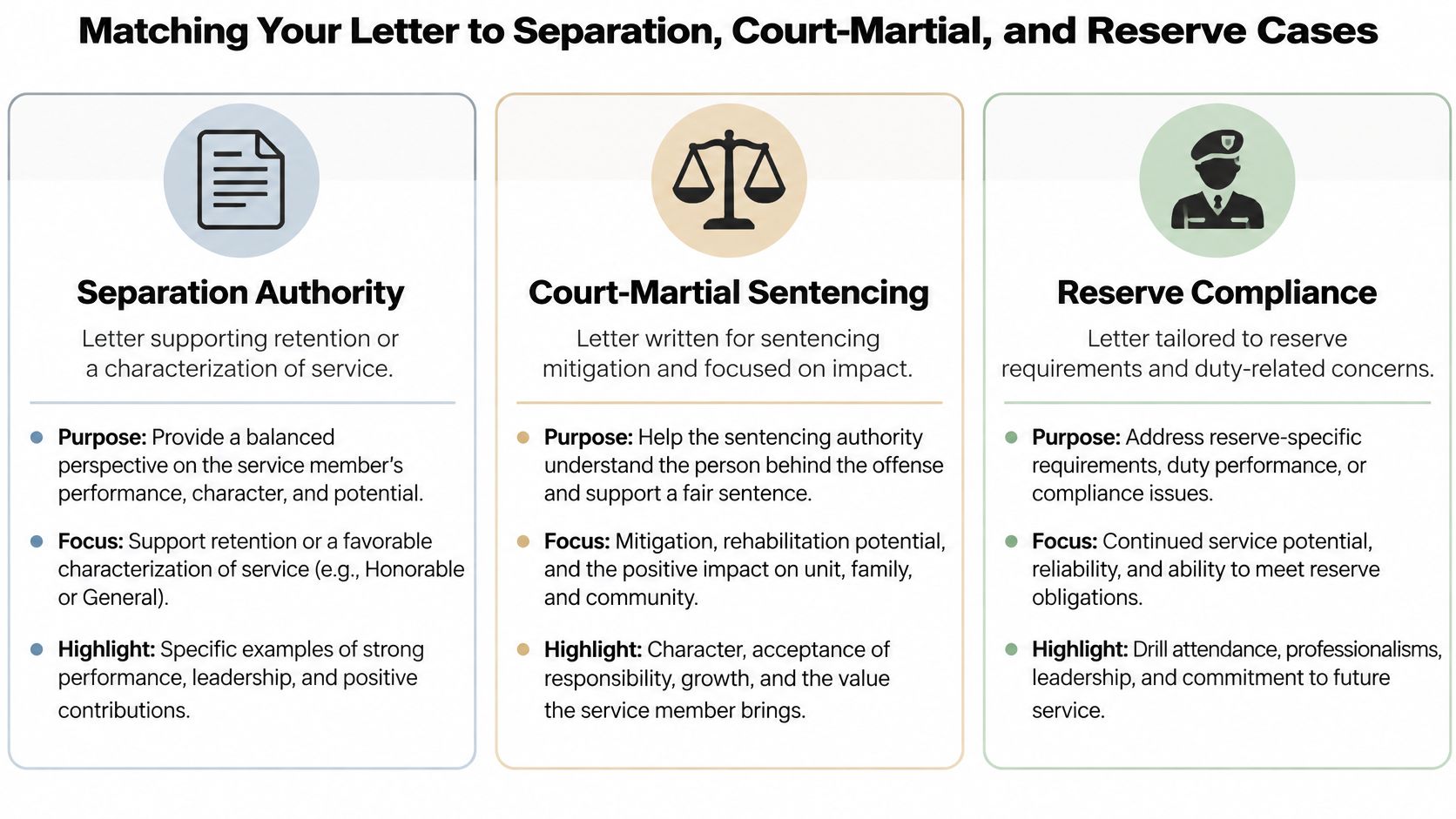
A staff sergeant facing an administrative separation board submits a long, emotional letter from his company commander. The board must weigh retention and characterization; the letter speaks to neither. Months later, the same letter goes to a court-martial panel at sentencing and misses again. Two proceedings, two wasted opportunities. A reference in any of these settings functions as evidence tied to a specific decision, and a short, candid page that answers the decision-maker’s actual question outperforms a long letter full of praise.
| Proceeding | What the decision-maker needs | Useful focus |
|---|---|---|
| Administrative separation | Whether retention or a particular service characterization is supported | Duty record, reliability, rehabilitation, and significant contributions |
| Court-martial sentencing | Evidence relevant to the sentence and the defense’s chosen mitigation theory | A trait the witness observed, favorable conduct, service record, or rehabilitation |
| Guard or Reserve participation | Evidence relevant to military obligations and the member’s record of compliance | Attendance, training, communication with the unit, and corrective action |
Separation and sentencing are different assignments
An administrative-separation letter should address the question in front of the authority: retention, a favorable characterization, or mitigation of the proposed basis. Enlisted and commissioned-officer separations run under separate DoD instructions, so a letter drafted for an enlisted case rarely translates to an officer’s. DoD Instruction 1332.14 supplies the enlisted framework.
Sentencing is a different problem. The panel already knows the findings; the question is what punishment fits. Counsel should pick character evidence for a defined purpose, such as rehabilitation, diminished culpability, continued service, or reintegration into civilian life. Sentencing authorities may weigh reputation, service record, favorable conduct, and bravery when the evidence is relevant and properly admitted, and the Court of Appeals for the Armed Forces has recognized that counsel may hold good-character witnesses for sentencing rather than the merits. The Court of Appeals for the Armed Forces digest on character evidence shows why timing and purpose matter.
A letter that recounts observed conduct without arguing or conceding anything gives counsel room to use it at either stage. A letter written as advocacy locks itself into one use, or none.
Reserve compliance needs military-specific facts
Guard and Reserve cases turn on participation, so writers should cover what they personally know about attendance, training, mobilization compliance, communication, and follow-through on unit obligations. DoD policy connects failure to meet Ready Reserve participation requirements with possible administrative-separation processing, and DoD Instruction 1215.13 on Ready Reserve participation governs that issue. Praise for a member’s civilian career or family life does not answer a question about military service.
Participation disputes often come down to records and what the member’s agreement required. If you are sorting through your own service paperwork before deciding what witnesses can verify, this overview of service credit terms and conditions explains how such terms are commonly documented. It is not a substitute for advice on your case.
No letter is a standalone defense in any of these settings. If a separation board is in your future, study how administrative separation boards work before your writers draft a word, and have counsel match each letter to the decision it must support.
Building and Submitting the Letter Step by Step
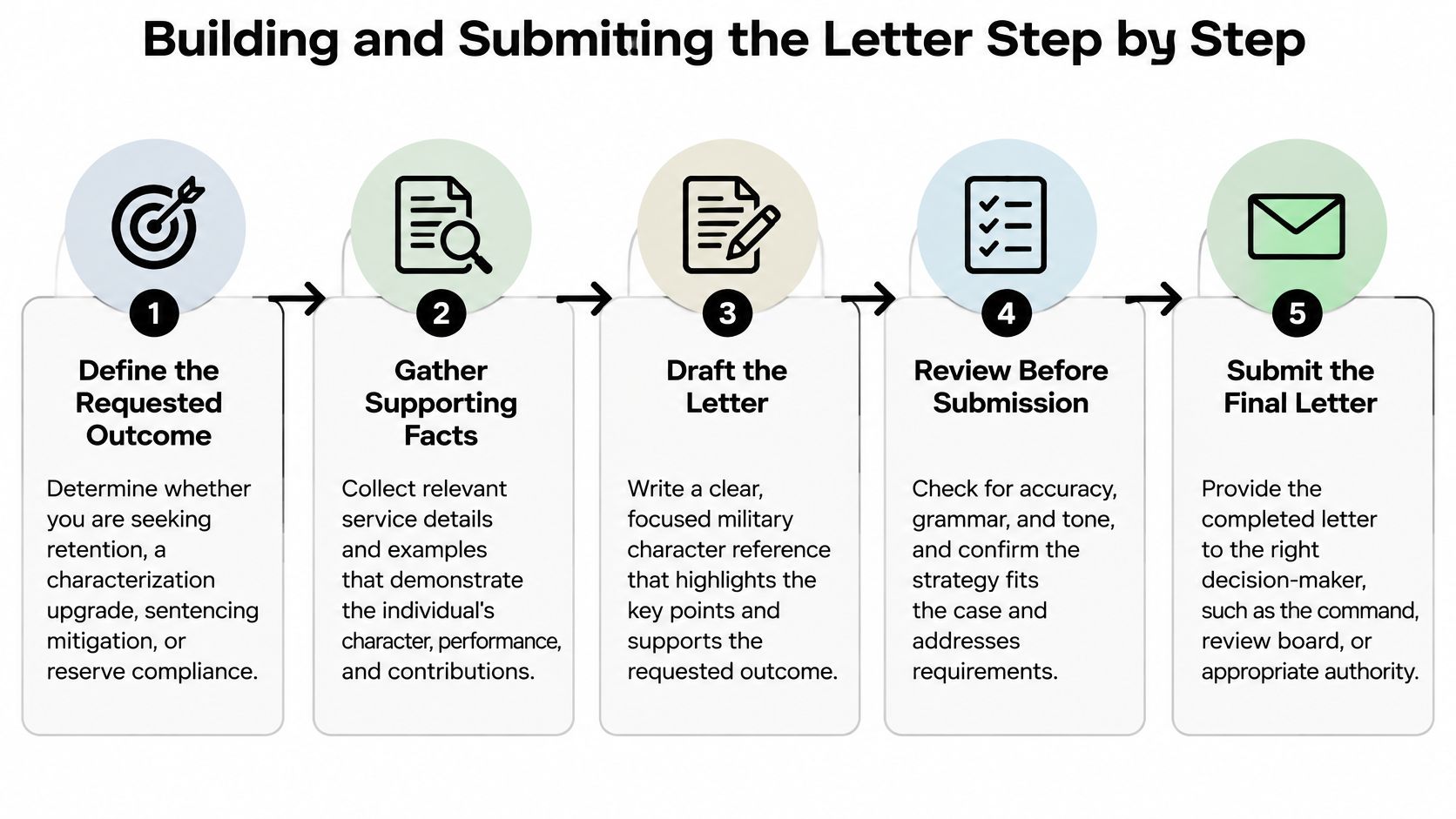
A letter should move from a clear objective to verified facts, then through legal review. Don’t ask writers to draft first and figure out the strategy afterward.
- Define the requested outcome. Decide whether the letter supports retention, a favorable characterization, sentencing mitigation, or a Reserve-compliance argument. Name the decision-maker and the issue they must decide.
- Build a dated chronology. Gather relevant service history, evaluations, awards, responsibilities, and any corrective action. The chronology helps identify what a writer can verify and where accounts may conflict with official records.
- Give witnesses a fact outline. List topics they can address, such as duties performed or an observed example of leadership. Don’t supply finished language. The writer’s independent account is more credible when it reflects their own knowledge and voice.
- Require concrete detail. Ask for the writer’s relationship to the member, the period observed, relevant dates, roles, and specific outcomes. A responsibility or performance example is more useful than a string of adjectives.
- Have counsel review the draft and submission plan. Check accuracy, consistency, privileged or sensitive information, retaliation concerns, and any sentence that could accidentally concede disputed misconduct. Confirm who should receive the letter and when.
The process also changes at sentencing. Counsel should distinguish reputation testimony from evidence of specific conduct, match each witness to a trait they directly observed, and decide whether a letter or live testimony better serves the strategy. A witness may be challenged about knowledge of the offense, bias, prior misconduct, or inconsistent evaluations. Make the decision with counsel before putting that witness in front of the fact-finder.
If you’re organizing a written response alongside character evidence, guidance on writing stronger GOMOR rebuttals can help you distinguish documented facts from unsupported argument. For clearer, more consistent written records, these suggestions to write clearer emails and documentation offer useful communication practices, but they don’t replace counsel’s review.
Mistakes That Undermine an Otherwise Strong Reference
A separation board president reads two letters about the same soldier. The first runs three pages, calls him the finest troop the writer ever served with, and insists the allegation must be a misunderstanding. The second fits on one page, describes two incidents the writer personally observed, and acknowledges the pending matter without claiming to resolve it. The short letter carries weight. The long one gets skimmed.
Emotion doesn’t add evidentiary value. Decision-makers need information they can test, and repeating “good person” or “deserves retention” hands them nothing firsthand to weigh against the allegation.
The same failure shows up when a writer declares the member innocent based on personal impressions alone. Someone who wasn’t present and hasn’t reviewed the relevant evidence can credibly describe the person they know. They can’t reliably decide what happened in an incident they never saw, and asserting it anyway invites the reader to discount everything else in the letter.
Where good intentions produce bad evidence
The recurring traps:
- Attacking the accuser or the investigators. Speculation about motives pulls attention away from the member’s record and damages the writer’s credibility.
- Describing records the writer never saw. Evaluations, allegations, and investigative findings shouldn’t be stated as fact without a sound basis.
- Sweeping assurances. “He could never do something like this” invites questions that expose how little the writer knows about the alleged conduct.
- Sensitive material. Classified information and protected medical details stay out of the letter unless counsel approves them.
- Empty endorsements. “She deserves another chance” substitutes a conclusion for the concrete example the decision-maker needs.
- Silence about the matter itself. A letter that praises the member while ignoring the proceedings reads as evasive. Any acknowledgment must be accurate and consistent with counsel’s strategy.
Once character evidence is admitted, cross-examination can test the basis for the writer’s opinion, so broad claims hand the opposing side room to question what the writer knows. A candid, limited letter gives the decision-maker something specific to assess and concedes nothing the writer can’t support.
How to Choose Civilian Military Defense Counsel
Have counsel review the reference strategy before witnesses sign. The wrong letter can expose a weakness, muddy a defense theory, or conflict with the official record. In a serious investigation, court-martial, or separation case, counsel should explain what each witness adds and how the statement fits the broader strategy.
Military-appointed counsel and civilian counsel serve different practical roles. Appointed counsel can provide representation within the military system. Civilian military defense lawyers can offer an independent perspective outside the chain of command, but experience varies. Don’t assume a civilian attorney’s general trial background means they know court-martial practice.
Compare experience and strategy, not slogans
Look for sustained military justice work, actual court-martial trial experience, and appellate experience relevant to the type of case. Ask whether the attorney has handled matters across service branches and whether they can explain how character evidence may be used at the merits stage, sentencing, or an administrative proceeding. You want a direct answer about risks, not a promise that a strong letter will fix the case.
Use these questions in consultations:
- What role should character references play in my case?
- Which witnesses have firsthand knowledge that matters to this decision?
- Could a proposed statement create an evidentiary or credibility problem?
- What experience do you have with the proceeding I’m facing?
- How will you communicate with me and review written submissions?
For more criteria to use when choosing a military defense lawyer, focus on what the attorney has handled and how clearly they explain your options.

Your Next Step Before the Deadline Passes
If you’re under investigation, facing an Article 15, preparing for a court-martial, or responding to a separation action, treat the reference as one part of a time-sensitive legal strategy. A commander, separation authority, or sentencing authority may be making decisions about your career and record while you’re still trying to understand the process. Early advice gives you more room to make deliberate choices.
This week, take practical steps:
- Write a dated chronology. Record your service history, relevant events, and corrective action. Keep facts separate from assumptions.
- Identify firsthand witnesses. List two or three people who can describe your duty performance or conduct from personal observation. Don’t ask them to make promises about an outcome.
- Preserve your records. Keep relevant evaluations, awards, communications, and notices. Don’t alter, delete, or circulate material without getting legal advice.
- Limit discussion of the case. Don’t try to coordinate accounts or explain the allegations to people who aren’t part of privileged legal advice. Even a well-meant conversation can complicate the record.
- Arrange legal consultations before submitting letters. Compare experienced civilian military defense counsel and ask how each would use, limit, or sequence character evidence.
Your reference should support a clearly defined decision, not try to replace a defense. Don’t send a packet to command just because the deadline is close; get counsel to review the purpose, the witnesses, and the wording first. If you’re facing a court-martial, an investigation, or a separation board, contact experienced military defense counsel now and schedule consultations with at least two attorneys before anyone submits a letter.