
A guilty finding can make a service member feel that the case is finished. It isn’t. The judgment, appellate notice, trial record, and filing deadlines determine what can still be challenged, and waiting for paperwork to move through the system can put those options at risk.
The UCMJ appeals process isn’t one automatic trip up a court ladder. Different courts have different authority, and administrative remedies such as clemency or a discharge upgrade aren’t substitutes for a direct appeal. The first practical move is to get the judgment and appellate notice, confirm the relevant dates, and have counsel identify the route that applies.
Table of Contents
- Why the UCMJ Appeals Process Starts Before You Expect It
- How the Military Appellate Courts Are Structured
- Filing Deadlines and Requirements at Each Appellate Level
- What Each Appellate Court Can and Cannot Do
- Common Mistakes That End Appeals Before They Begin
- Choosing Appellate Counsel and Understanding the Record
- Clemency, Discharge Upgrades, and Records Correction After Appeal
Why the UCMJ Appeals Process Starts Before You Expect It
A service member hears the sentence announced and starts thinking about confinement, family, and what happens to a career. The appellate work may feel like a later problem. In reality, the post-trial record and notice of appellate rights shape what happens next, and the first task is to identify the formal dates and preserve the trial record.
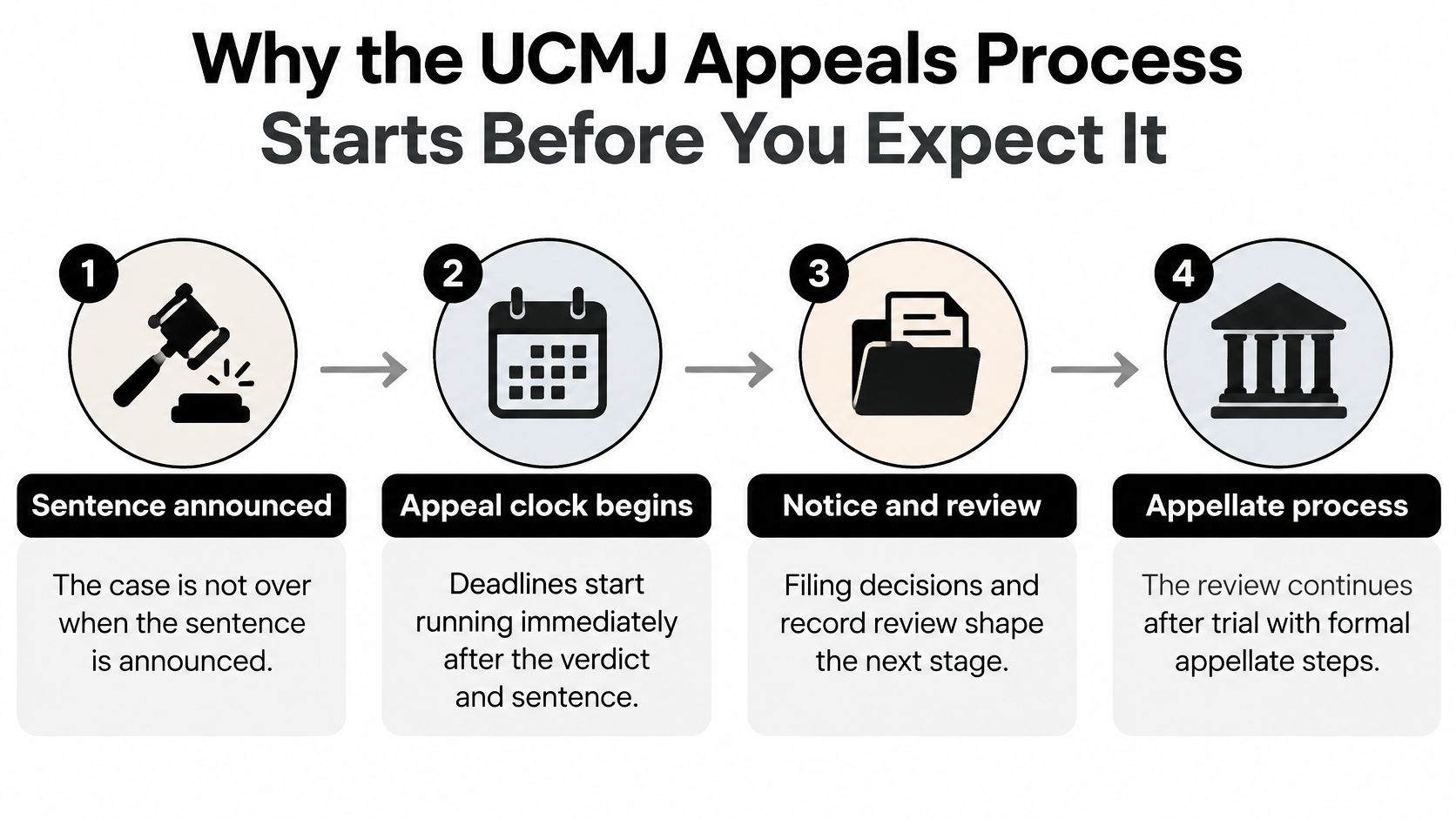
For a general or special court-martial conviction, Article 66 review is available regardless of the sentence imposed. The appeal is filed after the accused receives the formal notice of appellate rights under Article 65(c). Under the current timing rule, a filing is timely if made by the later of the 90th day after that notice or a deadline set by the applicable Court of Criminal Appeals (CCA) through rule or order. The notice date, not the day the judge announced sentence, is what matters for that calculation. (Service appellate review guidance)
Don’t assume that waiting for administrative processing is harmless. Confirm the judgment, the notice date, the status of the record, and the filing requirements of the service court. The court-martial basics guide can help families understand the trial process, but an appeal requires counsel to work from the actual record and dates in the case.
A direct appeal is also different from clemency, a discharge upgrade, or a correction-board application. Those routes have distinct decision-makers and purposes; they don’t automatically preserve a challenge to the conviction. Treat the immediate post-trial period as a time to identify the right remedy, not as a waiting period before the case becomes urgent.
How the Military Appellate Courts Are Structured
The military appellate system has multiple levels, and each level has a different job. The service Court of Criminal Appeals is generally the first principal appellate forum. The U.S. Court of Appeals for the Armed Forces (CAAF) is the next level, but it doesn’t function as an automatic second trial appeal.
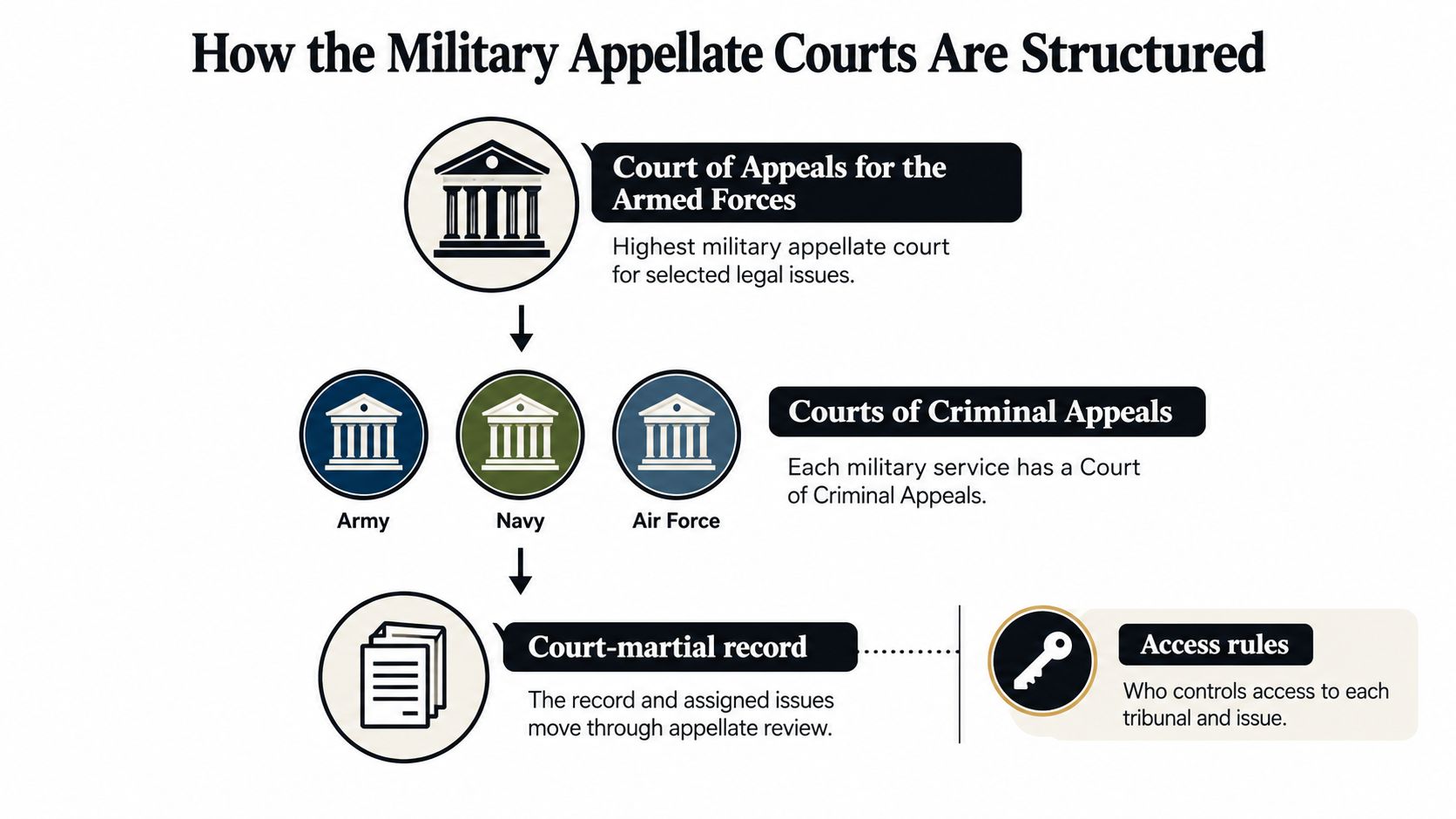
The service courts review the trial record
Under Articles 66 and 67, each military service has a CCA staffed by appellate military judges. These courts conduct the principal review of qualifying convictions. They consider legal issues and, within their authority, whether the evidence is factually sufficient. This is why the service-level appeal is usually the central opportunity to challenge factual sufficiency.
CAAF selects cases for narrower review
CAAF is a civilian appellate court. Its judges are appointed by the President and confirmed by the Senate. Its jurisdiction is narrower than the service courts’: it reviews qualifying death-penalty cases, cases a service Judge Advocate General directs to it, and cases it accepts on an accused’s petition.
The Supreme Court has described CAAF review as more limited than CCA review. When competent evidence supports each offense beyond a reasonable doubt, CAAF generally doesn’t reweigh the facts. (Government Accountability Office report discussing the appellate structure)
The Supreme Court sits beyond CAAF, but it isn’t a routine next step after every military appeal. The available route depends on the case’s procedural history and the statutory gateway. Understanding which court can hear which issue is more useful than assuming every adverse ruling can be appealed again.
The video below provides a visual overview of the courts and their roles.
Filing Deadlines and Requirements at Each Appellate Level
Appellate rights depend on paperwork and exact dates. Counsel should build a written deadline calendar from the actual notice, judgment, and appellate decision, then confirm it against the current rules of the court. Do not calculate a deadline from memory or from the date that feels most intuitive.
Article 66 review applies to general and special court-martial convictions. Automatic CCA review applies when the sentence includes death, dismissal, a punitive discharge, or confinement of two years or more. Even when review isn’t automatic, the accused may still file an Article 66 appeal. The applicable time limit runs from the Article 65(c) notice, subject to the later deadline allowed by the service court’s rule or order. (Court of Appeals for the Armed Forces brochure)
After a CCA decision, an Article 67 petition to CAAF is generally due within 60 days of the earlier of notification of the decision or mailing of the decision. The petition needs to establish jurisdiction, identify specific legal errors, and show good cause for discretionary review. Filing by itself doesn’t mean CAAF will hear the case.
Compare the routes before choosing one
| Route | Who may file | Deadline trigger | Deadline |
|---|---|---|---|
| Article 66 appeal to the CCA | Accused, with automatic review for specified sentences | Notice of appellate rights under Article 65(c) | Later of the 90th day after notice or the applicable CCA rule or order deadline |
| Article 67 petition to CAAF | Accused may petition; specified cases receive mandatory review | Earlier of notification of the CCA decision or mailing of the decision | Generally 60 days |
| Article 69 application to the Judge Advocate General | Accused | Depends on court-martial type and applicable review milestone | Generally one year, with a good-cause extension subject to an outer limit generally of three years |
Article 69 is a separate Judge Advocate General review mechanism, not an unlimited replacement for a missed direct appeal. For a summary court-martial, the usual deadline is one year after Article 64 review is complete. For a general or special court-martial, it’s generally one year after the end of the 90-day period beginning with Article 65(c) notice; if appellate review was waived or withdrawn before notice, the period instead runs from entry of judgment. The Judge Advocate General may extend the period for good cause, subject to the generally applicable three-year outer limit. (Article 69 statute)
For general court deadlines, a practical system for tracking court-ordered case deadlines can help organize dates and filings. It doesn’t replace checking the controlling military appellate rules or getting case-specific legal advice.
What Each Appellate Court Can and Cannot Do
A strong appeal puts the right argument in the right court. A factual-sufficiency challenge belongs principally at the service CCA, where the court reviews the trial record under Article 66. CAAF is not a place to re-present every disputed fact and ask for a fresh verdict.
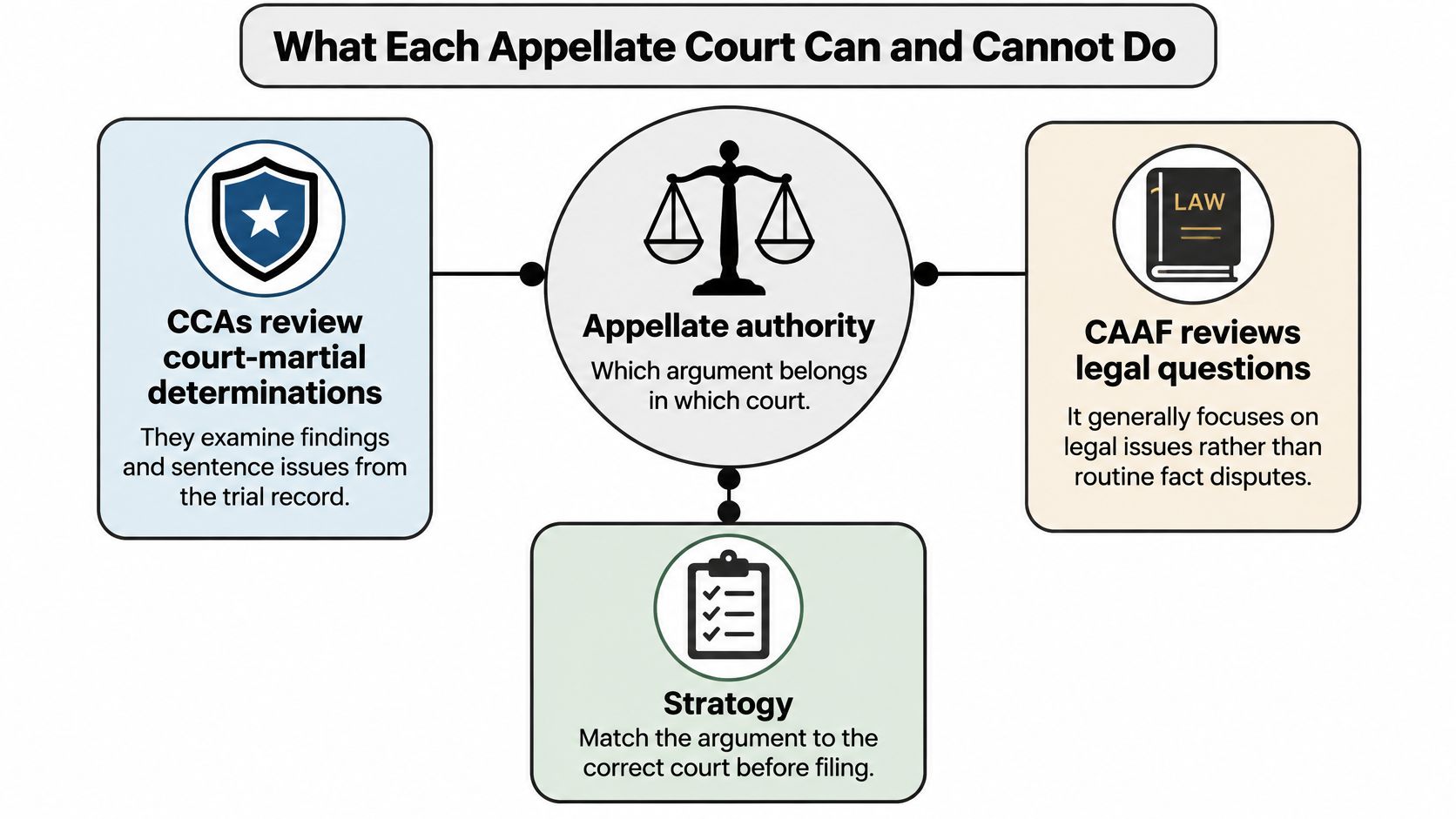
Match the claim to the tribunal
At the CCA, counsel can examine legal error, factual sufficiency, and sentence appropriateness. A factual challenge needs to engage with the evidence in the record: what the witnesses said, what the exhibits establish, and whether the findings withstand the court’s review. Merely asserting that the panel should have believed a different witness is not a developed appellate argument.
CAAF focuses more heavily on legal questions and selected cases. An accused may petition, but review is discretionary and requires good cause; at least two judges must vote to grant review. The government can seek review through different procedures, including certification by a Judge Advocate General, but it doesn’t petition for a grant of review in the same way as the accused.
Practical rule: Build the issue where the record is made, then frame it for the court with authority to decide it.
Sort potential claims before filing. A preserved legal error may be suited to appellate briefing. An ineffective-assistance claim may depend on evidence outside the trial record and may require a different procedural approach. An extraordinary writ request has its own purpose and isn’t a substitute for an ordinary appeal.
The Supreme Court gateway is limited. Direct review generally concerns cases CAAF reviewed or cases in which CAAF granted some relief; a CAAF denial generally doesn’t itself create direct Supreme Court jurisdiction. (Congressional Research Service overview of military appellate review)
For CAAF, the practical sequence is to confirm Article 67 jurisdiction, select a reviewable issue such as an unresolved legal question or significant procedural error, file within the deadline, provide the required supplement, and brief only issues the court accepts. In government Article 62 appeals, deadlines can be shorter. Current CAAF rules generally give an appellee 14 days to answer a supplement and allow seven days for a reply. (CAAF Rules of Practice and Procedure)
Common Mistakes That End Appeals Before They Begin
Appeals can be lost through avoidable deadline and filing errors. The most dangerous mistake is treating a legal deadline as flexible because a family is waiting for a record, a command update, or a final administrative decision.
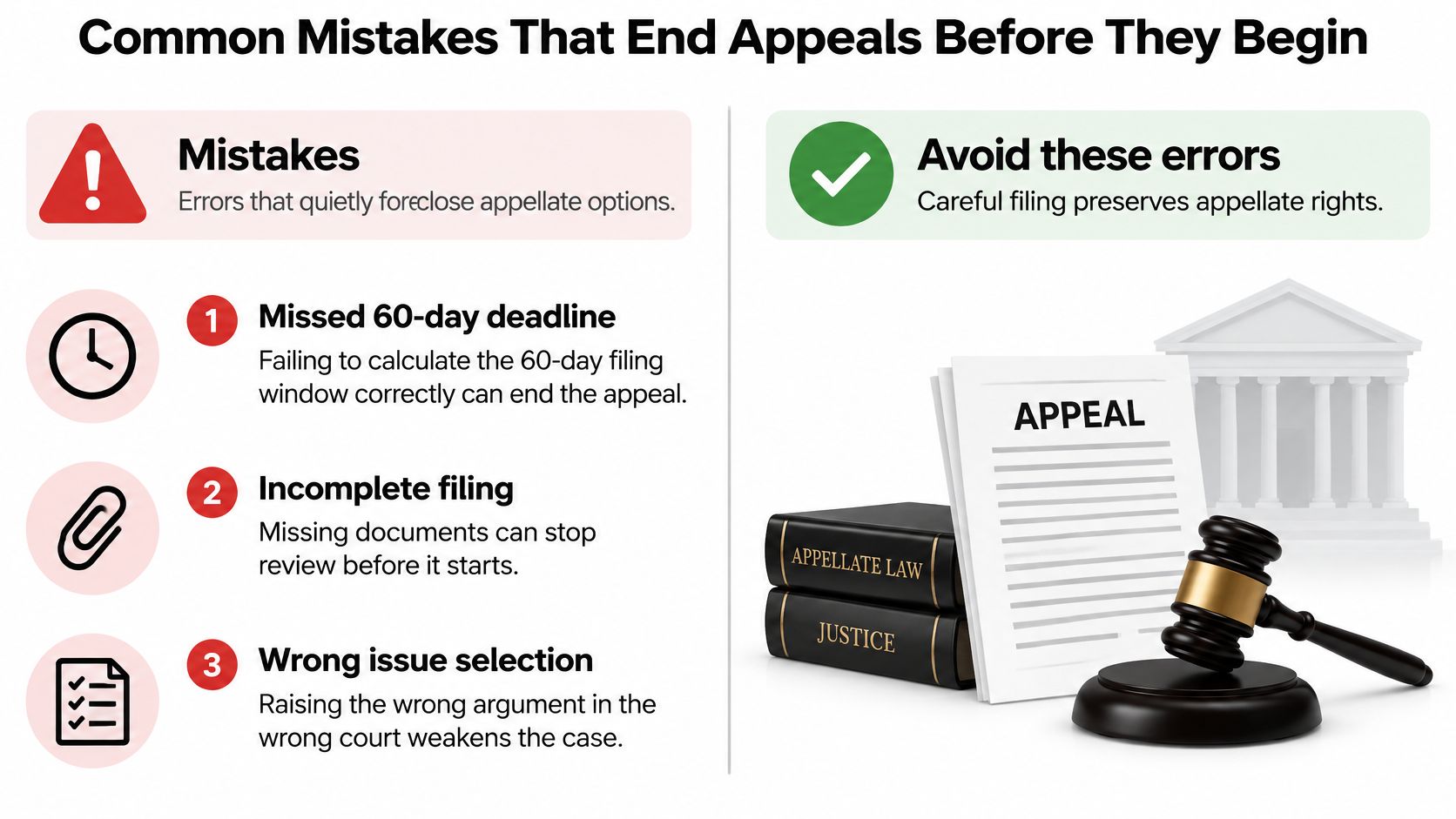
- Starting the CAAF clock from the wrong event: Track both notification of the CCA decision and mailing. Have counsel document the controlling date and deadline.
- Filing a bare petition: A petition must satisfy the court’s rules and present specific legal errors with the required supporting supplement and argument.
- Assuming a lighter sentence means no review: General and special court-martial convictions remain reviewable under Article 66 even when the sentence doesn’t trigger automatic review.
- Waiting for administrative processing: Confirm the Article 65(c) notice and service-court requirements instead of guessing when the clock starts.
- Using Article 69 as a fallback without checking its limits: It has its own eligibility, timing, and scope. It isn’t an unlimited substitute for a missed Article 66 or Article 67 route.
- Confusing appeal with clemency or discharge relief: Those remedies address different questions and don’t necessarily challenge the conviction in the same way.
Historical Article 15 figures shouldn’t be mistaken for court-martial appeal outcomes. A Government Accountability Office review of 1,117 Article 15 nonjudicial-punishment cases found that 7% of service members appealed and fewer than one-third of those appeals achieved some success. That review concerns NJP, not courts-martial, so it provides no court-martial appellate success rate. (Supreme Court materials discussing the historical GAO review)
Keep the record intact. Preserve objections and rulings, obtain the complete record, distinguish factual claims from legal errors, and verify current filing rules before submitting anything.
Choosing Appellate Counsel and Understanding the Record
The record is the foundation of most direct appeals. Counsel must review what happened at trial, identify preserved issues, and determine whether the record supports a claim of error and prejudice. An appellate court generally decides from the established record; it doesn’t conduct a new trial to fill evidentiary gaps.
Congress enacted a change requiring a copy of the record of trial to be provided to appellate defense counsel. That counsel must review the case and represent the accused before the CCA upon request. The provision took effect 180 days after enactment, so implementation and transition rules matter when a trial or record spans the effective date. The statutory change creates access to counsel, not a guarantee of success. (Enacted appellate-counsel provision)
Compare counsel by the work they will do
| Consideration | Military-appointed appellate counsel | Civilian appellate counsel |
|---|---|---|
| Record review | Ask who will review the record and how the review will be documented | Ask the same questions, including who will personally handle the file |
| Issue selection | Confirm how counsel will distinguish factual-sufficiency arguments from legal claims | Look for a clear explanation of which issues fit the reviewing court |
| Independence | Discuss whether counsel can raise a claim involving trial representation | Ask directly about conflicts and how a potential ineffective-assistance claim would be handled |
| Coordination | Confirm how trial counsel’s notes and preserved objections will be gathered | Confirm who will obtain and organize the complete record |
Military-appointed counsel may provide representation under the applicable system, while civilian counsel may offer an additional, independent perspective. Neither label proves the quality of the work. Ask about appellate experience, familiarity with the relevant service court, record-review methods, and how counsel handles claims that require evidence outside the trial record.
Ask for a written plan: It should identify the record being reviewed, possible issues, deadlines, and the steps counsel will take if the record reveals a problem.
A directory can help families compare attorneys, but it’s only a starting point. The guide to selecting a military defense lawyer offers questions to consider when evaluating counsel. Speak with more than one attorney where possible, and make the choice based on the case, the proposed strategy, and communication.
Clemency, Discharge Upgrades, and Records Correction After Appeal
Direct appellate review, clemency, discharge upgrades, and records correction are different processes. Each has its own decision-maker, standards, and available remedies. A request to change a discharge or correct a record doesn’t automatically reopen a court-martial conviction.
Article 76 generally makes a court-martial decision final after authorized review is complete, though limited collateral challenges may remain. In United States v. Denedo, the Supreme Court discussed the relationship between the direct-review framework under Articles 66 and 67 and Article 76, including the possibility of a collateral appeal during a two-year period after final judgment.
Article 69 is a separate review route with its own deadlines and limited scope, as addressed above. For summary court-martial cases, the Judge Advocate General may modify or set aside findings and sentence. For general or special court-martial cases, the Judge Advocate General may order Article 66 review. Don’t wait until the outer limit to start assessing eligibility; an extension requires good cause and is discretionary.
Clemency asks an authorized decision-maker to grant relief. A discharge upgrade or records-correction request focuses on administrative records and the applicable board’s authority. Those options may matter to Guard, Reserve, and separated service members, but leaving active duty doesn’t itself answer whether a particular direct appeal or administrative remedy remains available. For background on one distinct administrative route, see this guide to upgrading a military discharge.
If you’ve been convicted, contact appellate counsel now. Get the judgment, notice of appellate rights, and CCA decision if one exists, then have counsel calculate every deadline in writing. Don’t assume clemency, a discharge review, or a records application will preserve a missed appeal. Your freedom, career, and reputation may depend on acting before the available route closes.