
OSI calls while you’re at work and asks you to come in to clear something up. Your First Sergeant wants to see you, but nobody will explain why. Before you decide what to say, recognize the problem: you may be making defense decisions without knowing the allegation, the evidence, or who controls what happens next.
Table of Contents
- When an Airman First Realizes the System Is Moving Against Them
- The Three Types of Court-Martial in the Air Force
- How a Court-Martial Case Actually Moves Through the System
- The Office of Special Trial Counsel and Why It Changes the Timeline
- Rights of the Accused and What They Mean Tactically
- The Mistakes That Quietly Destroy Air Force Court-Martial Cases
- Why Experienced Civilian Military Defense Counsel Changes the Outcome
- What to Do in the Next 72 Hours and Beyond
When an Airman First Realizes the System Is Moving Against Them
An interview request isn’t an opportunity to improvise your defense. It’s a reason to get legal advice before you give an account investigators can compare against messages, witness statements, and records you haven’t seen.
An Air Force court-martial can threaten your freedom, pay, rank, and continued service. An official Air Force explanation of court-martial consequences identifies confinement, forfeitures, reduction in rank, and legally authorized punitive discharges among the possible punishments. Clearance and future-employment concerns also belong in your defense planning, not in an afterthought after trial.
Separate orders from investigative questions
A direction to report somewhere and a request to explain suspected misconduct aren’t the same thing. Don’t ignore an order, but don’t assume an order to appear answers whether you must discuss an allegation. Have defense counsel clarify the distinction.
Start by recording what happened:
- Identify the contact. Save the caller’s name, office, message, and requested meeting time.
- Preserve the paperwork. Keep interview notices, restrictions, administrative documents, and relevant communications.
- Get advice before responding substantively. Ask counsel what you must comply with and what decisions remain yours.
Practical rule: Be professional with investigators and command. Being cooperative about scheduling doesn’t require volunteering your version of events.
Investigators gather evidence for a case. They aren’t your confidential advisers, and a reassuring tone doesn’t change their role. Likewise, a commander who wants the matter resolved may have priorities different from yours.
The useful question isn’t whether you can explain everything convincingly today. It’s whether counsel can identify missing evidence, preserve favorable records, and address the allegation before the prosecution’s account hardens. Understanding how defense counsel can intervene during a military investigation helps you evaluate that work.
The Three Types of Court-Martial in the Air Force
Summary, special, and general courts-martial aren’t interchangeable. The forum affects punishment authority, procedure, and the decisions your lawyer must prepare you to make.
The comparison below is a broad orientation. Have counsel verify its punishment and panel descriptions against current law before relying on them, and don’t treat a summary court-martial as an Article 15 appeal.
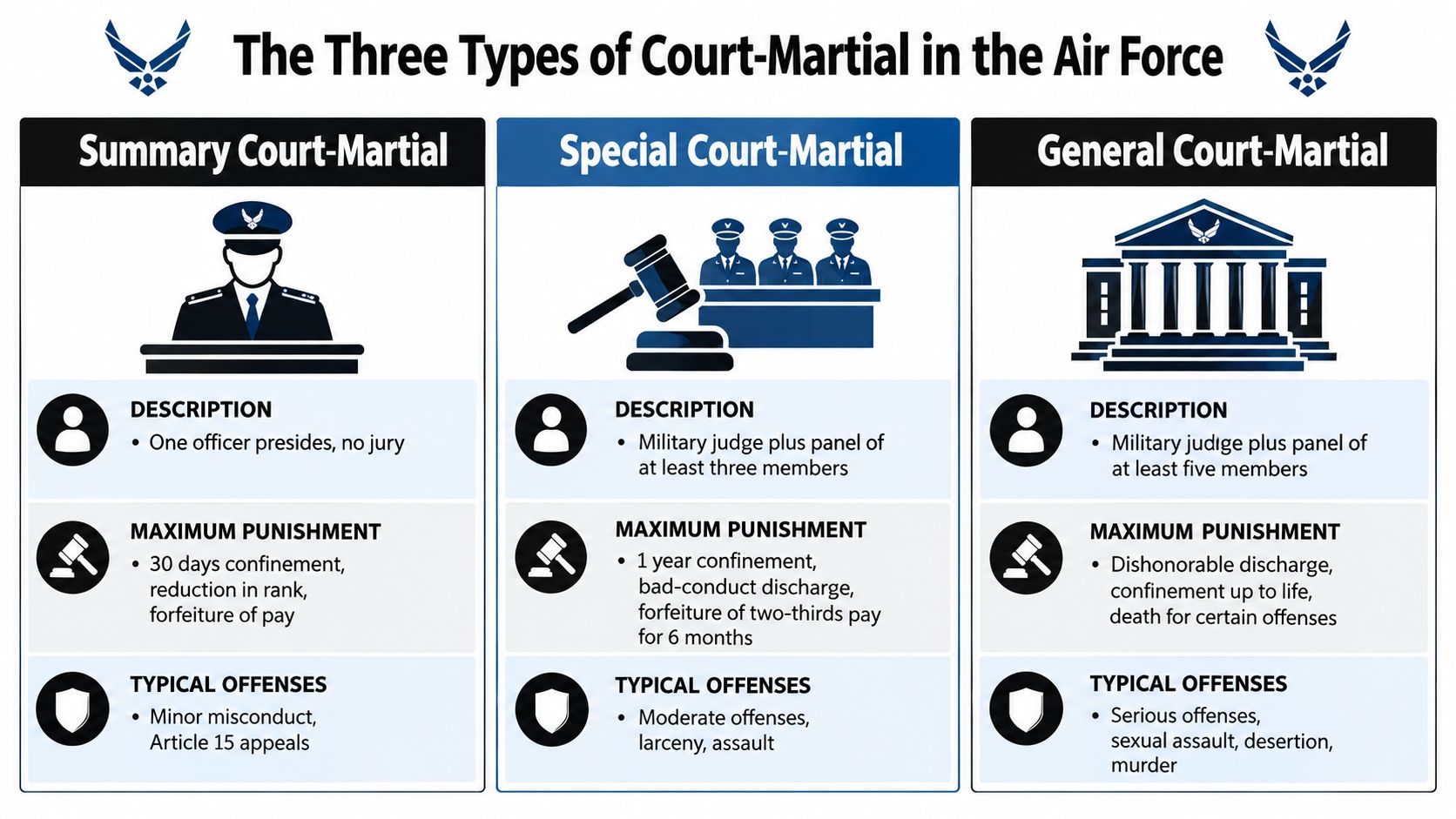
Identify the proceeding before evaluating the offer
| Proceeding | Practical distinction | Defense priority |
|---|---|---|
| Summary court-martial | A streamlined proceeding with more limited punishment authority than higher-level courts | Evaluate the available choices, evidence, and career consequences |
| Special court-martial | A criminal trial forum whose exposure depends on the particular form of proceeding | Confirm precisely what punishment the referred forum authorizes |
| General court-martial | The forum carrying the greatest punishment authority for serious offenses | Analyze every charged element, sentencing exposure, and litigation option |
Don’t accept a generic maximum-punishment description. Ask for a written exposure analysis tied to your charges, the applicable law, and the actual forum. Counsel should distinguish the legal ceiling from a realistic assessment and from any negotiated limitation.
Historically, special courts-martial handled much of the Air Force’s trial workload. In the reporting period July 1, 1969, through June 30, 1970, they accounted for 1,905 of 2,600 cases, approximately 73.3%, according to the military appellate court’s annual report. That history explains why “court-martial” alone tells you too little.
Compare punishment with career risk
Article 15 nonjudicial punishment isn’t a court-martial. Administrative separation isn’t a criminal trial. But neither should be dismissed as harmless because it avoids a general court-martial.
Department of the Air Force FY2025 reporting lists 137 general courts-martial, 119 bad-conduct-discharge special courts-martial, 7 military-judge-alone special courts, and 51 summary courts, demonstrating the range of proceedings counsel must distinguish (Department of Defense military justice report).
The strategic comparison must include rank, pay, characterization of service, clearance eligibility, and review options. A lower-level disposition may reduce criminal exposure without resolving every professional consequence.
How a Court-Martial Case Actually Moves Through the System
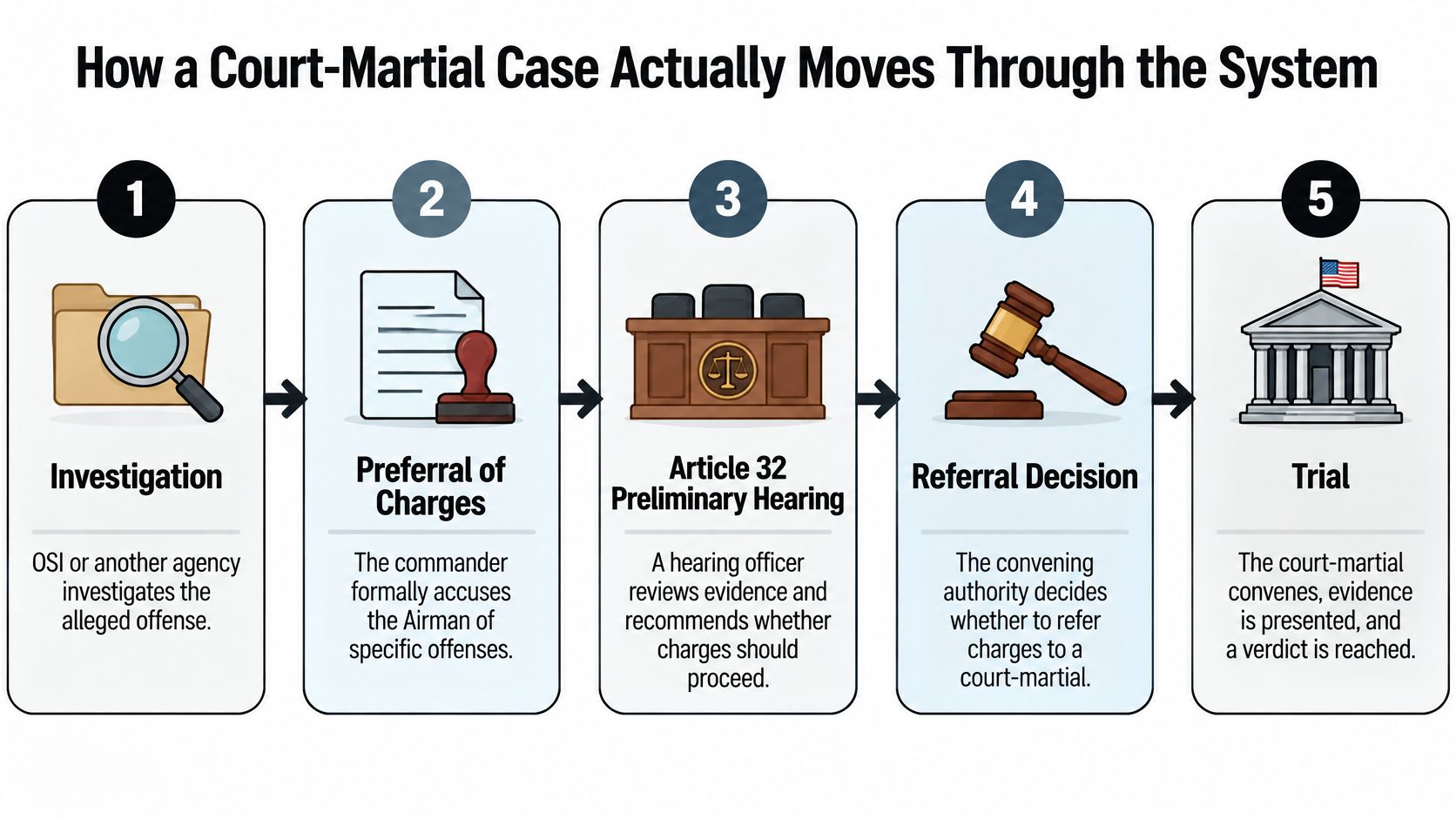
An Air Force court-martial isn’t a single event. Counsel must identify the current stage, the next decision-maker, and what can still be changed.
This flowchart shows the broad sequence, but its command-centered referral description needs the OSTC qualification discussed below.
Before the case reaches a courtroom
- Investigation. OSI or another investigating organization gathers statements and records. Defense work should test the collection process, locate overlooked witnesses, and preserve material that may disappear.
- Preferral. Charges formally identify the alleged offenses. Counsel should compare the specifications with the underlying evidence rather than assume the government’s wording accurately describes what happened.
- Article 32 proceedings where applicable. Prepare around the issues that can affect the case, including evidentiary weaknesses and the basis for proceeding. Do not treat the preliminary hearing as either a guaranteed dismissal opportunity or a meaningless appointment.
- Referral. The authorized decision-maker sends charges to a particular court-martial. Defense submissions should address an identified legal or factual weakness, not ask for sympathy.
Preferral is an accusation. Referral sends the case to trial. Neither is a conviction. Depending on the case, counsel may pursue a different disposition, challenge legal defects, or negotiate an agreement. No lawyer should promise that a persuasive submission will stop referral.
After referral
Arraignment and motions require decisions about pleas, evidentiary disputes, discovery, and available forum choices. A suppression motion needs a legal basis and supporting facts. A judge-alone strategy needs more justification than the belief that a judge will be less emotional.
At trial, the defense should connect witness examination and exhibits to the charged elements. If there’s a conviction, sentencing needs a separately prepared presentation addressing the person, the offense, mitigation, and the government’s aggravation evidence.
The following video provides additional context for the court-martial process.
There isn’t a responsible universal timetable for these stages. Digital examination, witness availability, discovery disputes, and litigation can affect scheduling. Ask your lawyer for the next event, its deadline, the outstanding evidence, and the decision it requires, rather than an unsupported prediction about when everything will end.
The Office of Special Trial Counsel and Why It Changes the Timeline
Command reassurance doesn’t resolve a case controlled by the Office of Special Trial Counsel. Your lawyer must establish whether OSTC controls the alleged offense before deciding whom to approach and what disposition to request.
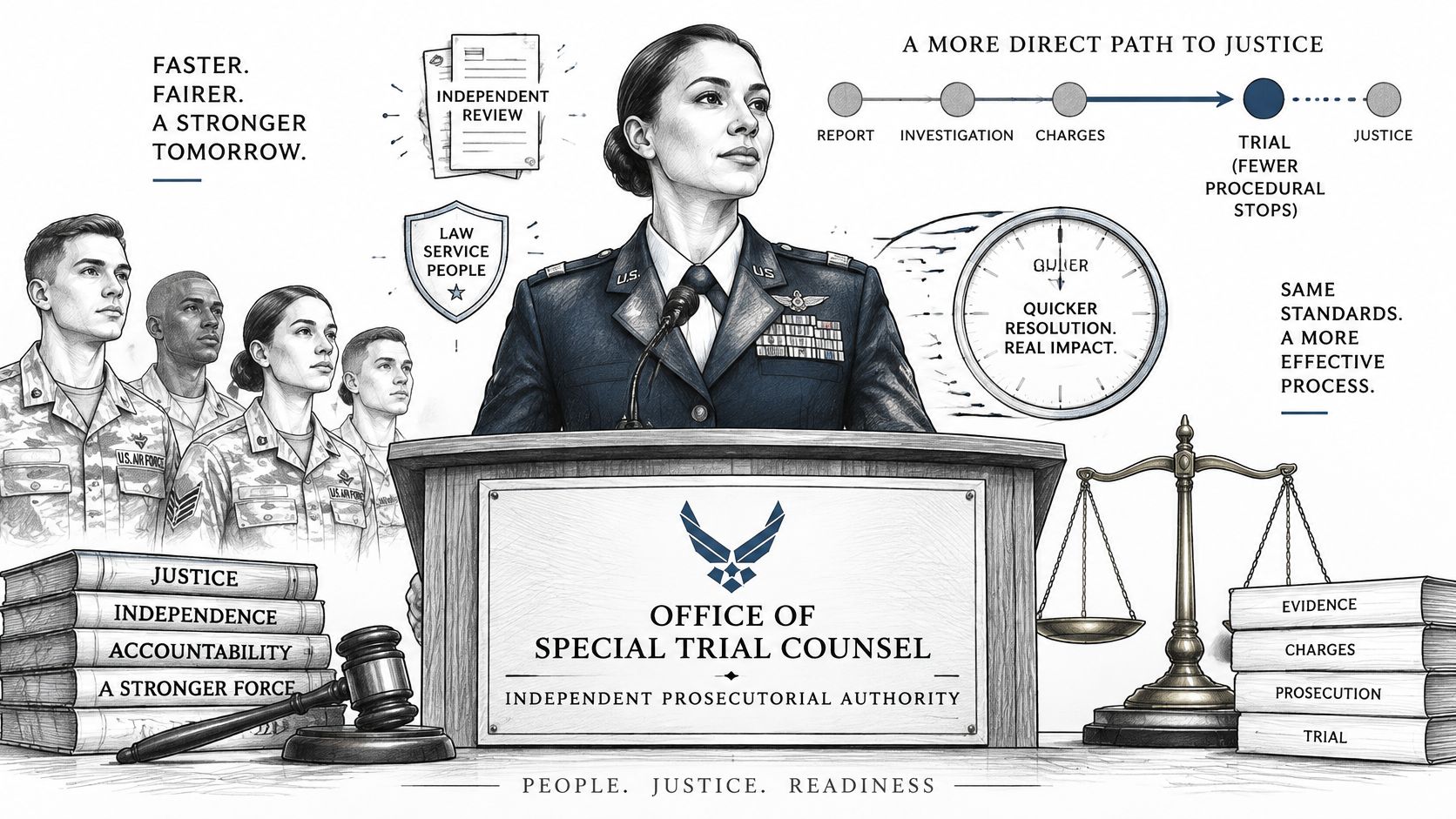
The Department of the Air Force reports that OSTC became fully operational on December 28, 2023, preferred its first exclusively controlled case on June 15, 2024, referred its first such case on July 1, 2024, and conducted its first OSTC-referred trial on September 17, 2024; by February 2025, 64 OSTC-referred courts-martial were docketed and awaiting trial (Air Force OSTC year-in-review announcement).
Find out who owns the decision
OSTC exercises authority over covered offenses, rather than every allegation of Air Force misconduct. Counsel should confirm coverage from the alleged offense and applicable rules, including how related allegations are being handled. Don’t assume that a familiar offense label answers every jurisdictional question.
The distinction changes the defense approach:
- Before preferral. Counsel can identify factual errors, missing context, and preservation needs while evaluating whether a submission would help or prematurely reveal the defense.
- Before referral. Counsel can assess a targeted request about charges or disposition and direct it to the office with authority.
- If OSTC defers a matter to command. Determine what action remains possible. A changed decision-maker doesn’t necessarily mean the allegation has disappeared.
A favorable conversation with your commander isn’t a substitute for understanding who has prosecution authority.
Early involvement requires judgment
Early representation doesn’t mean sending investigators every favorable fact immediately. Disclosing a witness prematurely may invite additional interviews before counsel understands the existing statements. Waiting too long, however, may leave favorable evidence uncollected.
Experienced court-martial attorneys weigh that trade-off deliberately. They should explain what they propose to disclose, what they’re withholding for now, and how the decision serves the defense.
OSTC involvement also doesn’t guarantee a trial. Treat investigation, charging, referral, and litigation as distinct decisions, with a strategy appropriate to each.
Rights of the Accused and What They Mean Tactically
Rights matter when counsel turns them into decisions, requests, and an adequate record. Knowing you have protections isn’t enough if you waive them without understanding the consequences.
Use this graphic as an issue checklist, not as a promise that every witness request will be granted or every delay will produce dismissal.

Questions Airmen and families ask
Can I refuse to answer OSI’s questions?
When questioned as a suspect, invoke your rights rather than trying to negotiate an informal explanation. Tell investigators you want counsel before discussing the allegation, and have your lawyer address the application of Article 31 protections under the UCMJ.
Do I need a lawyer before charges exist?
Yes, seek advice when you learn you’re suspected of misconduct. Interview decisions, consent requests, and evidence preservation can matter before any charge sheet appears.
What happens at an Article 32 hearing?
It’s a preliminary proceeding associated with potential general court-martial prosecution, not the trial itself. Ask counsel what issues can realistically be developed and what participation best protects your position.
Does the panel have to be unanimous?
Don’t assume civilian jury rules apply. For a general court-martial, the Department of Justice describes Article 52 as generally requiring concurrence of at least three-fourths of the members for conviction (Justice Department discussion of Article 52). Counsel must verify the rules applicable to your proceeding.
The tactical point is straightforward: focus on reasonable doubt about required elements, not on proving that every government witness is dishonest. Voir dire, evidentiary objections, and precise instructions deserve preparation.
Will I go to jail?
Nobody can responsibly answer from an allegation alone. Your lawyer needs the charges, evidence, forum, applicable punishment rules, and any proposed agreement before assessing confinement exposure.
Can the defense obtain witnesses and records?
Counsel can pursue relevant evidence through available procedures, but relevance, privilege, and other legal limits matter. Give counsel names, locations, dates, and a concrete explanation of what each witness or record can establish.
Make rights operational
Ask your UCMJ lawyer to identify disputed evidence, necessary witness requests, applicable timing issues, and review rights. The objective isn’t to recite protections. It’s to use them without making unsupported promises about dismissal, acquittal, or appeal.
The Mistakes That Quietly Destroy Air Force Court-Martial Cases
The most dangerous assumption is that an innocent Airman can safely explain everything without preparation. Innocence doesn’t tell you what investigators already possess, what another witness said, or which details the government considers incriminating.
Conduct that creates avoidable problems
- Talking to OSI without advice. A rushed explanation can create inconsistencies counsel must later address. Get legal guidance before a substantive interview rather than trying to repair the account afterward.
- Trusting command to make the problem disappear. Professional support from leadership isn’t a defense strategy. Ask counsel to establish the actual decision-maker and pending actions.
- Waiting for preferral to evaluate representation. By then, counsel may be confronting an established investigative account. Evaluate help while there are still collection and charging decisions to address.
- Assuming there’s no evidence. Your lack of access to a report doesn’t establish what it contains. Separate what you know from what you merely haven’t seen.
- Posting about the accusation. Public explanations can generate additional statements, identify witnesses, and invite arguments about motive. Don’t litigate credibility on social media.
- Failing to preserve original records. Selected screenshots may omit context. Preserve complete conversations and original files through a process your lawyer recommends.
- Treating the preliminary hearing casually. Preparation should reflect a strategic objective, even when counsel decides that restraint is better than extensive examination.
Credibility needs corroboration
A useful defense chronology separates confirmed facts, disputed facts, and inference. For every important proposition, counsel should ask what supports it independently: a complete message thread, an access record, a contemporaneous document, or a witness with personal knowledge.
Consider an allegation tied to an evening’s communications. A favorable excerpt may look decisive until the surrounding conversation changes its meaning. The better approach is to preserve the entire exchange and evaluate both helpful and harmful material before choosing how to use it.
Don’t delete an embarrassing message because it seems unrelated. Let counsel evaluate relevance and preservation obligations.
Bluntly, your lawyer needs the difficult facts too. A defense built around an incomplete client account leaves counsel vulnerable to evidence the prosecution already knows about.
Why Experienced Civilian Military Defense Counsel Changes the Outcome
Hiring civilian counsel doesn’t guarantee a better result. Choosing counsel with the right experience can materially change the work performed. Evaluate demonstrated judgment, not a military résumé alone.
Military-appointed defense counsel can provide capable, committed representation. Don’t assume they answer to your commander in defending you, and don’t assume civilian status automatically creates superior advocacy. The meaningful comparison is experience, availability, resources, and the proposed division of responsibility.
Compare actual capabilities
| Question | What a useful answer includes |
|---|---|
| Who will handle the case? | The lawyer responsible for preparation, hearings, and trial |
| What trial experience is relevant? | Contested court-martial work involving comparable evidence and charges |
| How will the team investigate? | A concrete plan for witnesses, records, experts, and digital material |
| How will counsel coordinate? | Clear responsibilities between civilian and military defense lawyers |
| What happens after trial? | Defined responsibility for post-trial submissions and appellate transition |
An Air Force report on military justice workload describes defense work spanning courts-martial, nonjudicial punishment, and administrative discharge matters. That breadth matters because a lawyer’s total client count doesn’t establish contested-trial experience.
Vet substance rather than confidence
Ask prospective military defense lawyers about Article 32 litigation, OSTC-controlled matters, suppression motions, sentencing preparation, appellate work, and overseas representation. Request an explanation of how they would assess your case before asking for a prediction about winning it.
Document handling deserves scrutiny too. For ordinary document-management research, firms may review resources such as PDFWix legal document utilities, but a service member shouldn’t upload investigative files to third-party tools without counsel’s approval and an appropriate security review.
Finally, get a written scope and fee explanation. Ask whether investigation, experts, travel, sentencing, and post-trial work are included or separately addressed. The strongest reason to hire civilian counsel is a defensible plan for your case, not pressure or an outcome promise.
What to Do in the Next 72 Hours and Beyond
Treat the coming days as an organization and preservation window, not permission to delay. An interview, order, or filing deadline may require attention sooner.
Build a usable defense file
- Confirm immediate obligations. Send counsel every notice and deadline, and request advice about any scheduled interview.
- Preserve communications. Retain original records without editing, deleting, or circulating them.
- Identify witnesses. Record what each person knows. Don’t coach testimony or coordinate accounts.
- Choose representation deliberately. Compare strategy, availability, fees, and responsibility for the next procedural event.
Administrative intake isn’t confidential legal advice from the lawyer handling your case. Resources describing intake assistant options for plaintiff firms illustrate a different practice context; in a military criminal matter, ask who will receive your information and how sensitive documents should be transmitted.
Plan beyond the verdict
Article 60 requires a Statement of Trial Results identifying pleas, findings, and the sentence in general and special courts-martial (statutory post-trial requirements). Counsel should verify the governing version of the law, review the record, and identify available submissions and review deadlines.
Appeals, discharge upgrades, and records correction are distinct processes, not guaranteed ways to undo an unfavorable result. Preserve the record now so later counsel can evaluate them properly.
If OSI has contacted you or Air Force charges are pending, contact military defense counsel before your next substantive statement or decision. Bring the notices, identify the deadline, and ask what counsel will do immediately. Your freedom and career deserve a strategy before the government makes its next move.