You’ve just learned that an investigation, court-martial, or adverse action may follow you long after your military service ends. The immediate concern may be confinement, separation, or a damaged career. The longer-term danger is less obvious: an incomplete or misunderstood record can affect employment, licensing, security-clearance decisions, veterans’ benefits, discharge-correction efforts, and how an agency interprets your past.
Court martial records aren’t one neat file sitting in one universal database. They’re scattered across trial records, appellate materials, agency systems, public portals, archival collections, and retention schedules. Some records remain available while related recordings, notes, filings, or exhibits disappear from ordinary access. If you wait until a civilian employer, licensing board, or government agency asks questions, you may discover that the evidence needed to explain or challenge your case is no longer easy to obtain.
Table of Contents
- Why Your Court-Martial Record Matters Immediately
- What Court-Martial Records Contain
- Where Court-Martial Records Are Stored and Accessed
- How to Request Copies of Your Military Records
- The Hidden Risks of Record Retention and Loss
- Why Civilian Military Defense Counsel Is Essential
- Common Mistakes That Damage a Records Strategy
- Talking before getting advice
- Assuming the public docket is complete
- Waiting until a deadline appears
- Sending a request to the wrong agency
- Treating a discharge upgrade as an exoneration
- Relying on memory instead of documents
- Assuming missing evidence proves misconduct
- Comparing cases without context
- Filing a complex petition without counsel
- Frequently Asked Questions About Court Martial Records
- Can I refuse to talk to CID, NCIS, OSI, or another investigator?
- What happens at an Article 32 hearing?
- Will I go to jail?
- Do I need a lawyer immediately?
- Are court-martial records public?
- Can I obtain my own military records?
- Does an appellate review mean the conviction was overturned?
- Can an old court-martial record be corrected?
Why Your Court-Martial Record Matters Immediately
A former service member contacts counsel after an employer asks about a military conviction. The person remembers the trial, the sentence, and the discharge. They don’t remember the docket number, the appellate history, which exhibits were admitted, or whether the public file contains the complete record. The employer has a short explanation. The veteran has fragments.
That imbalance matters. A court-martial record can become the government’s version of events long after witnesses have moved, memories have faded, and the accused has left the service. A short docket entry may show that a case existed, but it may not reveal the evidentiary dispute, the credibility problem, the ruling that excluded or admitted key material, or the later appellate action that changed the legal posture.
The record can outlast the proceeding
The consequences aren’t limited to the sentence imposed in court. A conviction or adverse military record may become relevant during:
- Civilian employment reviews: Employers may ask for explanations of criminal or military justice history.
- Licensing decisions: Professional boards may evaluate the underlying conduct, disposition, and later corrective action.
- Security-clearance matters: Investigators and adjudicators may focus on the official record, not your recollection of what happened.
- Discharge-upgrade efforts: A persuasive application depends on identifying the actual findings, sentence, procedural history, and mitigation.
- Records-correction litigation: A board or court needs a reliable record, not a general statement that the trial was unfair.
Investigations aren’t neutral exercises designed to protect the accused. They collect information for command and prosecutorial decision-making. A service member who assumes that an innocent explanation will automatically find its way into the file is relying on a process that doesn’t work that way.
Practical rule: Preserve the record before you need to defend the record.
Early action also protects against a common mistake, treating a public entry as the entire case. The public-facing material may be useful, but it might omit sealed material, redactions, attachments, audio, reporter’s notes, or later appellate decisions. You need to identify what exists, where it is held, and what may be lost before asking an agency to explain your past.
What Court-Martial Records Contain
A public docket may show that a court-martial occurred, but it rarely preserves the full fight over the evidence. A court-martial record can include far more than a judgment. The National Archives describes the principal Army collection as Record Group 153, Entry 15, Court-Martial Case Files, covering 1809 through 1894. Those files may contain court organization and personnel details, charges and specifications, pleas, arraignments, exhibits, findings, sentences, reviewing-authority reports, actions by the Secretary of War and President, and related correspondence. The National Archives’ historical description of Army court-martial case files shows why “court-martial record” can mean an entire litigation history rather than one document.
That distinction matters when the public entry omits attachments, audio, reporter’s notes, sealed material, or later appellate action. A missing item can affect how counsel assesses a ruling, challenges testimony, or explains the case years later. Treat the docket as an index, not as proof that the file is complete.
Modern records add administrative data to the individual trial documents. They can reflect cases still moving through the system, including recurring statistical reports and case-status entries. At the end of fiscal year 2020, the Army reported 278 pending courts-martial cases, including 38 referred for trial, while the Navy reported 170 pending cases, including 108 referred for trial and 62 with preferred charges awaiting disposition decisions. The services’ fiscal year 2020 Article 146a reporting illustrates that “records” can describe pending matters, not only completed trials.
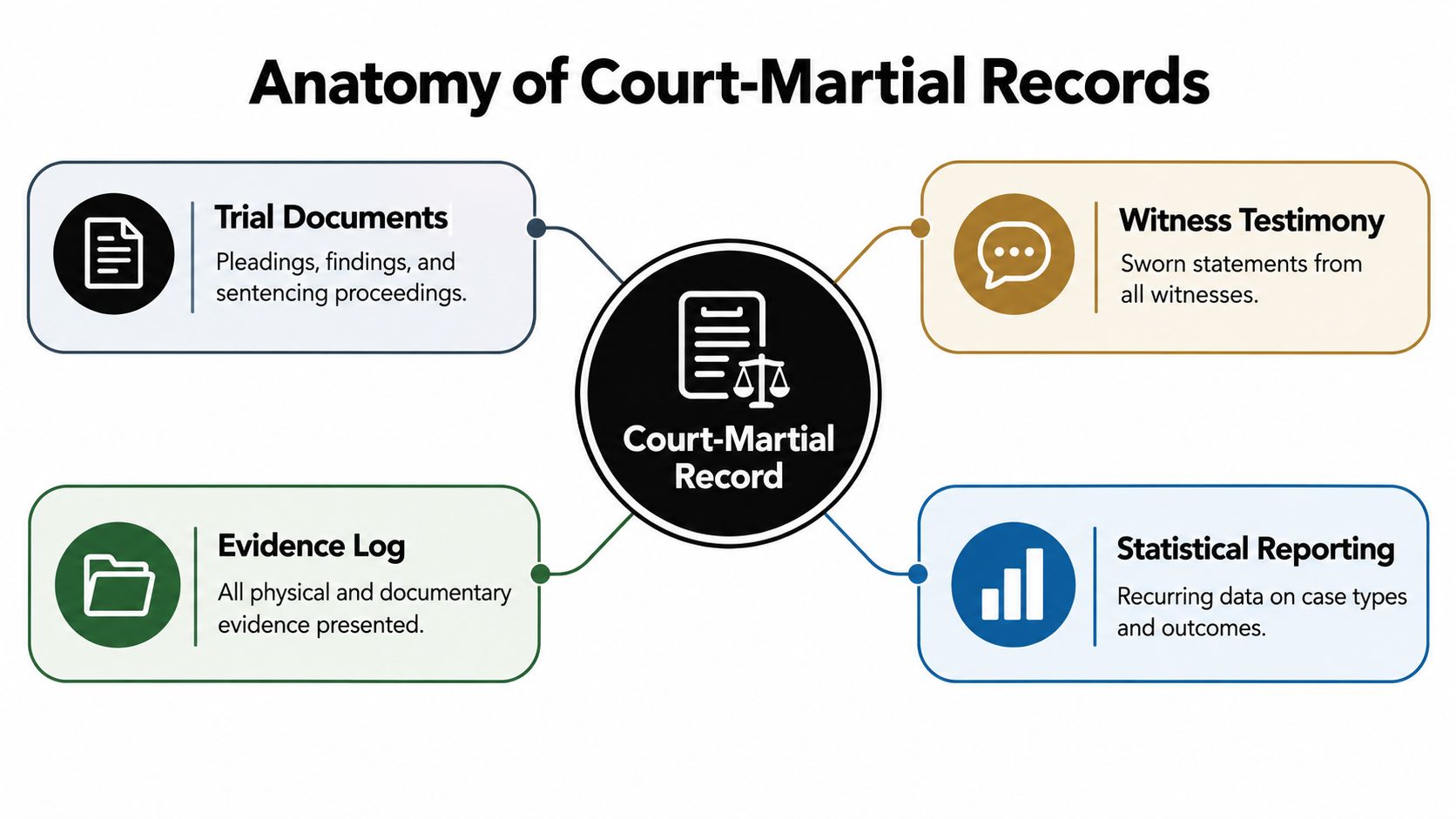
The main components
A serious review separates the record into categories:
- Trial materials: Charges, specifications, motions, rulings, pleas, findings, sentencing proceedings, and the formal record of trial.
- Evidence materials: Exhibits, documentary evidence, physical-evidence references, and the sequence in which evidence was presented.
- Witness materials: Sworn testimony, investigative statements, prior statements, and disputes over credibility.
- Administrative materials: Dockets, referral decisions, case-status entries, convening documents, and reviewing-authority actions.
- Appellate materials: Decisions, opinions, orders, and later actions affecting the result after trial.
The Army’s historical microfilm publication, M1105, contains registers of records of proceedings for Army general courts-martial from 1809 through 1890. The Civil War period has six indexes, arranged by the accused’s surname and details such as rank, regiment, company, court president, judge advocate, and the place and date of the proceeding. Some files from 1861 through 1865 were lost during the Civil War and recovered by the Judge Advocate General in the early 1890s. The archive has depth, but no lawyer should assume every underlying item survived.
For a plain-language starting point, review this court-martial basics resource, then identify the precise record required. A docket may establish when and where a proceeding occurred. It may not show why a judge ruled as they did or whether an appellate court later changed the outcome.
Where Court-Martial Records Are Stored and Accessed
The correct repository depends on branch, time period, case type, sentence, and appellate status. Sending the same request to whichever agency appears first in a search result wastes time and may create serious problems if a deadline or retention period is approaching.
For historical Army matters, the National Archives holds Army case files from 1809 through 1917 in Record Group 153, Entry PC-29 15. The 1809 through 1894 files are under National Archives Identifier 301659, while the 1894 through 1917 files are under Identifier 5916762. National Archives guidance for Army court-martial case files explains that these files aren’t arranged as a simple alphabetical database. The earlier files are arranged by case number, and the later files are arranged numerically according to the filing number’s date.
Repository choices by situation
| Research situation | Likely custody or access route | What to provide |
|---|---|---|
| Older Army case | National Archives, including Archives 1 in Washington, D.C., or the National Archives in St. Louis depending on the record | Name, service period, unit, regiment, branch, and possible case number |
| General court-martial or special court-martial with an approved bad-conduct discharge | National Archives in St. Louis for the categories identified in National Archives guidance | Accused’s identity, branch, approximate trial date, and case type |
| Post-1976 Army case | Army custody, with the request directed through the Army | Accused, approximate trial date, case type, and requester status |
| Post-1976 Navy case | Navy Office of the Judge Advocate General | Signed FOIA or Privacy Act request and identifying case information |
| Closed Air Force trial | Air Force custody | Accused, approximate trial date, and identifying service information |
A veteran may use a Privacy Act request for their own records. Other requesters generally use the Freedom of Information Act process. Court-martial proceedings are ordinarily public criminal proceedings, so records are generally releasable under FOIA, subject to applicable exemptions and protections. Army guidance on custody and access routes makes the practical point clear: a requester must identify the right custodian before expecting a useful response.
The Army’s older index cards for 1900 through 1986 are permanently stored by the Office of the Clerk of Court and arranged alphabetically by accused name, with docket and accession information. Since mid-July 1986, court-martial information has been accessible through a computerized database. Those systems can help locate a case, but locating a case isn’t the same as obtaining the complete litigation record.
For historical research, a name alone may not be enough. Approximate service dates, regiment, company, unit, place, and possible case number can materially improve the search. For modern cases, appellate status and the approved sentence may determine which office has the most important documents.
How to Request Copies of Your Military Records
A service member may receive a public docket showing that a case existed, then discover that the transcript, exhibits, audio, or appellate materials are missing. Treat the request as an evidence-preservation project from the start. Identify the accused, branch, approximate trial date, court type, sentence, and appellate history before sending anything.
Step 1 Identify the record you need
Define the specific objective. You may need the docket, filings, transcript, audio, exhibits, findings, sentence, appellate decision, or complete record of trial. A request for “all records” can produce a broad but incomplete response. Name each document or recording, identify the proceeding, and state the relevant time period.
The public docket and the litigation record serve different purposes. A docket helps establish what happened procedurally. It may provide little assistance when counsel needs to examine testimony, objections, admitted exhibits, sentencing evidence, or appellate changes. Request each category that could affect the issue under review.
A service member requesting their own file may use the Privacy Act. Family members, journalists, employers, and other third parties generally must use FOIA and may receive redactions or withholding under applicable exemptions. Identify the accused and provide enough information for the agency to separate the case from other matters.
Step 2 Use the correct access system
The Army Court-Martial Public Record System provides public access to summaries, docket information, filings, and records pursuant to Article 140a. Army Regulation 27-10 states that uploaded filings and records in the system, together with materials in the Army Court of Criminal Appeals Appellate Library, are generally publicly accessible for three years unless properly removed. The Army Court-Martial Public Record System can locate public materials and reveal the case’s procedural trail.
Use that system as a starting point, then contact the appropriate records custodian for missing materials. Preserve the request, attachments, delivery confirmation, response, redactions, and any statement that records could not be located. A deficient response may become relevant when counsel evaluates whether the search was adequate or whether further preservation steps are needed.
Step 3 Request local and appellate materials separately
Court reporters’ notes and recordings for special and general courts-martial, including Article 30a and Article 32 proceedings, are maintained by the servicing Office of the Staff Judge Advocate for five years after entry of judgment or the applicable completion milestone under the regulation. Send requests for audio and reporter’s notes promptly, because local custody can differ from public availability.
Use the agency’s FOIA or Privacy Act process and request confirmation of the search scope. If the case reached an appellate court, request the appellate decisions and orders separately. The trial transcript alone may not show how the judgment or sentence changed on review.
Step 4 Review the production with counsel
Check for missing volumes, absent exhibits, unexplained redactions, incomplete transcripts, and gaps between trial and appellate action. Counsel can compare the production with the procedural history and identify whether the file contains the evidence needed for a motion, appeal, clemency request, or collateral challenge.
Send sensitive materials through a controlled process. Review these secure communication tips for lawyers before transmitting documents, and keep a record of what was sent, to whom, and when.
The Hidden Risks of Record Retention and Loss
The most dangerous assumption is that a court-martial file either exists forever or disappears all at once. In practice, different pieces have different custodians and different retention periods. A formal order may survive while the audio, reporter’s notes, or supporting material becomes unavailable through ordinary channels.
Records of special courts-martial without a bad-conduct discharge are retained for 10 years after case completion. After that period, the permanent record may contain only the special-court-martial order rather than the complete trial file. Army guidance on court-martial record custody and retention identifies the evidentiary consequence: a full litigation record can become a substantially thinner administrative record.
Retention and custody at a glance
The following table summarizes the specific retention and access points that should drive early preservation decisions.
| Record type | Retention period | Primary custodian |
|---|---|---|
| Uploaded Army public filings and records | Three years, generally, unless properly removed | Army Court-Martial Public Record System and related appellate library |
| Court reporters’ notes and recordings | Five years after the governing judgment or completion milestone | Servicing Office of the Staff Judge Advocate |
| Special-court-martial records without an approved bad-conduct discharge | Ten years after case completion, after which the permanent record may be limited | Army record custodian, subject to the applicable retention rules |
| Army historical case files | 1809 through 1917 collection period | National Archives, divided by identifier and location |
A person pursuing a discharge upgrade, records correction, or collateral-consequence remedy should preserve the file before filing the application. This guide to managing file retention offers useful general principles for organizing and tracking important records, although military case preservation still requires attention to the specific custodian and regulation.
Data quality creates another trap
Government systems don’t form one harmonized dataset. The Government Accountability Office reported that the services used separate personnel, investigation, and military-justice databases. The Army relied on both Military Justice Online and the Army Court-Martial Information System, and the GAO disparity analysis covered fiscal years 2013 through 2017, described as the most recent data available for that review. The GAO review of military justice data systems shows why published records shouldn’t be treated as a complete, uniform dataset.
That limitation matters when someone tries to compare conviction rates, racial or gender disparities, or attorney performance. Appellate records aren’t equivalent to all trial records. Sealed or redacted material may be absent, publication timing may differ from the proceeding, and raw counts lack the denominators and case-selection context needed for reliable conclusions.
If you’re pursuing a military discharge upgrade, don’t assume an administrative correction replaces the underlying trial history. Preserve both.
Why Civilian Military Defense Counsel Is Essential
Military-appointed counsel can provide valuable representation, but serious records problems often begin after the courtroom has emptied. A civilian military defense lawyer can identify the complete trial record, obtain the appellate history, locate missing exhibits and recordings, protect privileged communications, and assess whether the file supports an appeal, correction petition, discharge-upgrade application, or response to a government inquiry. Service members comparing options can review civilian court-martial defense lawyers with relevant military justice experience.
Military-appointed counsel can provide valuable representation, but serious records work may require the independence, workload flexibility, continuity, and specialized strategy that civilian counsel brings. A civilian lawyer remains focused on the service member’s long-term interests without being part of the command structure. That independence matters when deciding how to address an old conviction with an employer, clearance investigator, licensing board, or correction authority. Counsel should also establish secure communication tips for lawyers before sensitive records and explanations move between client and attorney.
Trial records are only one part of the legal history
The United States Court of Appeals for the Armed Forces explains that every general or special court-martial conviction, regardless of sentence, is reviewable by an intermediate appellate court. A search limited to the trial transcript can omit decisions that determine the conviction’s final legal status. The court’s explanation of appellate review supports obtaining the appellate history alongside the original case file.
An affirmed finding, modified sentence, remand, order, or other appellate action can change how the matter must be described. A public docket may identify the case, but it does not necessarily preserve every filing, exhibit, ruling, recording, or later disposition. A service member who relies on the docket or transcript alone may give an incomplete answer and create a credibility problem.
What experienced counsel examines
A serious records review asks questions that a basic search will not answer:
- What was the exact disposition? Separate the charges, specifications, findings, sentence, and later action.
- What evidence is missing? Check for referenced exhibits, recordings, attachments, investigative materials, and sealed items.
- What credibility issues were litigated? Compare sworn statements, testimony, prior inconsistent accounts, and corroboration.
- What happened on appeal? Obtain decisions and orders, not merely confirmation that an appeal occurred.
- What remedy fits the problem? Discharge correction, records correction, appellate relief, collateral review, and a supported explanation serve different objectives.
Ask prospective military defense lawyers, court-martial attorneys, or a UCMJ lawyer about actual trial, appellate, records-preservation, and correction experience.
Common Mistakes That Damage a Records Strategy
Talking before getting advice
Service members often try to correct the government’s account by giving investigators a detailed explanation. That statement becomes evidence, and an innocent mistake about timing or wording can damage credibility.
Assuming the public docket is complete
A docket is a locator and summary tool. It isn’t automatically the complete record of trial, complete exhibit file, audio record, or appellate history.
Waiting until a deadline appears
Retention periods run whether you’re ready or not. Waiting until a clearance issue, licensing application, or discharge petition is pending may leave you with fewer documents.
Sending a request to the wrong agency
Branch, date, case type, and custody control the request path. A request sent to the wrong repository creates delay and may produce an incomplete response.
Treating a discharge upgrade as an exoneration
A corrected discharge can provide important relief without vacating the underlying findings. Describe the remedy accurately. Overstating it can create a credibility problem.
Relying on memory instead of documents
Years later, people remember the emotional center of a case but forget procedural details. Counsel needs the actual record to test whether the memory matches the findings, rulings, and appellate disposition.
Assuming missing evidence proves misconduct
A missing document may reflect retention, custody, redaction, or an incomplete search. It can be strategically important, but it must be investigated rather than overstated.
Comparing cases without context
Raw counts don’t establish conviction rates, disparity, or attorney quality. The underlying populations, definitions, time periods, and selection rules must be consistent before comparisons mean anything.
Filing a complex petition without counsel
Appellate and collateral remedies have different standards. A strong personal narrative can still fail if it asks the wrong tribunal for the wrong form of relief.
Frequently Asked Questions About Court Martial Records
Can I refuse to talk to CID, NCIS, OSI, or another investigator?
You generally have the right to consult counsel before answering questions that may incriminate you. Don’t try to manage an investigation through improvisation. Ask for a military defense lawyer or civilian military defense counsel before making a statement.
What happens at an Article 32 hearing?
An Article 32 proceeding is part of the pretrial process for qualifying cases. The exact scope and procedure depend on the charges and current law. Your counsel should evaluate the evidence, witness credibility, investigative gaps, and whether the government has developed a legally sufficient basis to proceed.
Will I go to jail?
A court-martial can create serious punishment exposure, but the result depends on the charges, findings, forum, evidence, and sentence. No responsible lawyer can predict confinement from the existence of an investigation alone.
Do I need a lawyer immediately?
Yes, if you’re under investigation, facing referral, receiving adverse administrative action, or trying to preserve an old case. Early counsel can prevent damaging statements and identify records before retention or access problems arise.
Are court-martial records public?
Court-martial proceedings are ordinarily public criminal proceedings, and records are generally releasable under FOIA, subject to exemptions and protections. Public availability doesn’t mean every document is online or that every record is unredacted.
Can I obtain my own military records?
You may request your own records through the Privacy Act, while other requesters generally use FOIA. The request should identify the accused, branch, approximate trial date, case type, and the specific materials sought.
Does an appellate review mean the conviction was overturned?
No. Review means the conviction was subject to appellate consideration. You must obtain the actual decisions and orders to determine the final legal status.
Can an old court-martial record be corrected?
Potentially, depending on the defect, remedy, forum, and procedural posture. A discharge upgrade, records correction, clemency request, appellate action, and collateral petition are not interchangeable. Counsel should review the complete record before choosing a path.
If you’re under investigation, facing UCMJ action, dealing with a clearance problem, or living with an old court-martial conviction, start preserving records now. Request the trial materials, appellate decisions, filings, exhibits, and any available recordings before a custodian’s retention period closes. Then speak confidentially with an experienced civilian military defense lawyer who can analyze what the record says, what it leaves out, and which remedy protects your career, freedom, reputation, and future.