You’re probably reading this after a rights advisement, a command call, a CID or NCIS interview request, or a text from someone in your unit saying charges are coming. That’s the moment most service members make a fatal mistake. They think the fight starts at trial.
It doesn’t.
The fight starts when command and legal decide what type of court martial your case will enter. That choice shapes your punishment exposure, your negotiating position, your appeal rights, and whether your military career is merely damaged or completely destroyed. If you wait until arraignment to get serious, you’re already behind.
A lot of accused service members focus on guilt or innocence. That reaction is understandable. But strategy comes first. The system doesn’t reward outrage, and it doesn’t protect you just because the allegation is weak. It rewards whoever controls the early decisions, preserves evidence, and forces the government into the least dangerous forum available.
Table of Contents
- When the Forum Gets Decided Before You Even Know It
- The Three Types of Court Martial Under the UCMJ
- Summary Court Martial and What the Lowest Tier Really Means
- Special Court Martial and the Discharge That Changes Everything
- General Court Martial and the Cases That End Careers
- Comparing the Three Forums Side by Side
- Why Forum Choice Is Where Most Service Members Lose Ground
- Your Next 72 Hours If You Are Facing Any Type of Court Martial
- Frequently Asked Questions About Types of Court Martial
- Can I refuse to talk to CID or NCIS
- What is the lowest type of court martial
- Which court-martial can give me a bad-conduct discharge
- Which type of court martial is the most serious
- Do I need a civilian lawyer if I already have a military lawyer
- Will I go to jail
- Does forum choice affect my future after the military
When the Forum Gets Decided Before You Even Know It
By the time you hear “you may be facing court-martial charges,” someone is often already discussing where your case belongs. That conversation usually happens in legal offices and command channels, not in front of you. Your commander, the lawyers advising command, and the officials who will decide whether charges move forward are not waiting for your side of the story to become polished.
That’s why delay is deadly.
If you sign paperwork casually, agree to “just cooperate,” or waive a hearing without understanding what it affects, you can give away bargaining power before any judge ever sees your case. A forum decision is not a technical detail. It sets the floor and ceiling for everything that follows.
What that decision really controls
The forum choice drives practical consequences, including:
- Punishment range: Whether you’re looking at minor punishment, a bad-conduct discharge, or life-altering confinement.
- Who will hear the case: One officer, a military judge, or a panel.
- Your negotiation position: The lower the forum, the more room the defense often has to contain damage.
- Appeal posture: Some outcomes trigger stronger appellate review than others.
Practical rule: If anyone asks you to sign something tied to charges, hearings, or disposition, slow down and get legal advice first.
A lot of service members also confuse court-martial exposure with nonjudicial punishment. They are not the same thing. If you’re still at the stage where command is considering lower-level discipline, learn the difference between NJP and criminal trial exposure before you talk yourself into the wrong lane through a bad statement or a panicked explanation. This breakdown of what an NJP in the military is is a useful starting point.
My blunt advice
If you think “they haven’t charged me yet, so I have time,” you’re thinking like a target, not like a defense team. Early action is where forum pressure happens. Once the case hardens into a more serious path, reversing course gets much harder.
The Three Types of Court Martial Under the UCMJ
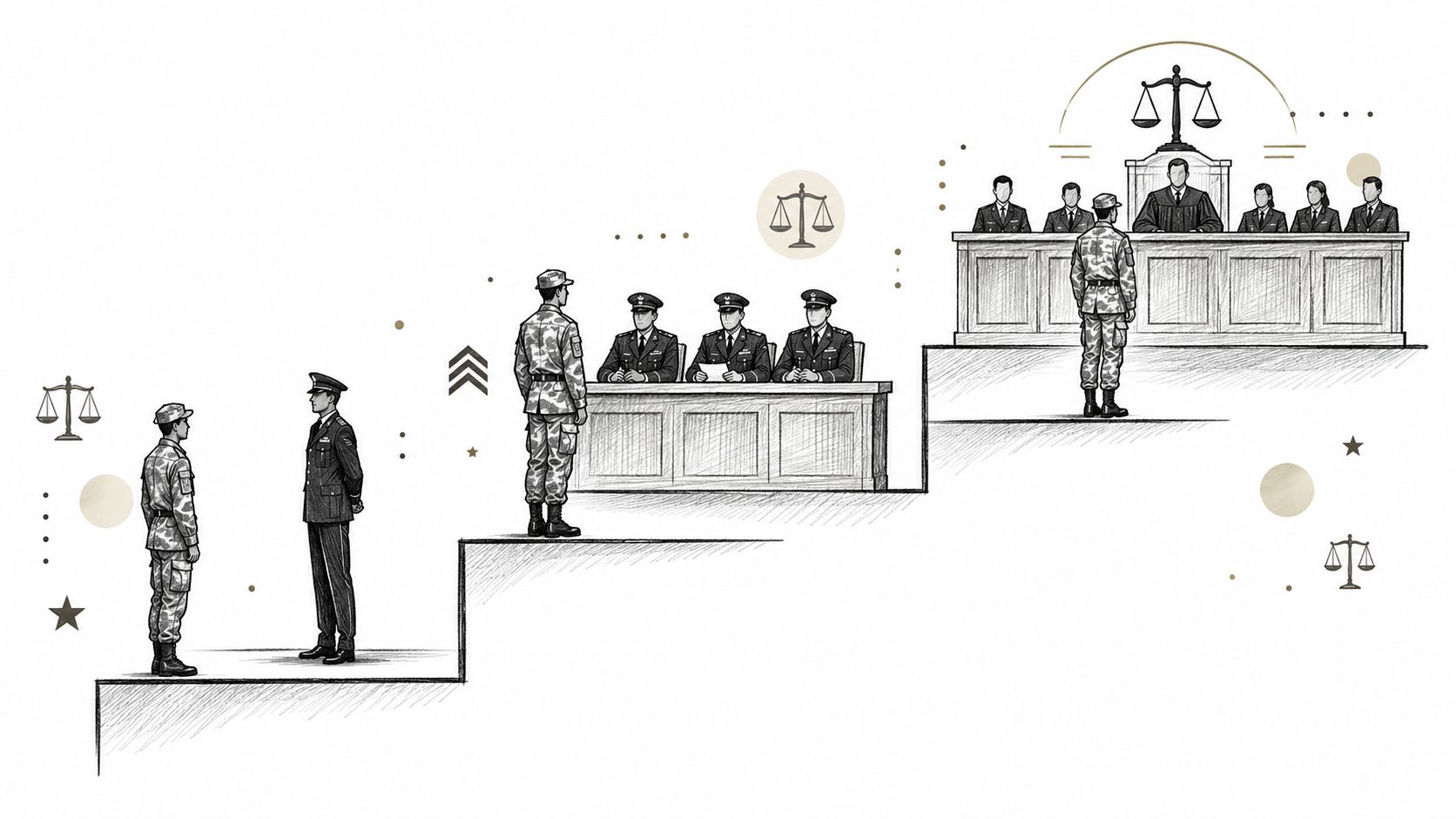
You can be standing in front of your commander hearing the words “court-martial” before you understand the question: which one? That decision tells you who can prosecute the case, what punishment is on the table, how much procedure you get, and how hard it will be to undo a bad result on appeal.
The Uniform Code of Military Justice uses three trial forums: summary, special, and general court-martial. The Congressional Research Service describes them as a tiered system tied to the seriousness of the alleged offense and the punishment authorized (Congressional Research Service overview). For you, that is not a textbook distinction. It is a forecast of risk.

Here is the practical map.
A summary court-martial is the lowest forum. It is built for minor misconduct, handled by one commissioned officer, and used when the government is not pursuing a punitive discharge or major confinement. A civilian defense lawyer becomes worth calling as soon as command starts steering the case toward any criminal forum, because even the lowest tier can damage rank, pay, and future assignments.
A special court-martial is where many service members misread the danger. It is still an intermediate forum, but it can carry confinement and, in many cases, a bad-conduct discharge. That discharge can do more damage than the short-term punishment because it follows you into civilian life, benefits issues, and employment screening. If your case is tracking toward special court-martial, the time to get outside counsel is before referral, not after arraignment.
A general court-martial is the top forum. It is reserved for the most serious allegations and exposes you to the harshest sentences the military can lawfully seek, including long confinement and, in qualifying cases, far more severe penalties. Once a case is headed here, you are not managing a disciplinary problem. You are defending your freedom, your record, and usually your entire career.
The forum also signals who will hear the case if you choose trial with members:
- General court-martial: at least five members
- Special court-martial: at least three members
- Summary court-martial: one commissioned officer
Those numbers matter because forum is not just a label. It shapes how command frames the accusation, how aggressively trial counsel prosecutes it, what sentence can be imposed, and what appellate review looks like if you are convicted.
After you’ve got that framework in mind, watch this short explanation to lock in the difference:
Summary Court Martial and What the Lowest Tier Really Means
You can get offered a summary court-martial before you fully grasp what command is doing. It sounds small. It is not small if you care about your rank, your pay, your record, or whether command now sees you as easy to convict.
A summary court-martial is the lowest trial forum under the UCMJ. One commissioned officer handles the case, and the forum is meant for lower-level misconduct rather than cases seeking a punitive discharge or extended confinement (2024 Manual for Courts-Martial supplemental material).
That label fools people.
Command likes this forum because it is fast and controlled. From your side, the question is simpler. Are you about to accept an outcome that solves a minor allegation, or are you about to hand the government a conviction it can use against you for the rest of your enlistment?
What you are actually exposed to
The punishment cap is limited, but it still hurts. Under the governing rules, a summary court-martial can impose:
- Confinement for 30 days
- Hard labor without confinement for 45 days
- Restriction for 45 days
- Forfeiture of two-thirds pay for one month
- Reduction to the lowest enlisted grade
That is enough to knock you backward fast, especially if you are junior enlisted and already under command scrutiny.
Why the “lowest tier” still deserves a strategy
Summary court-martial is usually prosecuted at the unit level with command pushing for speed, not nuance. That changes how you should evaluate it. The issue is rarely just punishment. The issue is whether the government can prove the allegation, whether command can be pushed toward administrative action instead, and whether refusing this forum gives you a better path.
For many enlisted service members, the decision point is immediate because you can refuse a summary court-martial. That is where a civilian defense lawyer starts earning their fee. Before you answer command, a lawyer should assess the evidence, the witnesses, the likely fallback option, and whether refusal increases your risk of a special court-martial or improves your negotiating position.
The smart move is case-specific, not automatic. Sometimes taking the summary forum contains the damage. Sometimes it gives command an easy win, drops your rank, takes your pay, and locks in a conviction that affects clearance reviews, evaluations, reenlistment, and promotion.
If summary court-martial is on the table, do not treat it like a paperwork event. Treat it like an early fork in the road. Bad choices made here often create the record that command uses to justify harsher action later.
Special Court Martial and the Discharge That Changes Everything
You get called in, hear the words “special court-martial,” and assume you are still in the middle ground. That assumption gets people discharged.
A special court-martial is often the forum where command stops treating the case like unit discipline and starts building a record that can remove you from the service with a federal conviction attached. The prosecutor is still military. The process is still faster and more command-driven than many service members expect. But the exposure is no longer limited to a short-term hit to rank or pay. A special can end with confinement, forfeitures, reduction in grade, and for enlisted members, a bad-conduct discharge.
Why this forum changes the case
The bad-conduct discharge is the dividing line.
Once a BCD is on the table, your case is no longer just about staying out of trouble this month. It is about whether your military service ends with punitive paper that follows you into hiring decisions, security clearance reviews, reenlistment opportunities, and benefit fights. If you want the practical version of that problem, read this breakdown of how discharge status affects benefits and post-service consequences. The discharge categories are different, but the career damage works in the same direction.
That is why service members routinely underestimate this forum. “Middle tier” sounds survivable. A punitive discharge is not survivable for a military career.
What special court-martial usually means in practice
This forum is commonly tried before a military judge, either with a panel or judge alone depending on how the case is set and what elections are made. For you, the strategic question is simpler than the procedure. Who is driving the case, what sentence can they lawfully ask for, and how early can the defense cut off the discharge risk?
At the special court-martial level, the government has enough punishment authority to force bad plea decisions out of unprepared service members. That pressure point matters more than the label of the forum. If trial counsel believes command wants a conviction and a discharge-capable sentence, you need a defense plan before arraignment, not after the charge sheet hardens.
The lawyer timing is earlier than most people think
A civilian military defense lawyer becomes worth the money before the case is “ready for trial.” Hire one when any of these facts show up:
- command is talking about a punitive discharge
- the charge sheet is broader than the actual misconduct
- NCIS, CID, OSI, or command investigators already shaped witness statements
- the government is floating a plea that protects them more than it protects you
- there is still time to push for administrative separation or a lower forum instead
At this stage, good defense work is not just trial work. It is forum pressure, witness damage control, charge narrowing, sentencing containment, and stopping the case from turning into a discharge vehicle.
Appeals also become more serious here. A conviction at a special court-martial can move into the regular military appellate system, which is very different from the limited review attached to lower-level proceedings. That does not save you at the front end. It means the record built now matters more, because appellate courts review records, not regrets.
If your case is headed to special court-martial, stop calling it “just a special.” Treat it like the point where your defense either preserves your future or lets the government define it for you.
General Court Martial and the Cases That End Careers
You get called in, sit down, and hear words that change your entire risk profile at once: general court-martial. At that point, this is no longer a bad month, a command problem, or a disciplinary headache. It is a felony-level prosecution inside the military system, and it can take your rank, your pay, your retirement, your freedom, and your civilian future in one shot.
A general court-martial can impose the full punishment authorized for the charged offense. In the right case, that means life imprisonment or even death for a capital offense. Panel trials also require a larger factfinder group than the lower forums, which tells you something important. The system treats this forum as the top tier because the stakes justify it (general court-martial authority and panel requirement).
Who is driving the case now
At this level, you need to stop focusing only on what you did or did not do and start focusing on who controls the prosecution. General courts-martial are used for the most serious UCMJ allegations, and recent reforms changed who makes key decisions in many of those cases. For certain major offenses, specially assigned military prosecutors now play a central role in charging and trying the case, which means your defense has to answer both command pressure and a prosecution office built for high-stakes litigation (overview of the post-reform military justice system).
That changes strategy.
A weak lawyer treats a general court-martial like a bigger special. An experienced civilian defense lawyer treats it like a prosecution machine that has to be disrupted early, before the government locks in witnesses, digital evidence, expert framing, and sentencing themes.
What actually matters in a general court-martial
The forum matters because the punishment ceiling is wide open. The charge sheet matters because every specification affects sentencing exposure. The pretrial record matters because your appeal will rise or fall on what your defense team preserved before and during trial.
That is why your defense team should be working on four fronts at once:
- Investigation pressure points. Attack bad interviews, missing messages, contaminated witness accounts, and sloppy forensic handling.
- Article 32 decisions. Do not waive it by reflex. Use it when it helps expose holes, preserve testimony, or pin the government down.
- Forum and panel strategy. Member selection can decide how facts are heard and how punishment is judged.
- Suppression and record preservation. Illegal searches, bad rights advisements, and evidentiary mistakes have to be litigated cleanly and preserved for review.
One ruling can change the outcome of the whole case.
When civilian counsel becomes worth the money
In a general court-martial, civilian counsel is worth it before referral if there is still a chance to narrow charges, shape the Article 32 process, challenge the investigative file, or push the case away from a trial posture. After referral, civilian counsel is still worth it because military defense counsel often carry crushing caseloads, while your case now requires focused work on experts, motions, witness preparation, and sentencing mitigation.
Do not wait for arraignment to get serious.
If your case is headed to general court-martial, you need a lawyer who tries contested military felonies, knows the judges, understands how military prosecutors build serious cases, and can protect the appellate record from day one. At this level, delay costs options, and mistakes cost careers.
Comparing the Three Forums Side by Side
You may hear the forum name late. By then, command and trial counsel may already be treating your case like a minor discipline problem, a discharge case, or a career-ending felony case. That label drives how hard the government pushes, what punishment is on the table, and how fast you need outside help.
Use the chart below for what matters: who decides the case, how much punishment you face, what review you can expect, and when hiring civilian counsel stops being optional strategy and starts being damage control.
Three Types of Court Martial at a Glance
| Forum | Real Punishment Exposure | Who Handles and Decides It | Counsel Situation | Review and Appeal Reality | When Civilian Counsel Starts Paying Off |
|---|---|---|---|---|---|
| Summary court-martial | Confinement is limited, but the bigger risk is a fast conviction record and command-driven punishment. | One commissioned officer acts in a simplified forum under the UCMJ structure. | You do not get the same defense setup you get in higher forums. | Review exists, but the process is narrower and gives the defense less room to fix mistakes later. | Before you accept the forum or make any statement. A lawyer can help you decide whether to refuse summary court-martial and force the government to make harder choices. |
| Special court-martial | This is the forum where confinement is real and a punitive discharge can permanently change civilian employment, benefits, and reputation. | A military judge hears the case, or a panel can decide guilt and sentence in the intermediate trial forum recognized in the 2024 MCM. | Detailed military defense counsel is available. That does not mean your case is fully covered. | Appellate rights are stronger than summary, but the damage from a bad record, bad plea decision, or bad sentencing case can hit long before appeal helps. | As soon as a bad-conduct discharge is a possibility. That is usually the point where service members either protect their future or sleepwalk into a record that follows them for decades. |
| General court-martial | Full felony-level military punishment. In the most serious cases, that includes extreme confinement exposure and the harshest authorized penalties. | A military judge presides, and a panel decides the case if you do not elect judge alone. | Full military defense representation applies, but serious cases need far more motion work, expert analysis, witness preparation, and sentencing development than appointed counsel alone can often deliver. | This forum carries the strongest appellate path of the three, but appeal does not give you back a lost career, a conviction, or months of preventable mistakes in the trial record. | Before referral if possible. After referral, immediately. At this stage, every interview, motion, expert request, and election matters. |
What the comparison should tell you
Summary court-martial is not harmless because it is the lowest tier. It is dangerous because service members often treat it casually and give away options early.
Special court-martial is the pivot point for many careers. Once a punitive discharge enters the picture, you are no longer dealing with a “middle” forum in any practical sense. You are dealing with a case that can outlast your service by years.
General court-martial is a felony trial in uniform. Treat it that way from the start.
The mistake is focusing on the label. Focus on exposure, record, discharge risk, and who is building the case against you. That is how you decide whether to fight the forum, negotiate around it, or prepare for trial before the government defines the whole case for you.
Why Forum Choice Is Where Most Service Members Lose Ground
Most accused service members don’t lose ground because the government has a perfect case. They lose ground because they misunderstand when the decisive choices happen.
They assume the hearing is a formality. They assume appointed counsel will sort out forum issues later. They assume a lower forum is always a gift. They assume clemency can fix what poor early strategy caused. None of those assumptions is safe.
The common misreads
Here are the mistakes that come up over and over:
- Talking before strategy exists: You can’t unsay a damaging explanation.
- Treating paperwork like admin traffic: Waivers and elections affect bargaining power.
- Waiting for charges to become “official” first: By then, the government usually has momentum.
- Thinking command wants to be fair: Command wants the case resolved in a way that protects command interests.
- Believing weak evidence means weak risk: Weak cases still produce bad outcomes when the defense reacts late.
The better question
Stop asking, “Which forum do they think fits?”
Ask, “Which forum gives the defense the most room to win, negotiate, or limit damage?”
That question changes how you behave. It changes whether you make a statement. It changes whether you waive anything. It changes whether you hire civilian counsel before command legal has finished defining your case for you.
The right forum is not the one that feels less embarrassing. It’s the one that leaves the government with the least room to bury you.
Your Next 72 Hours If You Are Facing Any Type of Court Martial
You don’t need another abstract warning. You need a plan. If you may be facing any of the types of court martial, your next three days matter more than many realize.
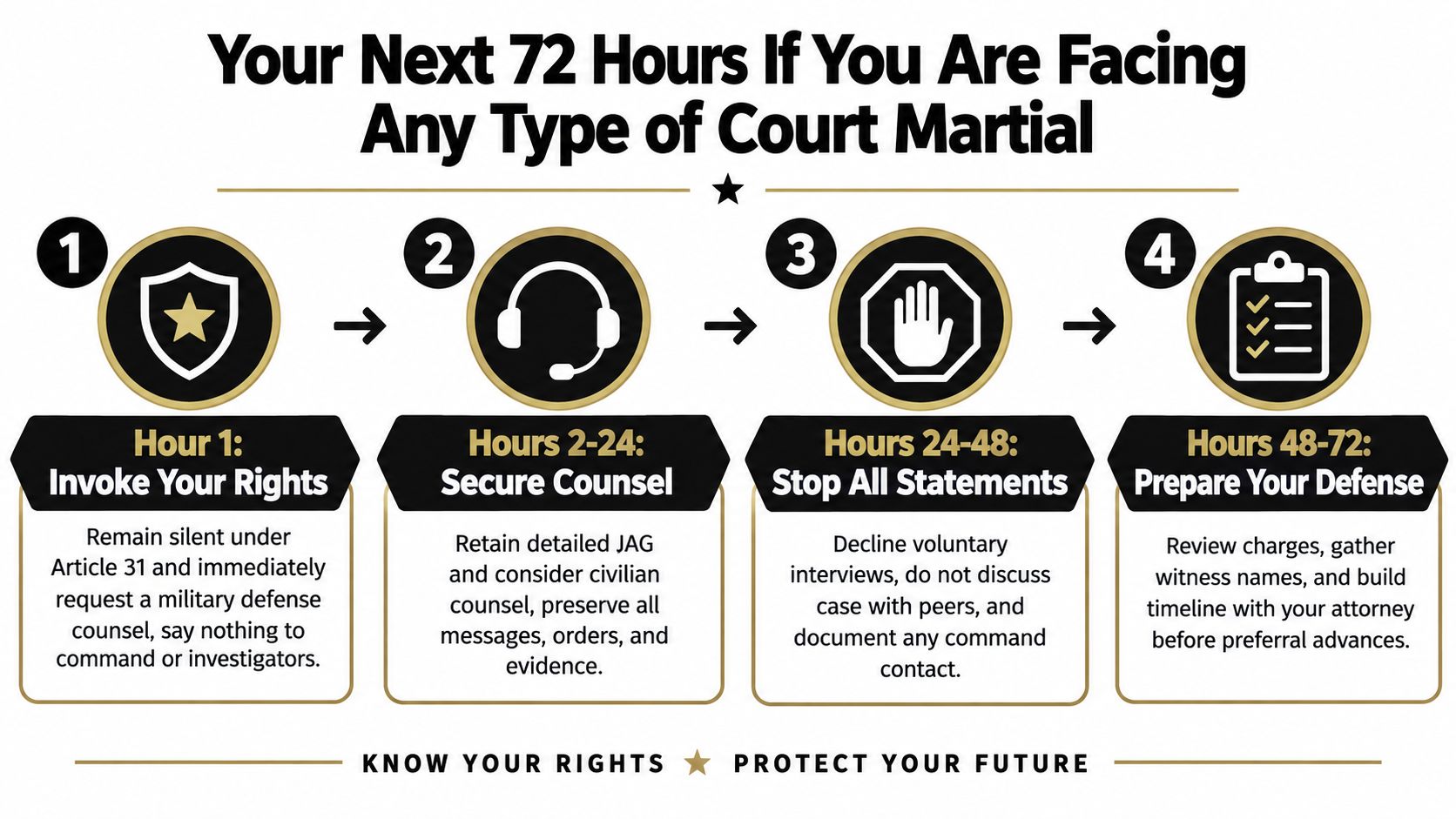
Hour 1
Invoke your right to remain silent under Article 31. Then stop talking.
If you need a plain-language refresher on that protection, read this guide to Article 31 of the UCMJ. Refuse voluntary written statements. Don’t “clarify” facts for your first sergeant, your chief, your platoon sergeant, or your buddy in the barracks. None of them can fix this for you.
If you’ve also been arrested off base or your situation overlaps with civilian custody, a practical general checklist like what to do when arrested in Southern can help you avoid the usual early mistakes that make both criminal and military cases worse.
Hours 2 to 24
Start building a defense file.
Get copies or preserve access to:
- Orders and duty records
- Texts, emails, and messages
- Witness names and contact details
- Prior counseling, NJP history, or administrative paperwork
- Any notice showing the recommended disposition
Write down every contact with investigators or command. Time. Place. Who was present. What was said. Memory decays fast, and investigators often write reports in a way that sounds cleaner than the conversation felt.
Hours 24 to 48
Find out what lane the case is entering.
Ask your lawyer to determine:
- Is command considering summary, special, or general court-martial?
- What punishment exposure are they signaling?
- Is this the kind of case likely to trigger the Special Trial Counsel system?
- Are there upcoming waiver decisions or hearing deadlines?
The point where many families panic and start calling random criminal lawyers. Don’t do that. You need a UCMJ lawyer or court-martial attorney who understands military procedure, command practice, and how forum selection changes the whole board.
Hours 48 to 72
Retain counsel before you respond to major process decisions if you can. Ask for time when time helps the defense. Push to preserve the widest possible range of strategic options.
Your checkpoint question for every move is simple:
- Does this preserve the ability to challenge evidence?
- Does this avoid locking me into the worst forum too early?
- Does this improve my position, or just make command’s job easier?
Frequently Asked Questions About Types of Court Martial
Can I refuse to talk to CID or NCIS
Yes. If you’re being questioned about suspected misconduct, staying silent is often the smartest move. Talking rarely makes the case disappear. It usually gives the government a cleaner exhibit.
What is the lowest type of court martial
Summary court-martial is the lowest forum. It is limited to minor offenses and uses a single commissioned officer as the trial authority in that proceeding.
Which court-martial can give me a bad-conduct discharge
A special court-martial can adjudge a bad-conduct discharge for enlisted personnel (special court-martial punishment authority). General court-martial carries even greater punitive exposure.
Which type of court martial is the most serious
General court-martial is the highest and most serious forum. It can adjudge the full punishment authorized for the offense, including life imprisonment or death for capital offenses (general court-martial authority).
Do I need a civilian lawyer if I already have a military lawyer
In serious cases, often yes. Detailed military counsel can be capable and hardworking, but civilian defense counsel brings independent strategy, outside perspective, and, in many cases, deeper trial-specific experience across multiple branches and installations.
Will I go to jail
That depends heavily on the forum. Summary has a sharply capped confinement range. Special carries up to 12 months of confinement in the intermediate forum. General can expose you to far more serious confinement based on the charged offense.
Does forum choice affect my future after the military
Absolutely. Forum affects discharge exposure, criminal consequences, appellate posture, and how much damage can follow you into civilian life. It’s one of the most important decisions in the case, even though you may not control it alone.
If you are under investigation, have been read your rights, or think charges are about to be preferred, act now. Don’t wait for command to “see reason.” Don’t assume the forum will sort itself out. And don’t mistake silence from legal for safety.
Your career is on the line. Your record is on the line. In some cases, your freedom is on the line.
Talk to experienced civilian military defense lawyers immediately. The earlier your defense starts, the more room there is to fight for the right forum, challenge the evidence, and keep a bad case from becoming a permanent one.