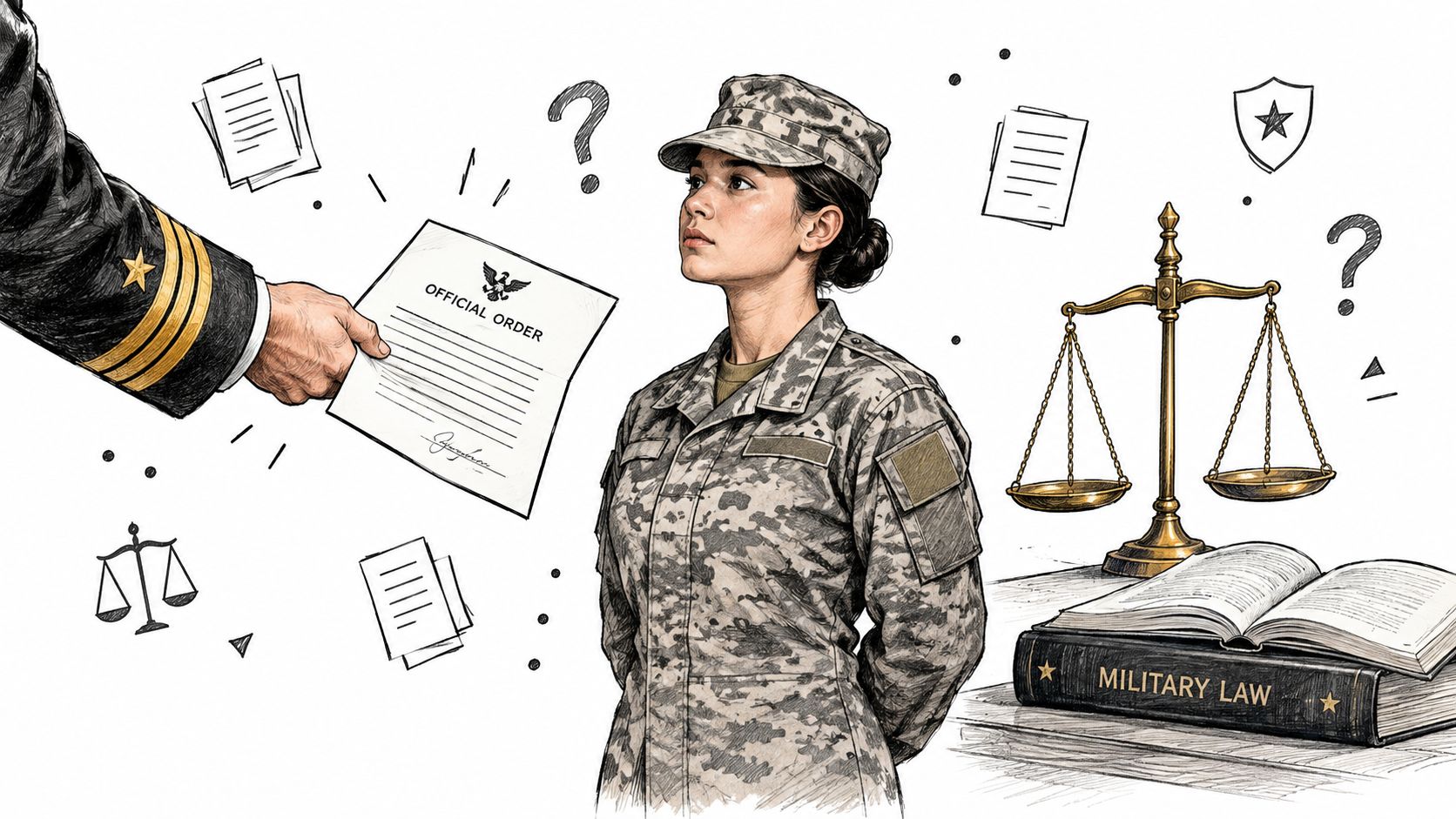
You get called into the company office because you allegedly disobeyed a commissioned officer. The conversation may have started with a rushed instruction, a conflicting message from an NCO, or a heated exchange during a demanding task. By the time CID, NCIS, OSI, or CGIS becomes involved, the command may already be describing the event as deliberate defiance.
That label matters. UCMJ Article 90 is a serious offense involving willful disobedience of a lawful command from a superior commissioned officer. A conviction can affect your freedom, rank, pay, discharge, career, and reputation. Even before trial, the allegation can trigger an Article 15, administrative separation, unfavorable evaluations, or referral toward a court-martial.
The public discussion usually stops at the maximum punishment. That misses the fight. Article 90 cases often turn on whether the order was lawful, specific, personally directed, clearly communicated, and intentionally disobeyed. Charge selection matters too. A command that cannot prove Article 90 may try Articles 89, 91, or 92 instead. The decisions you make immediately can influence whether the case is dismissed, reduced, negotiated, or referred.
Table of Contents
- When a Simple Argument Becomes a Career-Ending Charge
- What UCMJ Article 90 Says
- Elements the Government Must Prove
- Article 90 Compared to Articles 89, 91, and 92
- How an Article 90 Case Moves Through the System
- Mistakes That Destroy Article 90 Defenses
- Why Civilian Military Defense Counsel Changes the Outcome
- Frequently Asked Questions About UCMJ Article 90
- What is Article 90 of the UCMJ?
- Does an Article 90 order have to be written?
- Can conflicting orders defeat an Article 90 charge?
- Can I refuse to talk to CID, NCIS, OSI, or CGIS?
- Will I go to jail for Article 90?
- Do I need a lawyer immediately?
- Is Article 90 the same as Article 92?
- Can an Article 90 allegation affect an administrative separation?
When a Simple Argument Becomes a Career-Ending Charge
A junior Marine is standing near a maintenance area while a commissioned officer gives rapid instructions. The Marine believes an NCO has already changed the task. The officer repeats the order. The Marine mutters something under his breath, turns away, and walks toward the equipment bay.
The entire exchange lasts seconds. Within a short time, the command describes it differently. The officer says the Marine knowingly refused a direct order. A witness remembers the tone but not the exact words. Someone reports that the Marine “challenged authority.” The Marine is flagged, told not to discuss the matter, and hears that an investigation may begin.
He’s shocked. He knows he was frustrated, but he doesn’t believe he deliberately disobeyed a lawful order. He’s also worried that the officer will retaliate if he refuses to give a statement. His first instinct is to explain everything to the platoon sergeant and trust the chain of command to sort it out.
That instinct can make the case worse.
Practical rule: Don’t try to repair a command dispute by giving an unprepared explanation. Your words may become the government’s evidence of knowledge, intent, and willfulness.
The immediate risk isn’t limited to confinement. A referral can damage your record, expose you to a punitive discharge, and create pressure to accept a disposition you would have evaluated differently with counsel. The command may also use the allegation to support an administrative separation or other adverse action even before a court-martial decision.
The first defense questions are precise:
- What exactly was ordered?
- Who gave the order?
- Was the officer superior to the accused?
- Was the command personal and specific?
- Did the service member hear and understand it?
- Was the instruction lawful and possible to follow?
- Did another leader give conflicting guidance?
- What did the accused intend at the moment of noncompliance?
Those questions form the roadmap for an Article 90 defense. They also explain why an experienced UCMJ lawyer gets involved before the command settles on a charge. The rest of this article addresses the statutory requirements, the differences between related UCMJ offenses, the investigation pipeline, common self-inflicted damage, and the role of civilian military defense lawyers.
What UCMJ Article 90 Says
Article 90 traces to the original Uniform Code of Military Justice enacted by Congress on May 5, 1950. Congress codified it at 64 Stat. 135, and the provision later became 10 U.S.C. § 890, as shown in the official statutory history for 10 U.S.C. § 890.
The modern offense is narrow. Article 90 addresses willful disobedience of a lawful command from a superior commissioned officer. An officer’s instruction and a service member’s failure to follow it do not, by themselves, establish guilt.
The command must have legal force
The issuing person must be a commissioned officer, and the officer must be superior to the accused in the legally relevant relationship. The command must be lawful and specifically directed to the accused. A general statement, standing regulation, or duty that existed independently of the particular instruction may point toward another offense rather than Article 90.
Communication can occur personally, through another person, or through a published directive. The prosecution still must show that the accused knew of the command and deliberately disobeyed it. A rushed verbal instruction, an unclear message, or conflicting guidance can create a direct proof fight over notice and intent.
That distinction affects charging decisions. Violations of regulations, standing orders, directives, and previously established duties generally belong under Article 92 rather than Article 90, according to the CAAF digest on Article 90 elements. Counsel should examine whether the command is personal and specific, or whether the government is recasting a general obligation as a direct order. The same conduct may also prompt consideration of Articles 89 or 91, depending on the person involved and what allegedly occurred.
The punishment is severe, but it’s only a ceiling
For offenses committed outside wartime, the traditional maximum includes 5 years of confinement, a dishonorable discharge, forfeiture of all pay and allowances, and reduction to E-1. The statute authorizes death or another punishment a court-martial may direct in wartime, as stated in the current text of 10 U.S.C. § 890.
Those are maximums, not automatic sentences. The evidence, charging decision, forum, negotiations, and defense strategy determine the practical exposure. Before January 1, 2019, Article 90 also covered assaulting a superior commissioned officer. That provision moved to Article 89(b), leaving Article 90 focused on willful disobedience, as summarized in this Article 90 statutory overview.
Elements the Government Must Prove
An Article 90 prosecution is not a checklist where rank and noncompliance automatically equal guilt. Each element is a separate place to attack the government’s theory. The Court of Appeals for the Armed Forces identified the core requirements in United States v. Ranney, and the decision is available in the Ranney opinion.
The accused must fall within military jurisdiction
The government must establish that the accused was subject to the UCMJ when the alleged conduct occurred. That point may be routine for active duty personnel, but it can require closer examination for reservists, retirees, and dual-status personnel. Duty status, orders, and the precise timing of the event can matter.
The officer and relationship must be proven
The prosecution must show that a commissioned officer issued the command and that the accused knew the officer was a superior commissioned officer. Rank alone doesn’t answer every question. Counsel examines the officer’s status, the accused’s knowledge, the command relationship, and whether the person giving the instruction had authority over the accused in the circumstances.
The order must be lawful and specific
The order must be lawful, and it must be personally directed to the subordinate. A general policy, regulation, standing duty, or broad announcement may support another charge, but it doesn’t automatically satisfy Article 90. Defense counsel will request the underlying orders, command policies, communications, and records showing the asserted authority.
Knowledge and willfulness are where many cases break
The accused must know of the order and willfully disobey it. Willfulness means intentional disobedience, not mere negligence, delay, confusion, or an honest mistake. A service member who didn’t hear an order in a noisy environment, followed a conflicting instruction, or attempted compliance but encountered a genuine obstacle may present a different case from someone who deliberately refused.
The defense develops those facts through contemporaneous texts, witness interviews, timelines, duty records, medical documentation, and cross-examination. The key is to investigate what the accused understood at the time, not merely what the officer later says the order meant.
| Element | Defense attack |
|---|---|
| Status under the UCMJ | Verify duty status, jurisdiction, and timing |
| Superior commissioned officer | Test rank, relationship, authority, and knowledge |
| Lawful command | Examine legality, scope, clarity, and purpose |
| Personal direction | Determine whether the order actually targeted the accused |
| Knowledge of the order | Challenge communication, receipt, hearing, and understanding |
| Willful disobedience | Show confusion, competing instructions, inability, or lack of intent |
Article 90 is won or lost in the details surrounding the order, not in the emotional description of the argument.
Article 90 Compared to Articles 89, 91, and 92
Commands have several ways to characterize conduct that feels insubordinate. Article 90 concerns willful disobedience of a superior commissioned officer’s lawful command. Article 89 concerns assaulting or demeaning a warrant, noncommissioned, or petty officer. Article 91 addresses insubordinate conduct toward a warrant officer, NCO, or petty officer. Article 92 generally addresses failure to obey an order or regulation.
That overlap creates room for charge selection. The rank of the recipient, the existence of a specific command, the presence of assaultive or demeaning conduct, and the accused’s mental state can change the charging theory. A weak Article 90 allegation may be reframed under Article 92, while a command may retain Article 90 to create an advantage during negotiations.
| Article | Rank of recipient | Required conduct | Maximum punishment |
|---|---|---|---|
| Article 90 | Superior commissioned officer | Willful disobedience of a lawful, specific command | Outside wartime, up to 5 years of confinement, dishonorable discharge, total forfeitures, and reduction to E-1 |
| Article 89 | Warrant, noncommissioned, or petty officer | Assaulting or demeaning the protected leader | Depends on the charged conduct and applicable sentencing rules |
| Article 91 | Warrant officer, NCO, or petty officer | Insubordinate conduct, disobedience, disrespect, or assault covered by the article | Depends on the charged conduct and applicable sentencing rules |
| Article 92 | Varies by order or regulation | Failure to obey an order or regulation, or dereliction | Depends on the charged offense and applicable sentencing rules |
Article 92 deserves careful attention. A published regulation or standing directive usually isn’t a personal Article 90 command. If the charge alleges that you failed to perform an established duty rather than deliberately refusing a direct order, the defense should analyze whether the government selected the wrong offense. The distinction is explained in the guide to UCMJ Article 92 and failure to obey an order or regulation.
The practical lesson is uncomfortable. Charge selection often reveals the government’s confidence more than the underlying facts. A command may use the most intimidating label first, then retreat to a lesser or different offense after counsel exposes the proof gap.
How an Article 90 Case Moves Through the System
An Article 90 case usually begins with a command report, not a courtroom. The commander receives an allegation, gathers preliminary information, and decides whether to direct an inquiry, request a law-enforcement investigation, impose nonjudicial punishment, pursue administrative action, or recommend court-martial charges.

Step 1 begins with the command inquiry
The first version of events can become the case narrative. Defense counsel should preserve messages, identify witnesses, obtain relevant orders, and document the environment before memories change. If investigators are involved, the service member should invoke applicable rights and avoid attempting to explain the matter informally.
Step 2 is the investigation
CID, NCIS, OSI, CGIS, or a command-directed investigator may interview witnesses, collect digital records, obtain video, and question the accused. Investigations aren’t neutral in practice. The officer’s account may receive immediate weight, while contradictory context gets overlooked.
Step 3 is the Article 32 preliminary hearing
For charges headed toward a general court-martial, an Article 32(b) preliminary hearing provides a formal opportunity to test probable cause, identify weaknesses, and develop the record. It isn’t a trial, but cross-examination and documentary evidence can influence whether charges are referred and how the command evaluates the case.
The accused may face preferral before or around this stage, followed by legal advice from the staff judge advocate. The special or general court-martial convening authority then makes the referral decision. That decision is often the most important point because a well-presented defense can show that the evidence doesn’t support the proposed forum or charge.
Step 4 is the court-martial
A summary court-martial, special court-martial, and general court-martial differ in authority, procedure, and potential exposure. Counsel evaluates the forum, motions, witness testimony, digital evidence, order language, and sentencing consequences. Article 39(a) sessions address matters outside the presence of the members, including motions and evidentiary issues.
Readers who need the broader procedural framework can review court-martial basics. The defense objective is to attack admissibility, credibility, notice, legality, and intent before the factfinder hears a simplified command narrative.
Step 5 ends with disposition and review
After a finding and sentence, the accused may submit matters for consideration, seek clemency where available, and pursue post-trial review. Article 76 gives finality rules to completed court-martial judgments, subject to the rights and review mechanisms that apply to the case.
Early intervention matters because many cases resolve before trial. A defense lawyer who waits for a courtroom may miss the opportunity to prevent referral, narrow the specifications, or show that Article 90 doesn’t fit the evidence.
Mistakes That Destroy Article 90 Defenses
The government doesn’t need help proving willfulness. Service members often supply it through avoidable statements, deleted messages, or inconsistent explanations. The first response should protect the defense, not satisfy the command’s demand for immediate closure.

- Giving a voluntary statement: Talking to CID, OSI, NCIS, or command investigators without counsel can lock you into a version that later appears inconsistent. Invoke your rights and consult counsel before answering substantive questions.
- Trusting the chain of command to fix it: Your leaders may believe the allegation must be addressed to preserve authority. Being “right” doesn’t guarantee that the command will interpret events in your favor.
- Waiting for Article 15 proceedings: A nonjudicial punishment decision doesn’t replace early defense work. Counsel may influence whether the matter is handled administratively, reduced, or referred.
- Failing to preserve evidence: Texts, call logs, schedules, duty rosters, watch records, and witness contact information can disappear or become harder to authenticate. Preserve them without altering or deleting anything.
- Accepting the first proposed forum: A summary court-martial offer, plea proposal, or administrative resolution may carry consequences you haven’t evaluated. Compare the forum, maximum exposure, collateral effects, and evidentiary defenses.
- Posting about the dispute: Angry social-media posts can create new evidence and damage credibility. Keep the issue off public platforms.
- Preparing testimony alone: An honest witness can still make damaging admissions under pressure. Testimony requires preparation around chronology, wording, perception, and limits of memory.
A defense lawyer may issue preservation requests, build a timeline, locate witnesses, review the actual order, and prepare a written response for the commander. Those actions are difficult after the command narrative hardens.
The first response should preserve options. It shouldn’t be an emotional attempt to win the argument with the people who may recommend charges.
Why Civilian Military Defense Counsel Changes the Outcome
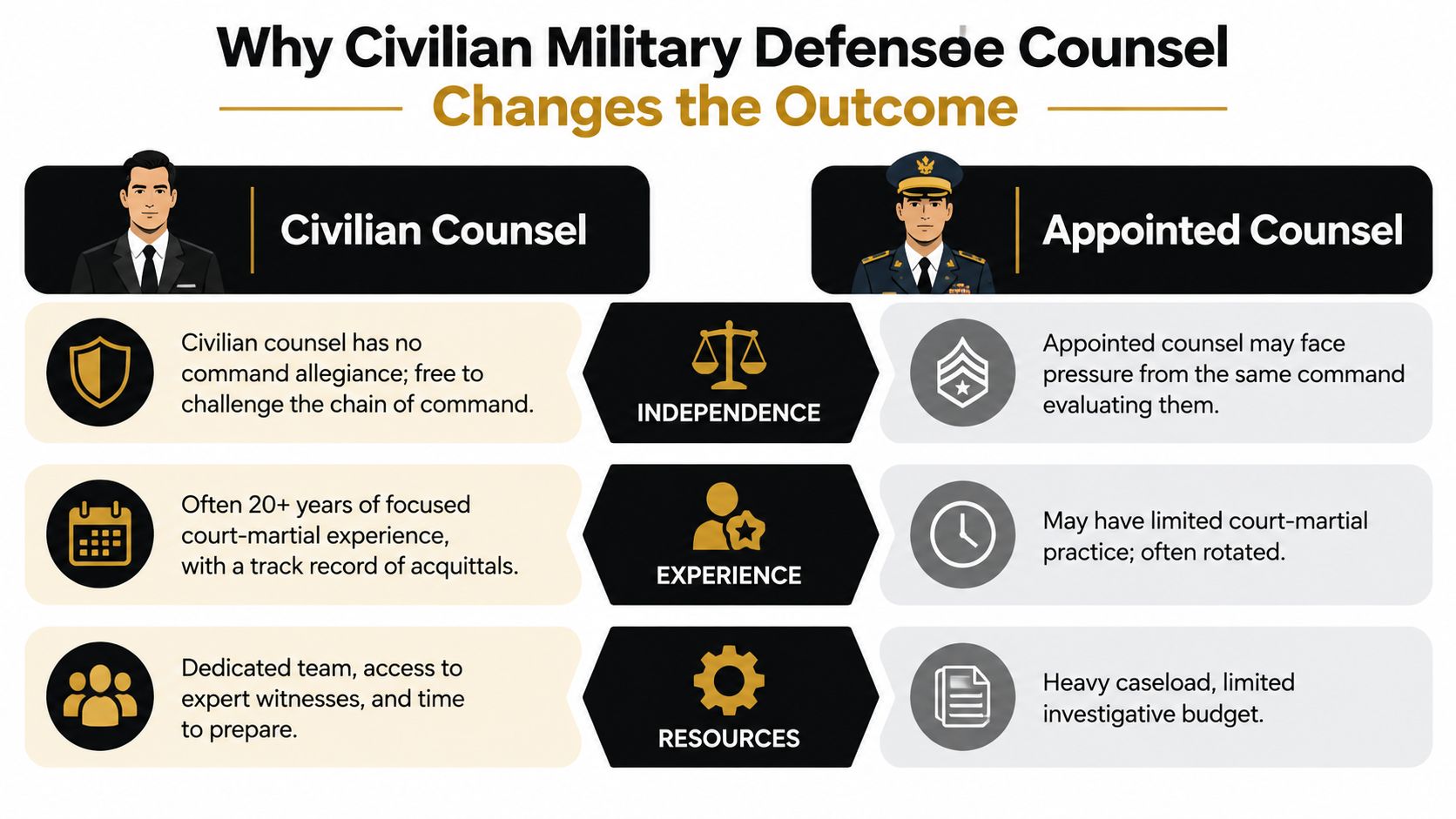
Military-appointed counsel can be capable and dedicated. The issue is not that every appointed attorney lacks skill. The issue is structural. A detailed defense counsel works inside a rotating military system, may carry multiple cases, and may have limited control over time, investigative resources, and long-term availability.
A retained civilian military defense lawyer has a different operating position. Civilian counsel isn’t evaluated by the command that investigated you. Counsel can challenge the officer’s credibility, subpoena or seek records through litigation, coordinate civilian witnesses, consult outside experts, and remain focused on the case without a collateral military assignment.
Independence changes the first conversation
An appointed lawyer can advise you about rights and defend you at court. A civilian attorney can also begin building a defense before referral by examining the command’s theory, identifying charge-shopping, interviewing witnesses outside the unit, and presenting a focused response to the convening authority.
That independence matters when the command describes disagreement as defiance. The lawyer must be willing to say that the order wasn’t clear, the officer lacked authority, the witness is unreliable, or Article 92 fits better than Article 90. A lawyer who avoids conflict with the institution cannot reliably protect you from the institution.
Trial experience changes preparation
Article 90 litigation requires more than reading the elements. Counsel needs to understand cross-examination, military credibility dynamics, digital evidence, command investigations, Article 32 practice, and sentencing consequences. The defense must turn a short emotional incident into a disciplined factual record showing what was said, heard, understood, and intended.
Civilian firms also may provide continuity from investigation through trial and post-trial work. That can matter when the case includes parallel Article 15 proceedings, administrative separation, security-clearance concerns, or command-directed investigations.
Before retaining anyone, ask direct questions:
- How often does the lawyer litigate court-martial cases?
- Has the lawyer defended Article 90 or related disobedience allegations?
- Who will personally handle interviews, motions, and trial?
- What is the plan for the first week?
- How will the lawyer preserve digital and command evidence?
- What are the risks of accepting a proposed disposition?
The guide to selecting a military defense lawyer can help organize those questions.
Civilian counsel isn’t a guarantee of a particular result. It is a strategic choice to add independent, focused advocacy when the command has already decided that your conduct deserves punishment.
A short explanation of the difference between appointed and civilian representation is available here:
Frequently Asked Questions About UCMJ Article 90
What is Article 90 of the UCMJ?
Article 90 covers willful disobedience of a lawful command from a superior commissioned officer. The government must prove more than noncompliance. It must establish the required relationship, a lawful and specific command, knowledge of the command, and intentional disobedience.
Does an Article 90 order have to be written?
No. A verbal order can support an Article 90 charge, but the government still must prove that the order was lawful, specific, directed to the accused, communicated, understood, and willfully disobeyed. A noisy, rushed, or ambiguous exchange can create reasonable doubt about those facts.
Can conflicting orders defeat an Article 90 charge?
They can. Conflicting instructions from an NCO or another officer may undermine the government’s claim that the accused deliberately defied the commissioned officer. The defense should preserve the messages, identify the people who gave the competing directions, and establish what the accused reasonably understood at the time.
Can I refuse to talk to CID, NCIS, OSI, or CGIS?
You have the right to consult counsel before making a statement, and you should exercise that right when questioning may expose you to criminal or disciplinary action. Be professional, don’t argue with investigators, and don’t try to explain the incident before receiving legal advice.
Will I go to jail for Article 90?
Confinement is authorized outside wartime, and the traditional maximum is 5 years, along with other severe punishment, as reflected in the statutory text of Article 90. Whether confinement is imposed depends on the forum, findings, sentence, facts, negotiations, and defense presentation. A charge isn’t a conviction, but waiting to prepare can increase the risk.
Do I need a lawyer immediately?
Yes, if the command has accused you of willfully disobeying a superior commissioned officer, questioned you about the incident, flagged you, or mentioned an Article 15, investigation, separation, or court-martial. Early counsel can preserve evidence and challenge the charging theory before it becomes fixed.
Is Article 90 the same as Article 92?
No. Article 90 focuses on willful disobedience of a superior commissioned officer’s specific lawful command. Article 92 generally involves failure to obey an order or regulation or dereliction. The exact wording and facts determine which article fits.
Can an Article 90 allegation affect an administrative separation?
It can. Even when the command doesn’t refer a court-martial, the allegation may influence adverse evaluations, a GOMOR, Article 15 proceedings, or separation recommendations. Defense strategy must account for every forum, not just the possibility of trial.
If you’re under investigation, have been accused of disobeying an officer, or have received notice of an Article 15, administrative action, or court-martial recommendation, contact an experienced civilian military defense lawyer now. Preserve every message and order, stop discussing the facts with investigators or coworkers, and get a case-specific assessment before you make another statement. Your career, freedom, and discharge status may depend on what happens this week.