
Article 133 applies only to commissioned officers, cadets, and midshipmen. It carries no fixed sentence cap in the statute and can expose a convicted officer to dismissal, confinement, and total forfeiture of pay.
You may be reading this after receiving a legal assistance notification, a command inquiry, or an unexpected request to meet with CID, NCIS, OSI, or CGIS. The command may describe it as fact-finding. Investigators may say they only want your side. Treat the situation as serious from the first contact. An Article 133 UCMJ allegation can affect your commission, career, security clearance, reputation, and liberty.
The most dangerous mistake is assuming the government will sort out the difference between a bad decision and a crime. Investigators collect evidence. Commands protect missions and leadership confidence. Neither process is designed to build your defense. You need a strategy before you provide statements, consent to searches, or let an administrative record form without correction.
Table of Contents
- Understanding Article 133 UCMJ Charges
- Statutory Elements and Legal Standards
- Evolution and Modern Application
- Preemption Doctrine and Charging Strategy
- Potential Punishments and Procedures
- Why Civilian Defense Counsel Matters
- Common Mistakes That Destroy Defenses
- Frequently Asked Questions About Article 133 UCMJ
- Who can be charged under Article 133?
- What must the government prove?
- Can I refuse to talk to CID, NCIS, OSI, or CGIS?
- Does Article 133 have a fixed maximum sentence?
- Can Article 133 overlap with another UCMJ offense?
- Will I go to jail?
- Do I need a lawyer immediately?
- Can the government use Article 133 as a catch-all?
Understanding Article 133 UCMJ Charges

Article 133 is the UCMJ offense commonly called conduct unbecoming an officer, and it applies to commissioned officers, cadets, and midshipmen. The current provision appears in 10 U.S.C. § 933, with punishment left to the court-martial under the statute’s terms. The current U.S. Code provision identifies the covered officer statuses and the offense’s statutory language.
The government does not need to claim that your conduct harmed a unit or injured a particular victim. An allegation may involve official duties, private behavior, an act, or an omission. The dispute is whether the evidence proves what happened and supports the required officer-misconduct theory under the circumstances.
Why officers face a different risk
An officer’s commission gives the allegation a second target. Prosecutors and commands may argue that the conduct shows unfitness to hold a commission, lead subordinates, or represent the service. That argument can gain force even when the underlying evidence is thin.
A rumor can become a command narrative. A poorly documented interview can become an alleged admission. A private dispute can be recast as a leadership failure. The same allegation may then appear in an evaluation, clearance review, reprimand, or administrative board. A court-martial is not required for the professional consequences to continue.
The strategic mistake is treating Article 133 as a catch-all charge. If the alleged conduct fits a more specific UCMJ offense, counsel must examine whether that specific offense preempts an Article 133 theory. Charging the broad officer-misconduct provision may give the government flexibility, but it does not erase limits imposed by the preemption doctrine. Raise that issue early, before broad language controls the investigation or plea discussions.
Practical rule: Do not try to talk your way out of an Article 133 investigation before counsel has reviewed the allegation, the evidence, and any more specific offense that may apply.
Your first priorities are straightforward:
- Preserve evidence: Keep messages, calendars, records, and relevant documents. Do not delete or alter anything.
- Control communications: Do not discuss the allegation with witnesses, subordinates, or investigators without legal advice.
- Identify every forum: Determine whether the matter involves a criminal investigation, command inquiry, reprimand, clearance issue, or separation action.
- Test the charging theory: Ask whether Article 133 is being used because the facts support it, or because the government has not identified a more specific offense.
- Get independent advice: A UCMJ lawyer can assess the charge before your words become evidence.
Statutory Elements and Legal Standards
The government must prove two core elements. The first is that the accused did or omitted certain acts. The second is that, under the circumstances, those acts or omissions constituted conduct unbecoming an officer and gentleman under the doctrinal formulation reflected in the Manual for Courts-Martial. The Court of Appeals for the Armed Forces digest describes the controlling standard as a material, pronounced, morally unfitting departure that dishonors or disgraces the officer and seriously detracts from the person’s standing as a commissioned officer.
The law doesn’t punish every mistake, awkward interaction, or lapse in judgment. The prosecution has to connect the proven conduct to the officer standard. That connection is where many defenses are won.
Element one concerns what actually happened
The government must identify the act or omission with enough clarity to let the accused understand the allegation and defend against it. Vague accusations are not a substitute for proof. Counsel should examine:
- What specific conduct is alleged?
- When and where did it occur?
- Who observed it directly?
- What document, recording, message, or admission supports it?
- Does the evidence prove an act, or only an interpretation of an act?
Investigators often collect conclusions before they collect context. A witness may describe an officer as “unprofessional,” but that label doesn’t prove the underlying event. A command may characterize a conversation as abusive, dishonest, or improper without preserving the exact words, sequence, tone, or surrounding circumstances.
Element two supplies the legal boundary
The second element asks whether the conduct was unbecoming an officer under the circumstances. The test is not whether someone disliked the behavior or whether a commander lost confidence. The factfinder must assess whether the conduct materially and seriously compromised the officer’s standing.
The 2024 Manual for Courts-Martial%20(2024_01_02)%20(adjusted%20bookmarks).pdf) identifies the two core elements and explains the practical burden. The government doesn’t need to prove a separate injury to the unit or a specific victim. It must prove the conduct and establish that the conduct crossed the line for officer behavior.
That standard creates a defense opportunity. The prosecution may have evidence that something happened, yet lack proof that the event was a material, pronounced, morally unfitting departure. Context matters. So do motive, authorization, misunderstanding, privacy, credibility, and the officer’s actual role.
Don’t accept the government’s label as the legal test. A defense lawyer should separate the alleged act from the command’s characterization, then attack each element independently.
Evolution and Modern Application
Article 133 entered the original UCMJ on May 5, 1950, during the post-World War II modernization of military law. The codified provision now appears at 10 U.S.C. § 933. Its history reflects a continuing expectation that commissioned leaders meet professional standards tied to their commissions. The historical statute and codification record establishes that legal timeline.
Congress changed the wording through Public Law 117-81, the FY2022 National Defense Authorization Act. Effective December 27, 2021, the statute removed “and a gentleman” from the title and text. The offense is now titled conduct unbecoming an officer. The amendment modernized the language while preserving the central inquiry, whether the conduct materially and seriously compromised the officer’s standing.
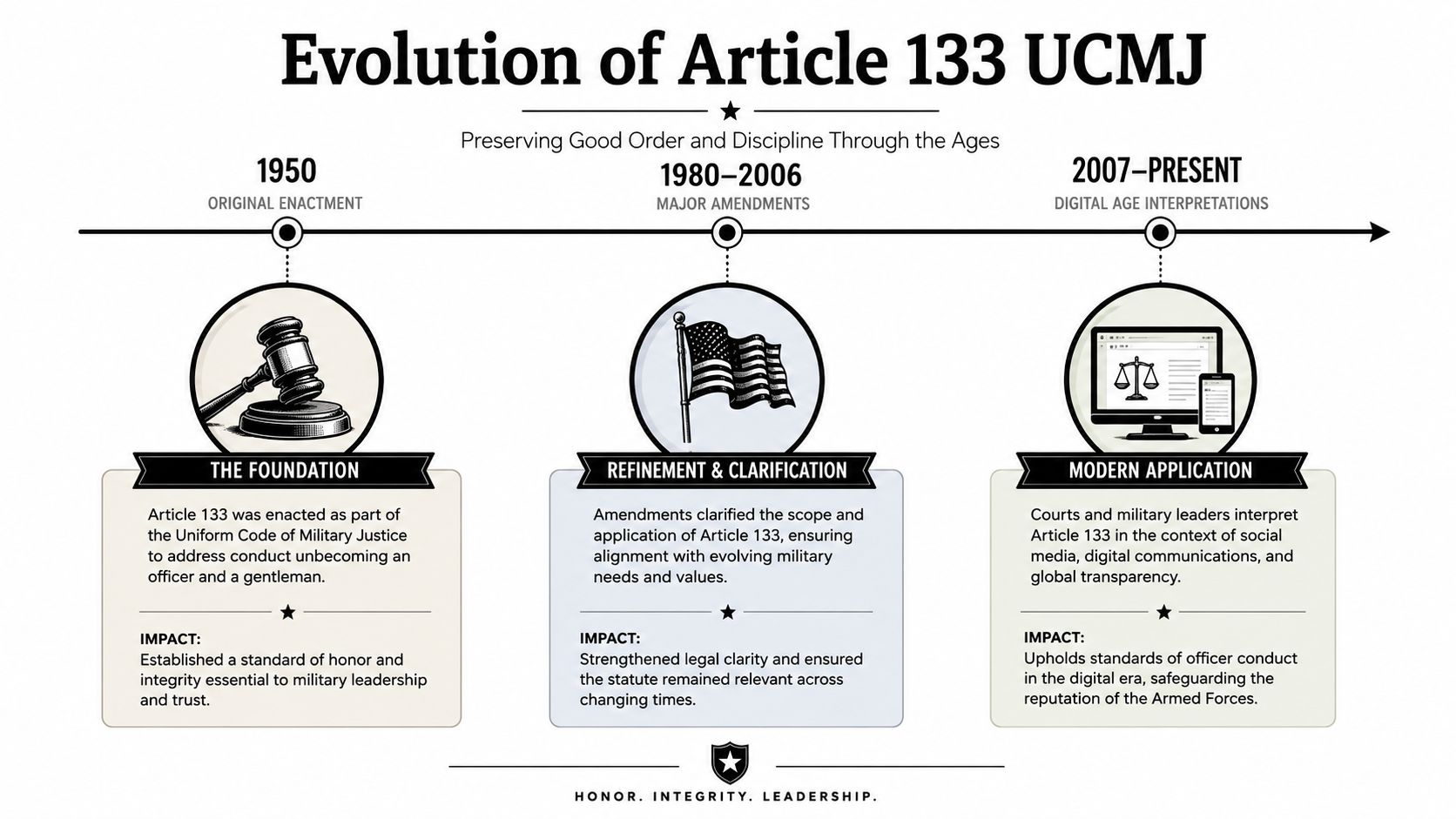
What changed and what didn’t
The statutory phrase changed. The prosecution still must prove the alleged conduct and establish that it was unbecoming under the circumstances. Removing gendered terminology modernized the offense, but it did not make Article 133 a general morality charge or a substitute for a specific punitive article.
That distinction controls charging strategy. If another article directly covers the alleged misconduct, counsel should examine whether Article 133 is being used as a catch-all. A broader officer-status theory can expand the government’s narrative and create pressure for a quick plea, even when the specific offense provides the proper legal framework.
Older cases and doctrinal explanations may still help, but counsel must separate useful reasoning from obsolete terminology. The 2024 Manual for Courts-Martial.PDF) continues to list Article 133 among the punitive articles.
For an accused officer, the practical rule is simple. Use the current statutory language, test whether a more specific offense controls, and challenge any attempt to turn Article 133 into a free-floating character charge. Older wording does not decide the case. The alleged conduct, evidence, charging theory, and relationship to the officer’s standing do.
Preemption Doctrine and Charging Strategy
Article 133 shouldn’t automatically be the government’s answer whenever an officer’s conduct looks bad. The preemption doctrine generally limits the use of Articles 133 and 134 for conduct already covered by Articles 80 through 132. The CAAF digest’s discussion of preemption is essential reading for anyone facing multiple specifications from the same facts. The military appellate digest on preemption explains the doctrine that many consumer summaries ignore.
Here’s why it matters. Suppose the government has a specific punitive article that directly addresses the alleged behavior. Charging Article 133 as an additional catch-all may blur the legal theory, expand the prosecution’s narrative, and create pressure for a quick plea. It may also create a legal issue that affects motions, instructions, charging decisions, plea bargaining, and appeal.
The charge may reveal the prosecution’s strategy
Prosecutors sometimes want both a specific offense and an officer-status theory. The specific article identifies the technical misconduct. Article 133 supplies the broader claim that the conduct disgraced the commission. That combination can be legitimate in some circumstances, but it deserves scrutiny rather than automatic acceptance.
Defense counsel should compare:
- The factual act: What exactly does the government say happened?
- The specific article: Does another punitive article already proscribe that conduct?
- The Article 133 theory: What additional officer-specific misconduct does the government claim?
- The proof: Is the second theory based on evidence, or merely rhetoric?
- The prejudice: Does duplicative charging pressure the accused or distort sentencing?
Defense position: A broad charge shouldn’t rescue a specific charge that the evidence can’t support.
Preemption isn’t a magic dismissal button. It’s a doctrine that requires careful legal analysis of the charged conduct and the articles involved. A lawyer must examine the specifications, the evidence, the pleadings, and controlling precedent. The issue can still produce influence even when it doesn’t eliminate every allegation.
Your written advocacy matters here. Counsel should organize the factual and legal arguments with the precision expected in writing a winning brief, especially when challenging duplicative theories or preserving an appellate issue. The objective isn’t to sound advanced. It’s to force the government to identify the correct legal path and prove every required part.
Potential Punishments and Procedures
Article 133 provides that a convicted person “shall be punished as a court-martial may direct.” The statute does not set a fixed sentence cap. Depending on the governing sentencing law, charged conduct, forum, and sentencing evidence, punishment may include dismissal, confinement, and total forfeiture of pay. The article’s continuing place among punitive offenses is addressed in the 2024 Manual for Courts-Martial.
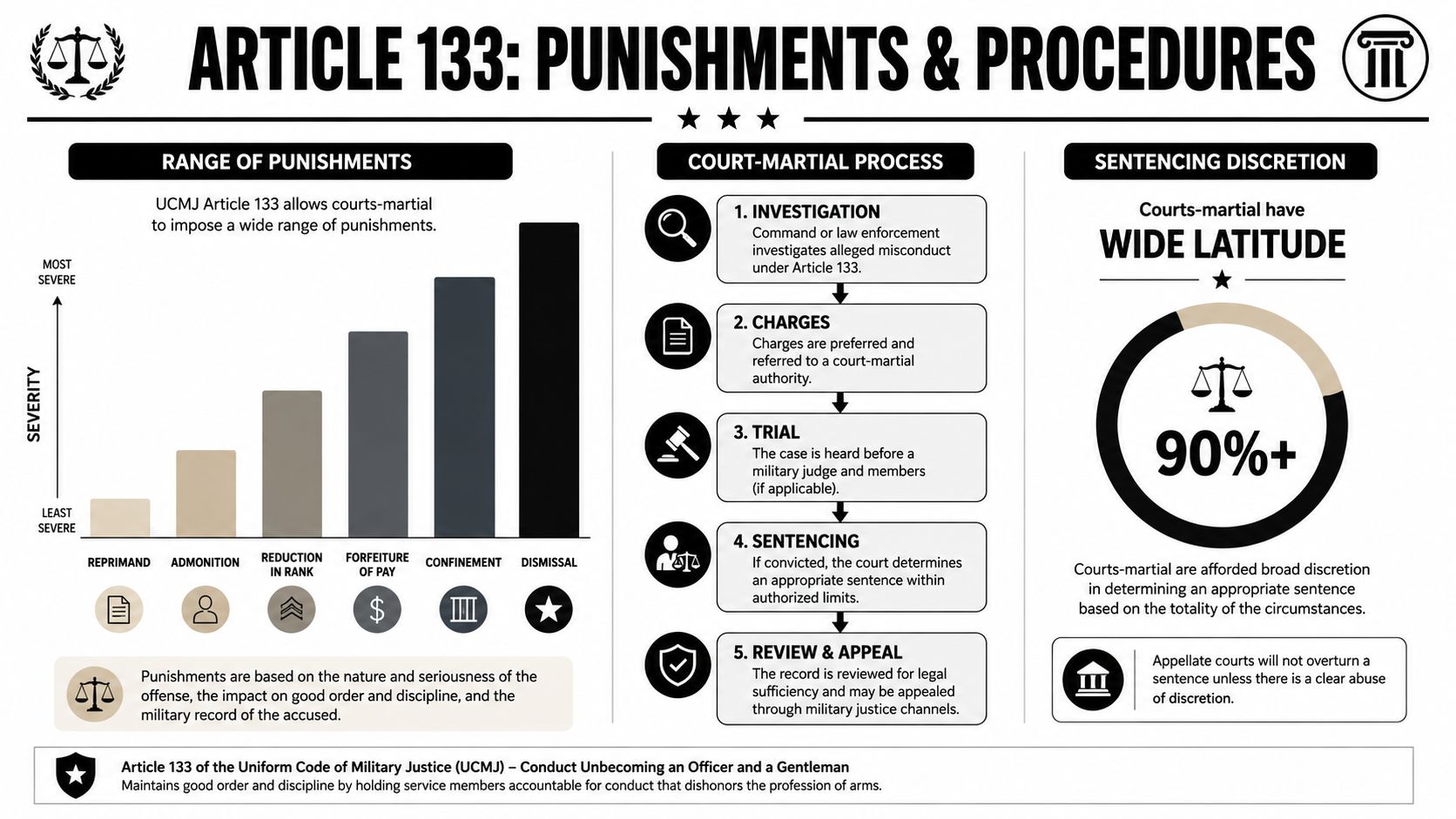
Punishment is only one part of the exposure
A conviction can put the commission at risk and trigger separate professional consequences. An officer may face adverse evaluations, removal from duties, clearance problems, or administrative proceedings. These consequences can develop during the criminal case, not merely after sentencing.
The forum changes both procedure and practical risk:
- Summary court-martial: A limited forum with meaningful restrictions and consequences. Treat it as a criminal proceeding, not an informal meeting.
- Special court-martial: A formal trial involving counsel, motions, findings, and sentencing.
- General court-martial: The most serious trial forum, with broader exposure and more demanding litigation.
The allegations and command decisions determine the precise path. The process commonly follows four stages.
Step 1, investigation. Law enforcement or command investigators gather statements, digital evidence, records, and witness accounts. Preserve evidence and invoke your rights before answering substantive questions.
Step 2, charging decision. The government selects the specifications and articles. Counsel should test factual sufficiency, jurisdiction, preemption, and the accuracy of the charging language. A specific offense may fit better than Article 133, and failing to challenge a catch-all theory can create unnecessary exposure.
Step 3, litigation or resolution. The defense may negotiate, file motions, contest the charges, or prepare for trial. Do not accept a quick resolution until counsel has assessed the proof, preemption issues, and collateral consequences.
Step 4, findings and sentencing. At trial, the factfinder evaluates each element. After a conviction, sentencing evidence becomes a separate fight.
Review these court-martial basics for orientation, but rely on counsel to analyze your actual specifications.
Why Civilian Defense Counsel Matters
Military-appointed counsel can be capable, hardworking, and committed. The problem is that a serious Article 133 case may require a level of specialization, availability, and independence that an accused officer shouldn’t assume will exist automatically.
A civilian military defense lawyer works for you alone. Civilian counsel isn’t assigned through your installation’s defense office and doesn’t answer to the command structure. That independence matters when the case involves senior leaders, a prominent unit, a sensitive investigation, or a command that has already formed a view of your character.
Compare the strategic roles
| Issue | Appointed military counsel | Experienced civilian counsel |
|---|---|---|
| Independence | Serves as defense counsel within the military system | Retained solely by the client |
| Article 133 strategy | May handle the issue, depending on experience and workload | Can focus deeply on officer-status, preemption, and charging theory |
| Investigation response | Advises under military defense channels | Can provide an outside strategic review and coordinate the response |
| Trial preparation | Depends on counsel’s individual background and caseload | Selection can be based on demonstrated court-martial experience |
| Family communication | Governed by counsel’s practice and availability | Can provide a separate point of contact for the family |
The right civilian lawyer should know how to challenge credibility, preserve suppression issues, analyze digital evidence, and present mitigation without conceding the charge. Ask about actual court-martial trial experience, experience defending officers, familiarity with the relevant service branch, and the lawyer’s view of preemption.
Ask the hard question: What is the defense theory, and what evidence will prove it?
A useful general resource is the Law Office of Bryan Fagan PLLC tips on evaluating criminal defense counsel. For military-specific comparisons, review court-martial defense lawyers and interview counsel directly.
You still need to assess communication, judgment, trial readiness, and whether the lawyer understands the stakes of your particular case.
Common Mistakes That Destroy Defenses
Officers often damage their own cases before charges are preferred. They do it while trying to appear cooperative, protect subordinates, or reassure the command. Those instincts are understandable. They’re also dangerous.
- Talking to investigators without counsel: Your explanation may create inconsistencies or fill gaps the government couldn’t fill. Ask for counsel before substantive questioning.
- Trusting a command promise: “This will stay informal” isn’t a legal protection. Preserve your rights and assume every written or verbal response may enter the record.
- Waiting for charges: Defense work should begin during the investigation. By the time charges arrive, witnesses may have aligned their accounts and digital evidence may be harder to reconstruct.
- Deleting messages: Deletion can look like consciousness of guilt and may destroy evidence that helps you. Preserve everything and let counsel handle lawful collection.
- Contacting the complainant: Direct contact can create allegations of pressure, retaliation, or witness interference. Don’t send the message.
- Arguing with subordinates: A heated exchange after learning of an allegation can become a separate issue. Keep communications professional and limited.
- Assuming no evidence means no case: Investigators may have statements, access logs, messages, or command records you haven’t seen.
- Treating Article 133 as a paperwork problem: A reprimand, evaluation entry, clearance action, or separation board can affect your career even without a court-martial conviction.
Read about the risks surrounding Article 31 rights under the UCMJ before you answer questions. Then contact an experienced civilian military defense lawyer immediately. Early advice preserves options. Delay hands the initiative to the government.
Frequently Asked Questions About Article 133 UCMJ
Who can be charged under Article 133?
Only commissioned officers, cadets, and midshipmen fall within Article 133’s status-based scope. It isn’t a general catch-all offense for enlisted personnel. The statute’s status requirement should be checked at the outset of every case.
What must the government prove?
The government must prove two core elements. It must show that the accused did or omitted certain acts, and that the conduct, under the circumstances, constituted conduct unbecoming an officer under the governing standard. The prosecution doesn’t need to prove a separate injury to a unit or a specific victim, but it must prove the conduct and its legally sufficient character.
Can I refuse to talk to CID, NCIS, OSI, or CGIS?
You have rights that may protect you from compelled self-incrimination, but the correct response depends on the setting and the questions. Don’t argue with investigators or guess at the legal consequences. Politely request counsel and follow counsel’s advice before providing a statement.
Does Article 133 have a fixed maximum sentence?
The statute authorizes punishment “as a court-martial may direct” and doesn’t state a fixed sentence cap in its text. Potential exposure can include dismissal, confinement, and total forfeiture of pay. The applicable sentencing framework and facts require case-specific legal review.
Can Article 133 overlap with another UCMJ offense?
Yes, but overlap raises the preemption doctrine. Articles 133 and 134 are generally limited when the conduct is already covered by Articles 80 through 132. Counsel should compare the factual allegations and specifications rather than accept duplicative charges as inevitable.
Will I go to jail?
You can’t answer that responsibly without reviewing the charge, evidence, forum, and sentencing framework. Confinement is among the possible consequences, but the outcome depends on the facts, the litigation strategy, and the sentence adjudged if there’s a conviction.
Do I need a lawyer immediately?
Yes, if you’re under investigation, have been asked for a statement, received a reprimand, or learned that charges may be coming. Appointed military counsel is available, but serious officer misconduct cases often justify consulting an experienced civilian UCMJ lawyer before you make decisions that can’t be undone.
Can the government use Article 133 as a catch-all?
It shouldn’t use Article 133 to bypass a more specific punitive article. The preemption doctrine can limit that approach and may create motion, negotiation, and appellate issues. Your defense counsel should analyze the specifications and the evidence before deciding how to challenge the charging theory.
If you’re facing an Article 133 investigation or allegation, contact an experienced civilian military defense lawyer today. Don’t give investigators a statement, consent to a search, contact witnesses, or sign an administrative response until counsel has reviewed your situation. Your commission, freedom, pay, clearance, and professional future are too important to leave to improvisation.