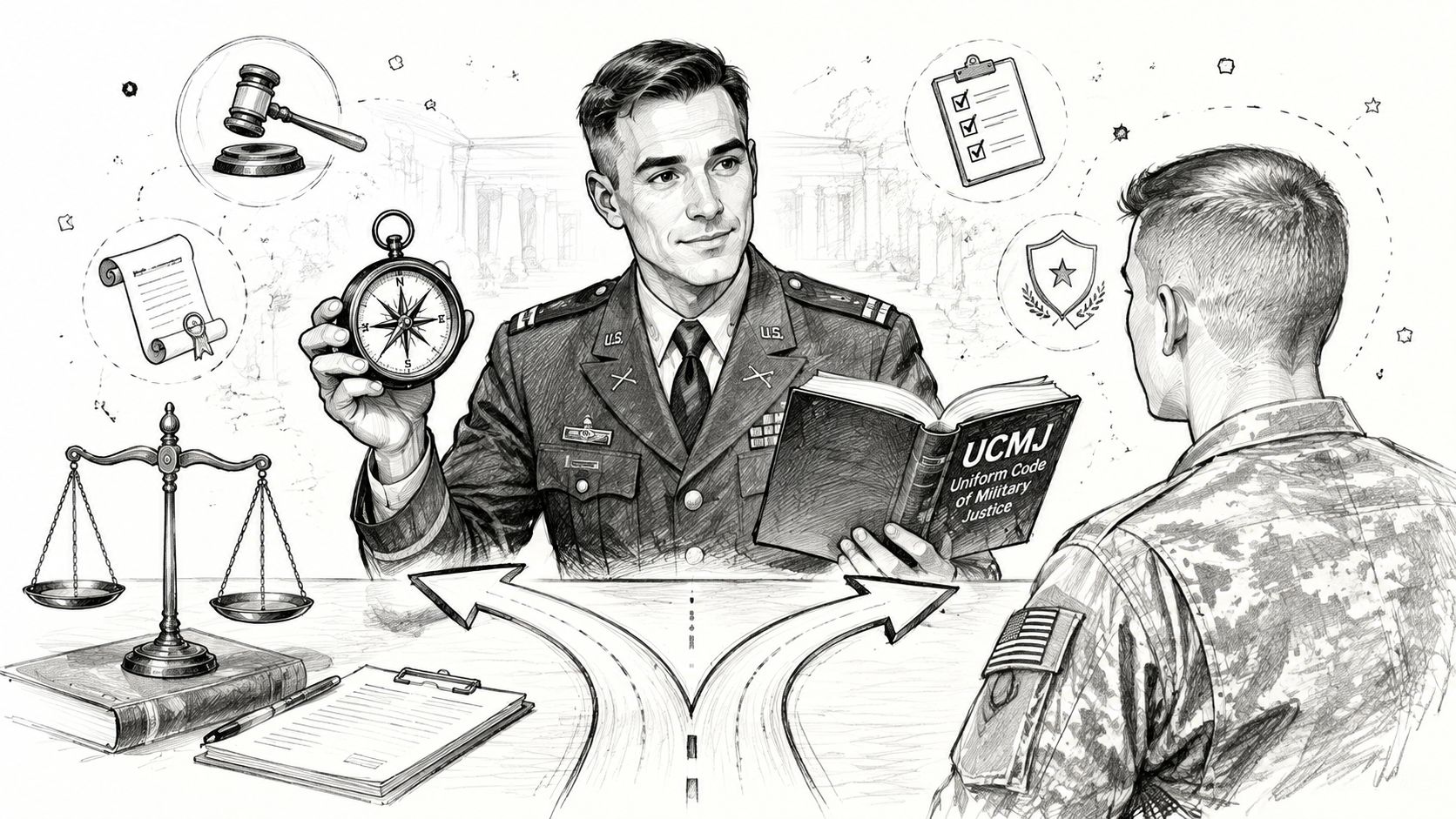
You’ve just learned that CID, NCIS, OSI, or CGIS wants to question you. Maybe your commander has mentioned an Article 15, administrative separation, or a possible court-martial. You’re searching for a military justice attorney because the consequences are no longer theoretical. Your career, security clearance, freedom, benefits, reputation, and family’s stability may all be affected by decisions made before you fully understand what’s happening.
The first lawyer you speak with can shape the entire case. Military justice isn’t ordinary criminal law with uniforms added. It operates under the Uniform Code of Military Justice, military rules of evidence, command procedures, specialized hearings, and rapidly changing regulations. Choose counsel for demonstrated military justice judgment, not a polished website or a generic promise to “fight hard.”
Table of Contents
- What a Military Justice Attorney Actually Does
- Workload and Stakes Behind Military Defense
- Civilian Defense Counsel Versus Appointed JAG Attorneys
- How to Evaluate and Select the Right Attorney
- Costly Mistakes Service Members Make Before Hiring Counsel
- Frequently Asked Questions About Military Defense
What a Military Justice Attorney Actually Does
The moment a service member realizes an investigation has started, the usual instinct is to explain. That instinct causes damage. An investigator may sound conversational, a supervisor may promise the matter will be handled informally, or a commander may say that cooperation will make everything easier. A military justice attorney steps in before those conversations become evidence.
This lawyer isn’t merely someone who appears in court after charges are preferred. A capable attorney first determines what stage the matter has reached, who is investigating, what evidence already exists, and what decisions are approaching. The lawyer then builds a plan that protects you during the investigation instead of trying to repair avoidable damage later.
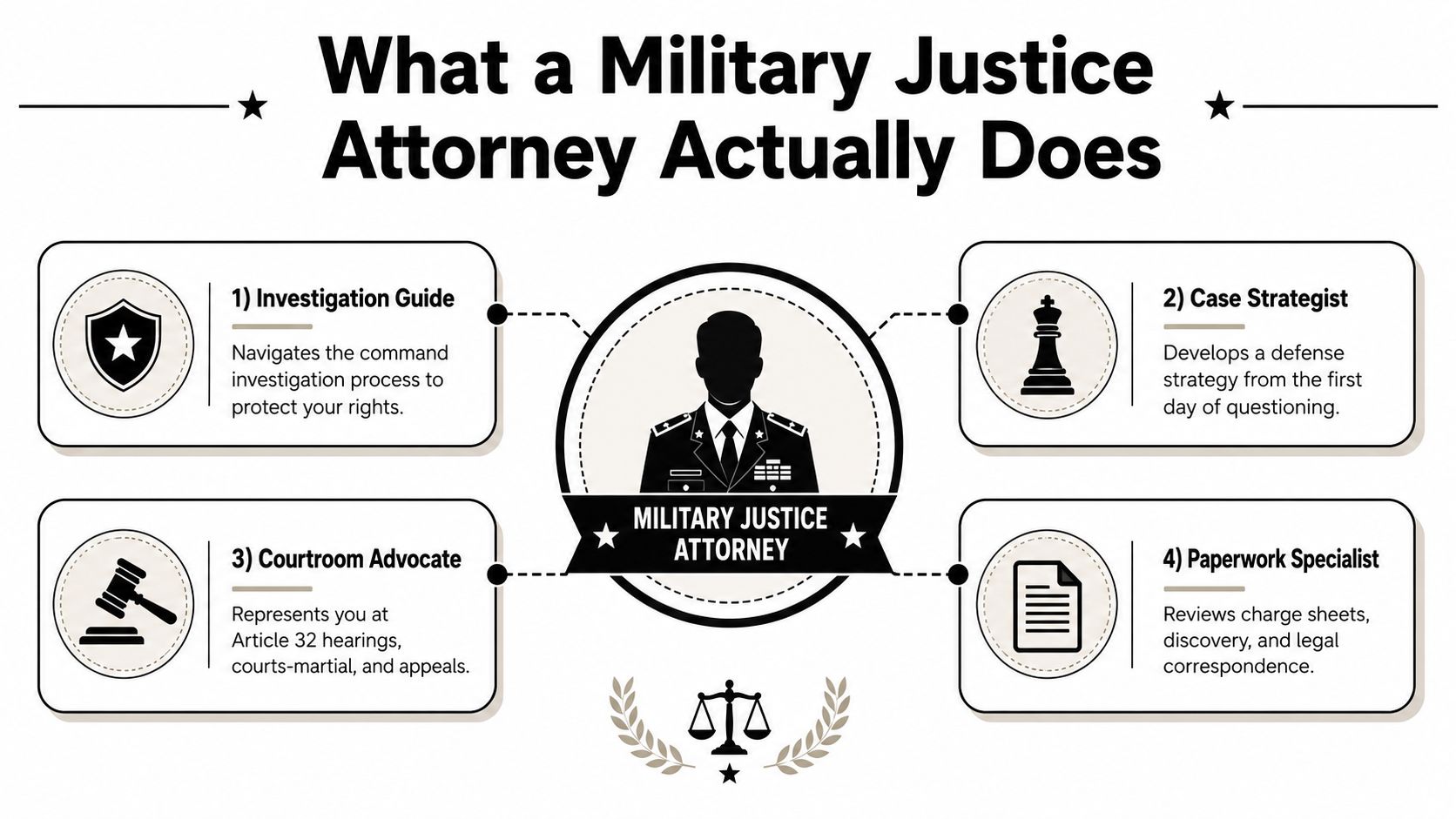
The attorney’s work begins before the courtroom
A military defense lawyer may represent you during:
- CID, NCIS, OSI, or CGIS investigations: Counsel advises you about interviews, searches, digital evidence, witnesses, and preservation of records.
- UCMJ charges and courts-martial: Counsel analyzes the charge sheet, discovery, motions, forum selection, plea negotiations, trial evidence, and sentencing exposure.
- Article 15 or non-judicial punishment: The lawyer evaluates whether to accept the proceeding, demand a trial where available, submit matters, or challenge the reliability of the evidence.
- Administrative separation and boards: Counsel protects your record, contests factual allegations, addresses characterization of service, and prepares witnesses and documentary evidence.
- Appeals and post-trial matters: An attorney can identify preserved errors, ineffective assistance issues, unlawful command influence, evidentiary problems, and discharge-upgrade options.
The system’s history explains why specialization matters. Congress passed the UCMJ in 1950, and it took effect in 1951, replacing the Articles of War with a unified framework for the armed forces. On October 24, 1968, President Lyndon B. Johnson signed the Military Justice Act of 1968, expanding the lawyer-based structure of special courts-martial and strengthening counsel’s role in military trials. The Library of Congress history of the UCMJ describes the military justice system as having a 225-year history, with the Army operating under the Articles of War for more than 175 years before the UCMJ era.
For a plain-English overview of how the system fits together, review this guide to the UCMJ system and military justice. Then speak with counsel about your facts, not just the offense label.
Practical rule: The lawyer who helps you control the first interview often has more strategic influence than the lawyer who arrives after your statements, messages, and explanations are already in the government’s file.
Workload and Stakes Behind Military Defense
A military justice attorney may be handling your case while carrying investigations, administrative boards, non-judicial punishments, and other courts-martial. That workload is not an abstract concern. In FY 2017, the military tried 1,877 courts-martial, including 815 general courts-martial, 685 special courts-martial, and 377 summary courts-martial, according to the military justice workload analysis published by Ohio Northern University.
Army defense assignments show how quickly attention can become scarce. In FY 2020, 148 active-duty Army defense attorneys collectively handled 660 courts-martial, 842 administrative boards, and 22,095 non-judicial punishments. That equals approximately 4.48 courts-martial and 154.97 non-judicial punishments per defense attorney, based on the same workload analysis.
Those figures do not establish that appointed counsel are careless. Many are capable, diligent, and committed. They do establish the questions you must ask: How many cases is this lawyer carrying? How much courtroom experience does the lawyer have? Who will investigate witnesses, review digital records, and prepare suppression motions before deadlines close?
A lawyer with too many active matters may give your case attention only after the government has already shaped the record.
FY24 Army Court-Martial Outcomes by Type
| Court-Martial Type | Cases Tried | Convictions | Acquittals |
|---|---|---|---|
| General courts-martial | 169 | 93 | 42 |
| Bad-conduct-discharge special courts-martial | 101 | 76 | 18 |
The FY24 combined service military justice reports provide the Army figures above. The outcomes show why forum selection cannot be treated as paperwork. Counsel must assess the forum, suppression issues, plea posture, sentencing exposure, and the practical consequences of conviction before recommending a strategy.
The system also remains active across the services. FY23 Navy reporting listed 85 general courts-martial, 76 bad-conduct-discharge special courts-martial, 4 military judge-alone special courts-martial, and 34 summary courts-martial, with an overall increase of 4.7% over the prior report period.
Rules change while cases are pending
The 2024 Manual for Courts-Martial includes proposed 2025 amendments and follows Executive Order 14130, signed on December 20, 2024, according to the Joint Service Committee current publications and updates. Counsel who relies on outdated outlines can miss a procedural change affecting motions, charging decisions, or sentencing preparation.
Ask whether the attorney regularly practices military justice and monitors current rules. If the answer is unclear, keep interviewing.
Civilian Defense Counsel Versus Appointed JAG Attorneys
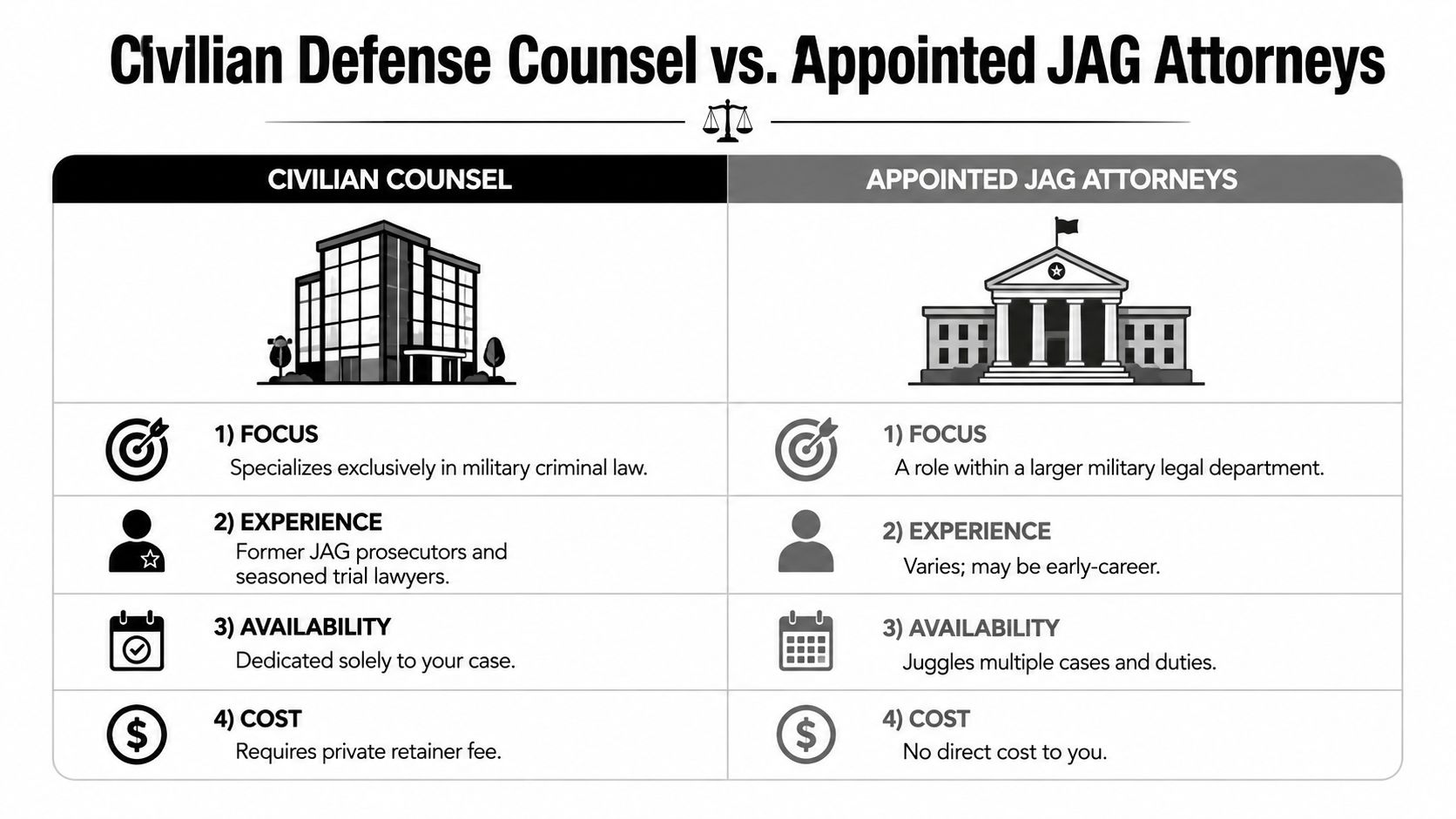
An appointed JAG attorney and a civilian military defense lawyer serve different functions, but the choice isn’t a referendum on whether one group cares more. Appointed counsel are part of the military legal system and may know local procedures, personnel, and command processes. Civilian counsel brings independence, private accountability, and a practice focused on defending service members.
Under Article 27 of the UCMJ, every general and special court-martial must have detailed trial counsel and defense counsel. For a general court-martial, defense counsel must be a judge advocate or a licensed attorney certified by the Judge Advocate General as competent to serve. The Article 27 statutory text also reflects the rule preventing a prosecutor from later switching sides in the same case.
Compare the decision on the factors that affect outcomes
| Factor | Civilian military defense counsel | Appointed JAG counsel |
|---|---|---|
| Independence | Works outside the chain of command and military legal department | Serves within the military defense organization |
| Focus | May concentrate on your case and related collateral consequences | Handles assigned cases and other official duties |
| Experience | Can be selected for sustained court-martial and appellate practice | Experience varies by assignment and career stage |
| Cost | Requires a private fee arrangement | No direct legal fee to the accused |
| Coordination | Can work with appointed counsel when appropriate | Can coordinate with civilian counsel |
For serious allegations, ask how many courts-martial the lawyer has tried, what role they played, and whether they have handled contested motions and sentencing. “I’m familiar with military law” isn’t an answer. You need specific experience relevant to your charge, service, forum, and evidence.
A civilian attorney can be especially important where the allegations could end a career, trigger confinement, produce a punitive discharge, or create long-term consequences outside the military. Civilian counsel may also provide continuity after a transfer, separation, or release from active duty. In many cases, appointed and civilian counsel can work together, with the client deciding how that relationship should operate.
The free lawyer may be competent. The private lawyer may be necessary. Those are separate questions, and serious cases deserve an honest answer to both.
Families often need help organizing consultations, records, and communications. A practical resource such as the SkipCalls lawyer guide can help you prepare for those conversations, but it can’t replace a case-specific review by military defense lawyers.
How to Evaluate and Select the Right Attorney
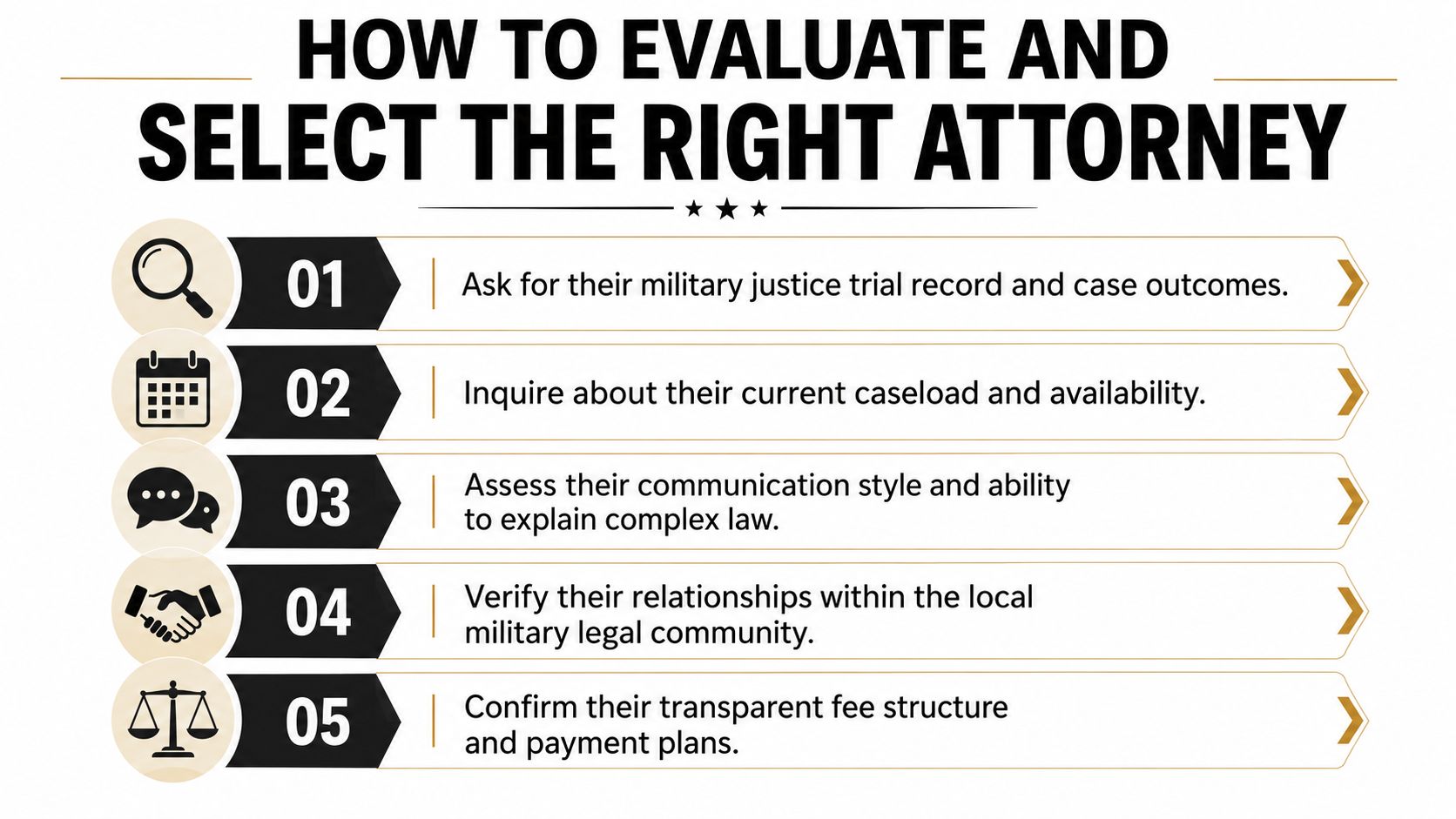
Don’t hire the first attorney who answers the phone. Use the consultation to test judgment, experience, and communication.
Start with relevant military experience
Ask whether the lawyer regularly handles courts-martial, UCMJ investigations, Article 15 matters, administrative boards, and appeals. Then narrow the question. Have they represented clients in your service branch? Have they handled the offense category involved? Have they litigated suppression, hearsay, credibility, expert, or digital-evidence issues?
A civilian lawyer who occasionally accepts a service-member case may know criminal procedure but still misunderstand command referral, Article 32 practice, military judge-alone options, or the collateral consequences of a punitive discharge. A former JAG background can be useful, but it doesn’t automatically establish defense quality. Ask what the lawyer did as a JAG, how long they’ve defended cases privately, and whether their current practice is dedicated to military defense.
Test the lawyer during the consultation
You’re not looking for a prediction of acquittal. You’re looking for a method.
- Ask for specifics: How will the lawyer identify missing evidence, inconsistent witnesses, unlawful searches, or defective rights warnings?
- Demand a communication plan: Who will answer questions, how will updates work, and who will attend critical proceedings?
- Discuss forum and sentencing: Can the lawyer explain the practical difference between court types and how sentencing is offense-based?
- Review conflicts: Has the lawyer represented a witness, another accused, or a government participant connected to your matter?
- Get fees in writing: The agreement should identify scope, expenses, trial preparation, hearings, appellate work, and payment terms.
Look for disciplined analysis, not dramatic promises
An experienced UCMJ lawyer should ask about dates, statements, witnesses, orders, searches, messages, medical records, command communications, and the exact language of any notice you received. The lawyer should identify what remains unknown and explain how the defense will obtain it.
Avoid anyone who guarantees an outcome, claims to know exactly what the command will do, or spends the consultation attacking every other attorney. Confidence is valuable. Certainty without investigation is marketing.
Costly Mistakes Service Members Make Before Hiring Counsel
The early phase is where people create evidence against themselves. Avoid these mistakes.
1. Talking to investigators without counsel
Under Article 31(b), investigators must advise a suspect of the nature of the accusation, the right not to make a statement, and the possibility that any statement may be used at court-martial. Service members also have the right to consult a lawyer and have one present during the interview, as explained in the Air Force Article 31 rights guidance.
Say you want counsel. Don’t try to “clear things up” first. A helpful statement can be incomplete, misunderstood, contradicted by records, or used to question your credibility.
2. Trusting informal assurances
A supervisor’s promise that the matter will stay at the unit level doesn’t control investigators, commanders, prosecutors, or later administrative action. Treat every request for information as part of a legal process until your attorney tells you otherwise.
3. Waiting for charges
You don’t need to wait for preferral, referral, or an Article 32 hearing. Counsel can act while facts are still available, witnesses are reachable, devices contain unaltered data, and your memory is clear.
4. Assuming there’s no evidence
You may not know about messages, access logs, medical records, witness statements, photographs, or prior reports. The government’s evidence may also be incomplete or unreliable. Your lawyer needs time to find those weaknesses.
5. Posting online
Social media posts, private messages, group chats, and comments can become evidence or create credibility problems. Don’t discuss the allegations online, even if you believe the audience is supportive.
6. Relying on a good record alone
Awards and strong evaluations can help during sentencing or administrative proceedings. They don’t eliminate the need to challenge unreliable evidence, defective procedures, or a weak government theory.
Read the Article 31 UCMJ guide for additional context, then contact counsel before answering substantive questions.
Frequently Asked Questions About Military Defense
Can I refuse to talk to CID, NCIS, OSI, or CGIS?
You can assert your right to remain silent and request counsel. Don’t lie, destroy evidence, pressure witnesses, or obstruct an investigation. Calmly state that you want a lawyer and stop substantive discussion until counsel advises you.
What happens at an Article 32 preliminary hearing?
An Article 32 hearing occurs before charges and specifications are referred to a general court-martial. The hearing addresses four core questions: whether each specification states an offense, whether probable cause exists, whether the convening authority has jurisdiction over the accused and offense, and what disposition is recommended, according to the Army Criminal Law Deskbook explanation of Article 32.
Your attorney uses the hearing to examine the government’s theory, expose weaknesses, preserve issues, and gather information for later litigation. It isn’t a casual briefing.
Will I go to jail?
That depends on the allegations, forum, evidence, findings, plea decisions, and sentence. At a special court-martial with members, authorized punishment can include one year of confinement, hard labor without confinement for up to three months, forfeiture of two-thirds pay per month for up to one year, reduction in grade, and a bad-conduct discharge, as summarized by the Congressional Research Service.
For general and special courts-martial, sentencing is offense-based. The military judge must specify the confinement term, if any, and any fine for each offense of conviction, under the current statutory sentencing provision.
When do I need a military justice attorney?
Immediately after learning you’re a suspect, witness, or subject of an investigation. Early advice can prevent statements, searches, messages, and decisions that later become difficult or impossible to undo.
Are domestic violence allegations treated seriously?
Yes. Recent reporting described domestic violence convictions rising across the services by 2024, including the Army from 43 convictions in 2021 to at least 101 in 2024, the Navy from 3 to 16, the Marine Corps to approximately 24, and the Air Force from 10 to 21. The same Military.com reporting stated that the Department of Defense reported 8,307 domestic abuse incidents in 2022.
These cases often turn on credibility, timing, medical evidence, digital communications, prior statements, and the difference between an allegation and admissible proof. Hire counsel who understands those issues.
Can a lawyer help with an appeal or discharge upgrade?
A military justice attorney may evaluate appellate issues, post-trial errors, ineffective assistance claims, records, and discharge-upgrade possibilities. The answer depends on your record, deadlines, procedural history, and the reason for the requested relief.
If investigators are calling, the safest time to get legal advice is before you answer.
If you’re under investigation, facing UCMJ charges, expecting an Article 15, or worried about separation, contact a qualified military justice attorney now. Gather every notice, message, counseling statement, search document, and recording, and don’t discuss the facts with investigators or post about them online before speaking with counsel. Delay gives the government time to shape the record while your options narrow.