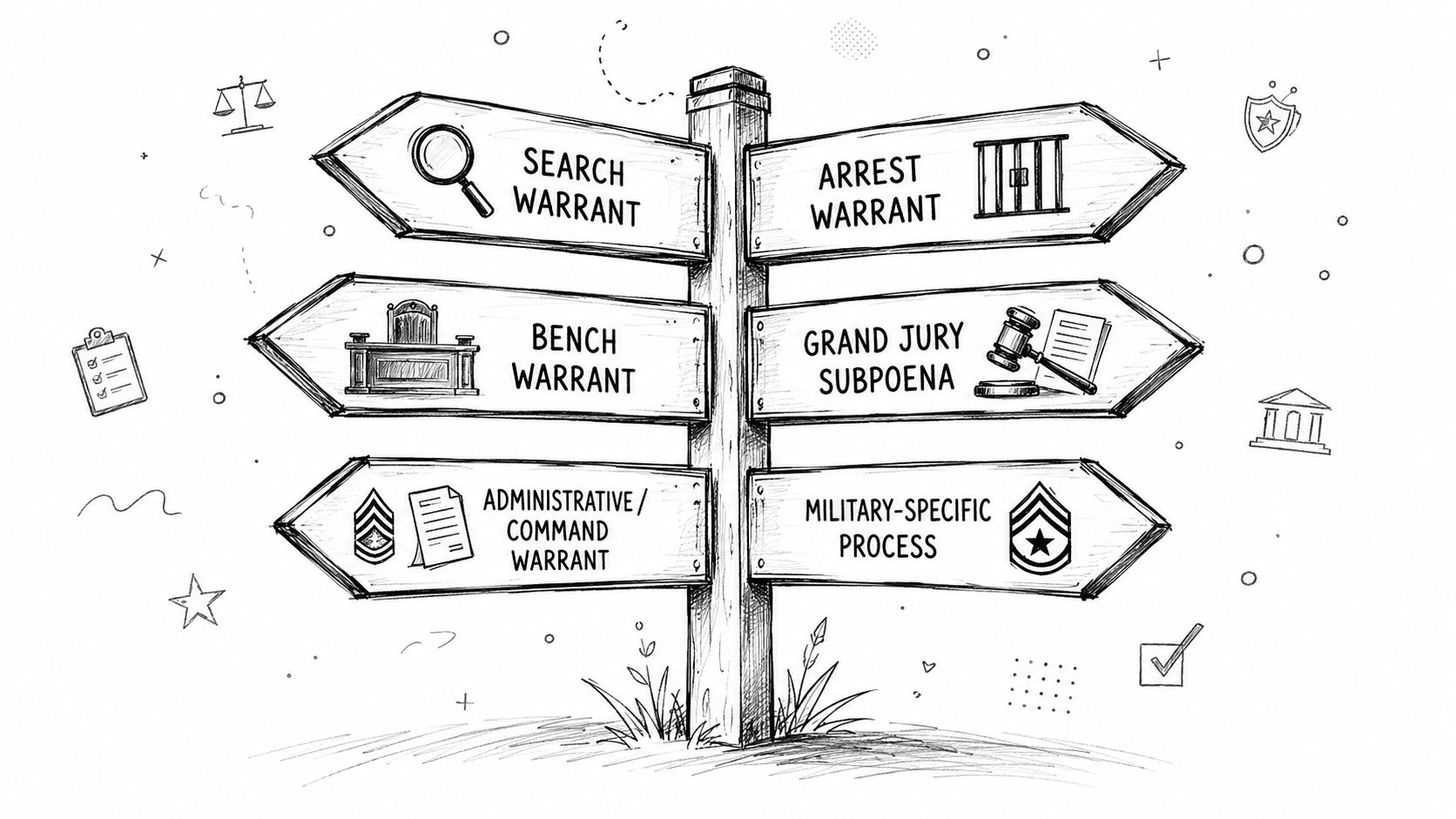
If you just found out there may be a warrant with your name on it, don't waste time pretending it'll sort itself out. A warrant can hit harder in uniform than it does in civilian life, because the problem doesn't stop with a court date or a traffic stop. It can touch your command, your duty status, your clearance, your promotion path, and your reputation in a way few people understand until they're already in the chute.
Service members often think they are dealing with a routine off-base issue, then watch it turn into a command problem by lunch. That's the core of the situation. Different types of warrants are not just legal labels. They're different tools with different consequences, and if you misread the type, you can make the wrong move fast.
Table of Contents
- Why a Warrant Can Disappear Your Career Overnight
- The Civilian Warrant Types You Need to Know First
- How Military and UCMJ Warrants Work Differently
- What Makes a Warrant Legally Valid and What Makes It Beatable
- Real Scenarios Service Members Actually Face
- What to Do in the First 72 Hours After Learning a Warrant Exists
- Why Independent Civilian Counsel Beats the System Handlers
- Your Next Move Decides How This Ends
Why a Warrant Can Disappear Your Career Overnight
The call usually starts small. A spouse says military police showed up at the gate. A supervisor says a detective asked questions at the duty desk. A neighbor says someone knocked on the door during leave and asked whether you live there. By the time the rumor reaches you, the warrant is already moving, and so is the paperwork that can follow it through your command.
That is why warrants against service members move faster than people expect. In the military world, once law enforcement sees your name, the problem rarely stays in a civilian lane for long. Command, the PMO, and investigators cross-check information constantly, and a civilian warrant can quickly turn into a readiness issue, a discipline problem, or a clearance problem.
Practical rule: if a warrant has your name on it, treat the next contact as a controlled event, not a conversation.
Service life changes the enforcement picture in ways civilians do not have to think about. A civilian defendant may be worried about one courthouse or one county. A service member has to think about flagging, duty restrictions, and whether a simple off-base problem is about to become a command brief, a legal review, or an investigation. That is the part people underestimate until the phone starts ringing.
Historical data from 2003 shows the Bureau of Justice Statistics reported that U.S. Marshals processed 120,131 warrants for investigation and that 62% of the warrants initiated were for felony offenses, including probation violations (12%), bond violations (5%), and parole violations (2%) BJS report. That same report found that 26% of warrants initiated were state and local warrants, while 12% were federal non-felony warrants for traffic and misdemeanor offenses. Warrants are not limited to violent crime. They can begin with lower-level misconduct and still snowball into something far bigger.
The military version is harsher because your chain of command does not get to ignore it. If the warrant surfaces during a leave request, a clearance reinvestigation, or a routine law-enforcement check, you may get very little warning before the machine starts moving. A civilian bench warrant can ruin your day. In uniform, it can snowball into command action, lost trust, and career damage that outlasts the case itself, which is why the comparison in bench vs Ramey vs arrest warrants matters before you say a word to anyone. The first mistake is always the same, hoping nobody notices. They do.
The Civilian Warrant Types You Need to Know First
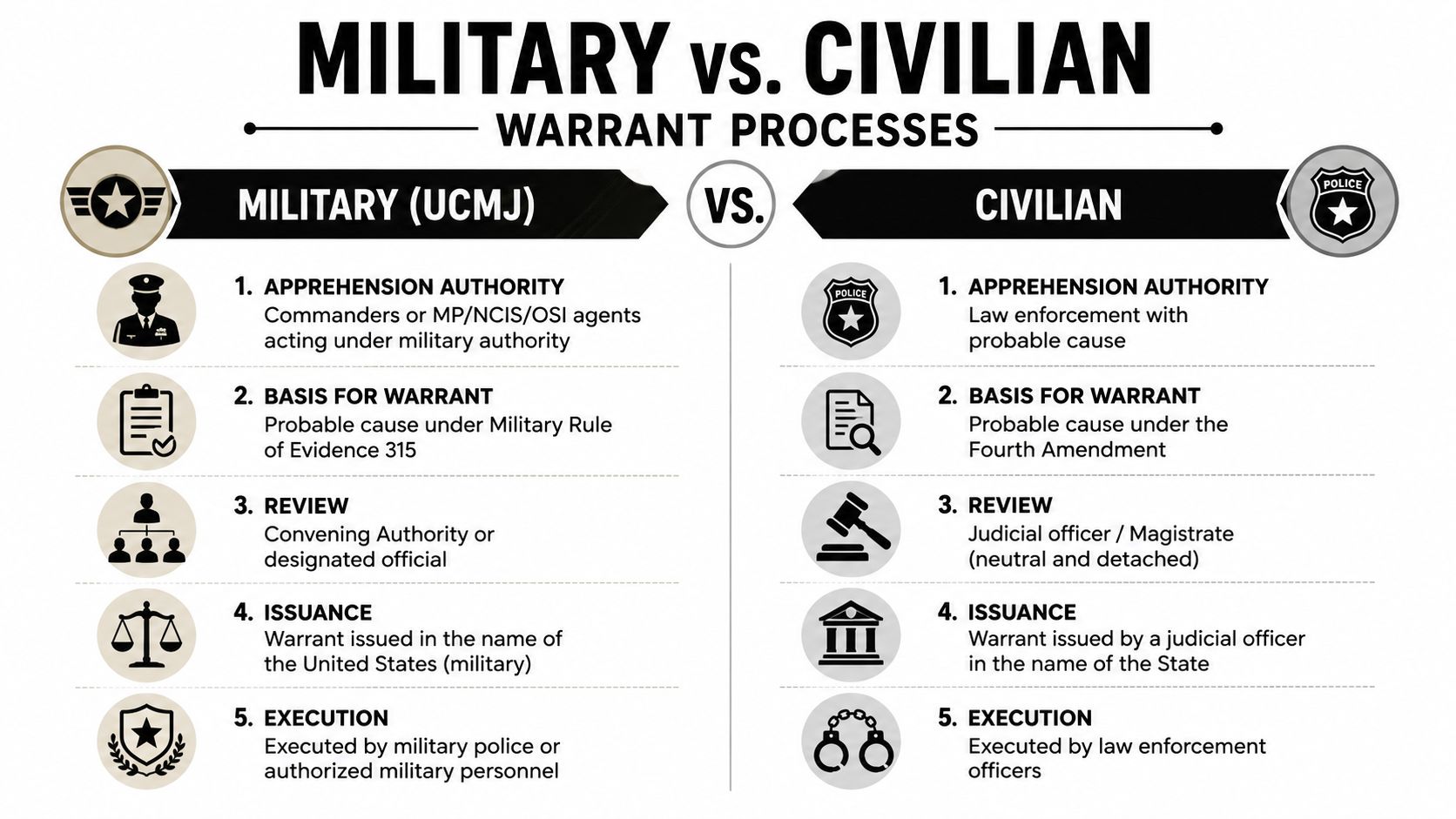
Arrest Warrant
A judge signs an arrest warrant after the government shows probable cause that a named person committed a crime. It is a targeted detention order, supported by a sworn showing, not a blank check for police to scoop up whoever they want. The order has to identify the person with enough specificity that the officers know exactly who they are authorized to take into custody NCSC warrant process guidance.
For a service member, that distinction matters fast. If your name is on the warrant, the arrest power exists the moment law enforcement locates you, and the fallout does not stop at the courthouse. Command hears about it, trust drops, and the case can start affecting duty status, access, and your future in uniform. That is why the comparison in bench vs Ramey vs arrest warrants matters before you try to talk your way through it.
Search Warrant
A search warrant authorizes officers to look in a particular place, search a specific person, or inspect a listed vehicle for evidence. The court has to define the target and the thing to be seized, because the whole point is to limit the government's reach to what a judge approved New Jersey criminal law explanation. If the paper is vague, the defense starts looking hard at scope, inventory, and whether the officers stayed inside the lines.
That issue gets sharper in a military setting. A search that turns up contraband in a barracks room, a vehicle on base, or a laptop tied to a service member can spill straight into command action and Article 31 questions. If the search goes beyond the warrant, the suppression fight matters because the government may have paid for a bad search with bad evidence. The warrant is not supposed to grow every time an investigator gets curious.
Bench Warrant
A bench warrant usually follows a missed court date or a violation of a court order. The court issues it because the person did not show up or did not comply, and the original case stays alive until the court recalls the warrant or the person is brought in bench warrant overview.
That is the trap. The warrant may have nothing to do with a new crime, but it still creates an arrest risk and a paper trail that follows the person until somebody fixes it. For a civilian, that can mean jail, missed work, and a pile of fees. For a service member, a bench warrant can collide with leave, training, travel, or a command decision that turns a courthouse problem into a career problem.
Grand Jury or Indictment Warrant
A soldier gets pulled into a civilian investigation, shows up later expecting a routine appointment, and finds out the case is already charged. At that point, the government has moved past suspicion and into formal accusation, which changes the entire posture of the case. If the indictment includes a warrant, law enforcement already has a court-backed path to take the person into custody.
That is the part service members underestimate. A grand jury or indictment warrant is not about whether investigators are still building a theory, it is about the state or federal system deciding the theory is ready to prosecute. Once that happens, the fight is no longer about casual explanations or hoping the matter fades out. It is about protecting the record, the defense, and the chain of command from making the problem worse.
For readers who want a civilian-side comparison of how these labels get used in practice, the breakdown at bench vs Ramey vs arrest warrants is a useful cross-check on terminology.
How Military and UCMJ Warrants Work Differently
A warrant in the military setting does not behave like a clean civilian courtroom order. The service member is dealing with command authority, military investigators, and the UCMJ at the same time, and that mix changes the risk fast. A piece of paper can trigger custody, searches, duty restrictions, and command attention before the civilian system even finishes sorting itself out.
The Military Layer Moves Through Command
In a civilian case, a judge or magistrate sits at the center of the process. In the military, the command structure can start moving before any civilian court gets involved. That means a service member may face apprehension, searches, or direct orders that function like warrant action because they come through the unit, not a county courthouse. Article 7 apprehension authority is one example of that military overlay, and search authorization under Military Rule of Evidence 314 is another.
A concrete example helps. An investigator develops probable cause, a commander is looped in, and the service member is taken into custody on base under Article 7 authority before a civilian warrant process ever matters. That arrest may still need to line up with military rules, but the practical effect is immediate. The person is pulled out of the workday, the command is now involved, and the case has already started affecting the chain of command.
There is also a rights issue that catches people every day. If investigators start asking questions, the service member is not just dealing with ordinary police doctrine. Article 31 rights can come into play, and you need to know the difference before you say a word. That is why the Article 31 explanation at bestusmilitaryattorneys.com/article-31-of-the-ucmj/ belongs in your toolbox, not on a shelf.
Why the Military Version Hits Harder
A civilian warrant can bring a court date. A military warrant-like event can bring a career problem. If command learns about it, the issue can spill into duty restrictions, access, and trust inside the unit. That is especially dangerous because military culture rewards quick compliance and punishes anything that looks like avoidance.
A command response can be just as damaging as the underlying warrant if you talk too soon, sign too fast, or assume the chain of command will protect you.
A service member also needs to understand how fast military action can harden into formal process. Preferral of charges can show that the case is already advancing, even if the civilian side is still collecting facts. The person who says “nothing has been filed yet” is often already behind the curve.
Military justice treatises explain that apprehension and search authority in the armed forces operate inside a system built around command responsibility, not just neutral court paperwork. That matters because the rules for who can act, who can authorize, and how far that authority reaches are not the same as the civilian model. For a closer civilian-side comparison of how warrant labels get used, the breakdown of what makes a document legally binding is a useful cross-check on formal validity.
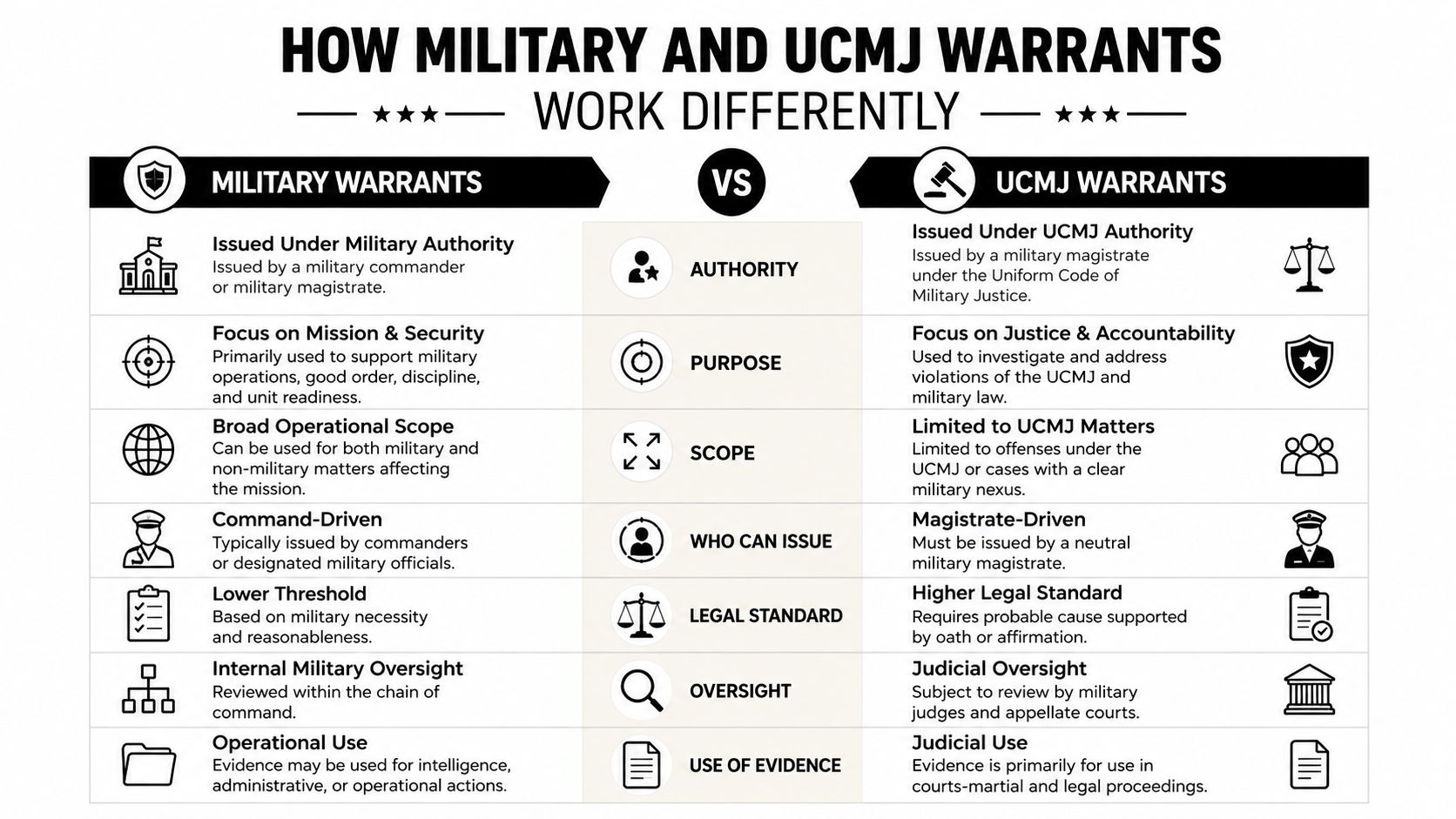
The blunt truth is simple. The military system can create pressure without using civilian-style language. That does not make the action less serious. It makes it easier to misunderstand, and that is where service members get burned.
What Makes a Warrant Legally Valid and What Makes It Beatable
A warrant only helps the government if it rests on real authority, a sworn basis, and a narrow enough target to survive review. If any of those pieces are missing, the paper starts to shake. In a military case, that shake can mean suppressed evidence, delayed action, and a command problem that follows the service member long after the search is over.
The Core Pieces
A lawful arrest warrant needs a judge or magistrate, a sworn affidavit, and probable cause tied to a specific person and offense. A search warrant needs the same judicial backing, plus particularity about the place and the items to be seized. That is basic constitutional work, and NCSC warrant process guidance lays out the usual structure. If the government cuts corners, the warrant becomes easier to challenge.
A search warrant has the same general demands, but the point that matters most is specificity. The affidavit has to support the place to be searched and the things to be taken, and the approval has to come from a neutral decision-maker. The civilian side of that problem is easy to miss until you read a plain explanation like New Jersey criminal law explanation, because form and authority are what give the document force in the first place. In a military setting, vague paperwork creates real exposure fast.
Where Defense Counsel Looks First
Defense lawyers go straight to the weak points. They check whether the information was stale, whether the location description was too broad, whether the affidavit was sworn, and whether the approving officer was neutral in fact, not just in title. In military cases, they ask a harder question too, whether the person who authorized the search or apprehension had authority under the military rules and the command structure.
The same logic shows up in civilian document law. If you want a clean cross-check on how formal validity turns on document integrity, the discussion of what makes a document legally binding is useful for that purpose. A paper can look official and still fail if the required elements are missing.
The Military Twist
Military actions often move through command channels that look efficient on paper. That does not make them bulletproof. If the government cannot show the proper authority chain, or if the search went beyond what was approved, the defense has a strong opening.
A defect in the warrant or authorization is not a technicality. It is a pressure point. If the government used the wrong process, or used the right process badly, the evidence may not hold up, and the case can change shape before trial. That is why counsel reads the paperwork first and argues about the facts second. For a service member, that matters because command attention, Article 31 rights, and career fallout can hit before the legal fight is even finished.
Real Scenarios Service Members Actually Face
A typical staff sergeant might have three very different problems and call them all “a warrant issue.” That's not sloppy. It's normal. The law uses different tools, but the stress feels the same.
The old civilian warrant that comes back during a clearance review
A service member can pick up an off-duty issue before enlistment or during a prior break in service, then forget about it until a reinvestigation or background check flushes it back out. Suddenly the old case is live again, and the command wants answers. The mistake is usually the same, trying to explain it casually to whoever asks first.
That's where a civilian warrant crosses into a military career problem. If the issue is linked to honesty, disclosure, or unresolved court process, the damage is no longer only legal. It becomes an integrity issue in the eyes of command.
The barracks search after someone else becomes the target
A service member can wake up to a barracks room search because a roommate, neighbor, or another occupant is under suspicion. The search may be justified by a broader investigation, but the person caught in the middle often assumes it will all sort itself out if they just cooperate.
That assumption is dangerous. For a background on how these investigations are typically handled, the overview at CID, NCIS, OSI, and CGIS explained is a useful map of the agencies involved. Once those investigators are in the picture, every statement and every object in the room can matter.
The missed court date over leave
A service member misses a civilian court date because of leave, travel, or a bad calendar handoff. A bench warrant follows, and no new probable cause is needed to enforce the failure to appear. That's the trap. People think the court will understand once they explain it.
It often doesn't work that way. The immediate mistake is usually talking to investigators or the court without counsel, then assuming the military side will absorb it. It won't always.
What to Do in the First 72 Hours After Learning a Warrant Exists
The first 72 hours decide whether you keep control or hand it away. Panic is a bad legal strategy, and improvisation is worse. In a military setting, a warrant can also collide with command authority, Article 31 rights, and a career that can unravel before anyone gives you a fair hearing.
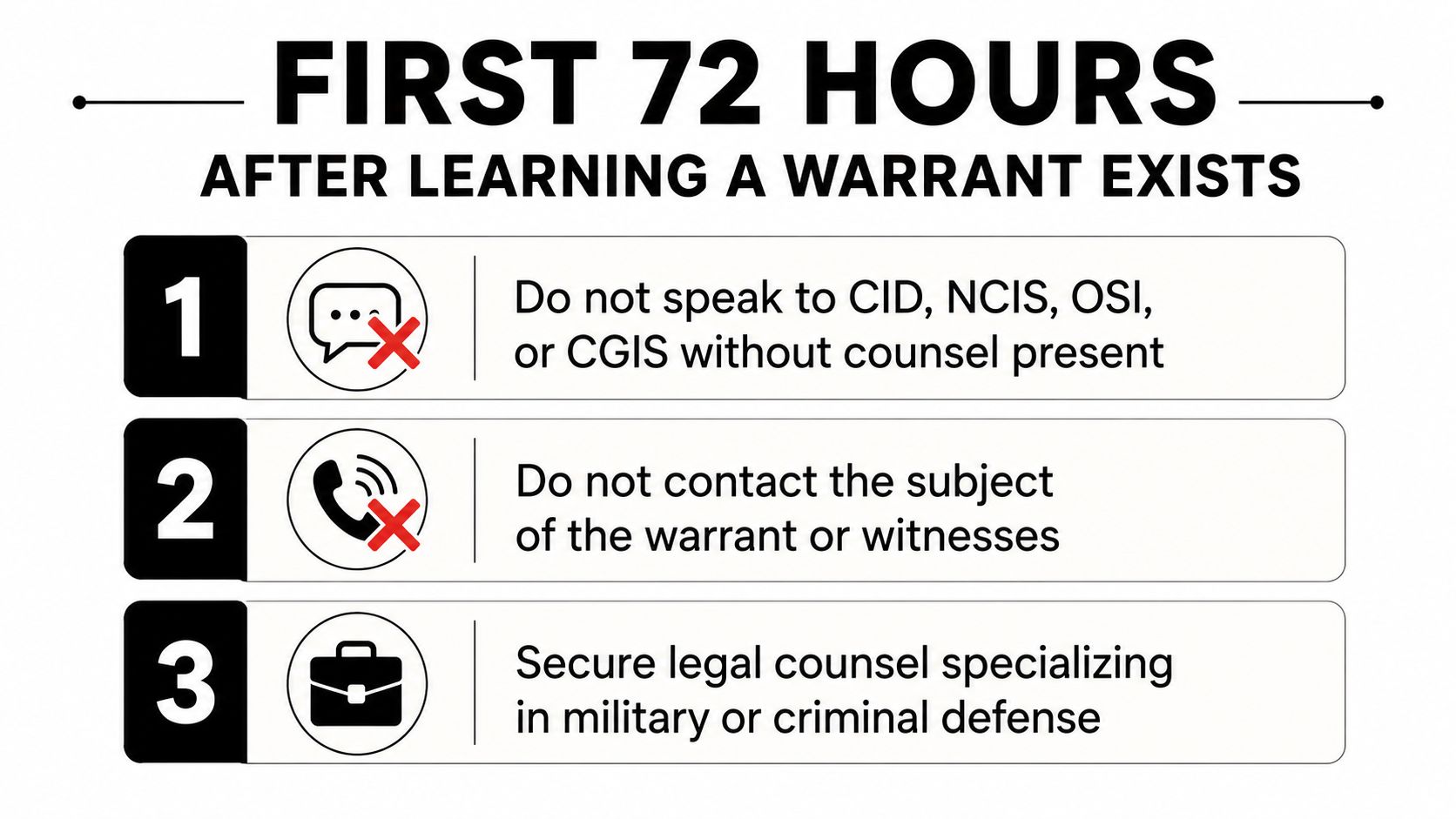
Step 1 Lock down your mouth
Do not speak to CID, NCIS, OSI, or CGIS without counsel present. Do not do “just a quick chat.” Do not try to talk your way out of it informally. The wrong sentence can become the government's favorite quote.
Step 2 Stop the side contact
Do not contact the alleged victim, witness, or accuser. That contact can be painted as pressure, retaliation, or interference, even if you believe you are clearing up a misunderstanding. Keep your distance and let counsel handle the communications.
Step 3 Preserve everything
Save texts, emails, orders, leave forms, screenshots, call logs, and calendar records in a secure folder. If the case later turns on timing, access, or who knew what, those records matter. If you do not preserve them now, you may never get them back.
Step 4 Identify the issuing authority
Pull the public docket if there is one and figure out which court or authority issued the warrant. A civilian court matter and a military action do not call for the same response. You need the right target before you can fight, and you need to know who has power over the next move.
Step 5 Don't sign shortcuts
Refuse to sign anything labeled a voluntary statement, polygraph release, or rights waiver until a lawyer reads it with you. “Voluntary” paperwork is often where people give away the advantage they did not know they had. Once signed, it can be hard to unwind.
Step 6 Tell one trusted person
A spouse, parent, or trusted co-observer should know what is going on. Not the whole unit. Not the barracks. One person who can help track what you have received and who has contacted you. That keeps the paper trail cleaner.
Step 7 Retain independent counsel
Get a civilian military defense lawyer before you start explaining anything to anyone else. If you wait until the command has its story, you are already reacting instead of directing. A lawyer who knows how to handle the military investigation phase can help you hold the line before the case hardens against you, and how experienced counsel win cases during the military investigation phase shows why timing matters.
The first 72 hours are about containment. The person who contains the problem keeps options. The person who talks first usually gives them up.
Why Independent Civilian Counsel Beats the System Handlers
A military-appointed lawyer can be competent and hardworking. That's not the issue. The issue is structure. Appointed counsel often carry heavy caseloads, operate inside a military system with its own pressures, and may not have the bandwidth to build the kind of defense a serious warrant-driven case demands.
A civilian military defense lawyer is not tied to the command chain. That matters. Independent counsel can investigate across installations, press harder on motion practice, and coordinate with outside experts and investigators without waiting for permission from the same system that is pursuing you.
Strategic point: the lawyer you choose changes the tempo of the case. Tempo changes leverage.
There's also a trial reality that families underestimate. If the case turns ugly, you want someone who has tried hard cases, negotiated with senior trial counsel, and seen how military decision-makers behave when the facts stop being clean. A good civilian defense team brings that muscle, along with paralegals and investigators who can work the file fast.
People often make a bad assumption. They think a “free lawyer” automatically means adequate representation. It doesn't. You need the right lawyer, not just a lawyer.
Your Next Move Decides How This Ends
The next 24 hours matter more than the next 24 excuses. If you're under investigation, if a warrant has surfaced, or if command has started asking questions, the case is already moving whether you are ready or not. Investigations are not neutral, evidence is often incomplete, and credibility can turn on the smallest thing you say.
Don't fool yourself into thinking silence alone will save you. Silence without strategy just leaves you exposed while others build the record. The system is not designed to protect the accused, it's designed to resolve the case in front of it.
If you need a fast way to compare serious civilian defense options, use the Military Justice Guide to learn how to evaluate independent counsel who handle court-martial and UCMJ matters. Don't wait for the knock, the phone call, or the face-to-face ambush at work. Get counsel now, and make your next move a deliberate one.