
If you just got told to report to CID, NCIS, OSI, or CGIS, or you’ve been handed preferral paperwork and your command suddenly sounds polite, you’re already in danger. The government does not move you into a court-martial posture because it’s being careful. It moves because it thinks it has a case, and it will keep building that case while you’re still trying to figure out who to trust.
That’s why picking a military court martial lawyer is only the first decision. The central question is whether you know how to evaluate that lawyer before you sign a retainer, before you give a statement, and before your phone, messages, and career are used against you. A bad choice early can lock in bad facts, bad strategy, and bad outcomes that no amount of later talent can fully undo.
Table of Contents
- What a Service Member Faces Right Now
- What a Military Court Martial Lawyer Actually Does
- The Court Martial Process Step by Step
- Why Hiring a Military Court Martial Lawyer Early Changes Everything
- How to Evaluate a Civilian Military Court Martial Lawyer
- Common Mistakes That Destroy Court Martial Cases
- What to Do in the Next 72 Hours
What a Service Member Faces Right Now
You’re probably not reading this because everything is fine. You’re reading because somebody in your chain has already used words like “investigation,” “statement,” “command-directed,” or “charges.” Maybe it was CID after a late-night call. Maybe it was NCIS, OSI, or CGIS. Maybe it was your first hint that the command already stopped looking at you like a troop and started looking at you like a file.
That shift matters. Once law enforcement is involved, every conversation can become evidence, every device can matter, and every delay helps the government organize its story. The practical danger is not just the eventual trial. It’s the early phase, when people talk too much, assume honesty will save them, or think command is still acting as their protector.
The first seventy-two hours are tactical
Your job in the first three days is simple. Stop talking casually about the facts. Preserve evidence. Get counsel involved. That means texts, DMs, photos, call logs, location data, emails, and anything on a device that might disappear, sync, or get overwritten.
Practical rule: if you’re asked to “just come in and clear this up,” treat that as a risk, not a courtesy.
The military justice system is still a small world, but it’s consequential. In FY 2022, the services completed 1,179 general and special courts-martial, and 76% were judge-alone proceedings, with only 283 involving members. The same source reports 169 acquittals, which means the conviction rate remained high, about 86% across those completed cases. Those numbers aren’t abstract. They tell you the system is active, specialized, and unforgiving once it starts moving against you. NIMJ’s FY 2022 military justice breakdown
You don’t need to panic. You do need to get serious fast.
What this means for your family
Your spouse, parents, or partner may want to help by calling command, asking around, or telling you to explain yourself. That usually makes things worse. The safest help they can give you is practical support, quiet, and speed in getting you to a lawyer who does military defense work every day.
What a Military Court Martial Lawyer Actually Does
A military court martial lawyer does far more than stand next to you at trial and object a few times. The job covers criminal defense, administrative defense, and career survival. That includes UCMJ charges, Article 15s, investigations, boards, separation actions, sentencing, and appeals.
The right lawyer doesn’t wait for trial to become useful. The right lawyer starts shaping the case during the investigation, because that’s where bad assumptions get exposed, witnesses get locked into positions, and evidence problems get identified before the government hardens its theory. In military cases, that early work is often more valuable than a polished closing argument.
The core jobs are different from civilian criminal defense
Civilian criminal defense experience helps, but it’s not enough by itself. Military cases sit inside a separate system with its own rules, command dynamics, and career consequences. A generic criminal lawyer may know how to handle a state felony. That doesn’t mean they know how military discipline, referral decisions, Article 32 practice, or service-specific culture really work.
A military defense lawyer also has to understand the difference between fighting the charge and protecting the career. Sometimes a case is about avoiding conviction. Sometimes it’s about preserving retirement, avoiding a bad discharge, or reducing the damage when the facts are ugly. Those are not the same fight.
What the work actually looks like
The lawyer should be doing some combination of these things:
- Pre-charge intervention: pushing back before preferral if the facts are thin.
- Article 32 work: testing probable cause, exposing weak witnesses, and preserving issues.
- Motions practice: challenging unlawful evidence, bad searches, and unreliable proof.
- Trial advocacy: handling judge-alone cases and panel cases with different tactics.
- Negotiation: making sure any plea discussion is informed by the full record.
- Sentencing and appeal planning: thinking beyond findings so the case doesn’t end at conviction.
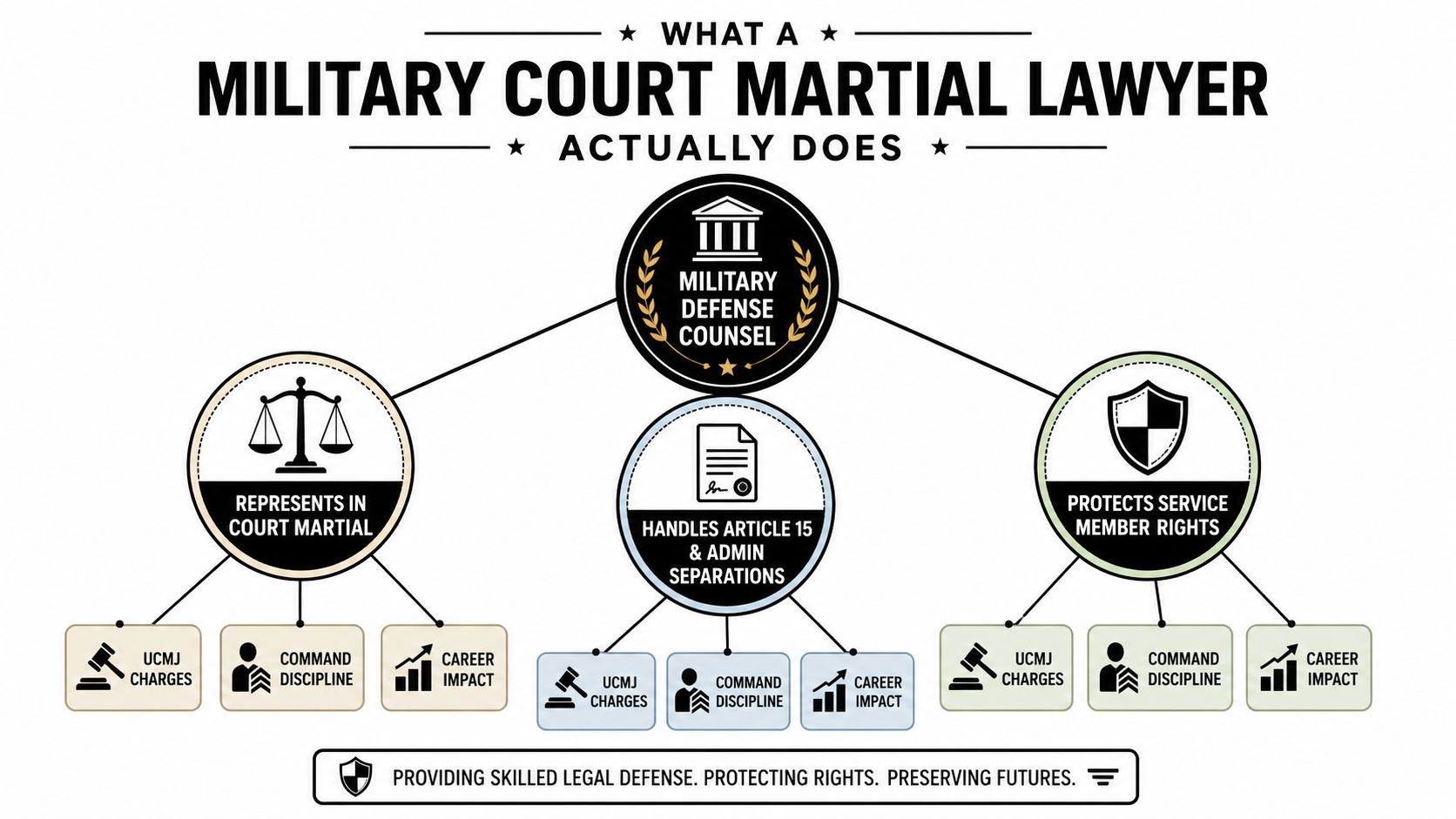
Experienced lawyers don’t just react. They build pressure points the government has to answer.
The Court Martial Process Step by Step
The process is not one dramatic courtroom scene. It’s a sequence, and the government uses each step to tighten the case. Your lawyer’s job is to break that rhythm early, before the file gets packaged for trial.
Step 1 through Step 4 happen before most people take the case seriously
The path usually starts with investigation, then preferral of charges, then the Article 32 preliminary hearing, then referral to court-martial. Once the case is referred, the litigation pace picks up fast. A judge is assigned, deadlines get set, and discovery, motions, witnesses, and trial planning start to matter in a very concrete way.
At the investigation stage, the defense should already be preserving evidence, mapping witnesses, and identifying gaps in the government’s story. By Article 32, the lawyer should be testing the theory of the case, not just showing up to listen politely. If counsel waits until referral to think strategically, the government has already had a head start.
The earliest mistakes are the hardest to fix later.
Step 5 through Step 8 are where the record gets built
After referral comes arraignment, then pre-trial motions, then trial by court-martial, and finally sentencing and appeals if needed. The defense has to think about pleas, forum choice, evidentiary fights, and witness selection well before the panel or judge hears the first live testimony. That’s where preparation beats improvisation.
A lot of service members assume the case will turn on whether the accused “did it” or “didn’t do it.” In reality, many cases turn on credibility, admissibility, and whether the government can survive the parts of the case it doesn’t like to talk about. That’s why experienced counsel focus on the file, the device data, the timeline, and the people around the allegation.
For a broader overview of the process, see the court-martial basics guide.
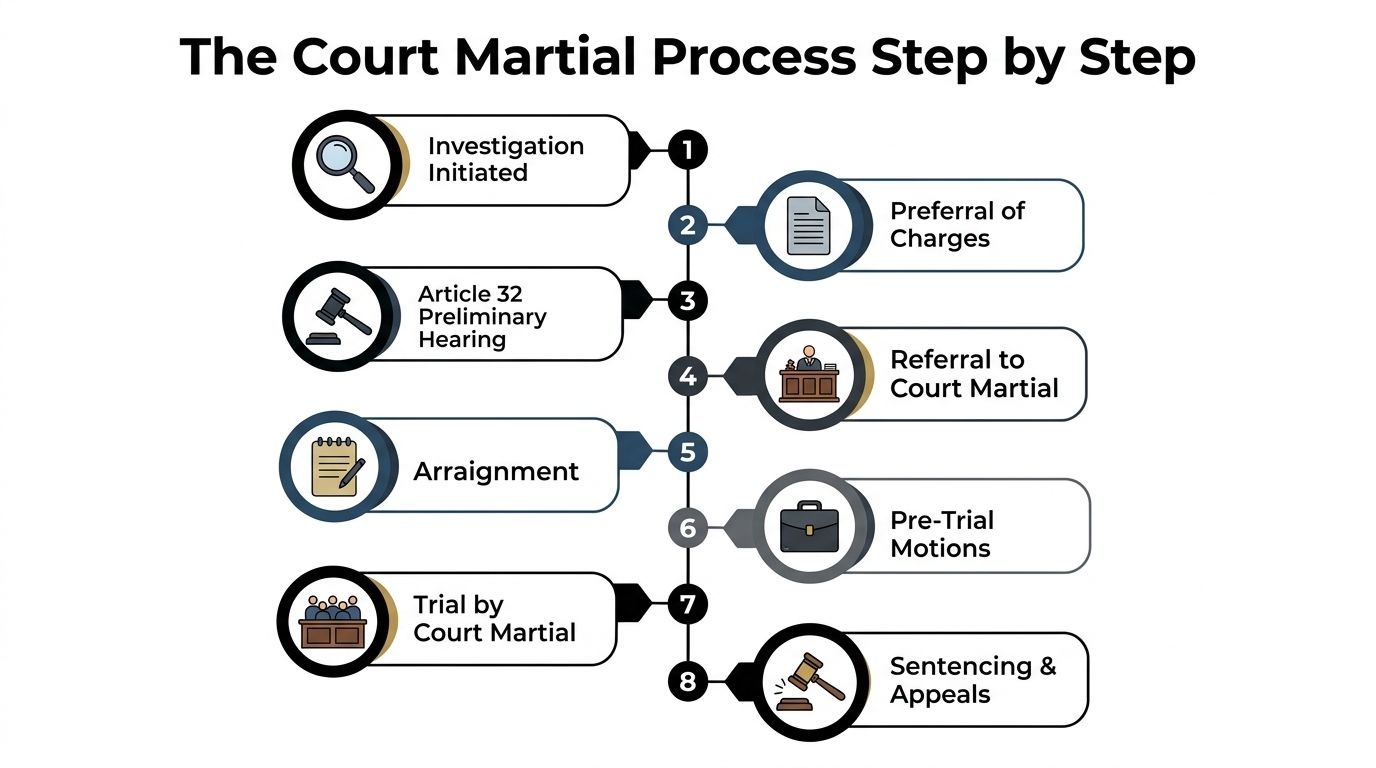
What to think about at each stage
- Investigation: stay quiet, preserve data, and assume the government is already recording its version.
- Preferral: treat the paperwork as the start of a fight, not a formality.
- Article 32: use the hearing to expose weak evidence and unsupported allegations.
- Referral: expect the case to become more expensive, more public, and more serious.
- Trial and sentencing: prepare for both guilt and damage control, because one does not erase the other.
The military court-martial process is a pressure cooker. If you’re waiting to “see how it goes,” you’re already behind.
Why Hiring a Military Court Martial Lawyer Early Changes Everything
Early retention matters because the government’s case develops in stages. If your lawyer gets involved before charges are preferred, there’s room to influence what happens next. If the lawyer appears later, much of the damage may already be locked into witness statements, forensic reports, and command assumptions.
A civilian military court martial lawyer can add real value. Detailed military defense counsel are qualified and essential, but they’re often carrying heavy caseloads and dealing with a broad mix of issues. In FY 2020, 148 active-duty Army defense attorneys handled 660 courts-martial, 842 administrative boards, and 22,095 nonjudicial punishments, which works out to about 4.48 courts-martial and 154.97 nonjudicial-punishment matters per attorney. That workload tells you why extra depth can matter in a serious case. Military defense workload data
Early civilian counsel changes the defense posture
A seasoned civilian lawyer can step in and do the things that matter most early on, including contacting investigators through the right channel, shaping the Article 32 record, and identifying weaknesses in probable cause before the case hardens. In some matters, that early work can keep a weak case from ever becoming a serious trial case.
The bigger advantage is independence. A retained civilian lawyer does not work for command, does not answer to the command climate, and does not have a career relationship with the people deciding whether to press forward. That independence matters when the accused needs someone whose only job is to protect the accused.
Detailed military counsel and civilian counsel are not the same job
| Factor | Detailed Military Counsel | Retained Civilian Military Court Martial Lawyer |
|---|---|---|
| Caseload | Often broad and heavy | Usually narrower and case-specific |
| Independence | Works within the military system | Fully independent from command |
| Trial focus | Shared with many duties | Centered on the individual case |
| Strategic redundancy | Limited | Stronger if used well |
| Long-term continuity | Can change with assignments | Stays with the case |
That table is the core question. Do you want one qualified defender inside the system, or one qualified defender plus an outside advocate who can push harder when the command is already committed? For serious cases, the second option often gives you better influence.
Bottom line: early action is not about luxury. It’s about creating options before the government closes them off.
How to Evaluate a Civilian Military Court Martial Lawyer
Some service members start by comparing websites, badges, and bold promises. That is the wrong filter. You need to judge actual court-martial skill, not marketing polish.
Start with practice depth, not broad claims
The first question is whether the lawyer focuses on court-martial and UCMJ defense. A general criminal defense lawyer who “also handles military cases” is not the same as someone who works in this space every day. You want specific experience with general and special courts-martial, not a vague military page attached to a broader criminal practice.
Look for multi-branch experience, appellate familiarity, and proof that the lawyer understands how cases move in different services. A lawyer who has handled only one narrow type of matter may miss how service culture, command structure, and forum selection affect the outcome. That gap matters when your career, your rank, and your discharge are all on the table.
Then test the lawyer’s actual record
Ask direct questions:
- What kinds of courts-martial have you handled?
- How often do you personally try cases versus passing them to others?
- Have you handled appeals or post-trial issues?
- Who will work my case day to day?
- How do you coordinate with detailed military counsel?
If the answers stay vague, that tells you something useful. Vague answers usually mean weak experience, hidden delegation, or both.
The workload issue matters here too. Defense counsel in the military often carry more than one kind of case at the same time, and that reality makes staffing depth and focused attention a real advantage in a hard case. That is one reason the Same workload source matters when you are comparing civilian options against in-house military defense structures.
Red flags you should not ignore
- Guaranteed outcomes: nobody honest guarantees acquittal or dismissal.
- No clear trial history: if the lawyer cannot point to real courtroom work, move on.
- Delegation hidden behind branding: if a firm sells one lawyer and hands you another, ask why.
- Vague strategy talk: “We’ll fight hard” is not a plan.
- Overconfidence without details: if they will not discuss evidence, discovery, or forum strategy, they are selling comfort, not defense.
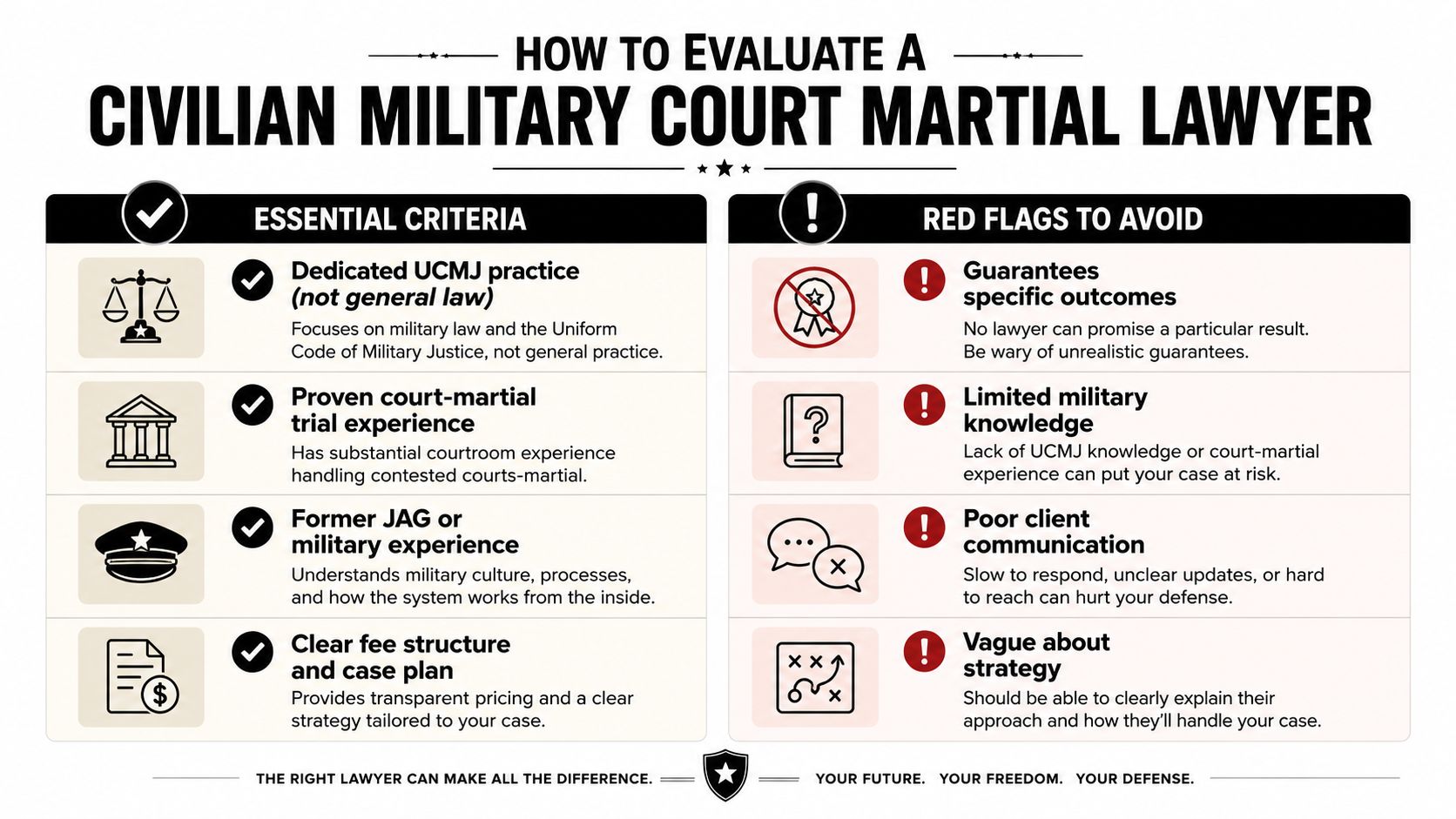
When you compare firms, look for sustained military justice experience, teaching, multi-branch work and other credibility signals. Treat those signals as a filter, not as a verdict.
Common Mistakes That Destroy Court Martial Cases
The worst cases often start before anyone sets foot in a courtroom. They start when a service member talks too soon, stays quiet too long, or treats a military investigation like a routine command problem.
Mistakes that come up over and over
- Talking to CID, NCIS, OSI, or CGIS without counsel: once you make a statement, the government can use it, and pulling it back is usually a fight you do not win.
- Trusting command to “handle it internally”: command has its own priorities, and protecting you is not one of them.
- Waiting until charges are preferred: by then, investigators may already have built the outline of the case they want.
- Posting on social media: screenshots survive long after the post is deleted.
- Failing to preserve texts, emails, and device data: what disappears can matter just as much as what stays.
- Accepting the first plea discussion without independent review: the first offer is often designed to see whether you will fold early.
Why these mistakes hurt
Each mistake gives the government more control. A statement gives them your words to quote back at you. Lost data makes it harder to attack timing, context, or credibility. Social media gives prosecutors clean exhibits they did not have to work to obtain. A rushed plea can leave you with a conviction, a discharge problem, and a record that keeps creating damage long after the case ends.
The military justice system has also changed in ways that matter when you are choosing defense counsel. The NIMJ FY 2022 data shows how much Article 15 use has fallen over time, from 150,000 in FY 1990 to 36,000 in FY 2022, while specialized defense work remains necessary. That change matters because the cases, the forums, and the pressure points are not the same as they were decades ago.
Don’t confuse access to command with protection from command.
If you remember one thing, make it this. The first week often shapes the rest of the case, and the wrong move early can narrow your options fast.
A good way to compare counsel is to screen for sustained military justice experience, teaching, multi-branch work, and other credibility signals, then test every lawyer on how they would handle your facts.
What to Do in the Next 72 Hours
You don’t need a perfect plan. You need a disciplined one. The next seventy-two hours should be about protecting your position, not explaining yourself to people who may already be building a case against you.
Your immediate checklist
- Do not give any interview without counsel: that includes “informal” talks that feel harmless.
- Preserve every device and message: don’t delete, edit, factory reset, or hand over anything casually.
- Write down the timeline now: memory gets sloppy fast when stress spikes.
- Contact an experienced military court martial lawyer today: not after the next formation, not after leave, today.
- Shortlist two or three counsel options: use a comparison guide, then interview them directly.
- Review the rights issue before speaking to investigators: if you’re being questioned, understand the basics of Article 31 protections.
The reason for urgency is simple. A court-martial conviction can end a career, damage retirement, trigger serious punishment, and follow you into civilian life through discharge characterization and collateral consequences. Waiting for the command to “figure it out” is not a strategy. It’s surrender by delay.
If you’re under investigation, under suspicion, or already charged, stop guessing and start building a defense. Contact a civilian military court martial lawyer who handles these cases, compare options, and move before the government’s version becomes the only version that matters.