
You got your DD Form 214, looked at the dates, the characterization, the awards, and then saw RE-4 in Box 27. It’s common not to know what it means at first. They just know it looks bad.
It is bad.
A reentry code 4 is the military telling every future gatekeeper that your service ended in a way the system treats as disqualifying for coming back. If you were hoping to reenlist, switch branches, join the Guard or Reserve, or keep a military path open later, this code is the kind of administrative mark that can shut the door hard.
The worst move is treating it like a clerical footnote. It isn’t. It’s a legal and strategic problem. If you want any real chance of changing the outcome, you need to stop thinking like a former service member filling out paperwork and start thinking like someone building a case.
Table of Contents
- That RE-4 on Your DD-214 Is a Red Flag Not a Period
- What Exactly Is a Reentry Code 4
- The Real-World Consequences of an RE-4 Code
- Why Your First Instincts Are Probably Wrong
- Your Three Battlefronts to Challenge an RE-4
- Why a Civilian Military Defense Lawyer Is Your Only Real Ally
- Reentry Code 4 FAQs and Your Next Move
That RE-4 on Your DD-214 Is a Red Flag Not a Period
You’re sitting at a kitchen table, in a parking lot, in the VA lobby, or on your couch staring at a document that’s supposed to close out your service. Then you hit Box 27 and see RE-4. That moment lands hard because even before you understand the code, you can feel the judgment behind it.
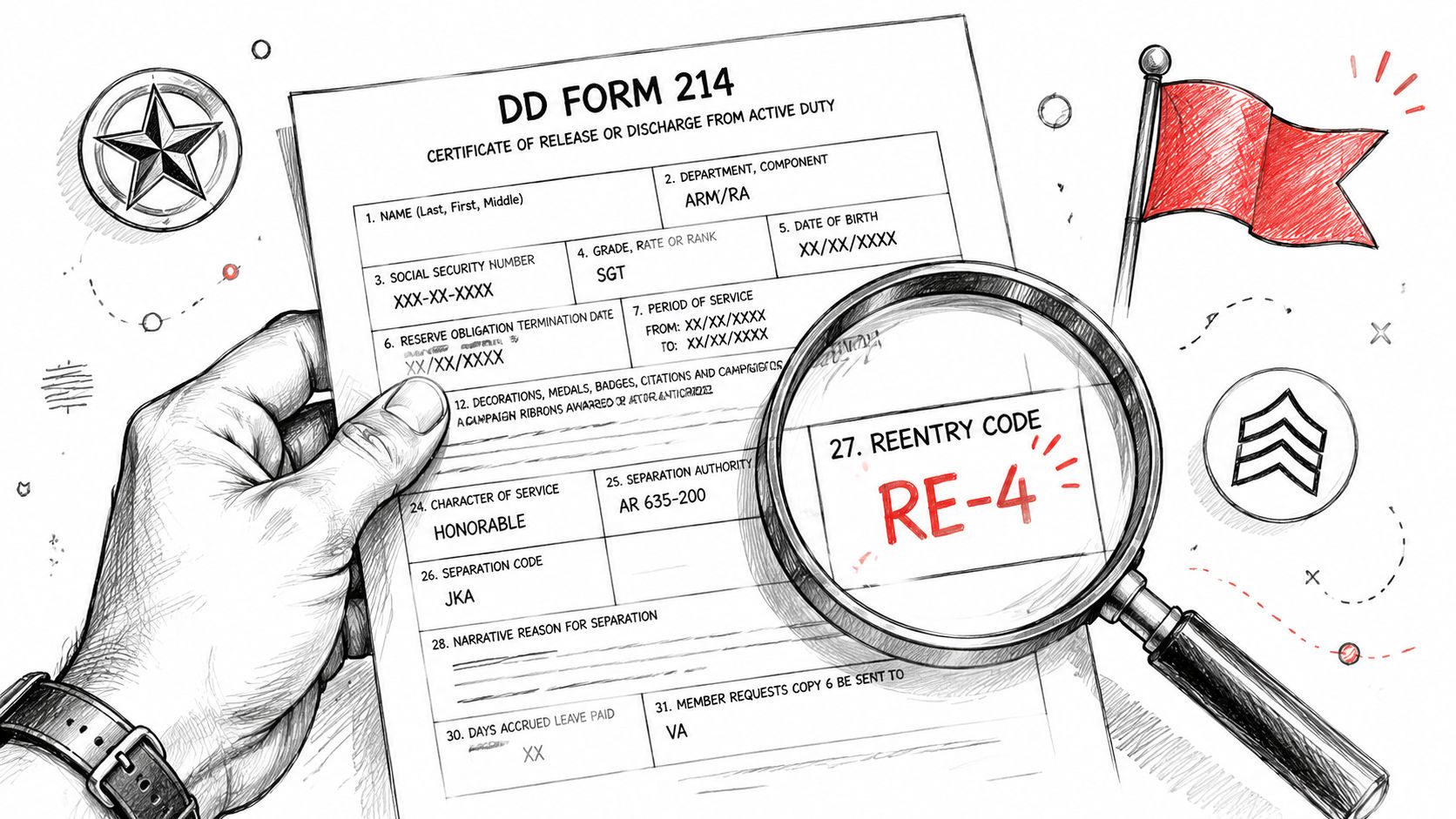
The same reaction comes up over and over. Shock first. Then denial. Then a bad plan. People tell themselves they’ll call a recruiter, wait a few years, or hope the code won’t matter outside the branch they left. That thinking burns time you may not be able to get back.
An RE-4 is not a period at the end of a sentence. It’s a red flag planted in your record. It tells future military decision-makers that your separation wasn’t just the end of one enlistment. It was a separation the system wants others to treat seriously.
Practical rule: If you found an RE-4 on your DD-214, assume it affects far more than one future application and start preserving records immediately.
That means you need to get organized now. Pull your separation packet, counseling paperwork, medical records, performance history, any adverse action paperwork, and anything tied to the basis for discharge. If you don’t know why the code was assigned, that’s your first problem to solve.
Here’s the blunt truth. You don’t beat a reentry code 4 with optimism. You beat it, if it can be beaten at all, by attacking the reason it exists.
What Exactly Is a Reentry Code 4
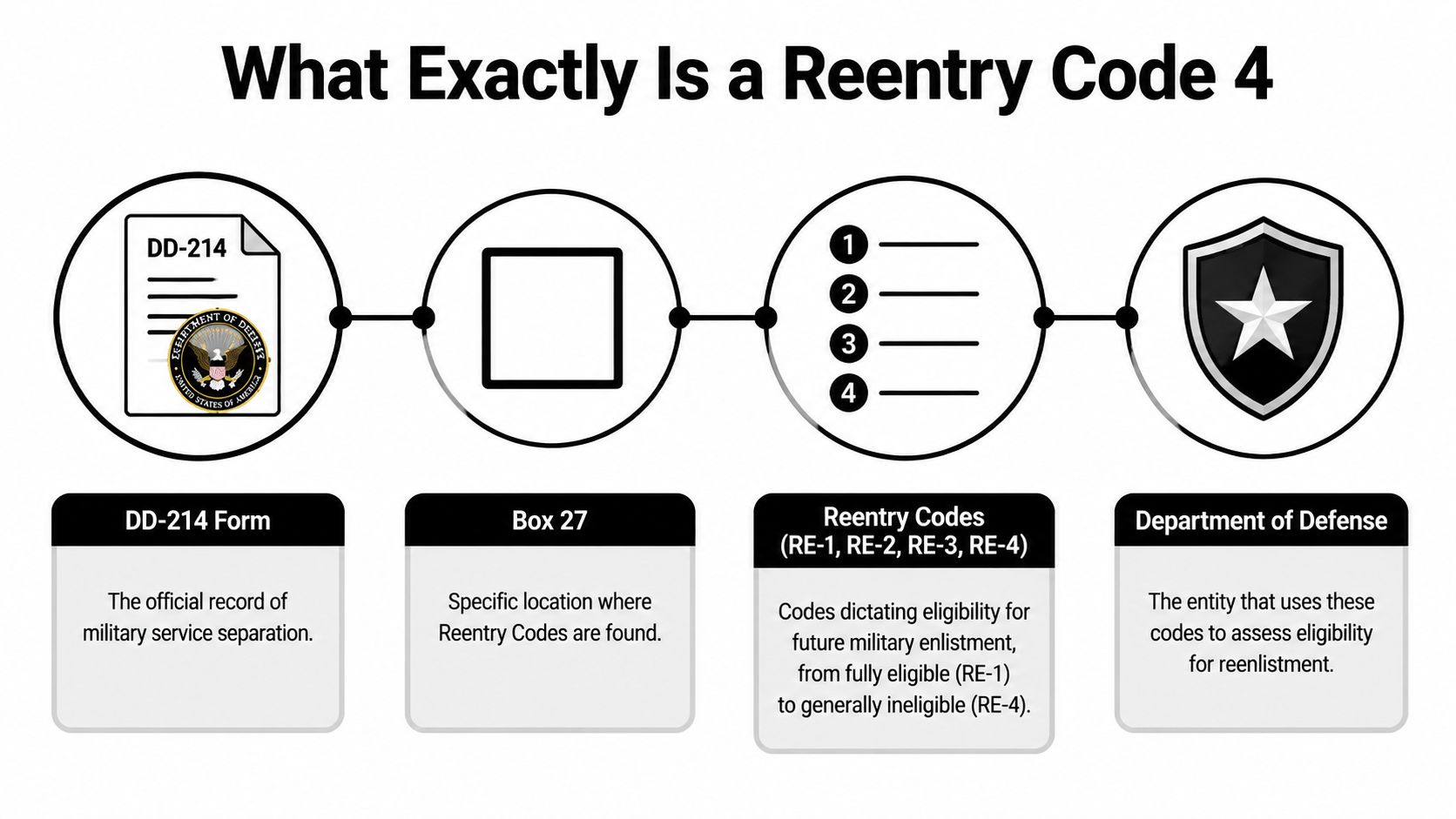
A reentry code 4 is part of the military’s reenlistment eligibility system. According to Swords to Plowshares guidance on re-enlistment basics, RE codes appear in Block 27 of the DD Form 214 and operate on a 1 to 4 system across branches. That same guidance explains that RE-4 is generally a hard stop for re-enlistment, while RE-1 is the code that permits immediate reenlistment.
What the system is saying
Cut through the jargon and the answer is simple. RE-4 means the system reads your separation as one that blocks you from coming back unless the code is changed or a rare exception is approved. That is why people call it a career killer.
This isn’t just about your old branch. The code functions as a signal across military channels. A recruiter seeing RE-4 doesn’t read it as “maybe later.” The default reading is “not eligible.”
If you’re dealing with an Army case involving the underlying discharge basis, start by understanding how the separation itself may have been framed in the record. A useful primer is this guide on Army administrative discharge issues.
Why recruiters usually aren’t the answer
Recruiters solve easy problems. An RE-4 is not an easy problem.
A recruiter can’t erase the record that produced the code. At best, a recruiter can tell you whether any route exists to process a case with a waiver or exception. But if the code stems from a serious separation basis, you usually need a correction strategy before a recruiter matters at all.
Recruiters work the front door. Your fight is in the record room.
That distinction matters. If your DD-214 carries a reentry code 4, your first serious question isn’t “Who will take me?” It’s “What in my file has to be corrected, challenged, or upgraded before anyone can even consider me?”
The Real-World Consequences of an RE-4 Code
An RE-4 doesn’t stay neatly inside your old unit or branch. It follows the narrative of your separation and can shape how other decision-makers view you.
According to Veteran.com’s explanation of reenlistment RE codes, reference materials describe RE-4 as tied to a nonwaiverable disqualification or a finding that the member is not recommended for reenlistment. That same guidance notes RE-4 is “normally not eligible to reenlist, nor join another service,” may require an Exception to Policy (ETP) waiver if reenlistment is attempted, and often requires a record correction before reenlistment can even be considered. It also warns that service members should verify the code on the DD-214 because errors do happen.
This follows you beyond your old branch
A lot of people think the code only matters if they want to go back to the exact branch they left. Wrong.
If you left one branch and planned to try another, the code can still block the path. If you hoped the Guard or Reserve might be a workaround, that may be blocked too. The military uses these codes to communicate reenlistment status across systems, not just within one office.
That’s why waiting is dangerous. The reentry code 4 may sit quietly on paper, but it can surface the moment you try to reopen a military career.
The code tells a story about your separation
The code also has practical spillover because it points back to why you were separated. Sometimes that reason involves misconduct allegations, medical findings, or an administrative conclusion that you were not fit for future service. Even when an outsider doesn’t understand the code itself, the underlying paperwork often frames the bigger problem.
That can matter if you’re sorting out broader post-service consequences tied to your discharge status. If your discharge characterization is part of the damage, review how that can affect benefits in this guide on other than honorable discharge and benefits.
Here’s the hard truth. The military didn’t issue this code casually. It’s historically significant because it’s reserved for separation circumstances the system treats as serious enough to block future access to service. If that judgment was wrong, unsupported, unfair, or based on a bad process, you need to challenge the basis for it. If you don’t, the record keeps speaking for you.
| What you may be thinking | What the record likely says |
|---|---|
| “My service is over anyway” | “This person is not eligible to come back” |
| “I’ll explain it later” | “The DD-214 already speaks first” |
| “Another branch might overlook it” | “Other branches can read the same code” |
Why Your First Instincts Are Probably Wrong
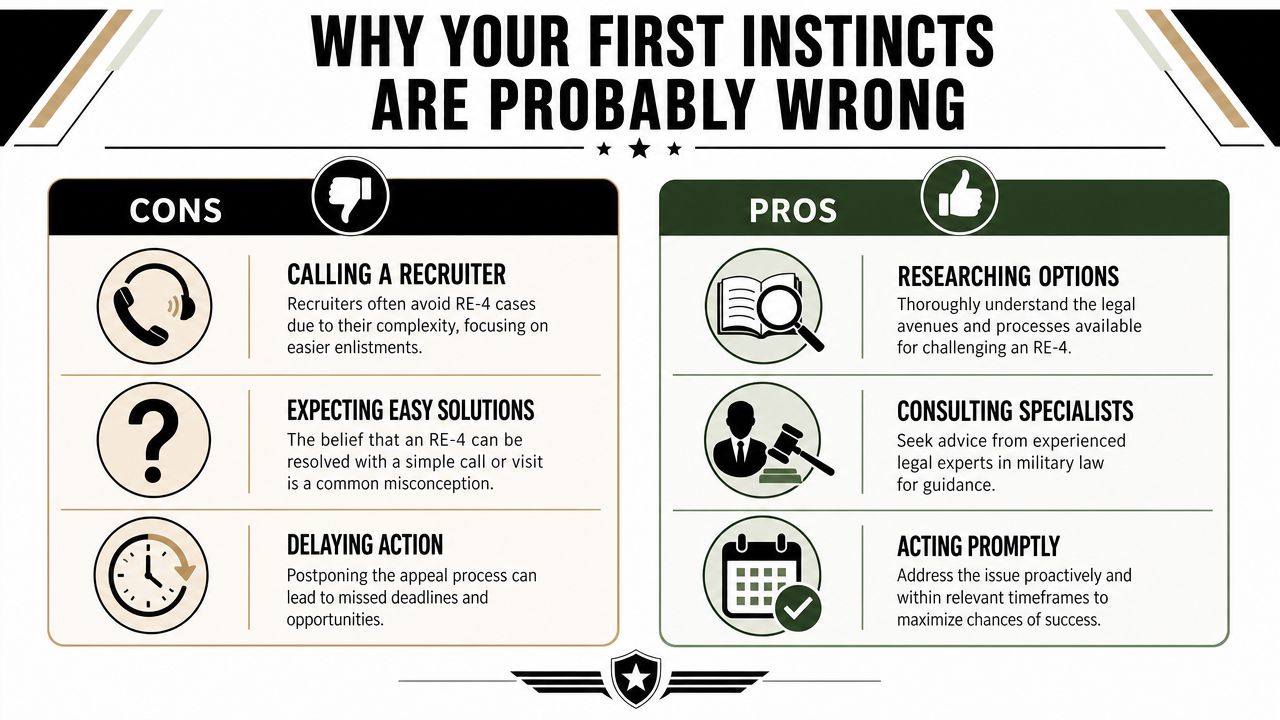
When people discover a reentry code 4, they usually make one of three moves. They call a recruiter. They do nothing. Or they start filling out forms without understanding what they’re trying to fix.
All three can waste time.
The bad first calls people make
Calling a recruiter first is usually a mistake because the recruiter isn’t deciding whether the original code was justified. Recruiters don’t rewrite separation history. They react to it.
Doing nothing is worse. People tell themselves they’re moving on, but the unresolved record stays there. If the code was assigned in error, you’re letting an avoidable problem harden into an accepted truth.
Then there’s the paperwork trap. People file something because they feel they must act, but they haven’t identified the actual target. Was the discharge characterization wrong? Was the narrative reason wrong? Was the medical basis flawed? Was there a procedural failure? If you don’t know which wall to hit, swinging harder won’t help.
The right question to ask
The question isn’t “How do I get around RE-4?”
The question is “Why was RE-4 issued, and what record entry has to be overturned, corrected, or upgraded to make a code change possible?”
That change in thinking is everything. You’re not asking for mercy. You’re building an argument that the original administrative result was legally wrong, factually unsupported, inequitable, or all three.
Common mistakes include:
- Calling a recruiter for legal answers. Recruiters process applicants. They do not litigate separation records.
- Trusting the code must be correct. Administrative records can contain errors, and bad assumptions can drive bad outcomes.
- Ignoring the underlying basis. The code is often the symptom. The separation reason is the disease.
- Waiting for life to calm down. Delay makes documents harder to find and witness memory weaker.
- Submitting a thin packet. Boards don’t reward emotion. They respond to evidence and coherent argument.
- Thinking sincerity is enough. It isn’t. These cases turn on records, procedure, and credibility.
If your strategy starts with “I’ll just explain what happened,” your strategy is too weak.
A strong challenge starts with the record, not your frustration. Your frustration may be justified. It still won’t carry the case by itself.
Your Three Battlefronts to Challenge an RE-4
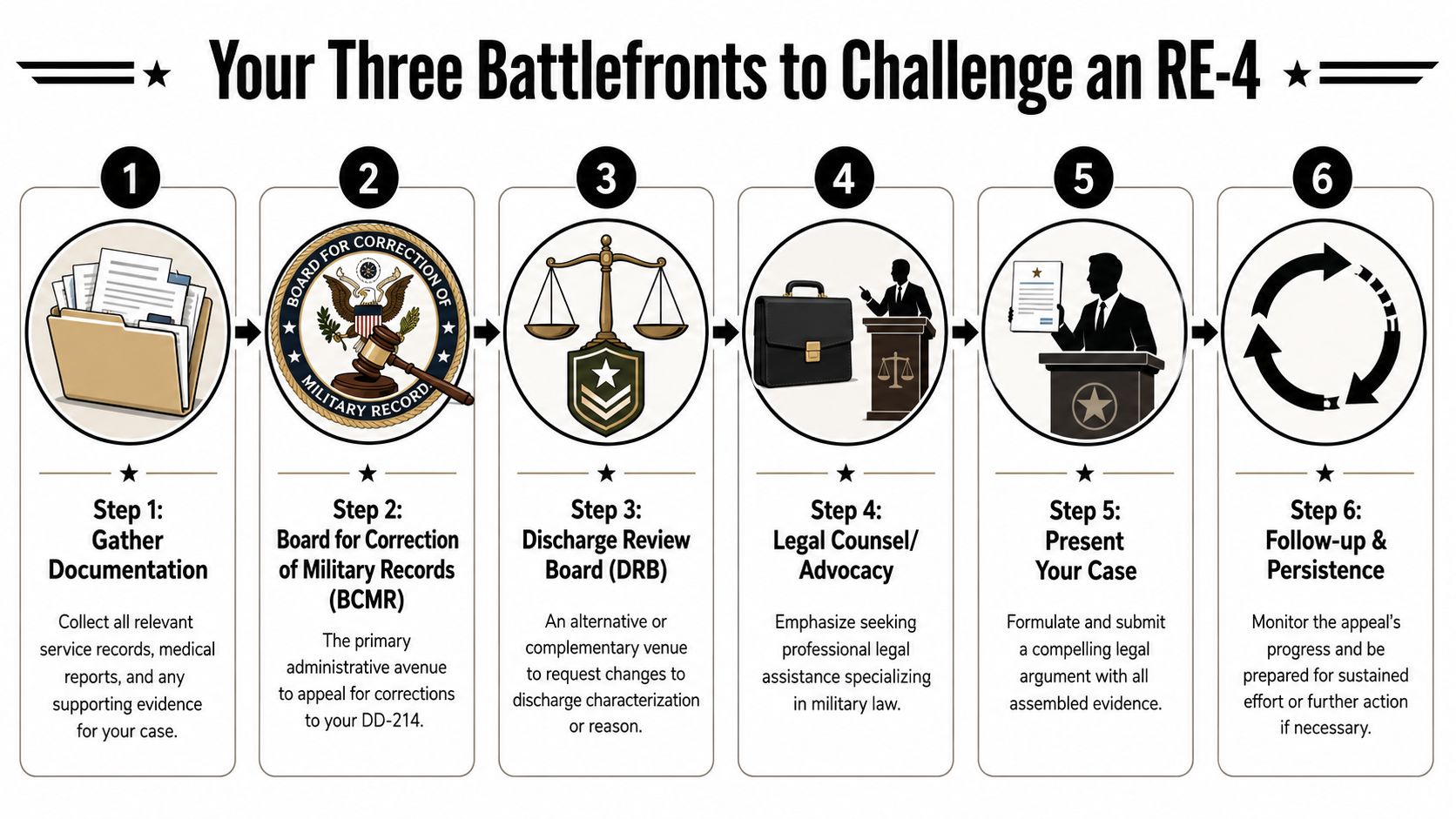
You don’t fix a reentry code 4 by asking nicely. You fight on the right administrative battlefield with the right target and the right evidence.
A Tennessee veteran services reference on military reenlistment codes highlights a common problem. People are told RE-3 or RE-4 may require a waiver, but they aren’t given practical guidance on whether the realistic path is a recruiter waiver, a discharge upgrade, or a records correction. That same material notes outcomes depend on branch policy and the original reason for separation, and that one-size-fits-all advice is unreliable.
Battlefront one the Discharge Review Board
If your separation falls within the board’s review window, the Discharge Review Board, or DRB, may be one place to attack the problem.
This route usually makes the most sense when the discharge characterization, narrative reason, or fairness of the separation itself is central to the bad outcome. If the discharge was improper or inequitable, that can open the door to downstream changes. In some cases, changing the discharge picture can support a change to the reentry code.
But don’t romanticize the process. The DRB is not a sympathy board. It’s a record-based fight. If you claim the discharge was unfair, you need documents, sworn statements, medical support when appropriate, and a legal theory that makes sense.
Battlefront two the Board for Correction of Military Records
The Board for Correction of Military Records, often the BCMR or branch-specific equivalent, is often the stronger route when the issue is a direct error or injustice in the record.
This board has broader corrective power. If the RE-4 itself is the central target, or if the problem involves how the service recorded the separation basis, the BCMR is often where serious legal work happens. This is especially important if the more limited review route isn’t available or doesn’t fit the problem well.
People lose here when they file vague narratives instead of a legal package. “Please help me, this hurt my life” is not a case theory. “The service assigned this code based on a flawed finding, unsupported record, or unfair process, and here is the evidence” is the beginning of one.
Battlefront three the evidence file
Here, most self-filed cases collapse.
Boards decide cases on records. That means your case file has to do real work. Depending on the facts, that can include:
- Service records that show strong performance before the disputed event.
- Separation documents that reveal procedural defects, unsupported conclusions, or mismatched paperwork.
- Medical opinions if the discharge involved diagnosis, fitness concerns, or disputed mental health conclusions.
- Affidavits from leaders, peers, or witnesses who can address what occurred.
- Post-service material that supports credibility, rehabilitation, or the broader equity argument.
- A legal memorandum that ties the facts to the correction requested.
If you’re also evaluating whether the discharge itself should be upgraded, this resource on how to upgrade a military discharge helps frame that part of the strategy.
Here’s a practical way to consider it:
- Identify the actual defect. Was it misconduct, medical separation, command bias, bad paperwork, or a characterization problem?
- Pick the correct forum. Not every bad record issue belongs in the same lane.
- Match the evidence to the defect. Medical cases need different proof than misconduct cases.
- Request precise relief. Ask for the specific correction, upgrade, or code change you can support.
- Expect resistance. These boards are built to preserve finality unless you force a reasoned correction.
A weak case asks for a second chance. A strong case proves the first result shouldn’t stand.
That’s why generic internet advice is dangerous. The path for someone separated over misconduct is not the same as the path for someone separated after a disputed medical label or a questionable administrative recommendation. The underlying reason drives the remedy.
Why a Civilian Military Defense Lawyer Is Your Only Real Ally
If you’re fighting an RE-4, you are not dealing with customer service. You are dealing with a system that already stamped your record with a disqualifying conclusion. Expecting that same system to casually unwind its own work is naive.
A seasoned civilian military defense lawyer brings three things you cannot get from guesswork.
First, independence. Civilian counsel doesn’t answer to your former command and doesn’t have to protect institutional relationships. That matters when your argument is that the institution got it wrong.
Second, strategic focus. A lawyer who handles military record corrections, discharge upgrades, and contested separation issues knows the difference between a case that needs a narrow correction request and one that needs a full attack on the underlying discharge basis. That judgment saves time and avoids self-inflicted damage.
Third, case-building discipline. Good counsel doesn’t just fill out forms. Good counsel builds a record that gives the board a reason to act and makes it harder for them to deny relief with boilerplate language.
You can file on your own. Plenty of people do.
Most of them confuse telling their story with proving their case.
Reentry Code 4 FAQs and Your Next Move
Can a recruiter waive a reentry code 4?
Usually, no. A recruiter is rarely your first meaningful move in an RE-4 case. If the underlying record is the primary problem, that record has to be challenged first.
Is RE-4 found on the DD-214?
Yes. The code appears in Box 27 of the DD Form 214, as noted earlier from the reenlistment guidance source.
Does RE-4 only affect one branch?
No. As covered above, RE-4 is treated as a barrier across branches unless there is a correction or rare exception.
Can an RE-4 be changed?
Sometimes, yes. That usually means pursuing a discharge review, a records correction, or both, based on the underlying reason for the code.
Should I ask for a code change or a discharge upgrade?
That depends on what caused the code. If you target the wrong issue, you waste time. The remedy has to match the defect.
What should I do first?
Get the full separation record. Then have a qualified civilian military defense lawyer evaluate the actual basis for the RE-4 before you start filing anything.
If you found a reentry code 4 on your DD-214, stop guessing and stop calling the wrong people. Your future military options, your reputation, and possibly your benefits picture are all tied to what happens next.
Move fast. Preserve records. Get a real case assessment from experienced civilian military defense counsel.