
You are holding a DD Form 214 that says dishonorable, or you are weeks from a general court-martial where that word is already in the sentencing conversation. Your spouse wants to know about the house, the VA clinic, and whether a hunting rifle in the closet is now a federal problem. Command is treating the case as finished. It is not finished, but dishonorable discharge consequences do not wait for you to feel ready.
A dishonorable discharge is a punitive sentence, not a bad performance review. It is adjudged by a general court-martial. From that day, benefits, firearms, and civilian screening each operate under their own rules. Fixing one does not fix the others. Pull the paperwork this week and list what you need before you file anything.
Table of Contents
- What a Dishonorable Discharge Takes Away
- How the Discharge Source Decides Your Correction Route
- How to Pursue a Correction, Step by Step
- Care and Benefits You May Still Reach During Review
- Firearms, Jobs and Civilian Fallout From the Record
- Mistakes That Lock In a Dishonorable Discharge
- Frequently Asked Questions About Dishonorable Discharge Consequences
- Confirm Your Options With Civilian Counsel This Week
What a Dishonorable Discharge Takes Away
A dishonorable discharge is a legal character-of-service bar, not a sticker on the separation form. The Congressional Research Service states that a dishonorable discharge is disqualifying for most VA programs. A bad-conduct discharge from a general court-martial creates a legal bar too, unless VA finds the person was legally insane at the offense or otherwise finds the service non-disqualifying. Eligibility turns on the legal character of the service, not on the fact that you wore the uniform.
| Area | Typical effect | Relief route |
|---|---|---|
| VA disability compensation and pension | Generally barred for the barred period | Character of Discharge review; insanity exception |
| VA health care | Generally ineligible | Character of Discharge review, then program rules |
| VA education and home-loan programs | Generally barred | Character of Discharge review; program-specific rules still apply |
| Firearms purchase, transfer and possession | Federal bar under 18 U.S.C. 922(g)(6) | No restoration written into the discharge label; confirm any path with counsel |
| Civilian employment screening | Characterization visible in background checks | Correction board upgrade, then a disclosure plan |
Disability compensation, pension, and dependency payments are generally barred for that period of service. The bar blocks the award. It does not merely cut the dollar amount.
VA health care is ordinarily conditioned on active service that did not end in a dishonorable discharge. People with dishonorable, bad-conduct, or other-than-honorable discharges may be ineligible until VA reviews the character of that service.
Education benefits, home-loan assistance, and burial benefits follow the same character test. A later finding that service was "other than dishonorable" can restore veteran status and basic eligibility for many programs. It does not erase the military discharge, and it does not guarantee every program.
Each loss has its own door
Firearms sit outside VA entirely. Under 18 U.S.C. § 922(g)(6), a person discharged under dishonorable conditions may not ship or transport firearms or ammunition in interstate or foreign commerce, and may not receive firearms or ammunition that have moved in that commerce. Prison time is not the trigger.
Civilian employers see the characterization on background screening. The Government Accountability Office has reported that former service members without honorable discharges may face restricted medical and educational access and difficulty getting civilian work.
Practical rule: Do not treat the discharge as one problem with one form. Map each right you need, then match it to the route in the table.
Your first move is mechanical. Pull the DD Form 214, the court-martial order, and the separation packet. Write down every benefit or right you still need. That list decides the order of filings. A blank "upgrade everything" request does not.
How the Discharge Source Decides Your Correction Route
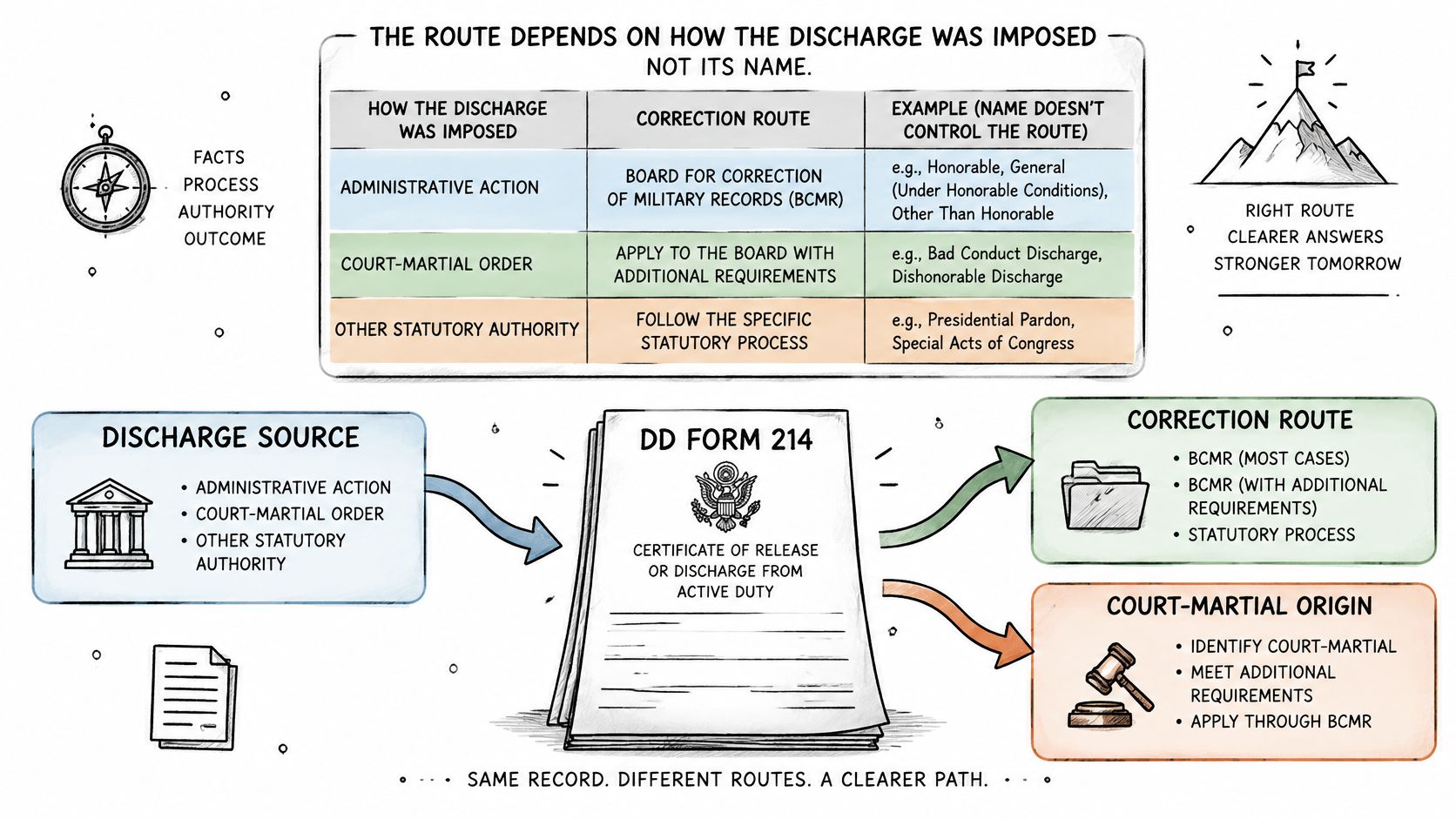
The name on the form does not pick your board. The source does. A discharge review board cannot review a dishonorable discharge or a dismissal imposed by a general court-martial. The Board of Veterans' Appeals materials on correction practice put the ordinary discharge-review deadline at 15 years, and that route is unavailable for this punitive category. You petition the service Board for Correction of Military Records on DD Form 149.
| Discharge source | Discharge review board | Correction route | Filing window |
|---|---|---|---|
| Dishonorable discharge adjudged by a general court-martial | No, excluded from review | Board for Correction of Military Records on DD Form 149 | Three years from discovery, waivable in the interest of justice |
| Administrative other-than-honorable discharge | Yes, within 15 years | Discharge review board, then correction board if denied | 15 years for the discharge review board |
| Bad-conduct discharge adjudged by a general court-martial | No. A review board does not take a punitive discharge from a general court-martial | Board for Correction of Military Records | Three years from discovery, waivable in the interest of justice |
Correction boards ordinarily apply a three-year filing period from discovery of the alleged error or injustice. The board may waive that limit in the interest of justice. Waiver is an argument you build. It is not a courtesy you receive for asking nicely.
Read the order before you pick a board
Open the court-martial order or the separation packet and answer one question. Who imposed this, and under what authority?
- General court-martial: Look for the convening order, the sentence, and the words "dishonorable discharge" or "bad-conduct discharge" adjudged as punishment. That file goes to the correction board, not a discharge review board.
- Lower court-martial: A special court-martial can adjudge a bad-conduct discharge. It cannot adjudge a dishonorable discharge. The caption tells you which forum you had.
- Administrative separation: An other-than-honorable characterization comes from a board or a waiver of board, not from a court-martial sentence. That file can reach a discharge review board inside 15 years.
Say a sailor received a dishonorable discharge at a general court-martial and, three years later, finds that trial counsel withheld favorable mental-health evidence. The 15-year review-board path was never open. The three-year correction clock may already be running from the day he discovered the error. He files DD Form 149 and argues waiver in the interest of justice, with the record, the medical file, and a clear statement of the legal error. A letter that only says the sentence was unfair gets denied.
If the source is a general court-martial, filing a thin petition on day one wastes the only clean shot. If you are still inside a discharge-review window on an administrative case, waiting to "build a longer civilian record" can blow the 15-year date. Source first, then timing.
How to Pursue a Correction, Step by Step
A correction is a contested filing. Boards deny unnamed errors and missing records before they ever reach your story.
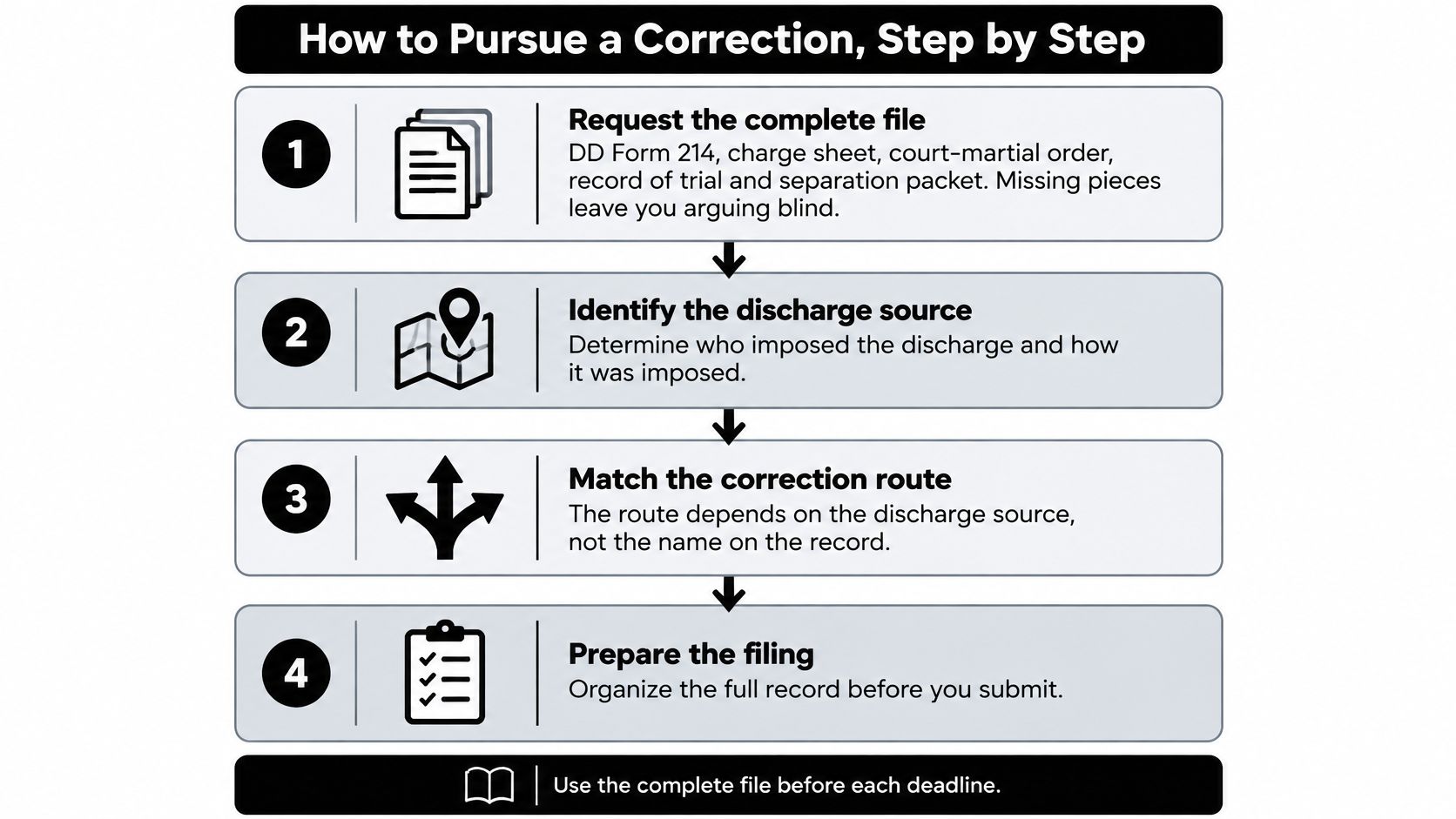
- Request the complete file. Get the DD Form 214, charge sheet, court-martial order, record of trial, and separation packet. Missing pages mean you are arguing blind, and the board will not fill the gaps for you.
- Identify the authority. Mark whether a general court-martial, a lower court-martial, or an administrative separation imposed the characterization. That single fact selects the board.
- Lock the window. Write the discovery date, the three-year correction date, and any 15-year review date that applies. If you need a waiver, say so in the petition, not in a later phone call.
- Name one error. Pick a procedural defect, an evidentiary problem, a sentencing error, or mental-health evidence nobody weighed. "I have changed" is not an error. Clemency can matter, but only when the statute and the board's rules allow it, and only with proof.
- Build the exhibit set. Medical and mental-health records, witness statements, and documented post-service conduct belong in the package. A bare form reads like a complaint, not a case.
- File DD Form 149 with the right service board. State the error, the facts that prove it, and the relief you want, usually a change in characterization. Our guide on how to upgrade a military discharge walks the form choices in more detail.
- Track the written decision. Calendar every response date. If relief is denied, you need an appeal or a new-evidence plan already drafted, not a fresh panic.
Why people lose before the board reads page one
Skip the record request and you cannot spot a defective advice-on-rights form or a sentencing exhibit that was never admitted. Skip the named error and the board has nothing to correct. Do not file until steps 1 through 5 are in one binder. Speed without a theory is how good facts die on a checklist.
Care and Benefits You May Still Reach During Review
A dishonorable discharge and a VA denial are two different rulings, and treating them as one pushes people off care they could still reach. An upgrade changes the military record. A VA Character of Discharge determination decides eligibility for VA purposes only, and VA can run that review even after a dishonorable discharge. The VA outcome does not rewrite the Department of Defense paperwork, and the military board's decision does not bind VA. Each consequence carries its own relief path.
VA weighs the service record, the facts that led to separation, and any statutory or regulatory bar. The best-known exception is a qualifying finding of insanity at the time of the offense. A later honorable enlistment does not automatically cure a barred period. You analyze each enlistment on its own.
Two stages, not one approval
Passing the character test is stage one. Stage two is the program rule: disability ratings, qualifying service, and income tests still apply. Filing a disability claim alone does not decide the character question, so ask for the character determination in the same breath as the claim and attach the separation package plus any mental-health evidence tied to the misconduct.
Other-than-honorable cases sit on a different map, and families mix them up with dishonorable cases. VA describes narrower care that can remain available with an other-than-honorable discharge, including care for a VA-rated service-connected disability, treatment tied to military sexual assault or harassment, certain mental-health care after qualifying combat service, emergency mental-health services, and Vet Center counseling. Read that split in what benefits remain with an other-than-honorable discharge before you assume your label matches your neighbor's.
Older advice that bad paper means nothing, forever, is incomplete, but do not invent a processing clock either. When you file, ask VA for the current review time and write that date down.
Say a Marine with a general court-martial dishonorable discharge submits a character request with a full mental-health package and asks VA to rule on the bar, not just on a diagnosis code. That is the right ask. Waiting for a military upgrade before filing anything with VA is the wrong move when care is urgent.
Ask for the VA determination, gather the service and medical records, and calendar every follow-up. Treat the military upgrade as a parallel track, not a prerequisite.
Firearms, Jobs and Civilian Fallout From the Record
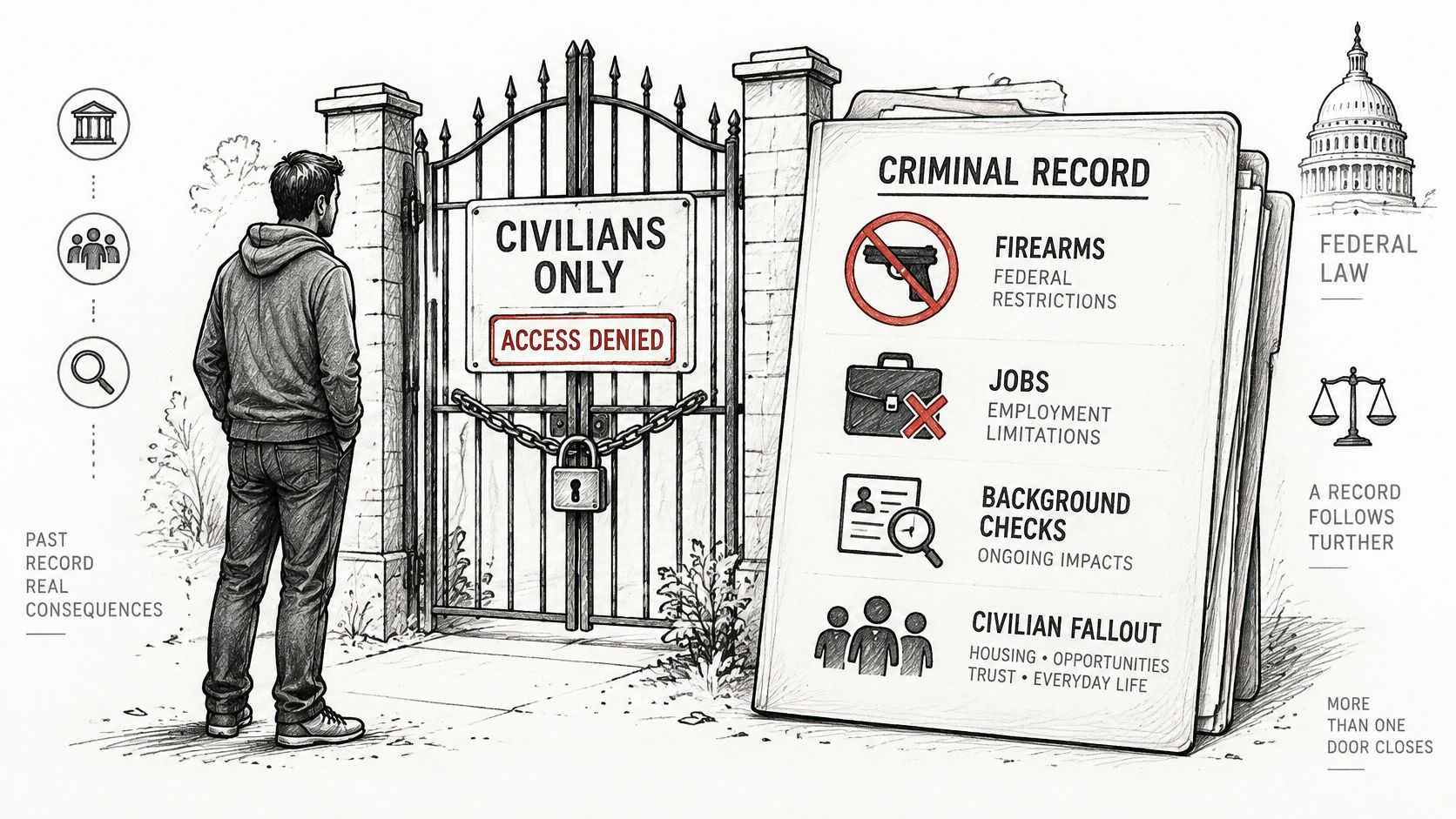
The firearms prohibition is its own federal disability. It reaches a person discharged under dishonorable conditions. It bars shipping or transporting firearms and ammunition in interstate or foreign commerce, and receiving any firearm or ammunition that has moved in that commerce. Judges do not have to send you to the brig for the bar to exist.
Where it shows up on an ordinary week
A licensed dealer runs a background check for a shotgun, and the transaction stops. Or you drive a family rifle across a state line for a hunt and you are now in the commerce the statute covers. People treat both scenes as "just possession at home." The statute is written broader than that, and guessing is how a personnel notation becomes a new criminal case.
Collateral damage sits next to the gun issue, and none of it is cured by a VA letter.
- Hiring screens: The characterization appears when an employer pulls the military record. A correction, if you win one, changes what you must disclose. A pending petition does not.
- Security work and clearances: Many armed-guard and clearance jobs treat this discharge as disqualifying on its face. Read the employer's standard before you apply and explain.
- Professional licenses: Nursing, law, and similar boards ask about court-martial convictions, not just the discharge word. Answer from the charge sheet, not from memory.
- State gun rules: Some states are stricter than the federal bar. Comply with both. A local range rule is not legal advice, and a clerk's shrug is not a defense.
Read the full court-martial and separation record before you decide the consequence is permanent or, just as dangerously, "only a military thing." The findings, the plea, and the exact characterization control what a board or a prosecutor can do later. Do not transfer, store, or travel with a firearm until counsel has read that record with you.
Mistakes That Lock In a Dishonorable Discharge
A dishonorable discharge creates several separate legal problems at once, and each carries its own clock and its own relief path. Most of the permanent damage after sentencing is self-inflicted. The system is built to close files, not to protect the accused. These are the errors that most often freeze a case.
- Blowing the three-year window: You discover an error and wait. Without a waiver argument tied to that discovery date, the board can dismiss the petition as late.
- Quitting on VA care: You hear "dishonorable means nothing" and never request a character review, so a possible care route dies from inaction.
- Signing unread paperwork: You initial a separation memo or a waiver because someone says it will "speed this up." Those sentences become the facts.
- Talking without counsel: You explain the case to investigators or the first sergeant. The statement lands in the record the board later treats as reliable.
- Trusting command to fix it: A short-notice appointed counsel may be capable, but command is not your advocate. Independence matters when the same chain wants the file closed.
- Filing a naked petition: No medical records, no witnesses, no documents. The board weighs evidence, not regret.
- Skipping the record of trial: You argue from memory. The charge sheet and exhibits are what the board will believe.
- Assuming "there is no evidence": Investigations often have gaps, bad identifications, and incomplete mental-health histories. You cannot test a gap you refuse to read.
The label is one line in the record. The consequences are not. A character-of-service request, a record correction, and the firearms question each sit in a different forum with different rules and different deadlines. Run each track on purpose. Doing only the one a friend mentioned is how people lose the others by silence.
Waiting feels safer than filing. It is not. Deadlines run while you look for a perfect story.
Frequently Asked Questions About Dishonorable Discharge Consequences
Is a dishonorable discharge permanent?
The label stays until an authority with power over it acts, and two different authorities can. A correction board can amend the military record on proof of error or injustice. VA can decide character of service for benefits under its own standard. Winning one does not win the other, so treat them as separate filings with separate deadlines.
Does it end all VA benefits?
No. VA generally bars benefits tied to the barred period, but a favorable character determination can reopen them, and narrow exceptions exist. File the character request on its own track instead of waiting for a record correction to finish first.
Does it ban all firearms?
It triggers a federal bar under 18 U.S.C. 922(g)(6) on shipping, transporting, or possessing firearms and ammunition in or affecting interstate or foreign commerce, and on receiving firearms or ammunition that have moved in that commerce. A firearm already in your home can still be a federal issue.
Can I still apply for VA care before an upgrade?
Often yes. VA can assess eligibility while the military record stands unchanged, because an upgrade and a VA eligibility decision answer different questions. Ask for the assessment rather than assuming the discharge settles it.
Can I get an upgrade after the deadline?
Sometimes. Past three years from discovery, the petition needs a waiver in the interest of justice plus an explanation for the delay. The longer the gap, the stronger that explanation has to be.
Do I need a lawyer right away?
Yes, before you file or sign. Early court-martial attorneys secure the full record and frame the error before you commit to a theory. Hiring counsel after a first denial means arguing against a record you helped build.
Confirm Your Options With Civilian Counsel This Week
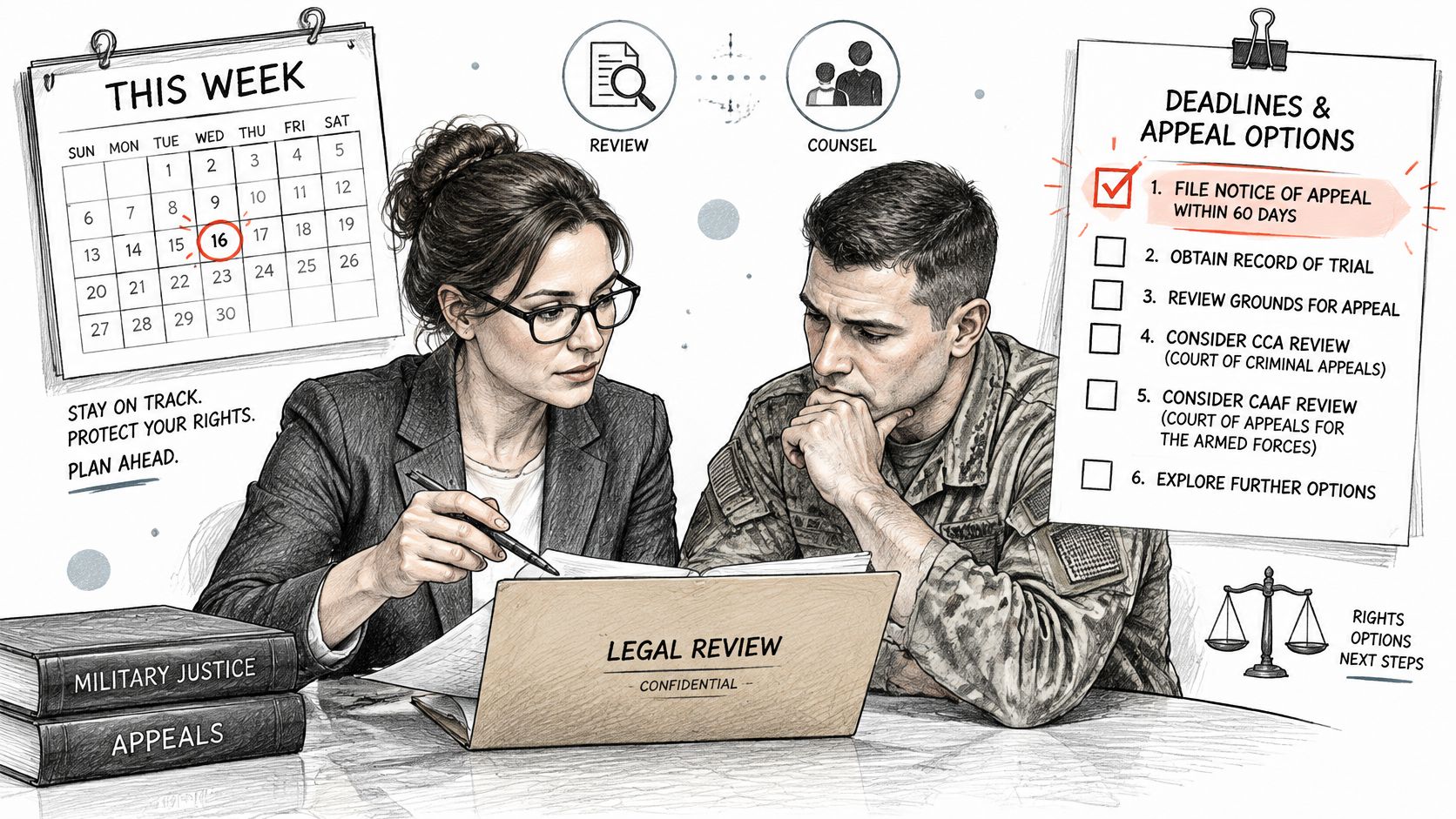
A discharge correction is a contested legal filing. Talk with experienced civilian military defense lawyers before the first deadline, not after a board has already said no.
Civilian counsel does not work for your command, and on a case this serious that independence is the point. One dishonorable discharge also creates separate problems with separate remedies: the correction board reviews the military record, VA makes its own character-of-service decision for benefits, and the firearms bar follows its own rules. A lawyer who files only one petition leaves the other consequences untouched, so the first conversation should cover every relief path you intend to pursue.
Compare UCMJ lawyer candidates on sustained military justice experience, a court-martial focus rather than a general practice, teaching and writing credibility, leadership in defense organizations, and a track record on similar discharge cases. When you compare lawyers, ask how many years each has practiced military law. Consult more than one candidate and judge strategy and fit, not confidence in the first call. A detailed guide on how to choose a military defense lawyer walks through that comparison step by step. Verify every credential yourself; no list or credential guarantees any case outcome.
If you want a plain walk-through of how these files move, start here.
If a dishonorable discharge is already on your record, do not wait for a better month. Pull the full file this week, calendar the correction date and the VA follow-ups, and contact qualified counsel before the window closes. Your benefits, your work, and your freedom turn on those first steps.