
You just got hit with a letter of reprimand, and your command wants you to treat it like paperwork. Don’t. A Letter of Reprimand (LOR) is a formal disciplinary action, not a coaching note, and it can land in your file in a way that follows you into promotion reviews, retention decisions, and later adverse action. In military and federal practice, the difference between a local warning and a permanent record entry is the difference between a nuisance and a career threat, and commanders know that. The Army’s own guidance treats an LOR as an administrative warning for failing to comply with standards, and it may be filed locally or permanently, which is exactly why you need to fight the filing decision as hard as you fight the allegation itself. Army guidance on Letters of Reprimand and filing options
If you’re reading this because you’ve been told “it’s just an LOR,” your chain of command is already softening the blow. The letter may not be a court-martial charge, but it’s still a written weapon. Your response has to be disciplined, fast, and strategic, because a sloppy rebuttal can turn a bad situation into a permanent mark on your record.
Table of Contents
- That Letter Is More Than Paper It Is a Weapon
- Local File vs Permanent Record The Only Thing That Matters
- How a Permanent Reprimand Ends a Military Career
- The Reprimand Process from Start to Finish
- Your Rebuttal Your First and Best Line of Defense
- Critical Mistakes That Guarantee a Permanent Filing
- Why an Experienced Civilian Lawyer Is Not Optional
- Frequently Asked Questions About Letters of Reprimand
That Letter Is More Than Paper It Is a Weapon
You open the envelope, and there it is. A command document saying your conduct, performance, or judgment missed the standard. The paper itself looks routine. The impact is not routine. An LOR creates a lasting record, and the command uses that record to justify harsher action later if it wants to. In the military, a letter of reprimand is formal written disciplinary action, and some versions end up in the Official Military Personnel File (OMPF). Military defense firm explanation of LOR filing impact
What the command is really doing
Commanders issue reprimands to document misconduct, performance failures, or violations of standards. That document does more than say, “fix this.” It freezes the command’s version of events and gives leadership a written foundation for further action if you do not respond the right way. Military guidance also makes clear that a reprimand can be used for UCMJ misconduct, state law violations, or substandard performance, so do not assume it only follows criminal conduct. Military criminal defense overview of LOR use
A commander also has to decide where the letter goes. That choice is a critical pressure point. A local filing keeps the damage narrower, while a permanent filing puts the reprimand into the personnel system that follows you into future decisions.
Why you should treat it as a live case
Do not shrug, apologize, and hope it disappears. That is how service members hand the command control of the story. A reprimand is paper, and paper becomes evidence. HR and university guidance on written reprimands treats them as formal discipline, an official warning, and a basis for more action if performance does not improve, which is the same posture you should expect here. University policy on written reprimands and rebuttals
Your response has to be strategic from the first minute. Build the rebuttal, challenge weak facts, and push hard on filing location before the command locks in a permanent record. If you wait, you give them time to decide the punishment for you.
Practical rule: if the command put it in writing, assume it will be read by someone you do not control later.
Local File vs Permanent Record The Only Thing That Matters
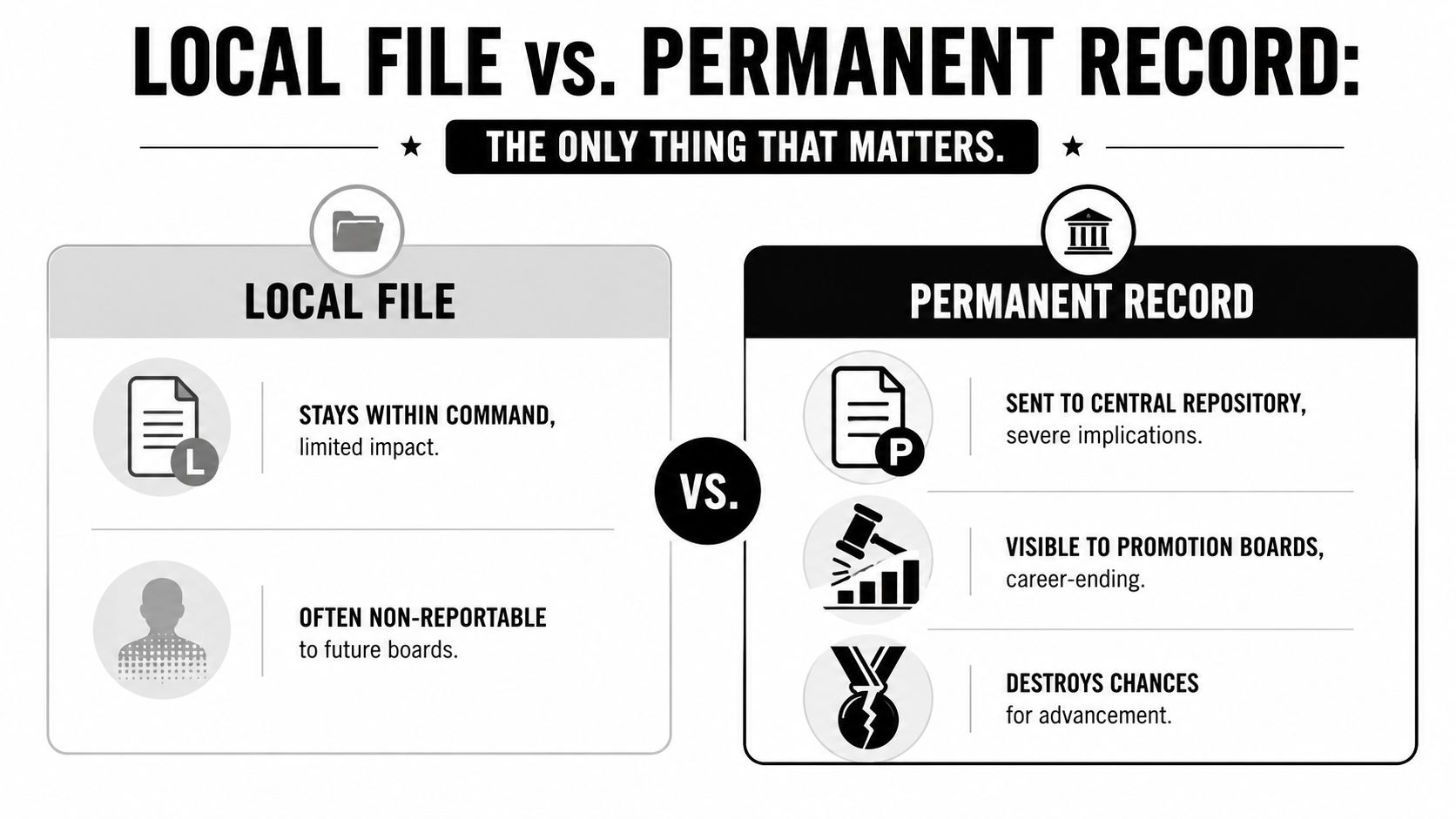
The primary issue is where the commander sends the letter. A local filing keeps the blast radius smaller, but a permanent filing puts the reprimand into the records that shape later decisions about your career. Army LOR filing guidance
Local file means limited damage
A local file is the lighter outcome, but it still matters. It stays inside the command chain, so the audience is narrower and the immediate fallout is usually less severe than a permanent record entry. That does not make it harmless. The allegation is still documented, the command still has a formal warning on paper, and the file still gives them a basis to hit you harder if there is another mistake.
Use the right frame. A local filing is like a supervisor keeping a formal warning in the office instead of sending it into the system that follows you around. It is still a problem, and it can still be used against you later.
Permanent file means institutional memory
Permanent filing is the career threat. Once the reprimand goes into the personnel system, promotion boards, retention authorities, and future decision-makers can see it and act on it. Army guidance says an LOR can be filed locally or permanently, and that choice affects promotions and future adverse actions. Army LOR filing guidance
A General Officer Memorandum of Reprimand, or GOMOR, is more damaging still. It is issued by a general officer and is normally placed in the permanent personnel record, where it carries far more weight than a local reprimand. GOMOR distinction and permanent filing
A permanent reprimand also feeds the separation process. A filing that sits in your official record becomes part of the paper trail used in administrative separation and discharge proceedings, which is why commanders know exactly what they are doing when they choose permanent placement.
What you should be trying to win
Your objective is straightforward. Keep it local, keep it restricted, or get it withdrawn. If the command refuses to pull it back, your rebuttal has to make permanent filing look like a bad decision for them. That is the fight. Anything less gives the command control over your future.
How a Permanent Reprimand Ends a Military Career
A permanent reprimand does not have to end your career on the spot to do serious harm. It creates a record the command can use against you later. Promotion boards see it. Retention authorities see it. Separation boards see it. Security-clearance reviewers can also treat it as a warning sign when they measure judgment and reliability.
The domino effect is the danger
A reprimand can be tied to conduct under the UCMJ, a state law violation, or poor duty performance. That range matters because it gives commanders a clean paper trail from one incident to later action. Once the document goes into a permanent file, the command has written support for saying you should not be promoted, should not be retained, or should be separated. Military criminal defense on reprimand consequences
That is why service members should stop focusing on whether they can survive the week. The key question is whether this will follow them into the next board, because that is where careers are won or lost.
Why permanent placement matters more than the allegation alone
The allegation can be ugly. The filing decision is what turns an ugly document into a lasting career problem. A local reprimand may die with the unit that issued it. A permanent one stays in the record future decision-makers rely on, which is why commanders can call it an administrative warning while still making a career-ending choice.
A command can label it administrative all day long. If it goes permanent, it becomes career evidence.
Where this connects to separation
If the command decides to push past the reprimand, the letter becomes part of the paper trail for separation. A reprimand can support later promotion denial, retention denial, or administrative discharge processing. If you want the next step in that chain, review administrative separation and military discharges, because a permanent filing rarely sits by itself for long.
The Reprimand Process from Start to Finish
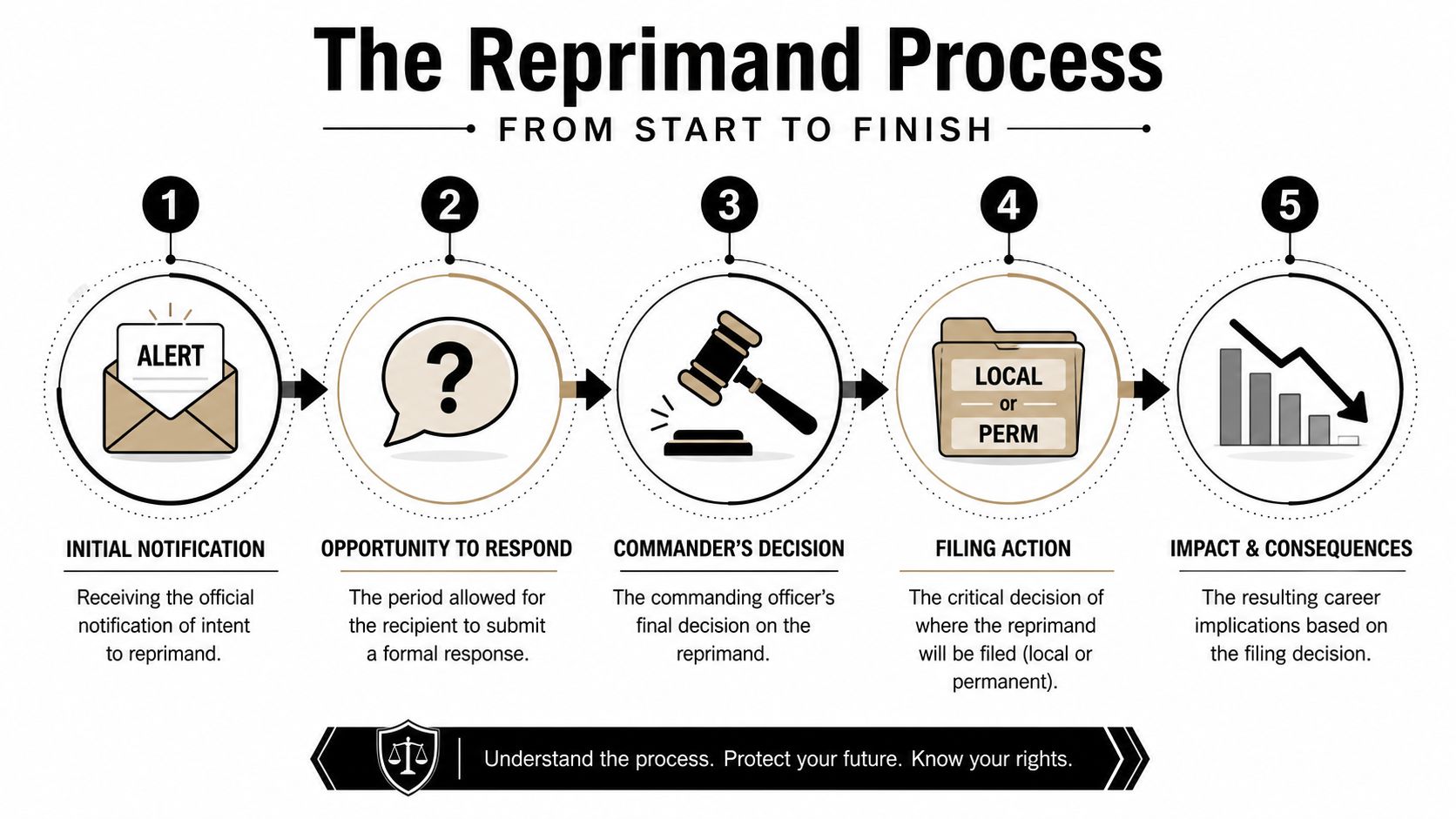
The process usually runs in a predictable order, and that helps if you act fast. Once the command decides to issue an LOR, you are working inside a short response window. The letter should spell out the conduct, identify the rule or standard the command says you violated, and state what it expects from you next. That is the same basic structure used in civilian written reprimands, which identify the misconduct, tie it to policy, and warn that further discipline can follow if the conduct does not change.
A reprimand is not just a lecture. It is a record the command can use later if it wants to push the case toward something harsher, including nonjudicial punishment in the military.
Step 1 Notification
You receive the notice and the supporting material. Do not argue in the hallway. Do not fire off a panic email. Read the document like evidence, because that is what it is.
Step 2 Response window
You usually get only a limited chance to answer. Use it. A formal rebuttal can be placed in your file, which means your response becomes part of the record too. Federal employee guidance on rebuttal rights
Step 3 Commander decision
The commander decides whether to issue the reprimand and where to file it. That is the decision that controls the damage. Local filing keeps the blast radius smaller, while permanent filing puts the matter into the record future decision-makers can see. Commanders know that difference, and they use it to sort out whether they are giving you a warning or building a paper trail for later action.
Step 4 Filing action
The command routes the letter to the chosen file. If it goes permanent, assume boards and future reviewers can see it. If it stays local, the problem is narrower, but it still matters. A local filing can still shape how your chain of command sees you, and that can affect what happens next.
Step 5 Downstream consequences
The letter can become the basis for promotion denial, retention action, or separation steps later. Military practice uses reprimands as part of progressive discipline, so the document is built to do more than warn. It creates a trail that can support later action if the command wants to keep pressing. Military defense article on reprimand consequences
Your Rebuttal Your First and Best Line of Defense
A rebuttal is not a confession with cleaner wording. It is your first chance to control the record before the command settles on a version of events that hurts you. The command is deciding two things at once, whether the allegation sticks and whether the reprimand belongs in a local file or a permanent one. Your response has to hit both issues directly, because that filing choice can shape your career long after the paper is signed.
A federal employee facing a reprimand often still has the right to submit a formal rebuttal for the file, even when the letter itself does not go to a review board. That is the opening you use. If you answer late, sound emotional, or treat the rebuttal like a personal apology, you hand the command exactly what it wants. A tight response built on facts, context, and filing strategy forces the decision-maker to work harder before placing the letter in a permanent record.
What a strong rebuttal actually does
It attacks the allegation itself, not your feelings about it. It separates the facts the command can prove from the assumptions it is trying to build around them. It also highlights missing context, procedural problems, and any point the command left out because it weakens the case for a permanent filing.
A strong rebuttal should include:
- Specific factual corrections, because broad disagreement does not change a commander’s mind.
- Supporting documents, such as emails, logs, evaluations, or witness statements.
- Mitigation, if the conduct is real but the proposed punishment is too harsh.
- A filing request, especially if local filing is the only outcome that makes sense.
- Professional tone, because anger helps the command, not you.
Why legal drafting matters
The strongest rebuttals do not read like pleas for mercy. They read like disciplined advocacy. That means every sentence has a job. It has to answer the allegation, preserve your best arguments, and steer the commander toward the right filing decision. If you want a model for how that kind of response is built, use strong GOMOR rebuttal drafting guidance as a reference for structuring a military rebuttal that fights the record.
Bottom line: your rebuttal is your first evidentiary brief. Treat it that way.
Critical Mistakes That Guarantee a Permanent Filing
Most permanent filings happen because the service member hands the command an easy path. That’s the ugly truth. The command is not looking for your best explanation by default. It’s looking for a decision it can justify. Your mistakes make that job easier.
- Missing the response deadline. If you blow the window, you give up the chance to shape the record.
- Writing angry or sarcastic language. Emotional writing makes you look unstable, not wronged.
- Admitting too much without strategy. A careless apology can read like a clean admission.
- Failing to attach proof. If you say the allegation is false, prove it.
- Trusting a verbal promise. If the commander says, “We’ll keep it local,” get competent counsel involved anyway.
- Ignoring the filing issue. If you only argue the misconduct and never address filing, you’re leaving the biggest issue untouched.
UCMJ lawyer search traffic is correct in this regard: People aren’t really asking what the document means. They’re asking how to stop the damage.
Why an Experienced Civilian Lawyer Is Not Optional
A military-appointed lawyer can help, but you need more than help. You need someone who treats the reprimand as a career event, not an administrative nuisance. Civilian military defense counsel brings independence from the chain of command, and that matters when the same command that accused you is also deciding where your future goes.
Why the difference matters
Civilian counsel usually has more room to focus on one case, one record, and one response strategy. They can push harder on the filing decision, rebuttal framing, and collateral consequences. Military counsel may be capable and ethical, but they’re still working inside the system you’re fighting.
What you should expect from counsel
You want someone who can read the document, identify the weak points, gather supporting material, and draft a rebuttal that sounds like it was written by someone who knows how boards think. You also want someone who can tell you when the right move is to seek local filing, rebut the allegation, or build a record for later correction.
If you’re facing an LOR, stop looking for reassurance and start looking for strategy. That’s the job.
Frequently Asked Questions About Letters of Reprimand
Can I refuse to sign it
You can refuse to acknowledge receipt, but that does not make the letter disappear. The command can still move forward, and your refusal will not stop the filing decision. It only leaves the command with a paper trail showing you declined to sign.
Is a letter of reprimand the same as an Article 15
No. An LOR is an administrative or disciplinary document. Article 15 is a separate nonjudicial punishment process, and the command may use one without using the other.
Can a reprimand go in my permanent file
Yes. That is the issue that usually decides the case. Local filing keeps the damage contained for now. Permanent filing puts the reprimand in the record that follows you to boards, promotions, and future assignments, so the fight is over where it gets filed as much as over the wording itself.
What is a GOMOR
A General Officer Memorandum of Reprimand is a more severe form of reprimand. A standard LOR can come from a lower-level commander, while a GOMOR is issued by a general officer and is usually headed for the service member’s permanent OMPF. GOMOR distinction and permanent filing
Should I hire counsel immediately
Yes. The clock starts when the letter lands, not when you feel ready. Every day you wait gives the command more room to lock in its filing choice and treat silence as weakness.
If you have been handed a letter of reprimand, do not sit back and hope the command goes easy on you. Get the document reviewed, build a rebuttal that attacks the filing decision as well as the allegation, and make the command justify permanent filing on the record. Your rank, your assignments, and your future boards are all in play, and the response has to start now.