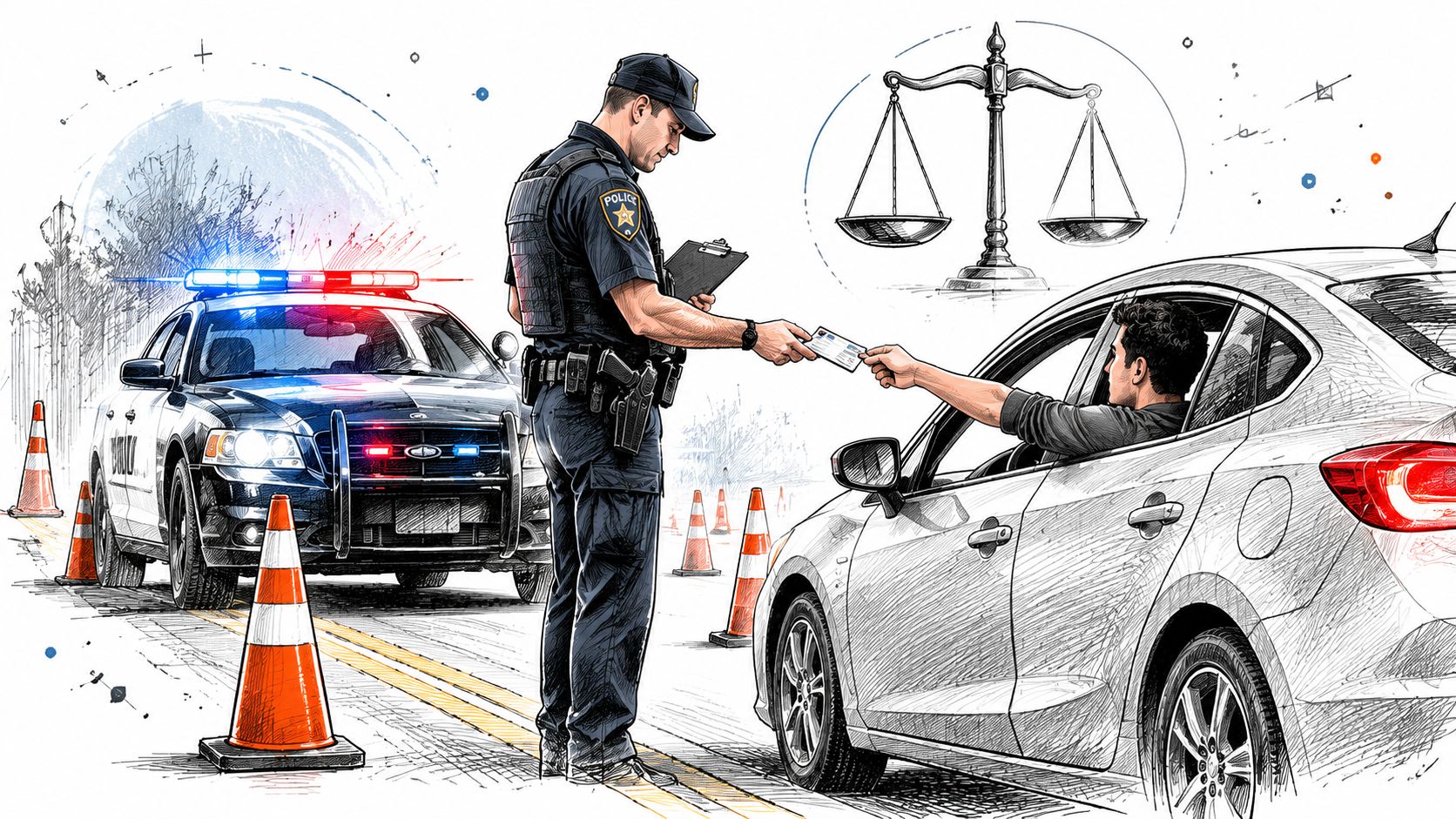
Sobriety checkpoints are constitutional under the Fourth Amendment, but only authorized by 38 states and prohibited by 12 states, so legality depends on where you are. If you’re on the wrong side of that state line, a bad stop can turn into a criminal case, a command problem, and a clearance headache fast.
One late-night checkpoint on a rural highway can change everything. Bright lights. Uniformed officers. Traffic funneled into a narrow lane. If you’re a service member, that roadside stop isn’t just about whether you had a drink. It can affect your driving privileges, your duty status, your security clearance, and how your command sees you the next morning.
Table of Contents
- Introduction to Sobriety Checkpoint Legality
- Federal Precedent and Constitutional Basis
- State Authorization and Prohibitions
- What Drivers Must Do at Checkpoints
- Evidence Risks and Suppression Strategies
- Tactical Advice for Interacting with Checkpoints
- Military Installation Checkpoint Rules
- Engaging Defense Counsel and Next Steps
Introduction to Sobriety Checkpoint Legality
A sobriety checkpoint is legal in some places and off-limits in others, and that split is exactly why people get burned. Federal law allows brief, neutral checkpoints, but state law decides whether police can run them where you live or travel.
For service members, that distinction matters more than most civilian guides admit. A checkpoint stop can lead to arrest, a report to command, and follow-on action that has nothing to do with the roadside encounter itself. If you’re in uniform, driving a POV after liberty, or heading back through a gate, the consequences stack up quickly.
Why the first question is never the last question
The primary question isn’t just whether checkpoints exist. It’s whether the checkpoint was lawful, whether the stop was neutral, and whether the officer stayed inside the limits of that stop.
Practical rule: If the stop looks improvised, biased, or uncontrolled, the defense angle gets stronger fast.
Military families need to think a step ahead. A roadside mistake can become a command issue, then a UCMJ issue, then an administrative issue. That’s why you don’t treat a checkpoint like a routine traffic inconvenience. You treat it like a legal event.
Federal Precedent and Constitutional Basis
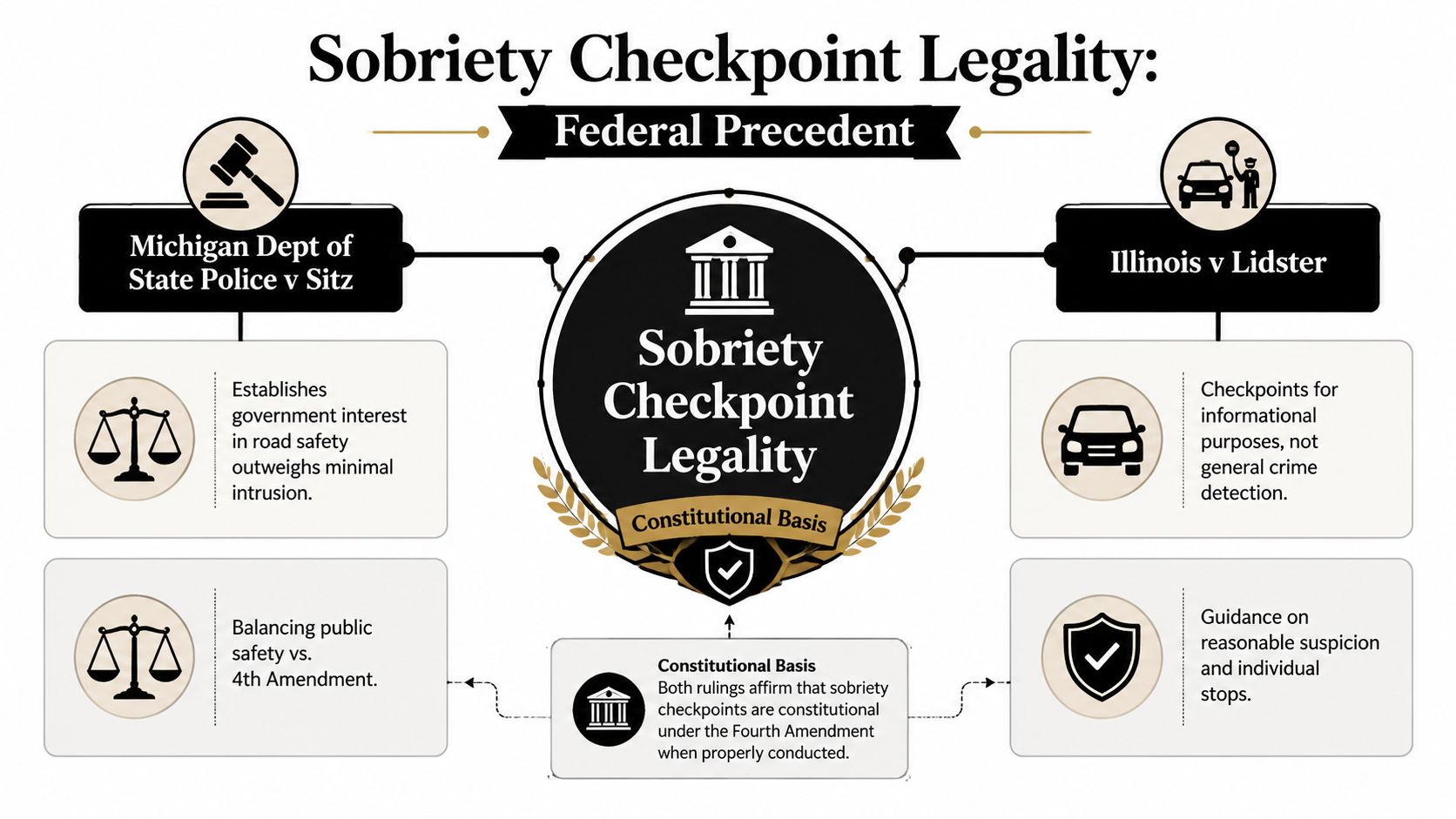
The constitutional baseline starts with Michigan Dept. of State Police v. Sitz. In that case, the U.S. Supreme Court upheld sobriety checkpoints, holding that brief, systematic stops can fit within the Fourth Amendment when the government’s interest in stopping impaired driving outweighs the limited intrusion on motorists. Illinois v. Lidster pushed the same point further. The legality question turns on the checkpoint’s purpose, whether it advances that purpose, and how much it interferes with liberty.
What neutral procedure really means
Neutral procedure is the entire test. The stop cannot depend on an officer’s hunch about the driver, the vehicle, or who is inside. The checkpoint has to run under a preplanned system, like stopping every third or tenth vehicle, with public notice, supervision, and minimal delay. That is the line between a lawful checkpoint and a fishing expedition.
For service members, that distinction matters immediately. A checkpoint that looks random on the roadside may still be defensible if the government can prove the plan was fixed in advance and applied the same way to everyone. If the officers start choosing vehicles by appearance, attitude, or convenience, the defense has a clean target. The stop begins to look discretionary, and discretion is exactly what constitutional checkpoint rules are meant to limit.
Why defense lawyers focus on the setup
Experienced defense counsel start with structure. Was there a written plan? Was the stop pattern fixed before the first car rolled through? Did officers keep the detention brief, or did they turn it into a free-ranging interrogation and stretch the stop beyond the checkpoint’s purpose?
That is where suppression motions are built. A checkpoint case rises or falls on the paperwork, the witness testimony, and the actual way the operation was run. If the government cannot show a neutral design and disciplined execution, the stop becomes vulnerable, and the record can support a challenge that matters in both civilian court and military follow-on action.
State Authorization and Prohibitions
Federal permission does not give local police a free hand. State law decides whether sobriety checkpoints can be used at all, and the rules vary sharply from one jurisdiction to the next. Current enforcement summaries show checkpoints are authorized in 38 states plus the District of Columbia and Puerto Rico, while 12 states do not allow them. A separate state summary also notes that checkpoints are not conducted in 13 states, with 10 of those states barring them by law, constitution, or legal interpretation. Use NHTSA’s current state summary to confirm the baseline before you treat any checkpoint as lawful.
Checkpoint Authorization by State
| Permitting Jurisdictions | Prohibiting Jurisdictions |
|---|---|
| 38 states, the District of Columbia, and Puerto Rico | 12 states |
States block checkpoints for different reasons. Some do it through state constitutional rulings. Others rely on statutes, legal interpretations, or agency rules. The result is the same for a driver at the roadside. A checkpoint may be allowed in one state and forbidden in the next.
Checkpoint planning still matters in the states that allow them. Approved programs usually depend on predetermined stop patterns and neutral selection rules, not officer preference. If officers are picking cars because of appearance, attitude, or convenience, the defense should press hard on whether the operation was systematic.
For military drivers, that issue has a second layer. A bad checkpoint stop does not stay in the roadside file. It can show up in a report that lands on a commander’s desk, and that makes the legality of the stop part of the defense from the start.
What Drivers Must Do at Checkpoints
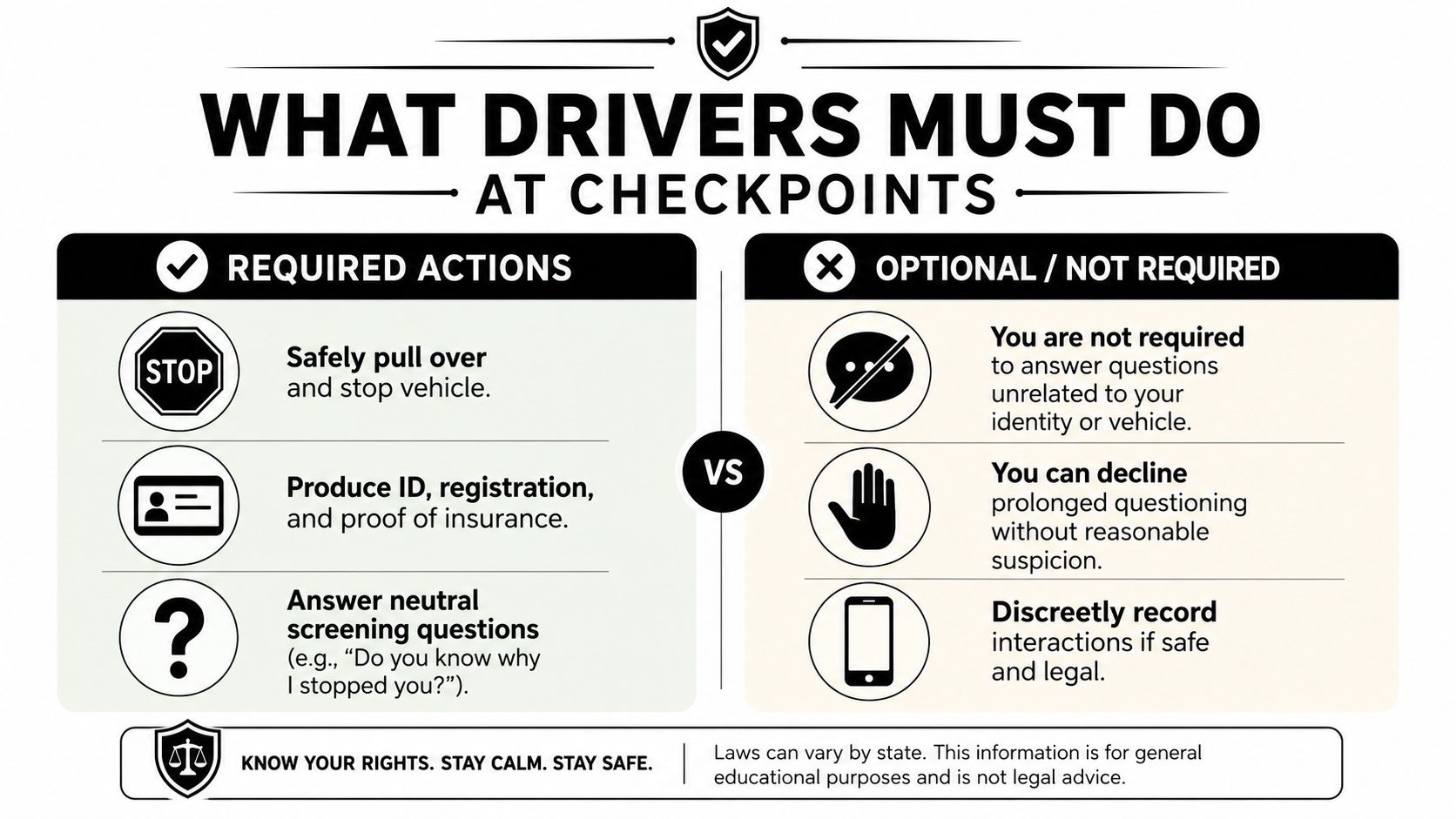
When you hit a lawful checkpoint, your first job is simple, stop safely and stay calm. You generally need to provide identification and vehicle documents when asked, and you should answer basic neutral screening questions without acting combative. That’s the safest move at the roadside.
What you can usually do without making things worse
Some state resources say a driver may avoid a checkpoint legally if the turn or reroute is safe and lawful. Others emphasize that you may need to stop and identify yourself, but you don’t have to volunteer incriminating details just because an officer asks casual questions. The distinction is important, and it varies by jurisdiction, as noted in sobriety checkpoint and testing guidance for drivers.
What not to do
Do not turn a short stop into a debate. Do not lie. Do not volunteer where you’ve been, how much you had, or whether you think you’re “fine.” If the officer asks you to step out, comply unless your lawyer later has a reason to challenge the request. If asked to perform roadside sobriety tests or to give consent for testing, understand that those choices can carry consequences depending on the state and the setting.
A service member has to think two moves ahead. Your words at the checkpoint can end up in a police report, then in a command action packet. Keep it tight, keep it polite, and stop talking once the legal purpose of the stop is over.
Evidence Risks and Suppression Strategies
Checkpoint cases are won by paperwork and process. If the government can’t prove the stop was neutral, supervised, and properly documented, the defense has an advantage. That’s why competent counsel asks for the operational logs, the stop pattern, the supervisor’s approval, and the actual conditions at the scene.
The strongest suppression arguments usually come from ordinary failures, not dramatic misconduct. Missing logbooks, irregular stop patterns, weak signage, and lack of on-site supervision all matter because they undermine the claim that the checkpoint was systematic. A checkpoint that looks neat on paper but sloppy in practice is exactly the kind of case that can crack under cross-examination.
What defense counsel looks for first
- Planning documents: Was there a real written plan or just an after-the-fact explanation?
- Stop pattern consistency: Did officers follow the same neutral sequence all night?
- Visibility and notice: Could drivers tell it was a checkpoint?
- Supervisor involvement: Was someone responsible for controlling the operation?
- Scope creep: Did officers expand the stop beyond screening and identification?
The legal theory is straightforward, sobriety checkpoints are generally constitutional when they follow a neutral plan, but legality turns on systematic design and minimal liberty interference under Michigan v. Sitz and Illinois v. Lidster. If the plan falls apart, the stop becomes attackable.
For a deeper military-collision example involving alcohol-related allegations, review this UCMJ Article 134 drunk and disorderly conduct guide. It’s the kind of charge that can grow out of a checkpoint stop when the facts are messy and the command wants a fast answer.
Tactical Advice for Interacting with Checkpoints
Your job at the stop is not to win the case on the shoulder of the road. Your job is to avoid handing the government extra evidence. That means staying calm, watching the procedure, and documenting what happened as soon as you can.

What to do in real time
- Stay steady: Keep your hands visible, speak calmly, and avoid sarcasm.
- Observe details: Note the number of officers, the lighting, the signs, and where you were stopped.
- Track names and badges: If it’s safe, identify the officer’s name, unit, or car number.
- Request clarity: If the stop shifts from screening to questioning, ask whether you are free to go.
- Document afterward: Write down the timeline, the questions asked, and any unusual orders while it’s fresh.
If the officer asks you to provide consent for a search or to perform tests, be deliberate. Don’t ramble. Don’t argue. If you’re directed to step out, do it safely and let counsel deal with whether the order was lawful later.
Here’s the hard truth. Officers write reports from memory, then supervisors build a case from those reports. You need your own version of the event, and you need it immediately.
Military Installation Checkpoint Rules
On a military installation, the rules tighten. Under 32 C.F.R. § 634.37, chemical testing after a traffic stop may happen only if the person was lawfully stopped on the installation, reasonable suspicion exists, and the person is asked to consent with a warning that refusal or failure to complete the test will revoke driving privileges. Read the regulation in 32 C.F.R. § 634.37.
Why that matters for service members
A base stop is not the same as a civilian roadway stop. The administrative consequences can be immediate even when criminal consequences are still uncertain. That means a refusal can cost driving privileges on base and still leave room for UCMJ or command fallout, depending on the facts.
For the investigative side of that process, see CID, NCIS, OSI, and CGIS explained. The point is not that every checkpoint leads to an investigation. The point is that once a military system gets involved, the paperwork can spread fast.
If you are a service member, treat an on-base stop as a regulatory event with career consequences. The government does not need to wait for a criminal conviction before it starts restricting your access, your license privileges, or your standing with command.
Engaging Defense Counsel and Next Steps
If you were stopped at a checkpoint and anything about it feels off, call a defense lawyer now. Don’t wait for the police report, the command email, or the “we’ll see what happens” speech from leadership. Early counsel can lock down video, request records, and identify whether the stop was neutral or sloppy.
The right civilian military defense lawyer brings something appointed counsel usually can’t, independent judgment, trial experience, and no chain-of-command pressure. If you’re facing aviation fallout, clearance risk, or a DUI allegation that could hit your career, you need counsel who knows both civilian checkpoint law and military consequences. For a practical way to evaluate representation, review how to select a military defense lawyer.
If you’re under investigation or worried that a checkpoint stop could turn into a UCMJ problem, contact experienced counsel now. Your license, your clearance, and your career are on the line, and time is not on your side.