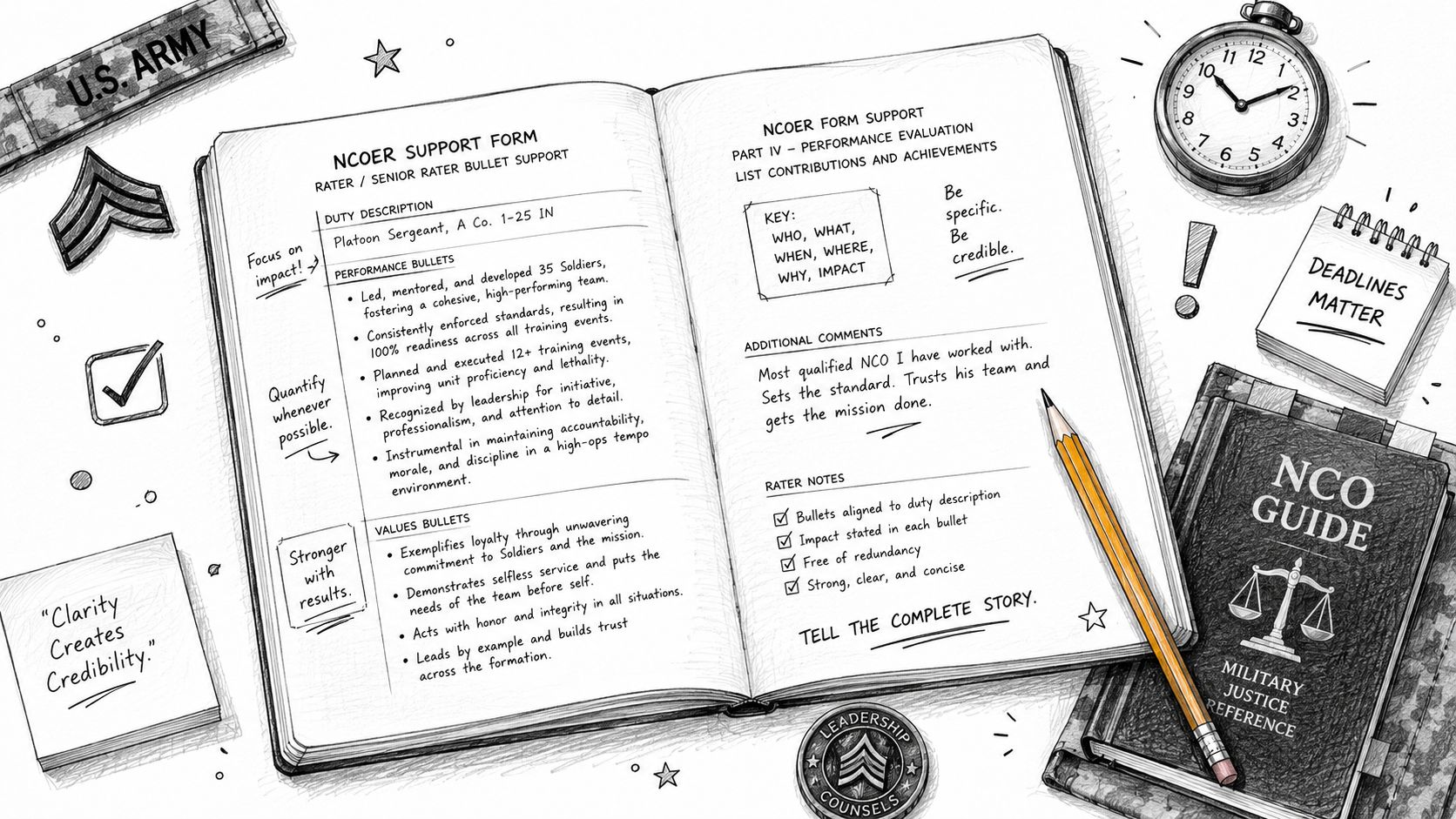
You’re probably staring at a sample NCOER support form because your rater handed you DA Form 2166-9-1A, gave you a few vague instructions, and expected you to somehow know how to protect your career with it. That’s how this goes. The counseling session feels routine. It isn’t. One careless duty description, one weak objective, one month of poor documentation, and command has the beginning of a record they can later use to deny promotion, justify adverse action, or support separation.
Too many NCOs treat this like admin clutter until the day a bad NCOER lands, a QMP problem appears, or a separation packet starts moving. By then, they’re not writing their story anymore. They’re trying to undo one already built for them. If your record starts drifting negative, the consequences can spill into promotions, assignments, retention, and even administrative separation and military discharges.
This form matters because paper becomes narrative, and narrative becomes evidence.
Table of Contents
- Your NCOER Support Form Is Not Just Paperwork
- The Support Form Is Not Your Friend It Is Evidence
- Mastering DA Form 2166-9-1A Block by Block
- Bullet Statements That Build or Break a Career
- Career-Ending Mistakes and How Command Uses Them
- When to Call a Defense Lawyer About Your NCOER
- FAQ
- What is a sample NCOER support form really for
- Is DA Form 2166-9-1A just an admin form
- Do I need DA Form 4856 for initial counseling
- What should I put in my duty description
- How often should I update my support form
- Can missing counseling dates hurt my NCOER
- What if my rater is building a negative paper trail
- Do I need a lawyer before I get a bad NCOER
Your NCOER Support Form Is Not Just Paperwork
You are in the counseling room. Your rater is talking fast, calling the support form routine, and sliding past blocks that will later shape your record. You have a choice right there. Fill it out like admin clutter, or treat it like a document that may be read months later by a chain of command trying to justify a bad evaluation, a flagged promotion file, or even administrative separation and military discharge action.
Pick the second approach.
A sample NCOER support form is not just a template. It is an early draft of the story others will tell about your competence, reliability, and leadership. If your duties are fuzzy, your objectives weak, and your results missing, you give command room to write the rest in a way that serves them, not you.
What’s really at stake
The NCOER Support Form is DA Form 2166-9-1A. It records duty expectations, goals, and documented performance during the rating period. On paper, that sounds simple. In practice, it becomes a reference point for counseling, later write-ups, and the final evaluation language that can follow you for years.
Bad entries do real damage. A vague duty description makes it easier to say you failed. A soft objective makes it harder to prove you met the standard. An empty achievement block gives a hostile rater clean space to fill with their version of events.
Write with that reality in mind.
Practical rule: If an accomplishment, task, or obstacle would matter to a promotion board or a defense attorney, put it on the form while it is fresh and support it with facts.
Why sample forms can hurt you
Online samples usually teach appearance, not protection. They show where words go. They do not show how weak wording gets used later. They do not warn you that a careless phrase today can become support for a negative narrative at the end of the rating period.
That is the trap. NCOs copy polished language that says almost nothing. Then the same empty language comes back during the NCOER cycle as proof that the Soldier had no defined impact, no measurable results, and no record of initiative.
Do not copy a sample because it looks clean. Build a form that pins down your duties, your standards, and your wins in plain language. That is how you protect your career before the fight starts.
The Support Form Is Not Your Friend It Is Evidence
Your rater sits down six months from now to explain a mediocre or negative NCOER. He does not need to invent much. He only needs your support form, a few counseling notes, and enough vague language to argue you fell short. That is how careers get boxed in. The damage usually starts long before the final report hits your file.
DA Form 2166-9-1A is presented as a developmental document under AR 623-3. Treat it like a record that can be quoted, compared, and used to justify later decisions. Once a problem develops in the chain of command, every weak entry becomes an opening. Every blank space becomes permission for someone else to write your story for you.
How command reads it
Command does not read this form the way junior NCOs do. Junior NCOs often see an admin requirement. Command sees a file that can support a rating, defend a decision, or justify distance from a Soldier when things go bad.
Read that again.
If the relationship is good, the form helps support strong bullets and favorable narratives. If the relationship sours, the same form gets combed for omissions, weak standards, missed suspense dates, undefined duties, and accomplishments you failed to document. Nobody needs a smoking gun. They need enough ambiguity to make a negative assessment sound reasonable.
Three parts carry the most risk:
- Duty descriptions set the standard you will later be judged against.
- Objectives create the benchmark for whether command can say you met, missed, or only partially achieved the mission.
- Performance notes preserve facts, dates, and outcomes that either support you or disappear.
If it is not on paper, you are relying on memory, goodwill, and a chain of command that may have none to spare.
Where the paper trail turns against you
The dangerous moment is not the day you receive a bad NCOER. It is the quiet counseling session where nobody bothers to tighten the wording, update the record, or capture a major result. That is when the file starts drifting out of your control.
Later, command can point to broad duties and claim you owned more than you did. They can point to soft objectives and say you failed to complete them. They can point to empty accomplishment space and argue there is no proof of impact. None of that has to be fair. It only has to look documented.
That is why sloppy support forms are so useful to hostile leadership. They create room. Room to reinterpret. Room to exaggerate. Room to say the record supports a conclusion you never saw coming.
The right mindset
Use sample forms for layout only. Never copy their wording unless it matches your job, your scope, and your measurable results.
Your support form should do legal defense work from day one. It should pin down what you were responsible for, what standards applied, what obstacles affected performance, and what you achieved with dates, numbers, and mission impact. Write every line as if a promotion board, an inspector, or a defense lawyer may have to read it later.
That approach protects you. Passive, generic language does not.
Mastering DA Form 2166-9-1A Block by Block
A bad support form usually starts the same way. Someone grabs an old template, copies generic language, and fills blocks with broad duties and soft objectives. Months later, that same form gets treated like a clean record of what you were supposed to do, what standards applied, and whether you met them. That is how a weak draft turns into adverse evidence.
Use the form block by block, with one goal. Close every gap a hostile reviewer could exploit later.
Start with the formatting rules because sloppy entries signal sloppy recordkeeping. The Army’s Evaluation Entry System training page and published evaluation resources spell out the baseline standards for support forms and NCOER preparation, including concise entries and proper duty and bullet formatting through official evaluation guidance on the Army HRC evaluations page. Objectives should follow SMART. Duty descriptions need to be written with discipline. Comments need to match Army format, not free-form narrative.
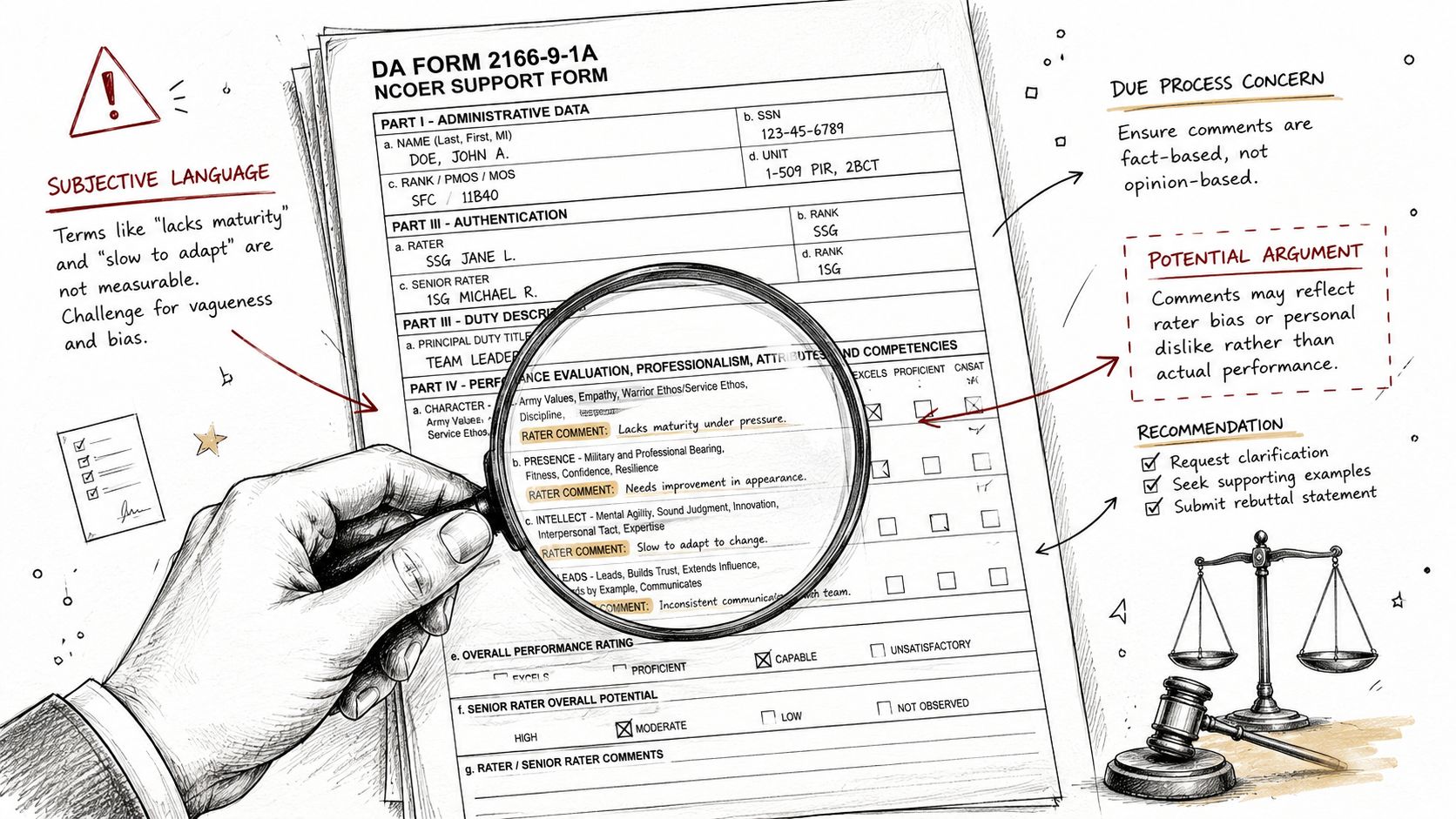
Part II duty description
Part II sets the boundaries of the case against you or for you.
If your duty description is too broad, command can later argue you owned far more than you controlled. If it is vague, they get room to redefine your role after the fact. If it omits your leadership scope, schools, property, programs, or additional areas of responsibility, they can minimize what you carried.
Write the duty description like you expect a stranger to read it during a dispute. Use the actual duty title. State the unit mission connection. Identify the number of soldiers supervised if you lead troops. Include real responsibility, not inflated language.
A strong duty description does three things:
- Defines the mission you support so your role is tied to actual unit requirements
- Pins down your level of authority through leadership scope, equipment, programs, or resources
- Cuts off later revisionism by making your job clear on day one
Do not let anyone bury your highest-value responsibilities in vague wording. If you were the squad leader, training manager, armorer, or schools NCO, say so plainly.
Part III objectives and expectations
Part III is where weak raters hide future attacks. They write broad goals that sound harmless, then use that vagueness later to say you failed to meet expectations.
Do not accept throwaway objectives like “improve readiness” or “enhance training.” Those statements prove nothing and can be stretched to mean anything. Write objectives that can be checked against facts.
A defensible objective answers five questions:
- What is the task
- How will success be measured
- Is the standard realistic
- How does it affect the mission
- When is it due
That is SMART without the fluff.
Practical rule: If a third party cannot read the objective and decide whether you met it, the objective is too weak.
Bad example:
- improve section performance and enhance training quality
Better approach:
- complete assigned training plan, document completion status, and meet the suspense tied to section requirements
Keep the wording honest. If you do not have verified numbers yet, leave space to add them later. Never invent metrics to make a block look stronger.
Update this section during the rating period. Objectives change. Taskings change. Personnel changes. If the form stays frozen while your job shifts, the written record stops matching reality. That mismatch gets used against you.
Here’s a useful briefing on counseling problems and EES issues that often surface later in disputes:
Part IV performance record
Part IV is where your evidence lives or dies.
Waiting until the end of the rating period is a mistake. By then, details are gone, dates get fuzzy, and leaders remember what helps them. Keep a running record while events are fresh. Weekly updates are good. Same-day entries are better after significant missions, inspections, training events, awards, disciplinary issues, or additional duties.
Use this checklist when updating Part IV:
- Record facts fast so dates, names, and outcomes do not disappear
- Lead with action verbs because Army writing standards still matter
- Keep each entry tight because forced brevity exposes weak wording
- Cut opinion words because praise without proof has no defensive value
- Save supporting records such as emails, rosters, trackers, counseling forms, and training documents
Another technical trap exists in Part IIIe. Appointed duties outside the normal duty description must be listed correctly, and official evaluation pamphlet guidance on DA Form 2166-9-1A formatting and preparation appears in DA PAM 623-3 on the Army Publishing Directorate site. If your additional duties are missing or badly listed, command can later argue those responsibilities were never formally part of your role.
Treat every block like an exhibit. A solid sample NCOER support form does more than look clean. It fixes your duties, your standards, and your accomplishments in writing before someone else rewrites them for you.
Bullet Statements That Build or Break a Career
Most bullets are worthless. They sound positive, but they don’t prove anything. That’s the problem. A weak bullet doesn’t just fail to help you. It leaves room for command to say your record lacks evidence.
The support form requires specific examples and quantified achievements, including the specific number of soldiers supervised, because the scope of responsibility needs to be documented with real numbers. Promotion boards prioritize “numbers that don’t lie,” according to the Army NCOER support form PDF discussing quantified performance.
What weak bullets do to you
Weak bullets usually share the same defects:
- They use praise instead of proof
- They describe effort instead of results
- They omit scope
- They hide impact
- They sound copied
If your bullet says you “supported the mission,” you’ve said almost nothing. Every NCO is supposed to support the mission. The record must show how, in what role, and with what effect.
Promotion boards and adverse reviewers both trust specifics more than adjectives.
NCOER bullet comparison
| Weak Bullet (Career Risk) | Strong Bullet (Career Builder) |
|---|---|
| o performed duties well in a demanding section | o led assigned section through mission requirements; documented results and responsibilities clearly to support a defensible performance record |
| o mentored junior soldiers effectively | o supervised soldiers in assigned role; tracked development, documented counseling, and preserved concrete examples of leadership impact |
| o was an excellent team player | o contributed to unit objectives through documented actions, measurable responsibilities, and recorded outcomes tied to mission execution |
| o handled appointed duties professionally | o listed appointed duties separately and clearly, preserving a record of responsibilities beyond the primary duty description |
| o improved readiness | o logged specific actions, mission effects, and supporting details so readiness contributions could be verified later |
The “strong” side is still qualitative here unless you have verified numbers. That’s the point. Good bullets don’t require invented statistics. They require specificity, scope, and proof.
The formula that works
When you draft a bullet, pressure-test it with this sequence:
Action
What did you do?Impact
Who or what did it affect?Result
What changed, improved, got completed, got fixed, or got prevented?
Then ask one final question. Could a hostile reviewer challenge this as vague, inflated, or unsupported? If yes, rewrite it.
Avoid these phrases unless they are backed by real documentation:
- excellent performer
- hard worker
- strong leader
- went above and beyond
- trusted by peers
Those aren’t bullets. They’re opinions.
A proper sample NCOER support form gives you a structure. Your job is to fill that structure with facts that survive scrutiny.
Career-Ending Mistakes and How Command Uses Them
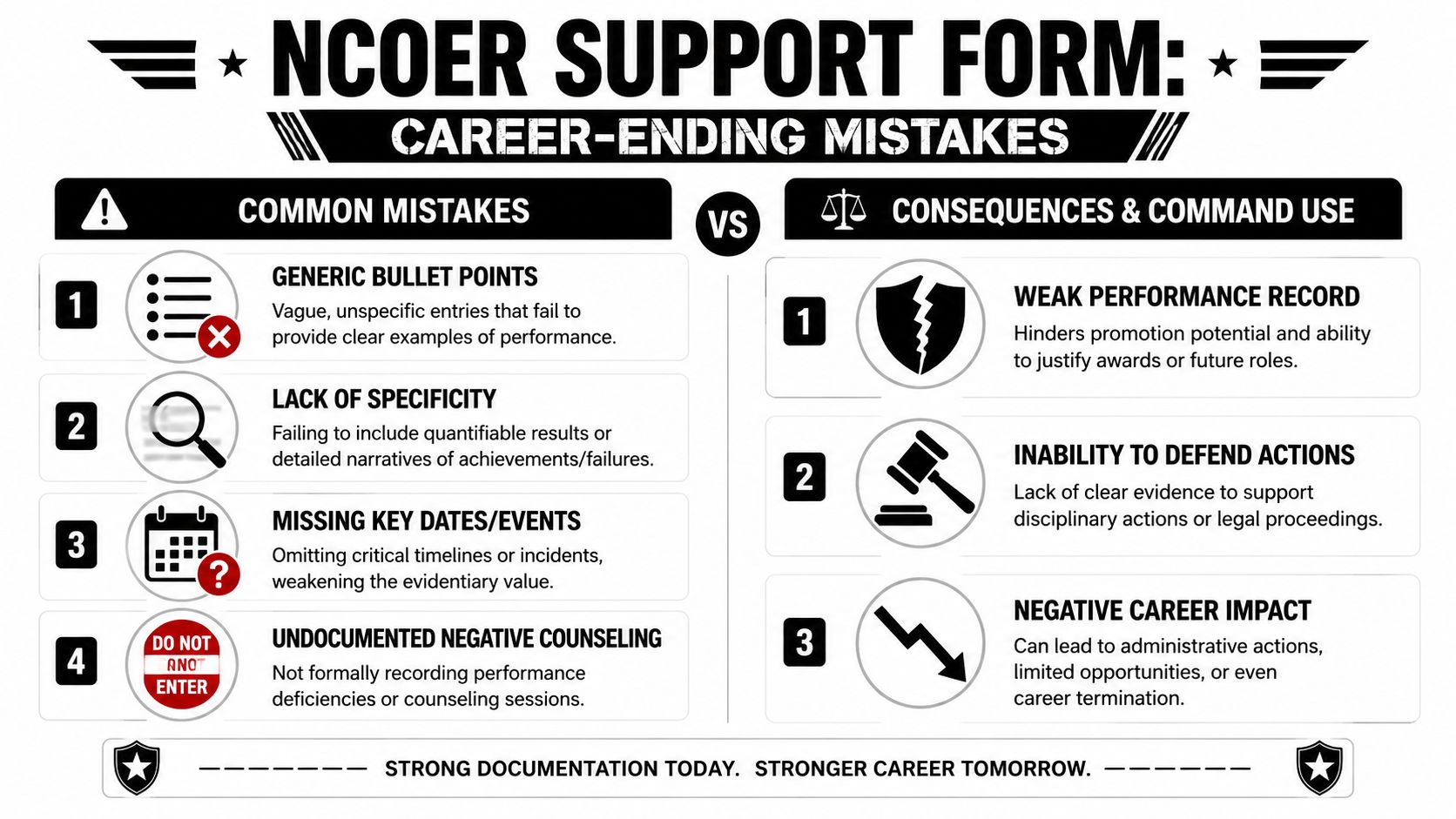
Most NCOER damage doesn’t come from one dramatic lie. It comes from a series of small, stupid mistakes. Generic bullets. Missing dates. No supporting notes. Counseling that wasn’t documented properly. By the time the report turns ugly, command can point to the file and act like the outcome was inevitable.
That’s how bad records get built. Subtly, then decisively.
The trap most online templates miss
Here is the procedural landmine almost nobody explains clearly. Initial counseling cannot be completed on the NCOER support form alone. It requires DA Form 4856. Guidance discussed at AskTOP on conducting initial NCOER or OER evaluation counseling states that 78% of initial counseling packets reviewed lacked the required DA Form 4856 attachment, and that this requirement is absent from 95% of online sample templates.
That should get your attention.
If you relied on a sample NCOER support form that skipped the 4856 requirement, you may already have a compliance problem. In a healthy command, that gets corrected. In a hostile command, that gap can become an issue to exploit. The same command that ignored the requirement early may later blame you for a broken counseling record, especially if other misconduct or performance allegations start circulating. And if you’re already worried about command-driven punishment, you should understand how paperwork failures can feed larger disciplinary problems like nonjudicial punishment in the military.
Bad paperwork gives command two advantages. It weakens your defense and strengthens their narrative.
How bad paperwork gets weaponized
Command uses avoidable mistakes in predictable ways:
- Missing counseling records become proof that development supposedly happened when the file says otherwise.
- Generic entries make it easier to argue your work had no measurable value.
- Late updates allow raters to shape events from memory instead of contemporaneous facts.
- Unclear appointed duties let reviewers ignore work that fell outside your main role.
- Unentered dates create administrative weaknesses that can damage credibility.
The danger isn’t just a poor report. The danger is that weak support-form practices create a paper trail that looks neutral until somebody decides to use it against you.
Keep your own copies. Save drafts. Preserve emails. Confirm counseling in writing. If a rater won’t document properly, that itself is information you may need later.
When to Call a Defense Lawyer About Your NCOER
If your NCOER is inaccurate, retaliatory, incomplete, or built on sloppy counseling, waiting is a mistake. Service members wait because they think the chain will fix it, because they don’t want to look combative, or because they assume the appeal can be handled later. Later is where weak cases go to die.
The right time is earlier than you think
Call a defense lawyer when any of these show up:
- You see a negative narrative forming in counselings, emails, or draft comments.
- Your rater stops documenting fairly or starts using vague criticism without examples.
- You discover counseling defects that undermine the record.
- A bad NCOER may trigger bigger consequences like QMP issues, a GOMOR fight, or separation processing.
- You need to preserve evidence before people “lose” notes or revise the story.
One credibility issue that matters immediately is EES compliance. If counseling dates from the support form are not entered into the Evaluation Entry System, the Senior Rater is legally required to address the missing counseling in Part V of the final NCOER, creating a credibility issue that can be challenged, as discussed in the YouTube briefing on NCOER counseling and EES problems.
Why civilian defense counsel matters
Military-appointed counsel can be dedicated and capable, but they operate inside the system. A seasoned civilian lawyer brings distance, independence, and a narrower focus on protecting you. That matters when command is shaping a record and everybody in uniform is pretending the process is ordinary.
A good civilian lawyer looks for:
- procedural defects
- retaliation indicators
- inconsistent counseling history
- unsupported bullet comments
- grounds for an appeal
- spillover risk into separation or punitive action
If the NCOER issue is connected to a broader disciplinary threat, you need somebody who understands not just evaluations, but the full litigation picture. That includes civilian court-martial defense lawyers who know how administrative records become trial exhibits, impeachment material, and separation evidence.
A bad NCOER is often the smoke before the fire. Treat it that way.
FAQ
What is a sample NCOER support form really for
It’s a reference tool for structuring DA Form 2166-9-1A. It should help you understand layout and formatting. It should not be copied blindly. A weak sample can leave out requirements that later hurt you.
Is DA Form 2166-9-1A just an admin form
No. It’s an administrative form with real legal and career consequences. It shapes the final NCOER and can become part of the record used in boards, adverse actions, and challenges to your performance history.
Do I need DA Form 4856 for initial counseling
Yes. Initial counseling cannot be completed on the support form alone. The required DA Form 4856 is the procedural point most bad templates miss.
What should I put in my duty description
Use precise duties tied to your actual role. If you supervise soldiers, identify that scope clearly. Don’t inflate. Don’t generalize. Define the job accurately so nobody can rewrite it later.
How often should I update my support form
Regularly. Weekly entries or immediate updates after meaningful events are the safest practice because they preserve facts while they’re fresh.
Can missing counseling dates hurt my NCOER
Yes. If those dates aren’t entered into EES, the missing counseling issue may have to be addressed in the final report, which can damage credibility and create grounds for challenge.
What if my rater is building a negative paper trail
Start preserving everything. Keep your own records, save draft forms and emails, confirm counseling in writing, and speak with experienced counsel early. Delay helps command.
Do I need a lawyer before I get a bad NCOER
If you see the warning signs, yes. Early legal advice is often more useful than a late appeal.
If you’re under investigation, facing retaliation, dealing with a bad NCOER, or watching command build a paper trail around you, don’t wait for the final report to hit your file. By then, the story is already written.
Get help early. Protect the record now. Your rank, retirement, reputation, and future opportunities are on the line.