You got called into an office. The tone changed fast. A senior enlisted leader or warrant officer is sitting there, maybe with a first sergeant, maybe with a commander, maybe with an investigator waiting nearby. Somebody says the words “insubordinate conduct” and suddenly this is no longer a simple chewing-out.
That moment matters.
If you’re reading this, there’s a good chance you’ve already sent the text, posted the comment, ignored the order, mouthed off in formation, or been accused of doing one of those things. You may still think you can explain it away. You may believe command will calm down once they “hear your side.” That instinct destroys cases.
UCMJ Article 91 isn’t a personality dispute. It’s a criminal charge under military law. It can cost you rank, pay, your clearance, your future in uniform, and in the right case, your freedom. In the digital era, service members talk themselves into disaster with screenshots, message threads, and social media posts they thought were private, temporary, or harmless.
Before you speak to CID, NCIS, OSI, CGIS, your chain of command, or the person accusing you, understand one thing. The system moves quickly once it decides you’re the problem. If you move slowly, you’re already behind.
Table of Contents
- The Moment Your Career Is on the Line
- What UCMJ Article 91 Actually Prohibits
- The Punishments A Conviction Will Bring
- Strategic Defense How We Win Article 91 Cases
- The Path from Accusation to Court-Martial
- Five Mistakes That Will Destroy Your Military Career
- Why Your Appointed Military Lawyer Is Not Enough
- Frequently Asked Questions About Article 91 Charges
The Moment Your Career Is on the Line
Many service members do not realize how serious UCMJ Article 91 – Insubordinate Conduct Toward Warrant Officer is until the paperwork starts. Before that, it feels personal. A clash with an NCO. A tense exchange with a petty officer. A warrant officer who took offense at your tone, your refusal, or your message.
Then command frames it as a discipline case, and everything changes.
This pattern repeats over and over. A service member thinks, “I was frustrated, but I didn’t commit a crime.” Then investigators pull texts. Somebody screenshots a post. Witnesses suddenly remember your exact words. The superior says they were carrying out official duties, and now the government has the core theory it needs.
Practical rule: The first person who frames the incident usually controls the case until a defense lawyer rips that framing apart.
That is why your first move matters more than your explanation. If you start apologizing, deleting messages, contacting the other person, or trying to clean up the story, you make the government’s job easier. If you lock down, preserve evidence, and get experienced counsel involved immediately, you give yourself a chance.
This is not the moment to “wait and see.” That’s how careers fade away.
What UCMJ Article 91 Actually Prohibits
Article 91 is narrower than commanders often make it sound and broader than accused service members expect. That combination gets people burned.
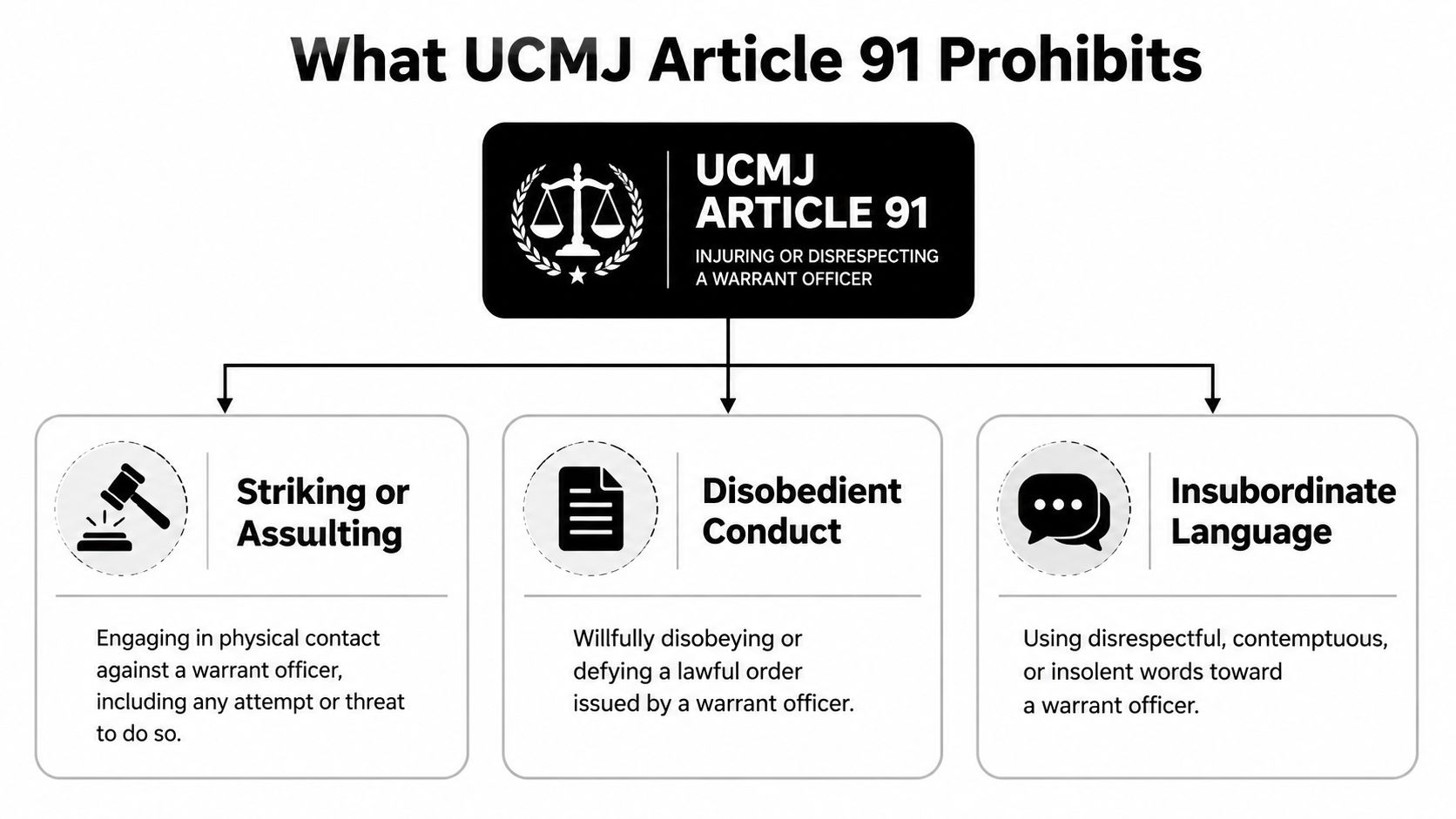
It applies to warrant officers and enlisted members as the accused, not commissioned officers. It targets three kinds of insubordination toward a warrant officer, noncommissioned officer, or petty officer. The fight in these cases is rarely over the label. The fight is over whether the government can prove each element with real evidence, not rank-driven assumptions.
Who can be charged
This article does not require the alleged victim to be in your direct chain of command. That mistake sinks defenses early. If you assume the case dies because the person was not your immediate superior, you are handing the government an easy start.
What matters is status, knowledge, the conduct charged, and whether the other person was acting in the execution of office when the incident happened. That last point is where many Article 91 cases live or die.
The three categories that matter
The government can charge Article 91 in three main ways.
Striking or assaulting a warrant officer, NCO, or petty officer while that person is performing official duties. The government will try to stretch shaky facts into assault. A chest bump, an aggressive step, a hand swipe at a phone, or disputed contact during an argument can become a criminal case fast.
Willfully disobeying a lawful order. The order must be lawful, clear, specific, and communicated in a way that leaves little room for confusion. If the order came through text, group chat, or a messy message chain, do not assume the government can prove clarity. Digital communication often helps the defense because it preserves the exact wording, the timing, and the surrounding context. It also lets us compare an Article 91 allegation to lower-level discipline, including how Article 15 and nonjudicial punishment can affect a military career, when command is overcharging a bad interaction.
Contempt or disrespect in language or deportment. This is the charge commands love because it sounds simple. It is not simple. Tone matters. Context matters. Audience matters. Whether the statement was sent privately, posted publicly, screenshotted by a third party, or delivered directly to the protected person matters a lot.
Why digital conduct matters under Article 91
A lot of modern Article 91 cases start with a phone, not a formation.
A text sent after duty hours. A sarcastic reply in a unit group chat. A TikTok, Instagram story, Snapchat, or Facebook post naming a warrant officer or mocking an NCO. Prosecutors treat screenshots like a gift from God. Good defense counsel treats them like a chain-of-custody problem, an authentication problem, and a context problem.
For a disrespect charge, the government still has to prove more than offensive words. It must prove the conduct was directed at the protected person, that you knew who that person was, and that the person was in the execution of office at the time. That element is not window dressing. It is a pressure point.
Here is the blunt truth. A warrant officer reading your message while off duty, arguing in a private side conversation, or reacting to a social media post as a personally offended adult is not the same as a warrant officer carrying out official duties. Commands blur that line all the time. Attack it every time.
The defense angle most lawyers miss
The government’s favorite shortcut is to say, “He was a warrant officer, so Article 91 applies.” Wrong. Rank alone does not satisfy the execution-of-office element.
You should force the case into specifics:
- What duty was the warrant officer, NCO, or petty officer performing at that exact moment?
- Was the communication part of an official task, or just a personal argument that started at work and spilled onto a phone?
- Who sent the first message, and in what capacity?
- Was the post or message directed to the alleged victim, or did someone else carry it back?
- Can the government authenticate the screenshot, metadata, account ownership, and full conversation thread?
Those questions are not academic. They are how you dismantle Article 91 cases.
If the government cannot prove the order was clear, the message was directed at the protected person, or the alleged victim was acting in an official capacity at the time, the charge weakens fast. If you handled the situation by deleting messages, editing posts, or trying to explain yourself in writing, you made their job easier.
Do not try to litigate that issue alone. Article 91 cases look minor until the record, screenshots, and sworn statements are assembled against you. By then, a bad theory becomes a career-threatening prosecution.
The Punishments A Conviction Will Bring
Numerous service members commit the same error following an Article 91 accusation. They focus on whether the text, post, or reply was “really that disrespectful” and overlook how a conviction impacts the remainder of their career. That is backwards. The punishment is the primary threat.
Maximum exposure under Article 91
Article 91 can put confinement and a punitive discharge on the table. For striking or assaulting an NCO or petty officer, the maximum punishment includes 1 year of confinement, forfeiture of all pay and allowances, and a bad-conduct discharge. For willfully disobeying a noncommissioned officer or petty officer, the maximum includes 1 year of confinement, forfeiture of all pay, and a dishonorable discharge. For contempt or disrespect toward a warrant officer, the maximum includes 9 months of confinement, forfeiture of all pay and allowances, and a bad-conduct discharge.
| Offense | Max Confinement | Max Punitive Discharge |
|---|---|---|
| Striking or assaulting an NCO or petty officer | 1 year | Bad-conduct discharge |
| Willfully disobeying a noncommissioned officer or petty officer | 1 year | Dishonorable discharge |
| Contempt or disrespect toward a warrant officer | 9 months | Bad-conduct discharge |
That is the formal exposure. The practical damage often starts earlier.
A screenshot case built from texts, DMs, group chats, or social media posts gives command multiple ways to punish you even before trial. Pulled clearance access. Lost recommendations. Flagged promotion packet. Dead assignment opportunities. If they decide to dispose of it below court-martial, do not mistake that for a win. A written record of digital “disrespect” becomes a ready-made exhibit in later adverse paperwork, separation action, and command screening. If you need a clear explanation of that risk, read how Article 15 and nonjudicial punishment can affect a military career.
Why these punishments hit harder than people expect
Confinement scares people first. It should.
But the discharge does the long-term damage. A punitive discharge follows you long after the command has moved on. Civilian employers read it. Licensing boards read it. Federal hiring officials read it. It also poisons your bargaining position inside the case. Once the government has your messages, your apologies, and your command’s paper trail lined up, pressure to plead guilty rises fast.
That is why digital Article 91 cases demand an aggressive defense early, especially where the government is stretching a personal phone argument into “official” conduct by a warrant officer. If the prosecution cannot prove that execution-of-office element, the punishment chart above becomes far less important. If you try to handle that fight alone, you give away the only part of the case that often breaks in your favor.
A bad facts case can still be won. A guilty plea built on panic stays in your record forever.
Strategic Defense How We Win Article 91 Cases
Most Article 91 prosecutions look cleaner on paper than they do under pressure. The charge sheet is tidy. The witness statements sound confident. The screenshots seem damning. Then the defense starts testing the government’s assumptions, and the case can start to break.
Execution of office is often the government’s weak point
For digital disrespect cases, the most important battleground is often execution of office. That phrase sounds simple. It isn’t.
In United States v. Brown, 84 M.J. 124, the court made two points that matter enormously. First, disrespectful conduct can be conveyed remotely through text messages or social media. Second, the government still has to prove the victim was in the execution of his or her office at the moment the message was sent, and the court set aside two convictions in that case because the government failed to prove that point, as summarized in the Brown case digest.
That means a screenshot alone doesn’t win the case. A rude message sent at the wrong time, to the wrong person, under the wrong circumstances may still be offensive, but it may not satisfy Article 91.
Digital evidence cuts both ways
Experienced court-martial attorneys earn their fee by focusing on these critical details. We don’t just read the message. We reconstruct the timeline.
Look at:
- Timestamps: When was the text sent, delivered, opened, or reposted?
- Duty status records: Was the alleged victim on duty or performing an official function at that time?
- Context of the thread: Was this a direct message, a group chat, sarcasm, venting, or a statement taken out of sequence?
- Device extraction issues: Are the screenshots complete, authenticated, and accurate?
- Who saw it: Was it directed at the protected person, or did someone else carry it to them later?
A lot of commands overcharge social media and text cases because the digital trail looks dramatic. That’s lazy lawyering by the government. The legal question is narrower. The government has to prove the required element at the required time.
The prosecution loves screenshots. The defense loves metadata.
Lawful order fights win disobedience cases
If the allegation is willful disobedience, one of the first questions is whether the order was lawful and specific enough to support a conviction. Sloppy commands create real defense opportunities.
Look closely at the order itself:
- Was it direct? Vague language leaves room for interpretation.
- Was it clear? If the wording was muddy, confusion matters.
- Was it specific? “Handle it” and “fix yourself” are not the same as a precise directive.
- Was there a duty to obey? Not every comment from a superior is a criminally enforceable order.
- Was the noncompliance intentional? Frustration, misunderstanding, and inability are not the same as willful refusal.
Good military defense lawyers also test whether the complaining witness was overstating authority after the fact. That happens often. People tidy up ugly interactions once sworn statements start.
The Path from Accusation to Court-Martial
The military justice process moves in stages. If you don’t know where you are in that sequence, you’ll make decisions blind.
Step 1 The allegation hardens into a case
It usually starts with a report up the chain. Sometimes it’s immediate. Sometimes it follows a counseling, a heated exchange, a barracks incident, or a message thread somebody forwards to leadership. If the command thinks the conduct threatens good order and discipline, it may involve law enforcement quickly.
At this point, preserve everything. Messages, call logs, screenshots, names of witnesses, your recollection of the timeline. Don’t curate it. Preserve it.
Step 2 Rights advisement and the trap of talking
Sooner or later, someone may read you your rights and ask for your side. That is the moment many service members ruin their defense.
Don’t talk because you think silence makes you look guilty. Don’t talk because your chain says this is your chance to clear it up. Don’t talk because you think you can charm your way out of a charge that already has momentum.
If you need a broader primer on the process, this overview of court-martial basics is worth reading before you make another move.
Step 3 Command decides how hard to hit
After the initial inquiry, command decides whether to push the matter as counseling, NJP, or a court-martial package. That decision often turns on the quality of the evidence, the unit climate, the rank of the complaining witness, and whether the command thinks the accused looks remorseful or defiant.
That last part is dangerous. “Remorseful” often means “made damaging admissions.”
Here is a short breakdown that many clients wish they had on day one:
- Early inquiry: Command and investigators gather statements and digital evidence.
- Disposition decision: The commander decides whether to dispose of the matter administratively or push charges.
- Charge drafting: Trial counsel shapes the facts into legal specifications.
- Litigation posture: The case becomes about proof, not fairness.
A useful visual explanation is below.
Step 4 Article 32 and referral
If charges are preferred and the case is headed toward serious court-martial litigation, the Article 32 preliminary hearing becomes one of the first real chances to expose weakness. Witness problems, missing digital foundation, duty-status gaps, and overcharging can surface there.
Strategic decisions carry significant weight in these cases. Not every victory requires a full acquittal at trial. Often, the most effective approach involves eliminating a key specification, narrowing the legal theory, or identifying a proof deficiency early enough to alter the command’s desire for prosecution.
Five Mistakes That Will Destroy Your Military Career
Service members under stress do stupid things. Smart people do them too. Stress doesn’t make you strategic. It makes you impulsive.
Here are the five most common mistakes in Article 91 cases.
- Talking to investigators: You think you’re clarifying. You’re usually supplying motive, admissions, and cleanup for holes in their timeline.
- Trusting command to protect you: Command protects the unit and the chain of command. That is their job. You are not their mission in this moment.
- Contacting the accuser or witness: You may think you’re apologizing or fixing a misunderstanding. Command may see witness tampering, intimidation, or consciousness of guilt.
- Deleting texts or social media content: That’s one of the fastest ways to turn a manageable case into an evidence problem with ugly inferences.
- Waiting to hire real counsel: Delay gives the government time to lock in statements, seize devices, shape the narrative, and isolate you.
What to do instead
Write down the facts while they’re fresh. Save the messages. Identify witnesses. Stop discussing the case in the barracks, on Signal, in DMs, or in group chats. If your spouse or family is involved, tell them to stop posting about it too.
Your case will not improve because you “stayed respectful and hoped for the best.” It improves when somebody with trial judgment gets in front of the evidence early.
One more hard truth. The absence of obvious evidence means nothing. The government may already have enough from one screenshot, one sworn statement, and one bad interview from you.
Why Your Appointed Military Lawyer Is Not Enough
Detailed military defense counsel can be hardworking and honest. Many are. That still doesn’t mean they’re enough for a serious Article 91 case with digital evidence, command pressure, and real punitive exposure.
Your appointed lawyer may be carrying a heavy caseload. They may be talented but relatively junior. They may have limited time to dig through device records, interview every witness fast, and build the kind of aggressive early defense that changes outcomes.
A seasoned civilian UCMJ lawyer has one job. Defend you.
That means independence from command. It means more control over time and strategy. It means the ability to push hard against weak digital assumptions, challenge legal elements without worrying about office politics, and prepare a case like a trial lawyer rather than a file manager.
If you’re weighing options, read this guide on how to choose a military defense lawyer. Then make the decision like your career depends on it, because it does.
Frequently Asked Questions About Article 91 Charges
Can a text or social media post really lead to an Article 91 charge
Yes. Under Article 91(3), digital messages can qualify if they are remotely conveyed to the victim while the victim is in execution of office, and the prosecution must also prove the accused knew the victim’s rank, as explained in this discussion of digital disrespect and Article 91 timing defenses.
If I was off duty, am I safe
No. Your off-duty status doesn’t automatically save you. The government’s bigger problem is usually proving the protected person was acting in an official capacity at the critical time.
What if the warrant officer or NCO was wrong
Being wrong doesn’t automatically make your response lawful. But it may matter a great deal when your lawyer analyzes context, authority, and whether the person was acting within official duties.
Does intent matter
Yes, especially in disobedience and disrespect cases. Context, wording, and the surrounding circumstances often decide whether the government can prove willfulness or contempt.
Should I explain that I was just venting
Not to investigators. “Just venting” often becomes an admission that you sent the message and meant the words.
Do I need a lawyer immediately
Yes. Early action is not optional in these cases.
If you’re under investigation or already facing UCMJ Article 91 – Insubordinate Conduct Toward Warrant Officer, get serious now. Stay silent. Preserve evidence. Stop trying to solve it yourself. That path leads straight into the government’s hands.
Talk to experienced civilian military defense lawyers immediately. If you need a place to start comparing qualified counsel, use this guide to choosing a military defense lawyer to identify civilian attorneys focused on court-martial and military justice defense. Your career is on the line, and waiting only helps the prosecution.