If you’re reading this, there’s a good chance your phone already rang, your command has gone quiet around you, or CID, NCIS, OSI, or CGIS wants to “hear your side.” That moment is where a lot of UCMJ Article 120 Rape cases are lost. Not at trial. Not at an Article 32. In the first bad interview, the first surrendered phone, the first text you send trying to “clear things up.”
An accusation under UCMJ Article 120 Rape can put your freedom, career, retirement, reputation, and family stability on the line in a matter of hours. The government does not need a perfect case to start building pressure. It needs a statement from you, a digital trail, and enough momentum to make command treat you like the problem.
You need to think like this is a fight from day one, because it is.
Table of Contents
- Deconstructing UCMJ Article 120 Rape and Sexual Assault
- The Investigation and Court-Martial Gauntlet
- The Unvarnished Truth About Penalties and Consequences
- Strategic Defense How We Find the Cracks in the Government’s Case
- The Top 5 Mistakes That Will Destroy Your Case
- Why Your Free Military Lawyer Is Not Enough
- Your Immediate Action Plan and Critical FAQs
Deconstructing UCMJ Article 120 Rape and Sexual Assault
A service member gets a call, figures the allegation is just a drunken misunderstanding, and starts explaining. By the time counsel gets involved, investigators already have the statement they wanted, the phone data they wanted, and a theory of the case built around the client’s own words. That is how Article 120 cases get lost early.
What Article 120 covers
Article 120 is not a single charge. It is a set of sex offense allegations with different elements, different proof problems, and sentencing exposure severe enough to end your freedom, rank, and career.
At the top is rape. Under UCMJ Article 120(a), the government may allege a sexual act committed by unlawful force, force likely to cause death or grievous bodily harm, or threats that place a person in fear of death, grievous bodily harm, or kidnapping. Prosecutors also build serious Article 120 cases around alleged incapacity to consent, especially where alcohol or drugs are involved.
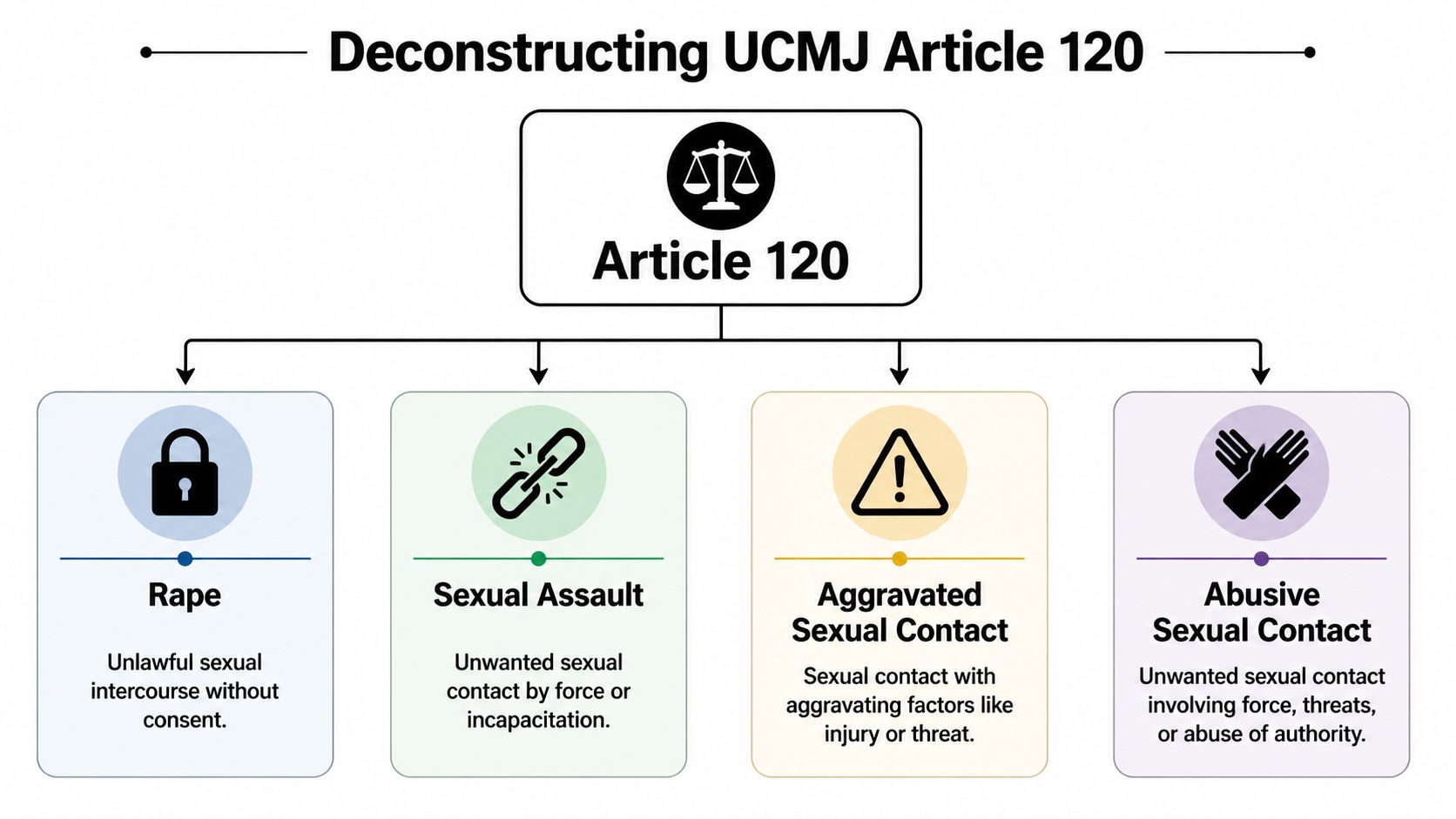
The related offenses below rape still carry punishments that can destroy a life:
| Offense | Maximum punishment |
|---|---|
| Rape | Life imprisonment and mandatory dishonorable discharge |
| Sexual assault | Up to 30 years |
| Aggravated sexual contact | Up to 20 years |
| Abusive sexual contact | Up to 7 years |
Those labels matter. So does the government’s charging theory. A weak force case may be repackaged as an incapacity case because investigators think it is easier to sell. A regretted encounter may be written up with language that sounds criminal long before anyone tests the facts against the statute.
Why incapacitation cases are dangerous
Alcohol cases trap service members because they misread the battlefield. They focus on what happened in the room. Investigators focus on what they can prove afterward.
If the allegation involves intoxication, the government will examine whether the other person could understand the nature of the conduct or physically communicate agreement or refusal. It will work backward from texts, witness impressions, video, ride history, bar tabs, timelines, and memory gaps. For context on how military investigators approach these agencies and cases before charges, review this guide to CID, NCIS, OSI, and CGIS investigations.
The strategic mistake is always the same. The accused treats the allegation like a private dispute and starts talking like a man trying to sound reasonable. The government treats it like a felony file and starts collecting admissions.
Practical rule: If alcohol is part of the allegation, assume the case will turn on consent, capacity, and your pre-charge decisions.
What the government has to prove
Your defense starts with the elements. If you do not know the exact theory charged or likely to be charged, you cannot make smart choices during the investigation.
In a rape case, the prosecution must prove the required sexual act and the specific theory behind it, such as force, threats, fear, or incapacity. That sounds simple on paper. It rarely is. Article 120 cases are often built on broad characterizations, emotional language, and assumptions that harden into a formal accusation before anyone challenges them.
A defense lawyer should attack questions like these early:
- Was the charging theory chosen because it fits the facts: Or because it sounds stronger to command and investigators?
- Do the facts satisfy the statute: Terms like “too drunk,” “pressured,” or “frozen” may matter, but they do not automatically prove an Article 120 offense.
- What evidence was missed or buried: Texts, access logs, surveillance, location data, social media, and witness timing often cut against the final narrative.
- What did the accused say before understanding the allegation: Early explanations, apologies, and attempts to be cooperative often become the backbone of the government’s case.
That last point matters more than clients expect. In many Article 120 cases, the biggest damage happens before charges are preferred. The investigation phase is not administrative buildup. It is the first fight, and careless moves there can hand the government proof it did not have when the complaint first surfaced.
The Investigation and Court-Martial Gauntlet
The first contact is a test
Most clients think the case begins when charges are preferred. Wrong. It begins when investigators decide you matter.
That first call from CID, NCIS, OSI, or CGIS is not an invitation to explain. It is a collection opportunity. They want your timeline, your emotional reactions, your phone, your consent to search, and your statements before you understand the allegation. If you need a branch-by-branch overview of the agencies, read this guide on CID, NCIS, OSI, and CGIS investigations.
You may get an Article 31(b) rights advisement. That is not a formality. It is the government warning you that the conversation can help convict you. Once that advisement starts, your best move is usually simple. Invoke your rights. Ask for counsel. Stop talking.
Investigators are not measuring whether you seem honest. They are measuring whether you give them usable admissions, inconsistencies, and digital access.
How the case moves toward trial
The process usually unfolds in a hard sequence.
Allegation and report
Someone reports misconduct. Law enforcement and command begin moving immediately.Interview and evidence grab
They seek your statement, devices, messages, location data, and witness names.Command action before charges
You may get orders restricting contact, movement, access, or duties. Your command may act long before guilt is decided.Preferral of charges
Once the government believes it has enough, formal charges are preferred.Article 32 preliminary hearing
This is not the trial, but it matters. It gives the defense a chance to test parts of the case, preserve issues, and expose weak spots.Referral and motions practice
The case moves toward special or general court-martial depending on the charges and exposure. Article 120 felony-level cases often push toward general court-martial.
What you should be doing at each stage
Your priorities are different from the government’s. That’s why service members get hurt when they “cooperate” without a plan.
- At first contact: Say you want a lawyer. Say nothing about facts.
- When they ask for your phone: Do not consent on instinct. Your device often contains the government’s best evidence and your best defense evidence.
- When command starts asking questions: Keep your bearing. Don’t confide in supervisors, first sergeants, or buddies who will later be witnesses.
- Before Article 32: Build your case, don’t react to theirs. Preserve texts, screenshots, call logs, rideshare records, travel receipts, and witness names.
A court-martial is not a truth machine. It is an adversarial process. The side that prepares first usually controls the narrative.
The Unvarnished Truth About Penalties and Consequences
The sentence is only the beginning
You wake up thinking the fight starts when charges arrive. That mistake ruins cases.
In an Article 120 investigation, the punishment starts taking shape long before a panel announces a sentence. By the time a conviction enters the picture, the government may already have your statements, your phone data, your command’s assumptions, and a theory of the case built around your worst decisions in the investigation phase.
The sentencing exposure is severe. A rape conviction under Article 120 can mean life in prison and a mandatory dishonorable discharge. Other Article 120 offenses also carry years or decades of confinement, total forfeitures, and a punitive discharge, as noted earlier in this article.
That is only the legal sentence.
The direct consequences hit every part of your life at once. A conviction can trigger sex offender registration, end your military career, destroy clearance eligibility, kill retirement plans, and follow you into civilian employment, housing, licensing, and family court. Even an allegation that never reaches a conviction can leave command paperwork, lost assignments, revoked trust, and a reputation problem that does not fade on its own.
| Consequence | What it means in real life |
|---|---|
| Punitive discharge | Your military career ends under a permanent stain |
| Forfeitures | Income drops fast and financial pressure spikes |
| Confinement | You lose your freedom and your leverage |
| Registration exposure | Civilian life gets harder for years |
| Reputation damage | Family, command, and future employers may never see you the same way |
The pre-charge phase decides how bad this gets
Clients often fixate on the maximum punishment and ignore the decisions that increase the chance of ever facing it. That is backwards.
The most expensive mistakes usually happen before charges are preferred. Talking to investigators without counsel. Handing over a phone out of panic. Deleting messages. Trying to smooth things over with the accuser. Confiding in a supervisor who later becomes a witness. Those moves give the government admissions, consciousness-of-guilt arguments, and digital evidence they would have struggled to get cleanly if you had acted with discipline.
That is why the investigative phase is a battlefield, not a waiting room. If you want to see how strong defense work changes the trajectory early, read this guide to winning during the military investigation phase.
Low referral numbers do not protect you
Some service members hear that many reported sexual assault cases never reach court-martial and tell themselves the odds are in their favor. That thinking is reckless.
The government screens these cases hard. If your case keeps moving, prosecutors usually believe they have a version of the facts they can present convincingly. They think the complaining witness will hold up, your words help them, and the digital timeline supports enough of their story to survive attack. You should treat that as a serious threat, not a reason to relax.
Assume every choice you make now affects the outcome later. In these cases, bad pre-charge decisions do not stay small. They become exhibits.
Strategic Defense How We Find the Cracks in the Government’s Case
Attack the story, not just the charge sheet
Good defense work in an Article 120 case is not speechmaking about fairness. It is controlled demolition.
The government walks into court with a narrative. Your job is to break its load-bearing walls. That means testing the accuser’s timeline, motive, bias, memory, prior statements, communications after the event, and every place where conduct and accusation don’t match. It also means examining whether investigators ignored facts that cut against the allegation because they locked onto a theory too early.
A lot of the most important work happens before charges harden. This is why strong counsel during the investigative phase matters, and this guide on how experienced counsel win cases during the military investigation phase explains that battlefield well.
The best defense theory is usually built from small contradictions that become one large reasonable doubt.
Digital evidence changes everything
Article 120 cases often turn on digital evidence more than people expect. Text chains. Deleted messages. Photo metadata. Location history. Entry records. Ride receipts. Social media timing. Draft messages. Calls before and after the encounter.
That evidence can help either side. A government theory can collapse because the timeline doesn’t fit the phone data. I’ve also seen accused service members wreck their own defense by deleting messages, contacting the accuser, or handing over devices without a plan.
Look at what matters most:
- Timing evidence: When did each person arrive, leave, call, text, or move?
- Post-event conduct: What was said afterward, and does it fit the allegation?
- Device integrity: Were messages deleted, screenshotted, forwarded, or altered?
- Third-party records: Rideshare logs, hotel entries, gate access, and roommate observations can matter.
MRE 412 fights can decide the case
One of the hardest parts of defending these cases is Military Rule of Evidence 412. It sharply restricts evidence about the accuser’s sexual history, even when the defense believes it relates to consent. That means you cannot stroll into court expecting broad cross-examination on prior sexual conduct.
The fight becomes surgical. You identify what is admissible, why it matters, and how it fits an exception. If the judge blocks key evidence, the defense has to adapt fast and reframe the case around what can still come in through other witnesses, statements, context, and impeachment.
That’s also why consent defenses need discipline. You don’t “argue consent” in the abstract. You prove facts that support it. Conduct. Words. timing. Inconsistencies. Objective records. In some cases, mistake of fact as to consent becomes central. In others, the better attack is that the government charged fear or incapacity when the actual evidence is muddled and overstated.
The Top 5 Mistakes That Will Destroy Your Case
Mistake one through three
Talking to investigators because “I can explain it”
You usually can’t. Not in that room. Not under that pressure. Investigators are trained to turn your effort to sound reasonable into admissions, contradictions, and locked-in details.Consenting to searches of your phone, car, room, or laptop
Service members give away the battlefield every day with one sentence: “Sure, go ahead.” Your device may contain exculpatory material, but once the government takes it without a defense plan, you lose control of the order, context, and framing of that evidence.Believing command will protect you if you’ve been a good performer
Command protects command. Some leaders are fair. Many are cautious. None of that changes the institutional pressure around a sex offense allegation.
Hard truth: Your rank, awards, and prior evaluations won’t stop investigators from building a case if they think the allegation is actionable.
Mistake four and five
Waiting to hire experienced counsel until things “get serious”
By the time charges are preferred, the government has often interviewed witnesses, seized evidence, framed the accusation, and influenced command perception. Delay helps them, not you.Underestimating the accuser’s story
Service members often say, “There’s no evidence.” That usually means there’s no DNA or video. But credibility is evidence. Testimony is evidence. Your messages are evidence. Your silence at the wrong moment can be twisted, and your overexplaining can be worse.
If you avoid these five mistakes, you give your defense room to work. If you make them, your lawyer spends precious time cleaning up damage that never had to happen.
Why Your Free Military Lawyer Is Not Enough
At 0700, your phone lights up. A supervisor says investigators want to “clear something up.” By lunch, command knows your name, witnesses have been contacted, and the government has already started shaping the story before a single charge exists. That is the point where service members make one of the most expensive mistakes in an Article 120 case. They assume appointed counsel alone will be enough to control a fight that starts long before referral.
Use your detailed military defense counsel. Then get realistic about what that lawyer can and cannot do.
Article 120 allegations are prosecuted in a system under heavy pressure. In FY18, there were an estimated 20,500 service members who experienced sexual assault, and of 5,805 unrestricted reports, only 307 cases, or 5.3%, reached court-martial, according to this military sexual trauma and Article 120 data summary. If your case is one of the few pushed toward trial, assume the government believes the file is strong enough to survive screening. Treat that as a warning, not a debate point.
The core problem is timing.
Free military counsel usually enters a case inside a system that is already in motion. Investigators are gathering statements. Digital evidence is being requested, seized, or reviewed. Command is forming opinions. The accuser’s account is being repeated and polished. In that stage, speed and attention matter. A lawyer carrying a heavy docket may be skilled, committed, and still unable to give your case the immediate pressure it needs.
That gap gets people hurt.
A retained civilian defense lawyer changes the fight because the job starts earlier and hits harder. The mission is not just trial defense. It is pre-charge damage control, witness control, evidence preservation, command-facing strategy, and building a theory of the case before the government hardens its version of events.
What should you look for?
- Independent judgment: Civilian counsel does not answer to the same institution investigating you.
- Time to act fast: Early interviews, records requests, digital evidence review, and expert consultation take hours your case may not get from an overloaded office.
- Article 120 trial experience: You want counsel who has handled credibility wars, consent issues, alcohol evidence, text-message framing, and forensic fights in military court.
- One strategy from start to finish: The defense position should stay consistent from the first investigator contact through Article 32, motions practice, and trial.
Do not hire based on rank, personality, or a polished website. Hire based on who can handle the investigative phase without wasting a week. If you need help vetting counsel, read this guide on how to choose a military defense lawyer.
Free is not the right metric in a rape case. Control is. Speed is. Experience is. If your future, freedom, clearance, and discharge are on the table, build your defense team like the case starts now, because it does.
Your Immediate Action Plan and Critical FAQs
At 0700, your phone lights up. A supervisor wants to “talk.” By lunch, someone says CID has questions. That is the moment service members lose cases before charges are ever preferred. They start explaining. They start deleting. They start trying to look cooperative. Stop. The investigative phase is a fight for evidence, witnesses, and timing. If you mishandle the first 24 hours, the government gets a cleaner case than it earned.
Your first moves
If you suspect you’re under investigation for UCMJ Article 120 Rape, do this now:
- Stop talking about facts: Do not explain the case to investigators, command, friends, family, or the other person involved.
- Preserve evidence: Save texts, screenshots, social media records, call logs, rides, receipts, photos, and calendar entries.
- Do not delete anything: Panic-driven deletion will be used against you and can be framed as consciousness of guilt.
- Write a private timeline for your lawyer: Include dates, times, locations, witnesses, alcohol use, messages, and movements.
- Identify witnesses early: Focus on people with direct observations, not cheerleaders.
- Get experienced civilian advice immediately: Pre-charge decisions shape the entire case.
Silence is discipline. In a criminal investigation, discipline keeps the government from building its case out of your mouth.
Frequently asked questions
Can I refuse to talk to CID, NCIS, OSI, or CGIS
Yes. Invoke your rights and ask for counsel before any substantive conversation. Do not try to “clear things up” first.
Can they take my phone
They may seek consent, command involvement, or legal process, depending on the facts. Do not hand it over casually. Do not consent blindly.
What happens at an Article 32 hearing
It is a preliminary hearing in serious cases. The defense can test parts of the government’s evidence, question witnesses in some circumstances, preserve issues, and shape later litigation.
Will I go to jail
You could if convicted. Article 120 exposure is severe, and rape allegations carry life-changing consequences far beyond confinement.
Should I contact the accuser to straighten this out
No. That move creates new evidence, opens the door to witness tampering allegations, and usually helps the prosecution more than the defense.
Do I need a lawyer before charges are preferred
Yes. That is when service members make the worst mistakes. The government is collecting statements, locking in witnesses, and framing digital evidence while you are deciding whether this is “serious yet.” It is serious already.
You do not need more internet research right now. You need a plan, and you need it today.
If your command has started asking questions, if investigators want an interview, or if you even suspect your name is in the file, treat the investigation like the main battle because it is. Speak with experienced civilian military defense lawyers who handle Article 120 cases in court-martial practice. A resource like the guide to choosing a military defense lawyer explains how to identify and compare serious court-martial attorneys so you can start making calls. Every hour you wait gives the government more time to shape the story before your defense does.