
Two agents walk in. Your first sergeant goes quiet. Somebody takes your phone. Somebody else asks for your laptop, your external drive, your passwords, your cloud logins. Then you hear the phrase that detonates everything: UCMJ Article 134 child pornography possession.
At that moment, most service members make the worst decision of their lives. They start talking.
They think they can explain the download, the popup, the shared device, the old account, the weird folder name, the file they never opened, the image they swear they didn’t know was there. That instinct is understandable. It is also dangerous. Investigators from NCIS, CID, OSI, or CGIS are not there to clear things up. They are there to build a case that can take your rank, your clearance, your retirement, your reputation, and your freedom.
This charge sits in a prosecution category that law enforcement treats as a priority. Federal sentencing data for FY2023 shows 1,408 child pornography cases, and 43.9% involved possession, which mirrors the core possession offense prosecuted under Article 134. That same federal snapshot shows these internet sex crimes are a top enforcement priority in both federal and military practice, which tells you exactly how aggressively the government approaches them (U.S. Sentencing Commission child pornography FY2023 quick facts).
If you’re under investigation right now, the clock is already running. The next 24 hours matter more than your next explanation.
Table of Contents
- The Knock on the Door Your Military Career is Over
- What Possession Under Article 134 Actually Means
- The Investigation Playbook How NCIS and OSI Build Their Case
- Strategic Defense Dismantling the Government’s Case
- The Five Mistakes That Will Destroy Your Case
- Why Your Appointed Military Lawyer Is Not Enough For This Fight
- Frequently Asked Questions and Your Immediate Action Plan
- Can I refuse to talk to CID, NCIS, OSI, or CGIS
- If the images were only in browser cache or deleted space, does that matter
- Can they charge me based on more than one device
- What if I didn’t know the files were there
- Should I let investigators search everything to show I have nothing to hide
- What should I do today
The Knock on the Door Your Military Career is Over
It usually starts one of two ways. Subtly, or violently.
One scenario: your chain tells you to report somewhere, and two agents are waiting. Violently means a search authorization, seized electronics, and a room that suddenly feels too small. Either way, your life splits into before and after.
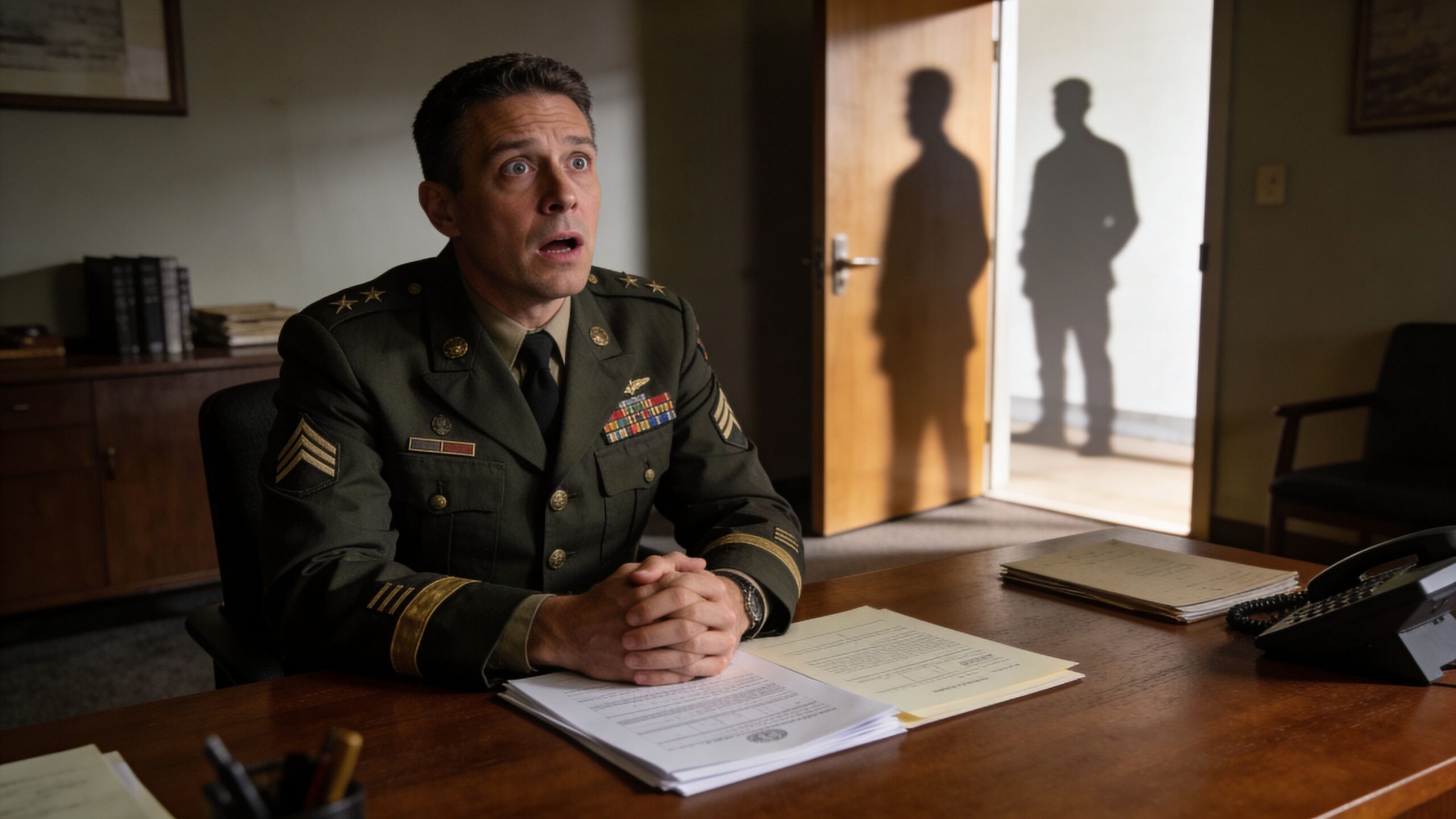
The same reaction comes from officers, senior NCOs, junior enlisted, Guard members, and reservists. Shock first. Then panic. Then the fatal urge to cooperate because they think silence makes them look guilty. That is backwards. In a possession case, your words often become the government’s cleanest exhibit.
What’s happening behind the scenes
By the time agents contact you, they usually believe they already have enough to justify the next move. They are not beginning an open-minded inquiry. They are advancing a theory.
That theory may be wrong. It may be incomplete. It may depend on a weak forensic interpretation. But once the machine starts, command attention follows fast.
Practical rule: If agents want to “hear your side,” they are trying to lock in admissions they can use later.
What this means for you right now
Your case is not just about criminal exposure. It’s about every second-order consequence that follows the allegation.
- Your command view changes fast. Even before charges, trust evaporates.
- Your security clearance is in danger. Digital sex offense allegations put your access and future assignments at risk.
- Your family gets pulled in. Phones, shared accounts, home devices, and statements from spouses can become part of the file.
- Your digital life becomes evidence. Investigators will treat searches, deleted files, cloud accounts, chat logs, and storage media as puzzle pieces.
You need to act like you’re already in litigation, because you are. This is not a misunderstanding that gets fixed with a polite explanation in an interview room.
What Possession Under Article 134 Actually Means
Article 134 breaks child pornography allegations into separate categories: possessing, receiving, or viewing; possessing with intent to distribute; distributing; and producing. In a possession case, the government still has work to do. Prosecutors must prove you knowingly and wrongfully possessed, received, or viewed the material, and they must also prove the conduct was prejudicial to good order and discipline or service-discrediting. The maximum punishment for a basic possession specification can reach 10 years confinement (Manual for Courts-Martial summary and case discussion of Article 134 child pornography offenses).
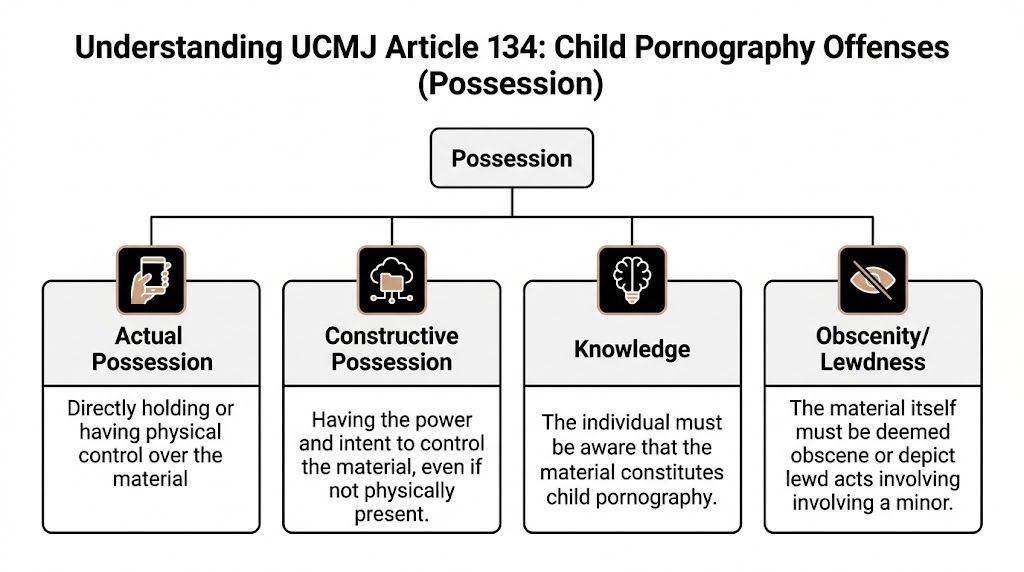
A lot of service members hear “the file was on your device” and assume the case is over. That is a mistake. Presence alone does not prove criminal possession.
The government has to prove three separate pressure points, and each one gives the defense room to attack:
- Knowingly. They must show you knew what the file was.
- Wrongfully. They must rule out accident, inadvertent saving, auto-caching, or another lawful explanation.
- Possession. They must prove control, either direct control or the legal version called constructive possession.
Actual possession is the cleaner theory for prosecutors. They want a file stored on a device assigned to you, used by you, and accessed by you.
Constructive possession is where their case often starts to wobble. Investigators and trial counsel like broad language about “access” and “ability to control.” That sounds convincing until you examine the facts. Shared devices, synced accounts, auto-downloaded attachments, cloud storage, remote access, old backups, and cross-device transfers create serious proof problems. A strong defense lawyer does not accept a forensic label at face value. He forces the government to show who had access, when the file arrived, how it was stored, whether it was opened, and whether anyone can tie that conduct to you instead of to a device in your vicinity.
That matters even more in military investigations because NCIS, CID, and OSI often build possession cases by working backward from a device hit and then trying to pin knowledge and control on the service member. If you want a better sense of how those agencies operate before charges are preferred, review this overview of CID, NCIS, OSI, and CGIS investigative practices.
Another hard truth. Device count can change your exposure fast.
Under United States v. Forrester, prosecutors may treat possession on separate material, such as different devices or accounts, as separate punishable offenses under Article 134. That gives the government room to stack specifications instead of charging one global possession theory.
| Issue | Why it matters |
|---|---|
| Single device | The government has a tighter theory, but it still must prove knowledge and control |
| Multiple devices | Prosecutors may stack charges and increase confinement exposure |
| Cloud or email account | Control, access, syncing, and authorship become contested issues |
| Shared device | Knowledge and dominion are much harder for the government to prove cleanly |
The fight is rarely just “was it there.” The core legal battle is “who controlled it, who knew about it, and what can the government prove beyond a reasonable doubt.”
That is where experienced defense work changes outcomes. The government will call a file location, account link, or device assignment proof of possession. A seasoned lawyer treats each of those points as a target. Bad attribution, sloppy forensic assumptions, shared access, weak timeline evidence, and overcharged specifications are not side issues. They are the pressure fractures that can break the case.
The Investigation Playbook How NCIS and OSI Build Their Case
These investigations are methodical. They are also predictable. That matters because predictable systems have predictable failure points.
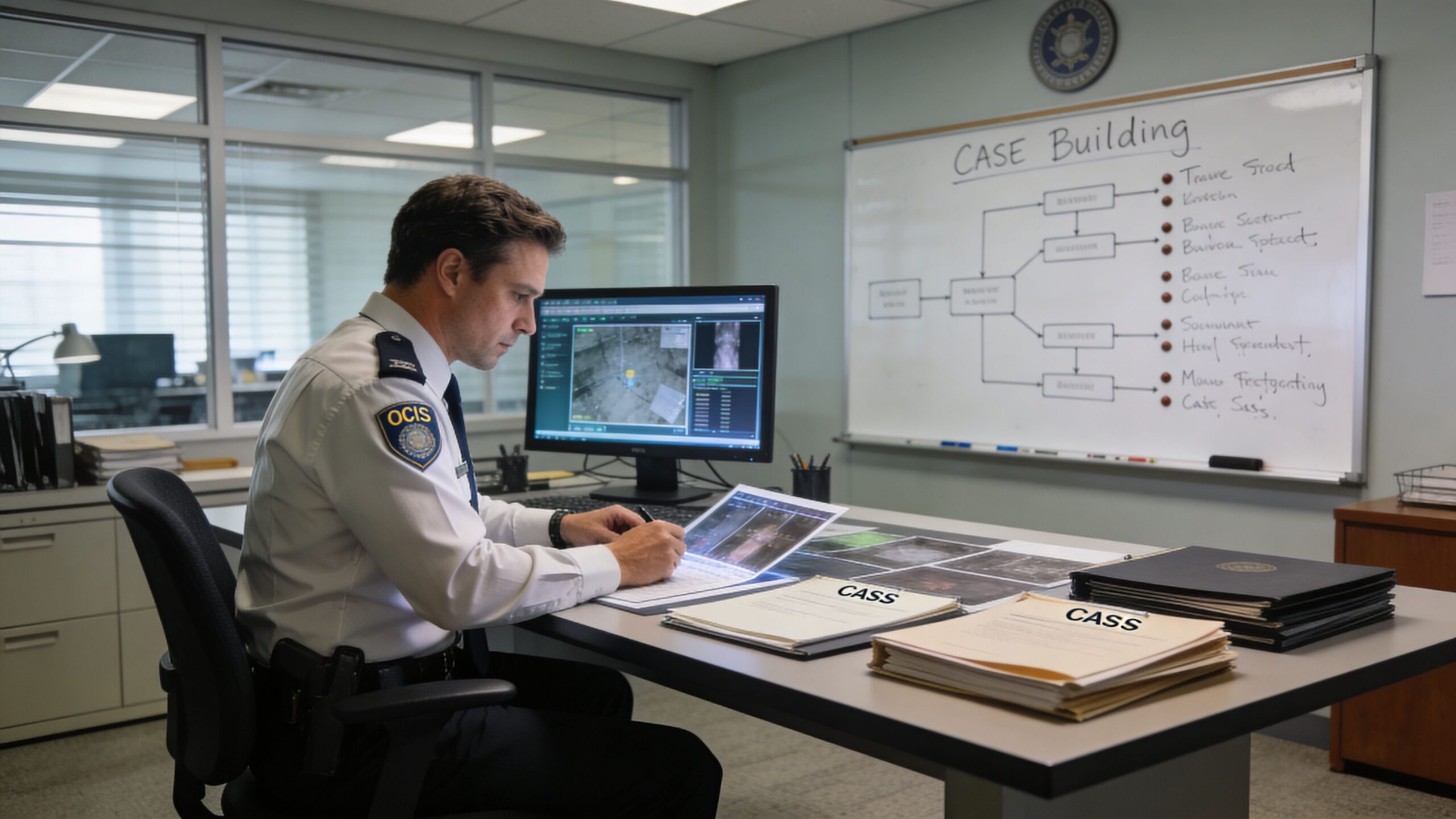
The case usually starts before you know it exists
Many cases begin with a cyber lead, a referral from another agency, or digital activity that investigators decide to trace back to a person. Once military investigators decide to pursue it, they work from a standard script: identify the subject, secure authority to seize devices, extract data, and interview the target.
If you need a clearer overview of how military investigative agencies operate, this breakdown of CID, NCIS, OSI, and CGIS investigations is worth reading.
From there, the focus narrows to ownership, access, and statements. They want to tie the device to you, the account to you, and the files to intentional conduct by you.
The interview is the trap
Agents are trained to sound reasonable. They may tell you this is your chance to help yourself. They may suggest they already know everything. They may imply that honesty will keep command on your side.
It won’t.
A possession case can survive weak digital evidence if the government gets a strong statement. Service members talk because silence feels uncomfortable. You need to get comfortable with it fast.
- You can invoke your rights. Use plain words and stop talking.
- You do not need to educate agents. Your explanation becomes their evidence.
- You should not guess. Guessing creates contradictions that look like lies.
- You should not consent beyond what they lawfully compel. If they have authority, they’ll act on it.
A useful primer on the pressure tactics and structure of these investigations appears in this video:
Digital forensics is powerful but not infallible
Once agents seize your devices, the government will use forensic tools and lab processes to reconstruct activity. That sounds airtight to jurors and commanders. It often isn’t.
The prosecution still has to connect machine findings to human intent. A cache file, sync artifact, old download fragment, mislabeled folder, or shared login does not explain itself. Investigators often present digital traces as if they tell one story. Good defense work shows there may be several.
That is why the defense in these cases starts early. Not at arraignment. Not after preferral. Early.
Strategic Defense Dismantling the Government’s Case
Agents pull a laptop, image a phone, and hand command a clean story. You downloaded it. You kept it. Case closed.
That story is often far weaker than it looks.

Strong defense in these cases starts by tearing apart the government’s shortcuts before they harden into “facts.” If you want to see how serious counsel does that early, read this guide on how experienced counsel win during the military investigation phase.
Possession cases usually break on knowledge and control
The government loves a possession charge because it sounds simple to a commander, a military judge, and a panel. It is not simple. Article 134 still requires proof that you knowingly and wrongfully possessed the material, and those words give the defense room to attack.
A file on a device is not the end of the analysis. The government still has to prove you knew it was there, could access it, and exercised control over it in a way the law recognizes as possession.
That is where experienced defense counsel goes to work:
- Shared devices and shared accounts: If other people used the device, login, cloud storage, or network, the government has an attribution problem.
- Automatic downloads and software-created artifacts: Sync tools, peer-to-peer programs, messaging apps, browser caching, and backup systems can place data on a device without a deliberate save by the user.
- Inaccessible or obscure storage locations: Files buried in cache, unallocated space, or system folders do not carry the same proof value as files intentionally sorted, renamed, or moved.
- Lack of knowing retention: Even if a file landed on a device, the prosecution still has to show wrongful possession, not accidental presence.
A good lawyer does not argue vibes. A good lawyer forces the government to prove each link in that chain.
The government often oversells forensic certainty
NCIS, CID, and OSI rely heavily on digital forensic reports because they sound technical and final. Jurors hear file paths, hash values, extraction logs, and artifact timelines and assume the machine answered every question.
It did not.
Forensics can show that data existed in a certain place at a certain time, or that a process created a trace. It does not automatically prove who put it there, who knew about it, who could access it, or whether the file reflects intentional possession instead of automated system behavior. That gap matters. It is often the whole case.
An experienced defense lawyer presses the examiners where their work is most vulnerable.
| Vulnerability | Why it matters to the defense |
|---|---|
| Chain of custody gaps | The government must show the evidence seized, copied, stored, and analyzed is the same evidence they want to use against you |
| Imaging or extraction errors | A bad forensic copy can contaminate the government’s timeline and conclusions |
| Weak user attribution | Device ownership is not the same as proof that you accessed or controlled the material |
| Missing or unclear metadata | Timing, origin, and characterization become less certain without reliable metadata |
| Search authorization defects | If agents exceeded the scope of the warrant or authorization, key evidence may be vulnerable to suppression |
The prosecution wants the court to treat the lab report like a finished answer. Defense counsel treats it like a draft full of assumptions.
Smart defense work targets procedure, not just sympathy
Begging for mercy is a losing strategy in a digital possession case. You win by exposing how the government cut corners.
That means examining the seizure authority, the wording of the search authorization, the scope of the forensic review, the handling of cloud data, the methods used to identify the alleged files, and the qualifications of the examiner who wants to explain everything to the court. One mistake in that chain can change the case. Several mistakes can collapse it.
A file that exists somewhere on a machine is not automatically a possession case. Sometimes it is a forensic artifact the government is trying to dress up as intent.
What strong counsel is really doing behind the scenes
The right defense lawyer is not waiting for trial to start fighting. Counsel should be preserving evidence, locking down expert review, challenging overbroad searches, testing the government’s attribution theory, and forcing prosecutors to commit to specifics they may not be able to prove later.
That pressure changes cases. It exposes weak warrants. It exposes sloppy forensic handling. It exposes the distance between “data was found” and “the accused knowingly possessed child pornography.”
In a case like this, that distance is where careers are saved.
The Five Mistakes That Will Destroy Your Case
Panic makes people do stupid things. These five are the most common.
Talking to investigators because you think honesty will save you
It usually saves the prosecution time. Silence is not guilt. It is discipline.Consenting to a search when they ask nicely
If they already have authority, they don’t need your consent. If they are asking, there is a reason.Deleting files, wiping devices, or “cleaning up” accounts
That can create a separate disaster. It also hands the government an argument that you knew exactly what was there.Discussing the case with your chain, friends, coworkers, or even family in text messages
Those messages can be seized, forwarded, misunderstood, or turned into evidence. Loose talk kills defenses.Waiting for charges before hiring real counsel
By then, investigators may have had months to shape the narrative without resistance.
The blunt version
- Don’t explain.
- Don’t consent.
- Don’t delete.
- Don’t gossip.
- Don’t delay.
Your first bad decision in a digital case is usually not the alleged offense. It is the statement you make after the seizure.
Why Your Appointed Military Lawyer Is Not Enough For This Fight
You are entitled to military defense counsel. Use that right. But in a possession case under Article 134, appointed counsel alone often isn’t enough.
This is not an insult to military lawyers. Many are smart, hardworking, and committed. The problem is structural. These cases are technical, high-stakes, and unforgiving. They demand deep familiarity with digital forensics, suppression practice, expert consultation, and military-specific charging strategy.
The practical difference
| Appointed military counsel | Experienced civilian military defense counsel |
|---|---|
| May have limited trial exposure in digital sex offense cases | Often brought in specifically for serious court-martial litigation |
| Balances a heavy docket | Can focus resources where your case is weakest for the government |
| Works inside the military system daily | Brings outside independence and is harder to pressure through command climate |
| May have less flexibility with outside experts | Usually pushes early for independent forensic review |
The charging environment is also getting harder. Prosecutors increasingly use multiplicity theories to stack charges by device or image. United States v. Forrester allows separate punishment by distinct material, and evolving issues involving cloud storage and AI-related material mean your lawyer needs to be current on the latest appellate developments, not just generally competent in military justice (CAAF digest discussion of Article 134 child pornography offense issues and multiplicity).
If you’re weighing options, start with a serious process for selecting a military defense lawyer. This is not a case for a generalist.
My opinion
If your freedom depends on challenging forensic evidence, stacked specifications, and a command already primed to assume the worst, you cannot afford to be somebody’s first serious digital possession trial.
Frequently Asked Questions and Your Immediate Action Plan
Agents do not need a perfect case on day one. They need enough access, enough statements, and enough digital noise to make you look guilty before your lawyer can slow them down. Your job is to stop helping them.
Can I refuse to talk to CID, NCIS, OSI, or CGIS
Yes. Do it clearly and do it once. Say, “I am invoking my right to remain silent. I want a lawyer.” Then say nothing else.
Do not explain. Do not deny. Do not try to sound cooperative. Investigators are trained to keep talking until you hand them admissions they could not prove on their own.
If the images were only in browser cache or deleted space, does that matter
Yes. It often matters a great deal.
A possession case still rises or falls on control, knowledge, and access. Files buried in cache, unallocated space, thumbnails, or deleted fragments can expose weak spots in the government’s theory. Those artifacts do not automatically prove you knowingly possessed contraband in any usable sense. A strong defense lawyer presses hard on that gap and gets an independent forensic expert involved early, before the government’s interpretation hardens into the version everyone repeats.
Can they charge me based on more than one device
Yes. They often do.
Phones, laptops, tablets, external drives, cloud accounts, and shared storage can become separate specifications or separate theories of possession. That charging strategy increases pressure fast and gives prosecutors more ways to argue punishment. Your lawyer needs to attack the links between you and each device or account, not just the images themselves.
What if I didn’t know the files were there
Then knowledge becomes a central fight.
That issue is rarely won by your explanation to agents. It is won through timestamps, user activity, download history, account access, file paths, sync settings, remote access issues, and who used the device. The government likes to blur presence with knowing possession. A disciplined defense separates them.
Should I let investigators search everything to show I have nothing to hide
No.
If investigators already have legal authority, your consent gives you no advantage. If they do not have legal authority, your consent fixes a problem in their case. Do not solve that problem for them.
What should I do today
Take these steps, in this order:
- Invoke your rights immediately. Use plain words. Ask for a lawyer.
- Do not consent to any search of your phone, laptop, accounts, home, vehicle, or barracks room.
- Do not delete, move, wipe, reset, or alter anything.
- Write down the facts while they are fresh. Note who contacted you, what agency they were with, what they said, whether rights were read, what devices were seized, and who witnessed it.
- Stop talking about the case. That includes your chain of command, coworkers, friends, family, and anyone in your unit who says they are trying to help.
- Get experienced civilian military defense counsel involved now.
Speed matters here. Early mistakes give the government evidence. Early defense work takes it away.
If you are under investigation for UCMJ Article 134 Child Pornography Offenses (possession, do not wait for charges. By then, agents have usually seized devices, drafted reports, and framed the case for command.
Call an experienced civilian military defense lawyer now. Your career and your freedom depend on what you do next.