
You get the call after duty hours. Your First Sergeant says report in. Or MPs knock and tell you there’s a complaint from the barracks, a bar, the gate, the sidewalk outside a club, or some parking lot you barely remember. You think this is a stupid alcohol incident that will blow over once people calm down.
That is usually the first bad decision.
An accusation of UCMJ Article 134 Drunk and Disorderly Conduct is not a paperwork nuisance. It can become an NJP, a summary court-martial, a special court-martial, a reprimand, a separation packet, or a career stain that follows you long after the night itself is forgotten by everyone else. While you’re trying to piece together what happened, your command is already collecting statements, locking in a narrative, and deciding whether you’re now a discipline problem.
The next 24 hours matter. What you say to MPs, CID, NCIS, OSI, CGIS, your chain of command, your roommate, your spouse in text messages, and your friends in group chats can hand the government the missing pieces it needs. Service members can survive ugly facts by getting strategic early. I’ve also seen people sink defensible cases because they talked, apologized, guessed, and tried to “clear things up.”
Table of Contents
- Your Career on the Line The Moment You Are Accused
- What Prosecutors Must Prove for Drunk and Disorderly Conduct
- How an Article 134 Investigation and Prosecution Unfolds
- Strategic Defenses to Dismantle the Government’s Case
- Punishments and Career-Ending Collateral Consequences
- Five Critical Mistakes That Will Destroy Your Defense
- Why a Civilian Military Defense Lawyer Is Your Best Weapon
Your Career on the Line The Moment You Are Accused
A drunk and disorderly allegation usually starts with chaos and then turns into paperwork. Loud voices. A duty NCO. Shore patrol. Civilian police. A barracks complaint. A supervisor who only heard the last part of the story. By morning, the command version sounds clean and your version sounds defensive.
That’s how careers get cornered.
What the first contact usually means
When command calls you in, they’re rarely “just trying to understand.” They’re assessing whether they have enough to move against you and whether you’ll help them do it. If investigators are involved, they already think the incident may support formal action.
You may feel pressure to look cooperative. Service members are trained to explain, comply, and fix problems. In a criminal or quasi-criminal setting, that instinct hurts you. Alcohol incidents are especially dangerous because people fill memory gaps with guesses, and guesses become admissions.
Practical rule: If you’re accused of UCMJ Article 134 Drunk and Disorderly Conduct, stop trying to sound reasonable and start acting strategic.
What’s happening behind the scenes
While you’re replaying the night, others are building the file:
- Witnesses are being shaped: People who were drinking often give sloppy, inconsistent accounts. Investigators still turn those accounts into polished statements.
- Your command is judging more than the incident: Rank, prior counseling, reputation, and unit climate all influence how aggressively they respond.
- Administrative fallout may start immediately: Flags, adverse paperwork, loss of trust, and duty restrictions can begin before any final decision on charges.
The accusation also creates a credibility fight. If your command already thinks you’re the problem, every later explanation sounds self-serving unless counsel gets in front of the case early.
Families need to understand this too. A spouse or parent often wants to call the command, explain character, or send emotional texts. That can make things worse. The right move is controlled silence, evidence preservation, and immediate legal strategy.
What Prosecutors Must Prove for Drunk and Disorderly Conduct
A drunk night does not equal an easy conviction.
Prosecutors and commands often talk about this charge like it proves itself. They say you were intoxicated, loud, embarrassing, or out of control. That framing is built to pressure you into giving up. It is not proof. In an Article 134 case, the government has to prove each required part beyond a reasonable doubt, and that burden gives your defense room to attack.
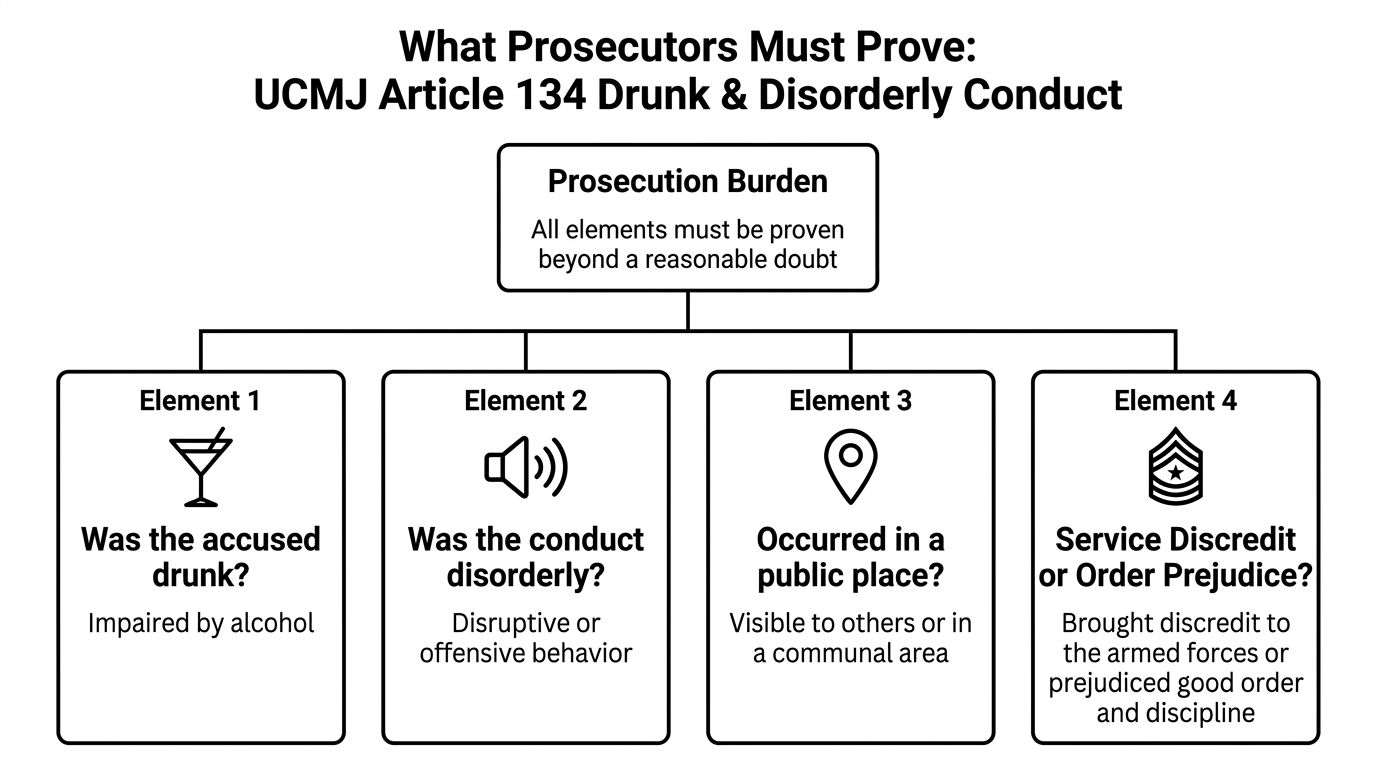
The government has hurdles to clear, not a free pass
Under Article 134, the prosecution must prove you were drunk, disorderly, or both under the charged circumstances. It also must prove the terminal element. That last part is often the weak point that decides the case.
“Drunk” is not just drinking. The government needs proof of intoxication that impaired your reason or behavior. “Disorderly” is not just being annoying, emotional, or unpopular. The conduct must disturb the peace, offend public decency, or provoke resentment in a way the law recognizes. If the proof is sloppy, the charge is vulnerable.
Use the elements the right way. Treat them as targets.
| Government issue | What prosecutors must prove | How the defense attacks it |
|---|---|---|
| Intoxication | Actual impairment | No testing, weak observations, conflicting witness accounts |
| Disorderly behavior | Specific conduct that crossed the line | Argument is not disorderly conduct, noise is not automatically criminal |
| Time and place | You were the person involved, at the charged location, under the charged facts | Bad identification, missing video, inconsistent timeline |
| Terminal element | Prejudice to good order and discipline or service-discrediting conduct | No direct unit impact, no meaningful public harm, no real damage to the service’s reputation |
If you need a clearer sense of how these proof requirements fit inside the larger court-martial process and defense strategy, start there. The prosecution still has to carry the load in your case.
The Manual for Courts-Martial also treats these offenses differently for punishment purposes, which tells you the details matter. Drunkenness alone, disorderly conduct alone, and drunken and disorderly conduct do not all carry the same exposure. The official Manual for Courts-Martial lays out those offense categories and authorized punishments.
The terminal element is the pressure point
Experienced defense counsel attacks the terminal element hard because many Article 134 cases are weak there.
The government must prove that your conduct either prejudiced good order and discipline or was service-discrediting. Prosecutors lose cases on this issue because they often rely on command irritation, moral judgment, or bad optics instead of actual evidence.
“Prejudice to good order and discipline” requires a direct and palpable effect on the unit or military functioning. A commander being angry does not satisfy that burden. Gossip in the barracks does not satisfy it. A bad impression on a supervisor does not satisfy it.
“Service-discrediting” requires proof that the conduct tended to bring the armed forces into disrepute. Public visibility matters. Actual reputational harm matters. A private incident with confused witnesses is much harder for the government to sell than they want you to believe.
Alcohol plus command embarrassment is not enough for a conviction.
That is the opening your lawyer should exploit.
A strong defense presses on the facts prosecutors would rather blur together:
- Who saw what happened? Drunk witnesses are often wrong, and sober witnesses often saw only fragments.
- What conduct was disorderly? Raised voices, profanity, an argument, or poor judgment do not automatically meet the legal standard.
- What concrete military harm followed? The government must show more than inconvenience or leadership frustration.
- Was the event public enough to discredit the service? If the incident stayed private, the service-discrediting theory may be thin.
- Did the command overcharge the case? That happens all the time in alcohol incidents.
This charge looks simple from a distance. Up close, it is full of proof problems. Your defense should be built around those problems, not around apologizing for the night.
How an Article 134 Investigation and Prosecution Unfolds
You get called in after a night out. A supervisor says they just want your side. An investigator acts casual. By the end of the week, your words are in a sworn statement packet, the command has labeled you the problem, and the government is already building around the parts that help them most.
That is how these cases start.

The government starts building its version before you realize it is a prosecution
An Article 134 drunk and disorderly case usually develops in a predictable sequence, but the primary danger is not the sequence itself. It is that prosecutors use the early stage to lock in a story before the weak spots are exposed.
Initial report
The case starts with a blotter entry, supervisor complaint, barracks incident report, civilian police contact, or a written memo from someone who says you caused a disturbance. That first report often contains exaggeration, missing context, and loaded words like “belligerent” or “out of control.” Those labels stick unless your lawyer challenges them early.Witness statements
Investigators gather statements fast. In alcohol cases, that creates obvious proof problems for the government. Witnesses are often tired, angry, drinking themselves, or only saw ten seconds of a longer event. Even so, command treats the first version as truth and builds from there.Interview of the accused
During the interview of the accused, many service members hand the government what it cannot prove on its own. They guess. They apologize. They fill memory gaps with words the prosecutor later quotes as admissions. If you want a clear map of how these proceedings work, read these court-martial basics before you say a word.Command review and legal screening
The command sends the packet up for review. Trial counsel and command do not just ask what happened. They ask what they can charge, what sounds bad on paper, and what forum gives them the most pressure. A weak drunk and disorderly allegation is often paired with other accusations to make the case look cleaner than it is.Charging decision
Once the charge is drafted, the government has committed itself to proving more than a messy night. It now has to prove criminal disorder and the terminal element. That is a real burden, and it creates openings for the defense if the file is examined early instead of accepted at face value.
Forum choice changes the pressure, not the government’s burden
The same allegation can be pushed into very different forums, each with different risks.
- Article 15 or NJP: Command likes this route because it is fast and gives them control. Do not mistake speed for weakness. A bad NJP result can still hit rank, pay, evaluations, clearance, and promotion potential.
- Summary court-martial: Commands often treat this as minor discipline. For the accused, it is still a prosecution with lasting consequences.
- Special or general court-martial: If the allegation is public, tied to another offense, or command wants to make an example out of someone, the case can escalate fast.
Rank does not protect you. Time in service does not protect you. A previously clean record does not stop command from pushing hard if leadership thinks the optics are bad.
What matters is timing. Early intervention gives your defense lawyer the best chance to break the government’s momentum by preserving video, identifying favorable witnesses, exposing contradictions, and forcing prosecutors to confront the weakest part of many Article 134 cases: proof that the incident harmed good order and discipline or discredited the service. Once the file gets polished into a command packet, bad assumptions harden into “facts.”
A short overview can help if you’re trying to orient yourself before making decisions:
Strategic Defenses to Dismantle the Government’s Case
Good defense work in these cases is not about giving command a sad story. It’s about denying the government clean proof. Every element creates a target. Every witness creates a vulnerability. Every overstatement in the report gives the defense room to attack credibility.
Attack proof not headlines
People describing a case for the first time usually start with the label. “They say I was drunk and disorderly.” Get the raw details instead. Who saw what. From where. For how long. Under what lighting. After how many drinks of their own. Whether body cam exists. Whether anyone recorded the scene. Whether the loudest person was someone else.
That’s how you dismantle these cases.
A few core strategies drive the defense:
- Challenge intoxication evidence: If the government relies on impressions instead of objective proof, that matters. “Smelled like alcohol” is not the same as proving impairment.
- Separate loud from disorderly: A raised voice, profanity, or boisterous behavior can sound bad on paper. It still may fall short of criminal disorder.
- Expose witness weakness: Intoxicated witnesses contradict themselves. So do angry supervisors and embarrassed command representatives.
- Force proof of actual impact: If the government can’t show real prejudice to good order or actual service discredit, the case may be overstated from the start.
A strong Article 134 defense often comes down to one question. Did your conduct actually meet the legal threshold, or did the command just decide it was tired of dealing with alcohol incidents?
The Court of Criminal Appeals has also reinforced that the terminal element is distinct. In United States v. Coleman (79 M.J. 100), described in the verified material above, the government still had to prove palpable harm to discipline or actual discredit, not remote effects. That matters because commands love remote effects. They’ll say morale suffered, leadership confidence declined, or the unit was embarrassed. Those themes sound persuasive. They are not substitutes for proof.
Mitigation is not surrender if you use it correctly
Mitigation does not mean admitting guilt and begging for mercy. Used correctly, it changes forum decisions, charging decisions, and sentencing posture. It also helps in administrative battles running alongside the case.
According to National Security Law Firm’s discussion of Article 134 disorderly conduct, mitigating factors are critical, and service members with clean records, combat experience, or voluntary alcohol treatment often see charges reduced from potential confinement to non-judicial punishment or even dismissal. The same source states that acquittals in appealed cases can reach 20-30% based on evidentiary weaknesses such as inconsistent witnesses.
That means a serious defense does two things at once:
| Defense track | Goal |
|---|---|
| Proof attack | Undermine the legal elements and witness credibility |
| Mitigation build | Give command and prosecutors a face-saving off-ramp from the harshest outcome |
Useful mitigation themes often include:
- Clean service history
- Strong duty performance
- Immediate treatment efforts
- Stressors that explain context without excusing misconduct
- Character witnesses who are credible and specific
What fails is fake remorse, generic letters, and sloppy timing. If you’re going to build mitigation, do it with structure. The wrong package looks performative. The right package makes the government think twice about how hard it wants to push.
Punishments and Career-Ending Collateral Consequences
You can survive a short punishment. A damaged military record is harder to fix.
That is why accused service members who obsess over confinement miss the larger threat. In an Article 134 drunk and disorderly case, the government often gets more mileage from the aftermath than from the sentence itself. A prosecutor knows that. Your command knows that. You need to know it early, because your defense has to target both the charge and the administrative fallout at the same time.
The sentence matters, but the paper trail can hurt longer
The Manual for Courts-Martial authorizes punishment for drunk and disorderly conduct under Article 134, including confinement, forfeitures, and reduction exposure depending on how the conduct is charged and resolved. You can review the offense listing and punishment framework in the Manual for Courts-Martial, United States.
Do not make the mistake of treating lower-level punishment as harmless. If command is steering this toward NJP, read this guide on Article 15 and nonjudicial punishment and how it affects a military career before you agree to anything. A quick disposition can still stain evaluations, block promotion, and set up separation.
The strategic point is simple. Even when the alleged misconduct sounds minor, the government still must prove the terminal element. If your lawyer can pressure that weak point, the command’s appetite for harsh punishment often drops. That changes outcomes.
Command can punish you without a conviction
A drunk and disorderly allegation can trigger damage far outside the courtroom or Article 15 process:
- Adverse evaluations that label you unreliable or lacking judgment
- Administrative separation processing even without confinement
- Loss of security-sensitive, leadership, or special duty positions
- Blocked schools, promotions, and favorable assignments
- A lasting command narrative that you are now a discipline problem
In many military cases, the most significant punishment is not the hearing. It is the career damage that starts once command decides you are a risk.
That is why the burden of proof matters so much here. If the government cannot clearly show your conduct prejudiced good order and discipline or brought discredit on the service, then the case is weaker than it looks. And if the case is weaker than it looks, your lawyer has room to attack the charge, challenge the command narrative, and blunt the collateral damage before it hardens into a permanent record.
Five Critical Mistakes That Will Destroy Your Defense
Service members rarely lose these cases in one dramatic moment. They lose them through a string of avoidable, self-inflicted errors.
Mistakes that come up over and over
1. Talking to investigators because you think honesty will save you
It won’t. Honesty without strategy usually fills gaps in the government’s case. If you were drinking, tired, embarrassed, or unsure, your statement will get cleaner on paper than it sounded in the room.
2. Explaining yourself to command in texts, emails, or hallway conversations
Every informal explanation becomes evidence. Commands remember admissions, not nuance.
3. Assuming there is “no real evidence”
Alcohol cases often look weak at first. Then the government builds them from statements, screenshots, body cam, duty logs, and your own words.
4. Waiting to hire counsel until charges are preferred
By then, witness stories may be locked, video may be gone, and command may have committed to a harsher path.
5. Contacting witnesses yourself and trying to coordinate stories
That can be framed as influence or obstruction. Leave witness work to counsel.
6. Posting online or discussing the incident in group chats
You do not control screenshots. You do not control context once somebody forwards what you wrote.
7. Treating NJP as harmless because it seems quicker
Quick is not the same as smart. A rushed decision can produce long-term career damage.
Here’s the cleaner checklist:
- Stay silent: Invoke your rights and stop volunteering facts.
- Preserve evidence: Save texts, rideshare receipts, photos, videos, and names of sober witnesses.
- Write a private timeline for your lawyer: Keep it factual. Don’t embellish.
- Avoid command theater: Don’t perform remorse, don’t argue, don’t speculate.
- Get counsel involved immediately: Early strategy changes outcomes.
One more point. Don’t assume your spouse, parent, or buddy can talk this out with leadership. They can’t. They usually give command more material and less reason to doubt its own narrative.
Why a Civilian Military Defense Lawyer Is Your Best Weapon
You may be assigned military defense counsel. Many of those lawyers work hard and care about their clients. But serious cases demand more than effort. They demand independence, trial judgment, and the ability to attack command decisions without worrying about institutional friction.
Independence changes everything
A civilian military defense lawyer answers to one person. You.
That matters in a UCMJ Article 134 Drunk and Disorderly Conduct case because these files often depend on interpretation. Was it disorderly. Was there actual prejudice. Did command overcharge because the optics were bad. Those fights require an attorney who is comfortable pushing hard, digging early, and telling the government its case is weaker than it thinks.
A seasoned civilian lawyer also brings a different lens:
- Broader comparative experience across branches and installations
- Freedom from command relationships
- More time to build witness strategy and mitigation
- A direct incentive to challenge the government aggressively
If you’re weighing options, this guide on selecting a military defense lawyer will help you ask the right questions.
You do not need a lawyer who processes your case. You need one who knows where Article 134 prosecutions crack, especially on the burden of proof and the terminal element. That is where careers are saved.
If you are under investigation or already accused of UCMJ Article 134 Drunk and Disorderly Conduct, move now. Don’t wait for command to “see reason.” Don’t assume this will stay minor. Don’t give investigators the statement they need to finish the case.
Talk to experienced civilian military defense lawyers immediately. Compare strategy, not promises.