
Your phone rang after CID, NCIS, OSI, or CGIS showed up. Or your spouse called about an Article 15, a separation notice, or a court-martial that suddenly feels real. You’re scrolling lawyer websites at midnight, every profile says experienced, aggressive, and nationwide, and none of that tells you who’s current on the law that’ll decide this case.
Table of Contents
- Why Continuing Professional Education Decides Counsel Quality
- CLE Hour Rules That Still Bind Military Lawyers
- Why a Completion Certificate Is Not Competence
- Military Justice Programs That Show Real Currency
- How to Find Courses and Verify the Credits
- Mistakes That Hide a Stale or Noncompliant License
- Frequent Questions About CLE for Military Defense Lawyers
- Why Civilian Counsel Matters and What to Do This Week
Why Continuing Professional Education Decides Counsel Quality
Say a sergeant is told not to leave post while investigators review his phone. His wife finds three civilian lawyers online. One hasn’t tried a contested court-martial in years but still advertises military defense. Another can explain what changed in recent appellate decisions, evidence practice, and ethics guidance, and can connect those changes to the sergeant’s facts. That gap is where continuing professional education matters.
Continuing professional education is the learning a licensed professional must complete after the first license is granted. For lawyers, that system is continuing legal education, or CLE. A bar card proves a lawyer qualified once. It doesn’t prove the lawyer kept up.
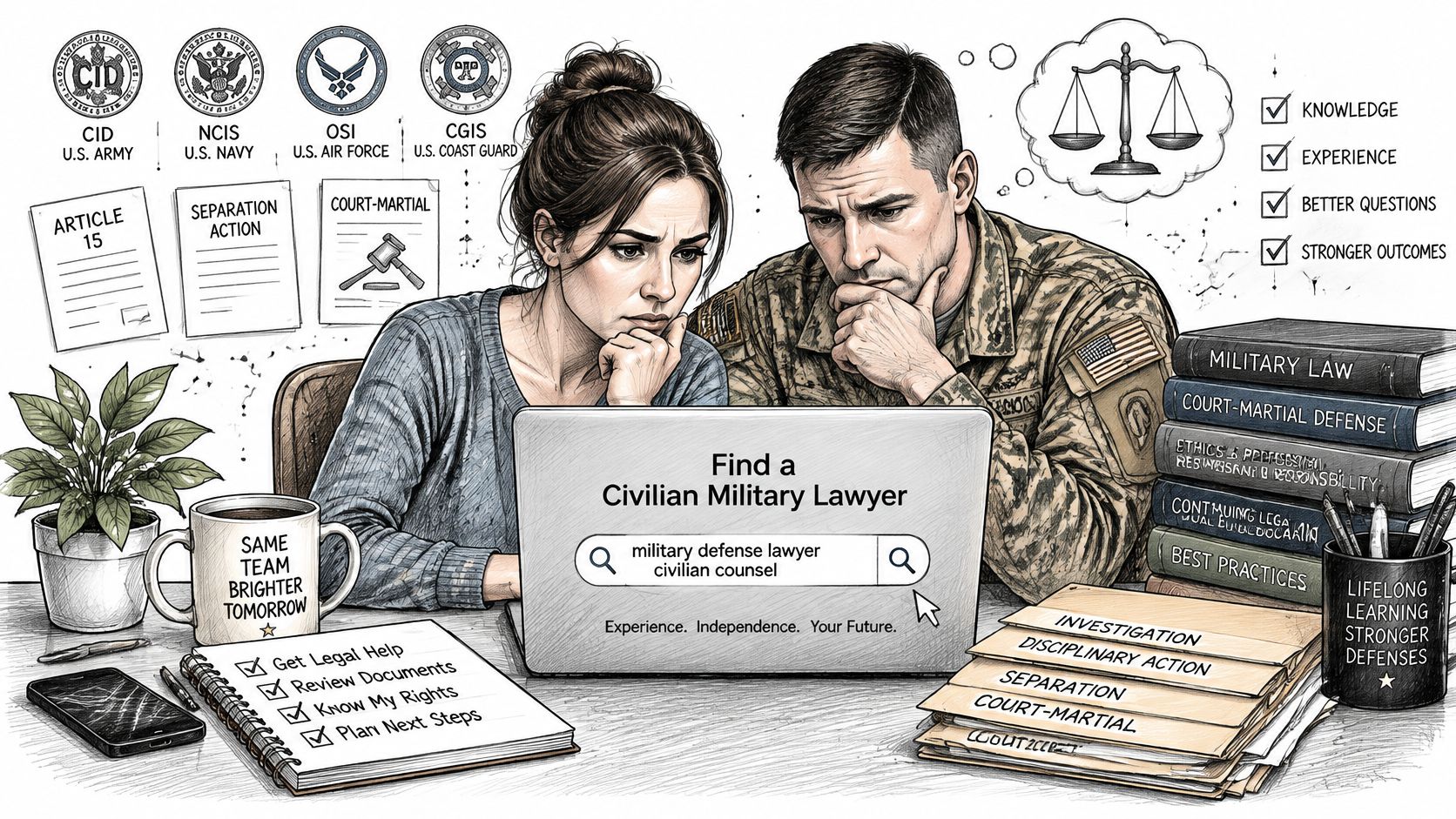
What current actually means in a military case
Court-martial practice moves. Appellate courts issue decisions, evidence rulings shift, and ethics opinions change what counsel can and can’t do for a client. If your lawyer learned this system during a short tour years ago and stopped training, you’re paying for old instincts in a new fight.
This applies whether you’re active duty, Guard, Reserve, or a spouse trying to protect a career, retirement, and reputation during a UCMJ investigation. The question isn’t whether a lawyer sounds confident on a sales call. It’s whether that lawyer maintains the license and the skills your case needs right now.
You’ve got two separate checks to run, and don’t confuse them. First, confirm the hour rules for the actual license the lawyer will use in your case. Second, judge whether the learning was real military justice work or unrelated filler bought to satisfy a quota.
A former uniform, a JAG title, and a polished website are not proof of current competence. Records are.
Deployment and PCS orders can complicate how a lawyer reports education. They don’t, by themselves, keep a license in good standing. Relief usually has to be requested and documented.
Use that standard when you apply the test for experienced military counsel to any name you’re considering. Then take the hour table in the next section into your first consultation and make the lawyer answer against it, on paper, before money changes hands.
CLE Hour Rules That Still Bind Military Lawyers
Start with the table. Bring it to a consult and ask which row, or which other state’s rule, controls the lawyer sitting across from you.
| License or program | Hours and ethics | Military accommodation | What to verify |
|---|---|---|---|
| Indiana active attorney | 6 approved hours each year and 36 each 3-year period, including 3 professional-responsibility hours in the period | Deployed outside the U.S. may petition for an exemption up to 3 years; active duty inside the U.S. may use an alternative method up to 3 years | Petition was filed, the end date, and on-time reporting |
| Wisconsin active attorney | 30 CLE credits every two calendar years, including 3 ethics and professional-responsibility credits | Full-time military service does not affect the CLE duty; a lawyer outside Wisconsin may have a separate exemption | Credits reported for the current two-year period and the ethics credits counted |
| Texas military-attorney registration | At least 15 hours of State Bar of Texas CLE, including at least 3 hours of legal ethics or professional responsibility | Registration is its own category; general courses do not replace the ethics minimum | Registration is current and the ethics hours fall in the required coursework |
| CAAF annual CLE and training | Credit is expected in every state that has mandatory CLE | Built for military and civilian judges and practitioners in the military justice system | Program year, subjects, and whether the home state actually awarded the hours |
Indiana requires a petition, not an assumption
Under Indiana Admission and Discipline Rule 29, attorneys generally must complete at least 6 approved CLE hours each year and 36 approved hours during each three-year educational period, including at least 3 hours of professional-responsibility instruction during that period. That’s the baseline before military service enters the picture.
A lawyer mobilized or deployed outside the United States may seek an exemption for up to 3 years by submitting military orders and a verified petition showing undue hardship. A lawyer on active duty inside the United States may instead be allowed an alternative method, also for up to 3 years, subject to a verified petition and the commission’s conditions.
Read that carefully. Military status does not automatically erase compliance obligations. The lawyer must ask, document the request, and follow whatever renewal or reporting conditions the licensing authority imposes. If a lawyer tells you deployment handled it, ask to see that the petition was filed and granted.
Wisconsin and Texas draw different lines
The Wisconsin State Bar membership FAQ states Wisconsin requires active attorneys to complete 30 CLE credits every two calendar years, including 3 credits in approved legal ethics and professional-responsibility coursework, and that full-time military service does not affect the lawyer’s CLE obligation. A lawyer serving in a legal capacity in the military usually must keep an active license in at least one state, although a separate exemption may apply when the lawyer is outside Wisconsin.
Texas is narrower and category specific. The Texas Board of Law Examiners military-attorney application requires at least 15 hours of State Bar of Texas CLE coursework, including at least 3 hours in legal ethics or professional responsibility. General professional development doesn’t cure a missing ethics minimum.
Consult rule: The hours that count are the hours tied to the license or registration the lawyer will actually use for your case, in the current reporting period, with ethics broken out separately.
These three rows don’t list every state. They show why you can’t accept a vague answer like I’m current everywhere. Rules diverge by jurisdiction, license category, and where the lawyer is serving or practicing. Your job is simple. Pin the lawyer to one license, one reporting period, and one transcript.
Why a Completion Certificate Is Not Competence
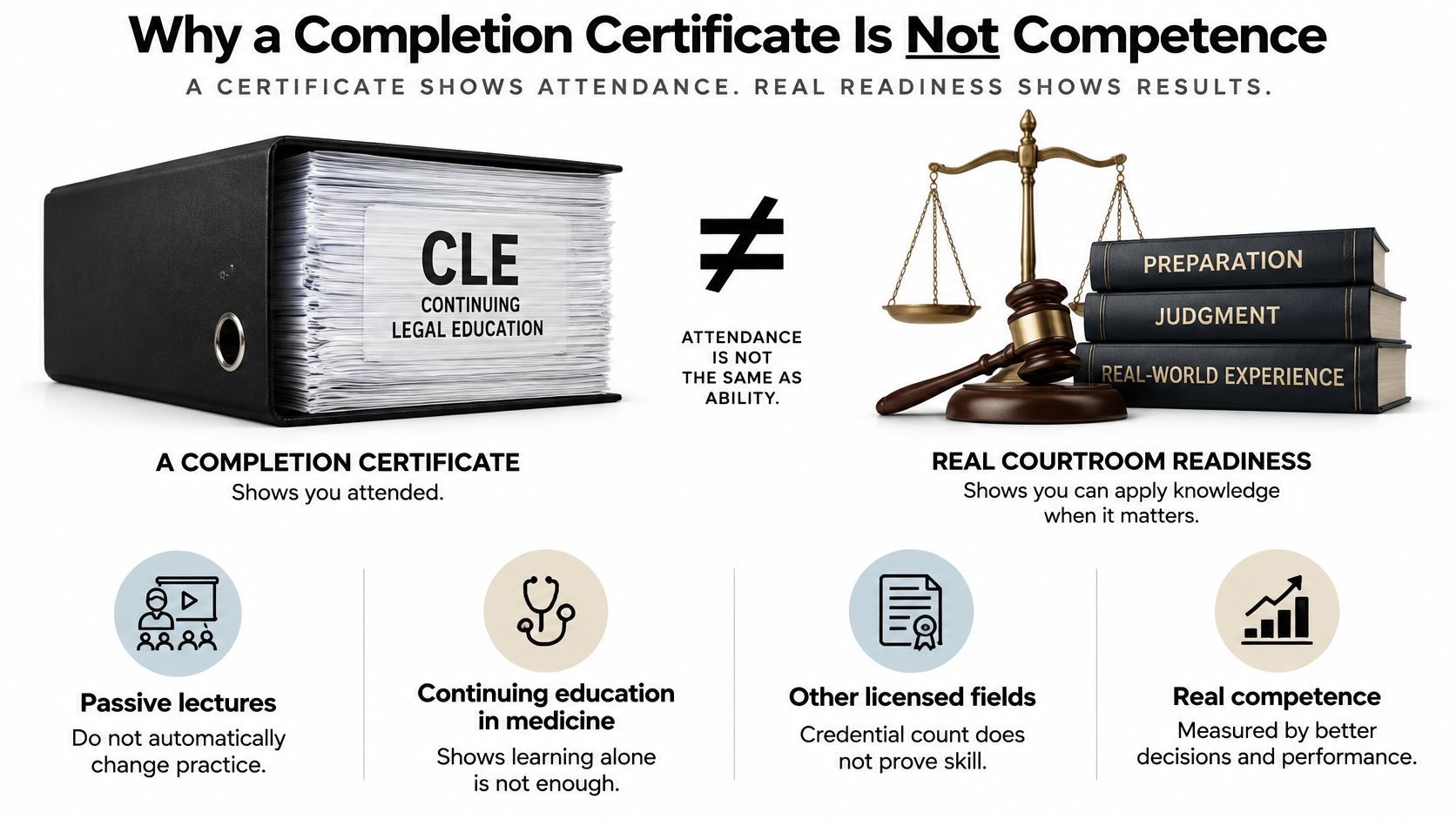
A lawyer can arrive at a court-martial with a thick CLE file and still lack the skills the case demands. For families choosing counsel, the question is what the lawyer learned and applied, not how many certificates fill a folder.
Continuing education is more useful when it asks lawyers to work through realistic problems, practice skills, and receive feedback. A lecture or webinar can introduce a topic, but attendance alone does not show that counsel can apply it in a hearing or trial.
The four part test for any course a lawyer names
Use this test when a lawyer points to a course as evidence of readiness:
- Work problem first: Did the course address a defense problem, such as a suppression issue, a flawed investigation, or a sentencing decision?
- Practice under pressure: Did the lawyer draft, argue, or make decisions in a realistic exercise, rather than only listen?
- Qualified critique: Did an instructor or peer review the work and identify errors?
- Transfer checked later: Did a later task show the lawyer could apply the skill to a file, motion, or examination?
A passive “UCMJ update” webinar offers little evidence of courtroom ability. Timed work on a charge sheet, suppression motion, or oral argument, followed by pointed critique, gives a clearer view of what the lawyer practiced. Ask what the lawyer did during the course and how that work changed their approach.
Certificates confirm attendance or completion. They do not establish that counsel can handle your case. Judge a current court-martial lawyer by jurisdiction-specific records, ethics credits, and military-justice training that changed courtroom work, not by certificates alone.
Military Justice Programs That Show Real Currency
Specialized military justice training carries more weight than generic credit because it forces a lawyer to stay current on the system that will judge you. Use one concrete program as your benchmark.
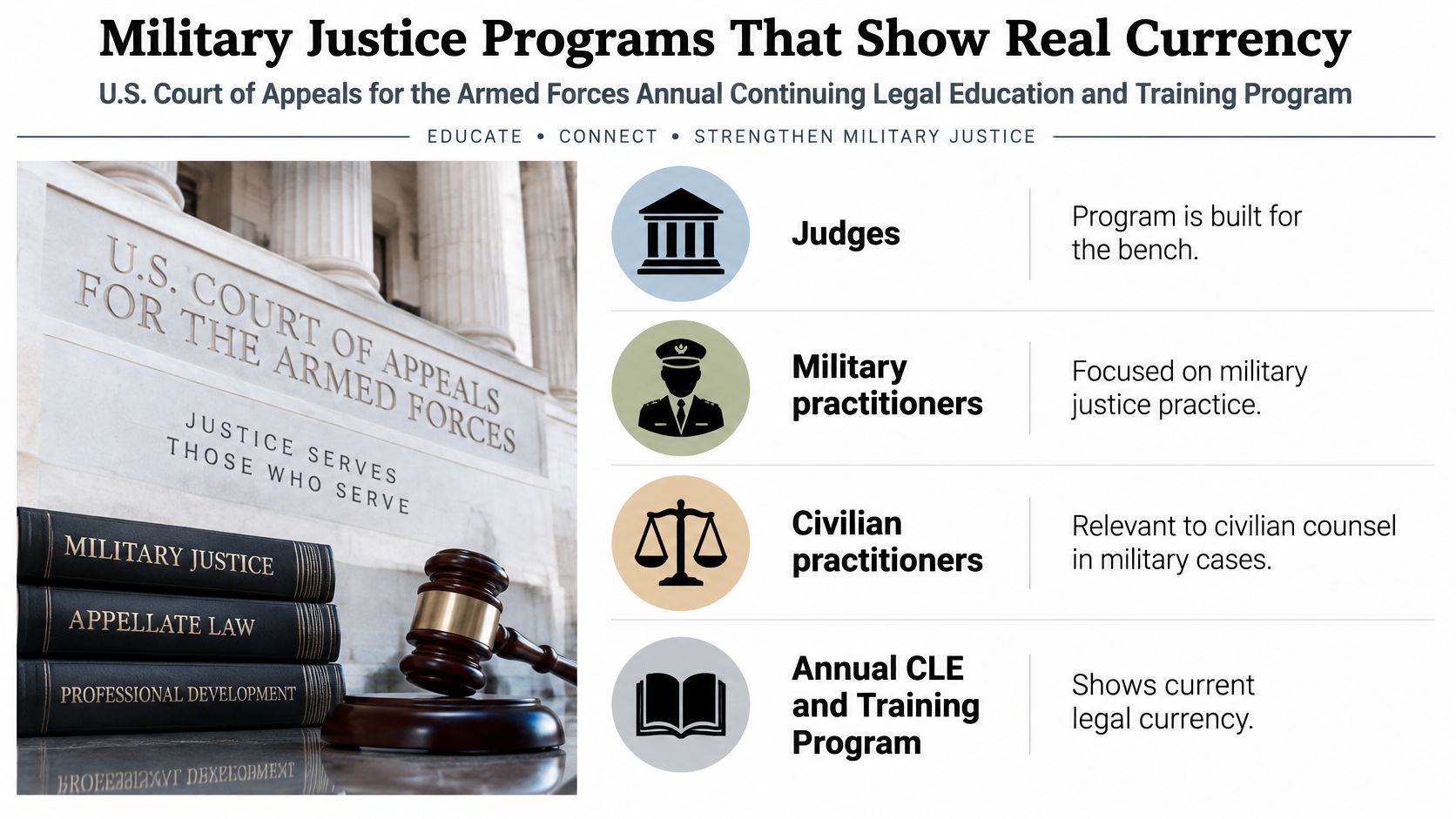
The U.S. Court of Appeals for the Armed Forces annual Continuing Legal Education and Training Program is maintained specifically for judges and practitioners, both military and civilian, who work in or follow the military justice system, and continuing legal education credit is expected from participants in every state with mandatory CLE rules. It’s a recurring forum on current courts-martial law, appellate developments, advocacy issues, and the practical operation of the military justice system.
Attendance alone still isn’t enough. A serious court-martial attorney should name the program year, the subjects covered, and one change in how that training affects present representation. If the lawyer can’t do that, the badge proves travel, not currency.
Two files that look similar until you read them
Lawyer A shows a recent transcript full of family law webinars, general civil practice updates, and the minimum ethics credit. The total hours may satisfy a state quota. They don’t prepare a defense to an Article 120 allegation, a violent offense charge, an administrative separation board, or a contested members trial.
Lawyer B points to military justice instruction on appellate developments, advocacy, evidence, and courtroom problems. Lawyer B can explain how a session changed a suppression motion, a member selection issue, expert preparation, or a sentencing presentation. That’s the difference between credit accumulation and professional currency.
Teaching is an even stronger signal than attending. A lawyer who teaches at a law school or a recognized training program had to organize the law, defend positions, and answer hard questions from other professionals. We give weight to teaching roles at major institutions, including law schools and recognized training programs, because passive attendance rarely demands that level of mastery.
Ask for three things every time. Program name. Year attended or taught. One skill the training changed.
Don’t let a lawyer substitute branch familiarity for current military justice education. A UCMJ lawyer who represents clients across services or before military appellate courts needs training that tracks that broader system, which is why understanding a guide to the UCMJ system and military justice helps you ask sharper questions. Credibility is everything in this system, starting with counsel’s own record. If the claimed expertise can’t survive three direct questions, it won’t magically appear when the government starts building its case.
How to Find Courses and Verify the Credits
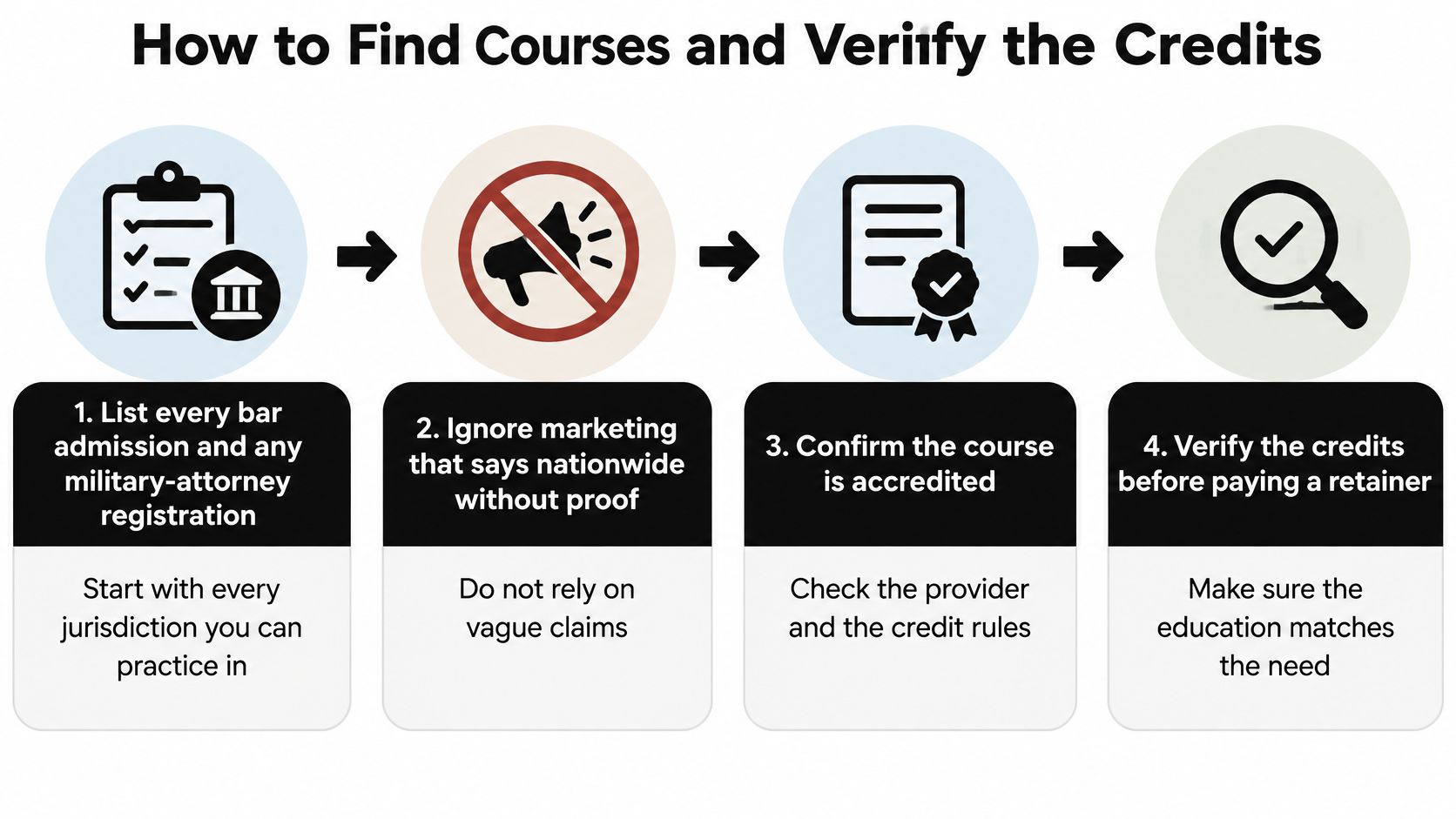
Run this sequence before you pay a retainer. Don’t do it from memory after a stressful phone call. Write down names, dates, and answers while the lawyer is talking.
The seven checks
- List every admission and registration: Ask for every bar admission and any military-attorney registration by jurisdiction. Ignore marketing that says nationwide without naming the license that authorizes the work.
- Get the current reporting period: Obtain the period and the ethics subcategory from the regulator or the lawyer’s compliance transcript. A biography is not a compliance record.
- Break out the course record: Request course titles, providers, dates, total hours, and ethics hours separately for that period. A single total hides the category that most often causes problems.
- Sort relevance without mercy: Investigations, evidence, sentencing, appeals, professional responsibility, and court-martial procedure count toward the work you’re hiring for. A generic catalog course may fill a quota, but it doesn’t show military justice currency.
- Confirm approval and reporting: Ask whether the provider was approved for credit in that jurisdiction and whether the hours were reported on time. Attendance at a respected event isn’t the same as credit awarded by the home state.
- Test any military relief claim: If the lawyer claims a deployment exemption or an alternative method, ask whether the petition was granted, what conditions apply, and when the relief ends. Orders alone don’t answer those questions.
- Put the comparison on paper: Write the answers before a second consultation so you’re comparing records, strategy, and communication, not personalities under pressure.
What a clean file looks like
A clean file is not mysterious. The lawyer has an active admission that fits the work, the ethics requirement is met inside the current period, the hours were approved and reported, and at least part of the recent education ties directly to the kind of case your family is facing. If relief was used, there’s a granted request with an end date.
A messy file sounds different. The lawyer changes jurisdictions mid-answer, offers certificates without dates, can’t separate ethics hours from total hours, or treats a conference program as proof the state awarded credit. Those aren’t minor paperwork quirks when your liberty, discharge, and retirement are at stake. They’re warnings about discipline and organization.
Paper beats reassurance: If a lawyer won’t identify the license, reporting period, provider, and ethics hours, don’t hire first and clarify later.
One limit matters. The rules discussed here don’t set out every penalty for late CLE reporting. Ask the licensing authority in writing what happens if a deadline was missed and whether any lapse changes the lawyer’s authority to appear in your case. Get that answer from the regulator, not from the lawyer whose record is in question.
Early action matters, but rushed hiring is not early action. Spend the time to verify counsel now, while you can still choose. After statements are made, evidence hardens, and command decisions lock in, replacing an unprepared lawyer gets harder and more expensive.
Mistakes That Hide a Stale or Noncompliant License
The most common mistake is assuming years in uniform or years as a judge advocate prove a current license. They don’t. Past service explains background. A current compliance record proves present authority and maintenance.
Watch for these errors:
- Assuming service satisfied the state: A deployment, PCS move, or former JAG title leaves you without a clear answer on good standing.
- Counting anything educational as credit: Unit briefings, unapproved podcasts, and in-house meetings can create a gap nobody notices until charges arrive.
- Trusting a website badge: Marketing becomes your basis for trust instead of a compliance report you can read.
- Waiting until charges are preferred: You lose irreplaceable time if the license is inactive, relief exists only on paper, or ethics hours are short.
- Treating all defense counsel as interchangeable: You hide the command independence gap that matters in serious cases where detailed counsel and civilian counsel operate differently.
- Believing investigators are neutral fact collectors: You talk, consent, or wait while the government builds a record that later counsel must undo.
Investigations are not neutral. CID, NCIS, OSI, and CGIS agents build cases, and commanders make career decisions on incomplete information every week. An early gap in counsel is hard to repair after you have given a statement, surrendered a phone without advice, or let a deadline pass.
Don’t make the education check a formality. A stale license and a stale skill set often arrive together, and both can stay hidden behind confident language until your case exposes them.
Frequent Questions About CLE for Military Defense Lawyers
Does military service satisfy state CLE automatically
No. Indiana requires documentation and a request for relief, and Wisconsin states that full-time military service does not affect the CLE duty. Relief exists only through the process the licensing authority recognizes.
Does a CLE certificate prove the lawyer is a good trial lawyer
No. A certificate proves participation. Ask whether the lawyer practiced a skill, received critique, and later used that skill in real case work.
What happens if a lawyer misses a reporting deadline during my case
Don’t guess. Ask the licensing authority in writing whether the license is in good standing and whether the lawyer can appear for you. Penalties and consequences depend on the regulator controlling that license.
Is a CAAF training certificate enough on its own
No. CAAF expects credit in every mandatory CLE state, but the lawyer’s home state must still award the hours. Verify the program record and the state transcript as two separate items.
Why Civilian Counsel Matters and What to Do This Week
Detailed military counsel can be skilled and dedicated. That isn’t the issue. Independent civilian counsel sits outside the command chain, chooses this work as a sustained practice, and can challenge command-driven assumptions without worrying about a military career path. In a serious investigation or court-martial, that independence matters.
Years of focused military law experience matter, especially sustained UCMJ and court-martial practice. Teaching roles and recognized training work also matter because they show a lawyer is shaping professional standards, not merely collecting hours. Use those factors alongside your written CLE answers when you follow how to choose a military defense lawyer and compare candidates.
A directory can narrow names. It doesn’t promise an outcome, and no honest lawyer should promise one either. Comparing multiple consultations helps you evaluate strategy, communication, relevant experience, and fit before you commit to the person who’ll stand next to you.
Then book two or three consultations this week and bring the verification questions with you.
If you’re under investigation, facing UCMJ charges, or watching a separation action move forward, don’t wait for command to solve your counsel problem and don’t talk your way deeper into the government’s file. Your career, retirement, freedom, and reputation may already be in play. Verify the license, test the training, compare civilian counsel now, and hire a UCMJ lawyer who can prove current competence before the next interview, hearing, or deadline arrives.