
You've been handed a separation notice, told to sign an election of rights, and given a deadline. Someone in the unit says an Army Chapter 14 is just paperwork. Your spouse wants to know whether you'll lose benefits, and you're trying to work out whether your career is already over.
The notice isn't the final decision. But your response can shape the record you'll carry into civilian life. Treat this as both a defense problem and a documentation problem. The Army's stated basis, the characterization of service, and the evidence preserved now can matter long after you leave the unit.
Table of Contents
- Army Chapter 14 Separations at a Glance
- How the Chapter 14 Process Moves From Notice to Decision
- Which Facts Shift a Chapter 14 Case Toward a Better Outcome
- Evidence Gaps and Mistakes That Cost Soldiers Their Characterization
- Characterization, Records and Review After Chapter 14
- Frequently Asked Chapter 14 Questions
- When to Hire Civilian Counsel and Confirm Your Next Step
Army Chapter 14 Separations at a Glance
A Chapter 14 notice identifies the Army's proposed basis for separating an enlisted Soldier for misconduct. The Fort Knox Chapter 14 information paper describes pathways for minor disciplinary infractions, a pattern of misconduct, and a serious offense. The Army may pursue separation when rehabilitation is clearly impractical or unlikely to succeed.
Chapter 14 misconduct pathways and separation codes
| Paragraph | Misconduct category | Triggers and examples | Separation code |
|---|---|---|---|
| 14-12a | Minor disciplinary infractions | Minor infractions under the disciplinary system | JKN |
| 14-12b | Pattern of misconduct | Repeated discreditable dealings with civilian authorities or conduct prejudicial to good order and discipline | JKA |
| 14-12c | Serious military or civilian offense | A single offense where a punitive discharge would be authorized for the same or a closely related offense | JKQ |
The paragraph defines the Army's theory of the case. A 14-12b response must address whether the cited events establish a pattern; a 14-12c response must address the evidence for the alleged serious offense.
Illegal-drug abuse, civilian convictions, desertion, and absence without leave can also arise in Chapter 14 cases. Use the paragraph and specific allegations in the notice, not an informal label, to identify the basis the command must support.
Administrative separation isn't a court-martial
A Chapter 14 separation does not require a court-martial conviction. The Army decides whether to retain the Soldier and how to characterize the service; the separation itself is not a criminal sentence.
The same conduct may also be a UCMJ offense. A statement intended to support retention can create problems in a parallel criminal case if it includes unnecessary admissions. Have counsel assess both matters before submitting a personal statement.
Practical rule: Address what the command must establish, then document why rehabilitation remains realistic.
The separation code appears on the DD Form 214. The paragraph, code, and characterization become part of the separation record, so check that the documents tell a consistent story. Find the paragraph in the notice and compare it with each supporting allegation. Guard and Reserve members should have counsel confirm which separation authority applies to their status.
How the Chapter 14 Process Moves From Notice to Decision
The packet moves through several hands, but you shouldn't assume someone later in the process will discover what's missing. Your response must make disputed facts, mitigation, and requested relief easy to identify.
This visual summarizes the main stages. Your actual notice and procedural rights control the details.
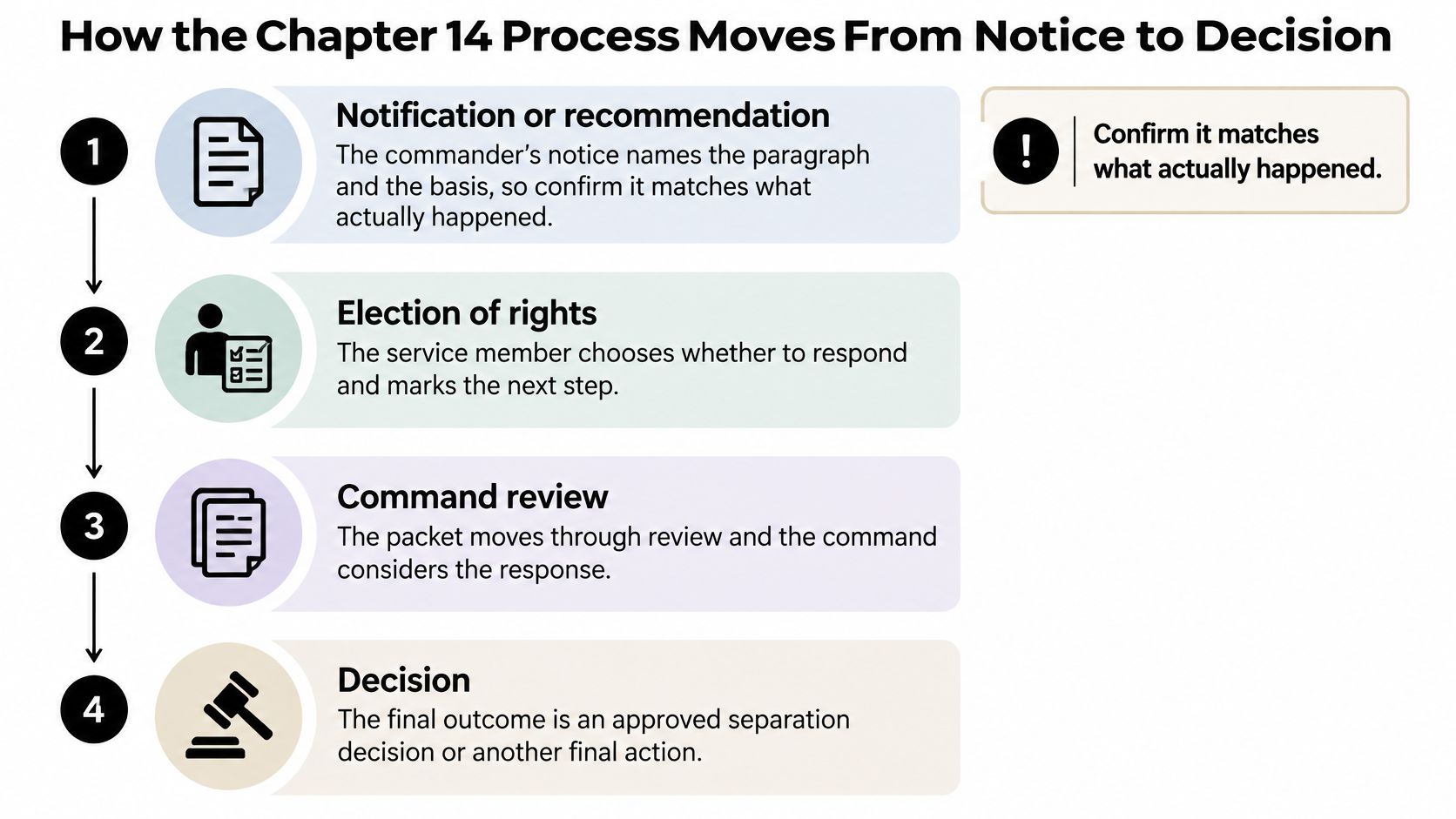
The working sequence
Notification or recommendation. The commander identifies the proposed basis and recommended action. Compare the paragraph, alleged events, and proposed characterization rather than assuming the summary accurately describes what happened.
Election of rights. Review your available choices with defense counsel, including submitting matters and any applicable hearing rights. Don't sign under time pressure without distinguishing acknowledgment of receipt from an election that waives a substantive right.
Separation packet. The file contains the documents, statements, and matters submitted for consideration, including your response. Add rehabilitation evidence, favorable records, and properly supported factual corrections now, rather than expecting to supply them after the decision.
Separation authority action. The authorized decision-maker considers the case and determines the disposition and characterization. Your submission should state the primary result you seek and any alternative relief, not leave the reader guessing.
Higher-level review. Battalion, brigade, and other required reviews occur as applicable to the case, often before the separation authority's final action rather than as a separate appeal afterward. Confirm the actual routing with counsel and retain proof that your response entered that route.
Final processing. If separation is approved, review the orders and DD Form 214 against the approved action. Don't leave an apparent inconsistency unresolved merely because you're focused on clearing the installation.
A board, when applicable, changes the preparation required. Review the administrative separation board process with counsel so you understand how witness preparation and evidence presentation differ from a written submission.
Control the deadline, not just the argument
Use the response deadline in your notice and confirm it with counsel before it expires. Applicable time periods can turn on the procedure and regulation version in force. Don't calculate your deadline from another Soldier's experience or an online discussion.
Before each deadline, confirm:
- The required action: Know precisely what must be submitted or elected.
- The recipient: Verify who must receive it and how delivery will be documented.
- The complete submission: Check attachments, signatures, legibility, and missing pages.
- Any requested extension: Obtain confirmation rather than treating silence as approval.
- Your retained copy: Save exactly what was delivered, including proof of receipt.
A persuasive rebuttal sitting on your phone doesn't help the separation authority. A timely, organized submission does.
Which Facts Shift a Chapter 14 Case Toward a Better Outcome
The paragraph label doesn't mechanically decide the characterization. The useful question is what the evidence establishes about the conduct, your service, and your potential to continue serving.
Factors that shape a Chapter 14 characterization
| Factor | Strengthens your case | Weakens your case | Evidence to gather |
|---|---|---|---|
| Alleged offense | Isolated, minor incident without a pattern | Serious conduct supporting the proposed basis | Allegation documents and civilian disposition |
| Proof quality | Inconsistent accounts or missing corroboration | Consistent testimony supported by records | Complete investigation and existing statements |
| Overall service record | Strong evaluations, awards, good standing | Prior discipline and adverse counseling | Evaluations, awards, counseling, disciplinary files |
| Mitigation | Documented family crisis, injury, or other stressor | Conduct left unexplained | Witness statements and family or medical documents |
| Rehabilitation history | Completed treatment and sustained improvement | Repeated incidents or unaddressed problems | Completion records and supervisor letters |
| Mental-health condition | Documented condition connected to the conduct | Unsupported assertion without clinical context | Relevant medical records and current evaluation |
An unsupported condition isn't the same as an irrelevant condition. If symptoms explain why treatment or disclosure came late, document that explanation rather than abandoning the issue.
How the factors interact
Consider a hypothetical first-term Soldier with solid evaluations, an isolated incident, a documented family crisis, and completed counseling. Contrast that record with a Soldier facing similar allegations after repeated nonjudicial punishment and no documented efforts to address the underlying problem.
The allegation may look similar on the notice. The rehabilitation argument does not. Prior nonjudicial punishment in the military also needs careful examination: what was found, what records support it, and what happened afterward?
Build rehabilitation records and mitigation documents early because providers, supervisors, and family members need time to supply useful material. Expect the command to emphasize prior discipline and unexplained conduct. Address adverse facts directly without inventing excuses or conceding disputed allegations.
A serious allegation with weak proof and a strong service record calls for a different strategy from well-supported misconduct following unsuccessful corrective efforts. Don't blur a factual denial with an apology that effectively admits the disputed act.
The Army Discharge Review Board decision addressing schizophrenia illustrates the importance of documented medical evidence: the board found the condition outweighed the misconduct, upgraded the characterization to honorable, and changed the basis to minor infractions.
That result isn't a prediction for another Soldier. This framework identifies what to prove, not what outcome anyone can promise. Decision-makers weigh the complete file, and a diagnosis alone doesn't explain its relationship to the alleged conduct.
Evidence Gaps and Mistakes That Cost Soldiers Their Characterization
A command summary is an allegation package, not a substitute for examining the underlying evidence. Read it against the original statements, records, and chronology.
Weaknesses worth investigating
- An unclear or incorrect basis: A vague allegation or mismatched paragraph can obscure what you're expected to answer.
- Conflicting dates: Compare counseling entries, messages, duty records, and witness accounts.
- Missing rights documentation: Ask counsel to determine what advisements were required and whether the file establishes compliance.
- Incomplete counseling history: Find the actual records rather than accepting a summary that corrective efforts failed.
- Witness inconsistencies: Separate firsthand observations from assumptions and repeated rumors.
- Unsupported conclusions: Identify where the packet asserts dishonesty, intent, or rehabilitation failure without showing the supporting facts.
Not every defect defeats a separation. A useful objection explains the error, why it matters, and what corrective action you request.
Suppose a notice cites the wrong subparagraph. A focused response identifies the mismatch, explains why the described conduct doesn't fit the cited basis, and asks the separation authority to address the defect. Calling it a typo misses the larger question: whether you received a meaningful opportunity to answer the actual case.
Mistakes you can prevent
- Discussing allegations without a strategy: Don't use conversations with leaders or unit peers to test possible explanations. Consult counsel before providing substantive accounts.
- Skipping medical documentation: A reference to stress won't explain symptoms, timing, treatment, or their connection to conduct.
- Assuming good work speaks for itself: Obtain specific statements from people who directly observed your performance.
- Waiting for the decision: Gather records while witnesses remain available and documents are accessible.
- Sending an emotional, unfocused rebuttal: Organize disputed facts, supporting exhibits, mitigation, and requested relief separately.
- Claiming there's no evidence: Examine unfavorable material carefully. A witness account is evidence even when you dispute its reliability.
Your controllable work includes a timely response, a clear chronology, evaluations, awards, treatment records, and specific witness statements. Where appropriate, counsel can help obtain sworn statements that distinguish personal knowledge from opinion.
Credibility matters more than volume. A short statement tied to a dated record is more useful than a stack of generic praise.
Preserve original messages and files without editing them. Don't delete unfavorable material, coordinate witness accounts, or pressure someone to support your version. Those choices can create a separate problem and undermine otherwise legitimate defenses.
Characterization, Records and Review After Chapter 14
Consider how different official records require different explanations. A former Soldier whose record identifies a serious-offense basis must address that basis accurately when asked, while someone separated for minor infractions should not describe the separation as though it involved the same finding.
The Army review record discussing separation codes identifies JKQ with serious-offense misconduct and JKN with minor infractions, illustrating why the narrative reason and code matter alongside characterization.
For an employer, licensing board, or security-clearance reviewer, the right explanation starts with the exact question asked. It should distinguish the administrative action from any criminal disposition without minimizing the documented conduct.
Characterization and the official record
Other Than Honorable is normally appropriate for misconduct separation, although the overall record and circumstances can support a different characterization, as explained in the Fort Carson misconduct separation guidance.
A general discharge may therefore be an important alternative objective when retention isn't realistically supported. That's a strategic trade-off to discuss with counsel, not a reason to concede allegations prematurely.
The DD Form 214 records the separation authority, narrative reason, separation code, characterization, and reentry information. Read those entries together. A favorable change to one entry doesn't necessarily answer every concern raised by the others.
For example, a former Soldier preparing a professional-license application should keep the official disposition available and answer the application's wording precisely. Don't substitute “honorable enough” or “just administrative” for the actual record.
Benefits aren't an all-or-nothing assumption
An Army Chapter 14 discharge doesn't automatically eliminate every veterans benefit. Eligibility requires examining the characterization, the particular benefit's governing rules, the underlying conduct, and any later agency determination.
Don't make financial or medical decisions based solely on what another veteran received. Ask for a benefit-specific assessment and retain written agency decisions, including the reasons given and any review instructions.
The same caution applies to employment, immigration, licensing, and security-clearance concerns. Those reviewers ask different questions under different standards. Counsel handling the separation should identify when you also need advice from a professional who practices in the affected area.
Preserve the file before you need it
Keep secure, readable copies of:
- The notification: Include every enclosure and amended notice.
- The election of rights: Preserve the signed version and associated correspondence.
- Counsel's response: Save exhibits, witness statements, and delivery confirmation.
- The separation authority's action: Keep the actual decision, not just an oral summary.
- The DD Form 214: Retain the issued document and subsequent corrections.
- Evaluations and awards: Preserve evidence of service outside the misconduct packet.
- Medical records: Include relevant diagnosis, treatment, and rehabilitation documentation.
- Post-service evidence: Maintain employment, education, treatment, and other records relevant to later review.
Later review requires a defined argument
Discharge-review and correction boards examine propriety and equity. A useful petition explains whether the original action was procedurally or legally defective, inequitable in context, or warrants relief based on relevant medical and service evidence.
These boards may consider service-era policy, behavioral-health conditions, and the overall record. They are not just a forum for resubmitting an unsupported denial.
Records strategy: Identify the exact entries you want changed and support each requested correction with a reason and an exhibit.
Review the available military discharge upgrade options and calendar the applicable filing deadlines immediately. Don't assume every board has the same jurisdiction or that one application preserves every possible remedy.
Relief is case-specific and never guaranteed. A filing should follow a documented review of the complete record, including unfavorable evidence, rather than a promise that time or good post-service conduct automatically produces an upgrade.
Frequently Asked Chapter 14 Questions
Separation and punishment
Can I be separated under Chapter 14 without a court-martial?
Yes. It's an administrative action and doesn't require a criminal conviction, although the same conduct may also support UCMJ proceedings.
Will an Army Chapter 14 discharge be Other Than Honorable?
That's normally the characterization for misconduct separation, but it isn't mechanically fixed. A general discharge may be possible when the overall record supports it.
Can a Chapter 14 separation send me to jail?
The administrative separation itself doesn't impose confinement. Separate criminal proceedings involving the underlying conduct can create that risk, so your separation response needs to account for both matters.
Benefits, review, and legal help
Does Chapter 14 always take away my veterans benefits?
No. The answer requires a benefit-specific assessment of your characterization, the applicable rules, the conduct, and relevant agency determinations.
Can I challenge my discharge later?
Yes, discharge-review or correction-board proceedings may offer a route to relief within applicable filing requirements. Preserve your full file now because a later challenge needs evidence, not just disagreement with the result.
Do I need a lawyer immediately?
Consult defense counsel before signing your election or submitting a substantive statement. Serious-offense allegations, drug issues, civilian convictions, and documented mental-health concerns make coordinated advice especially important.
When to Hire Civilian Counsel and Confirm Your Next Step
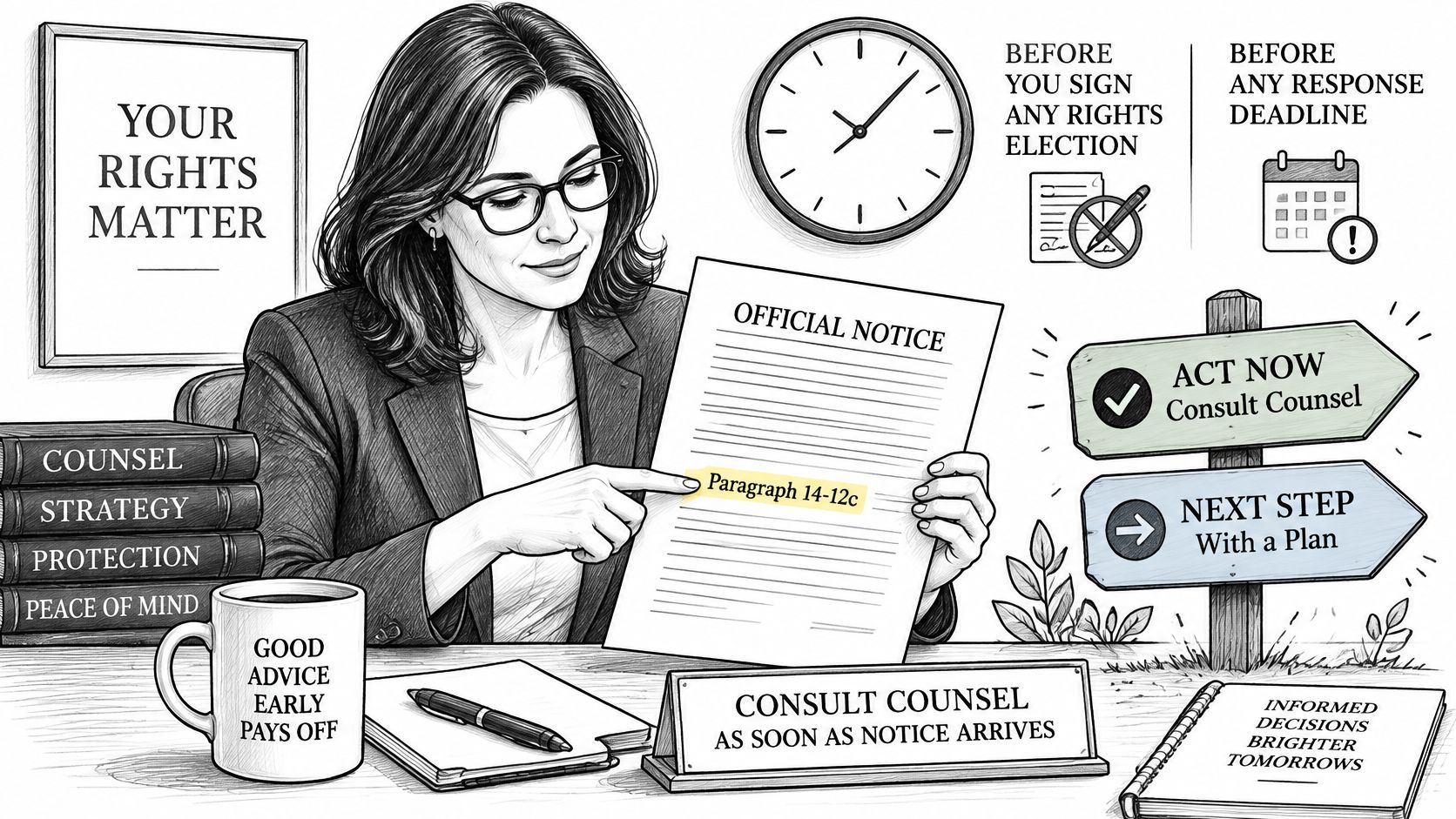
Consult counsel as soon as the notice arrives, before your rights election and first response deadline. Don't wait for a serious-offense allegation, drug case, civilian conviction, or mental-health issue to become a final separation decision.
Bring the actual paperwork to the consultation so counsel can evaluate the proposed action.
Military-appointed defense counsel and privately retained civilian counsel are different options, not a simple good-versus-bad comparison. Don't confuse your defense attorney with the legal adviser assisting command, and don't assume a civilian lawyer is more experienced merely because that lawyer charges a fee.
Civilian counsel is retained by you and operates outside the military chain of command. The practical value should be a coordinated strategy covering the allegations, potential criminal exposure, characterization, and permanent record.
Compare relevant experience
When you compare lawyers, give weight to a primary focus on military criminal defense rather than general practice. A directory list of military defense attorneys and firms is a starting point for comparison, not a guarantee of results.
When comparing military defense lawyers and court-martial attorneys, examine:
- Sustained practice: Look for focused UCMJ and military justice experience.
- Relevant cases: Ask about work involving comparable separation grounds.
- Professional credibility: Consider teaching, substantive writing, and defense-organization leadership.
- A concrete plan: Discuss who handles your case, fees, deadlines, and proposed strategy.
Use the video alongside your consultation preparation.
Consult several attorneys before deciding when the deadline permits. A suitable UCMJ lawyer should explain the weaknesses in your case as candidly as the opportunities.
Gather your notice, election paperwork, medical records, evaluations, and DD Form 214 if already issued, and book consultations before the first deadline. Your career, benefits, and permanent military record are at stake. Act now so counsel has time to build the response rather than merely react to the decision.