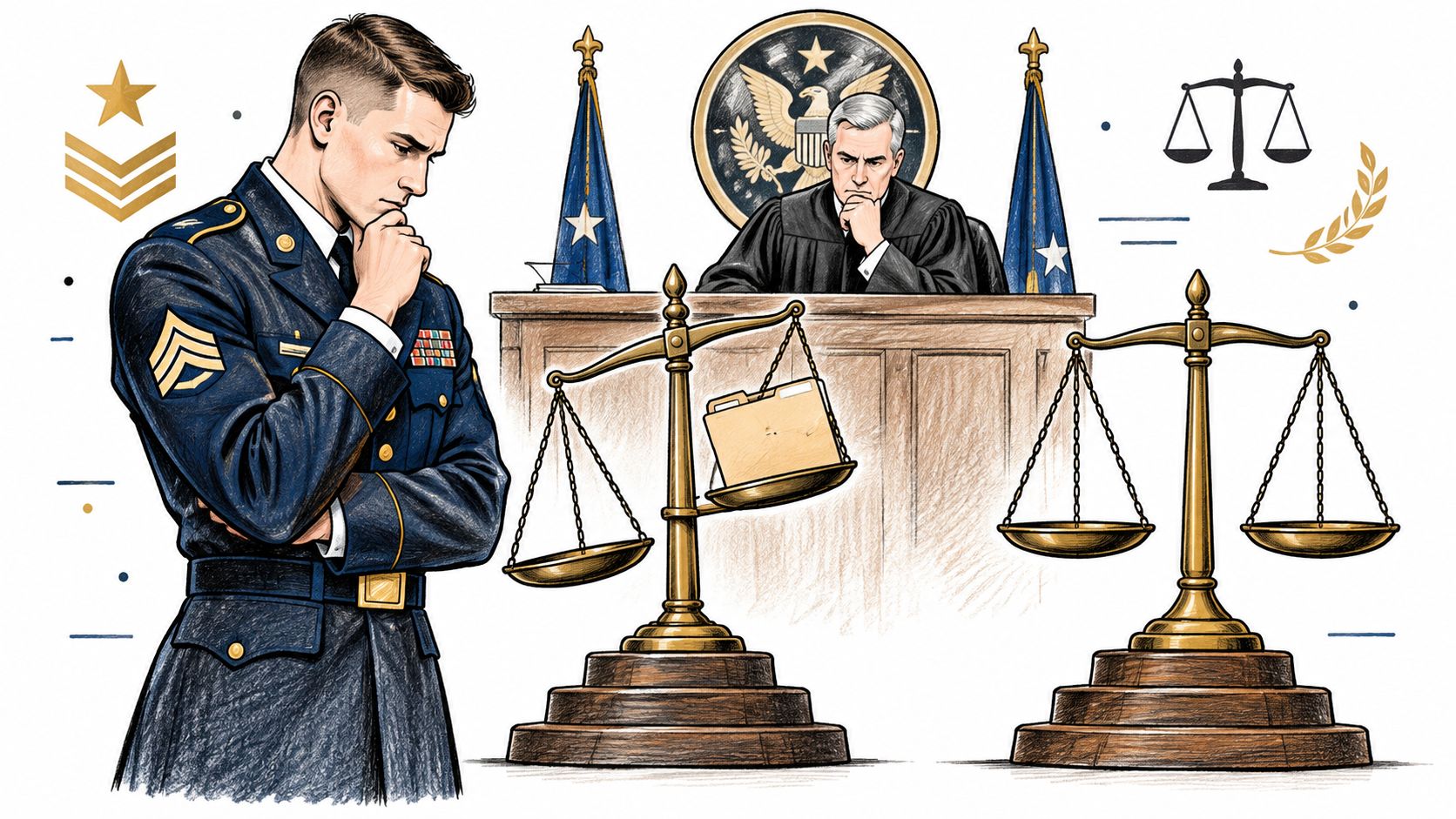
You're sitting in a CID, NCIS, OSI, or CGIS office, or your first sergeant just told you command "has the evidence," and you assume that means you're done. It doesn't. In a court-martial, who has to prove what, and how firmly they have to prove it, decides whether a urinalysis comes in, whether a mental health defense survives, and whether your career, retirement, and freedom stay intact.
Clear and convincing evidence is one of those side burdens that often decides cases without much notice. It's not the standard for guilt itself, but miss it or misunderstand it and damaging proof stays in, a viable defense dies, and the record hardens against you before trial even starts.
Table of Contents
- Clear and Convincing Evidence Versus the Other Burdens
- UCMJ Rules That Use This Burden
- How Cases Actually Come Out
- Tactics and Proof Quality
- Mistakes That Hand the Other Side a Win
- Frequently Asked Questions About Clear and Convincing Evidence
- Choose Counsel Before This Burden Locks In
Clear and Convincing Evidence Versus the Other Burdens
A service member hears an investigator summarize a file and thinks, "That sounds more likely than not, so I lose." That assumption is wrong in two directions. Sometimes the government needs far more than a slight lean. Sometimes you, the accused, carry a heavy burden of your own.
U.S. courts use three principal burdens, and you need them straight before you argue a single fact. Preponderance of the evidence means a fact is more probably true than false. Clear and convincing evidence sits in the middle and requires a firm belief or conviction that the fact is highly probable. Proof beyond a reasonable doubt is the government's burden on every element of a court-martial offense.
Three Burdens of Proof Compared
| Standard | What the factfinder must believe | Where it usually applies | What fails it |
|---|---|---|---|
| Preponderance of the evidence | More probably true than false | Many administrative and ordinary civil matters | A tie, speculation, or equally likely stories |
| Clear and convincing evidence | Firm belief or conviction that the fact is highly probable | Selected UCMJ side issues, not the elements of the crime | A slight tip of the scale, or a thick file of weak sources |
| Beyond a reasonable doubt | Near certainty, with reasonable doubt resolved for the accused | Every element of a court-martial offense, on the government | Any sensible remaining doubt about a required element |
That middle row is where members get ambushed. In Riley Hill General Contractor v. Tandy Corp., the Oregon Supreme Court explained that preponderance means the asserted facts are more probably true than false, while clear and convincing evidence requires the facts to be "highly probable", and beyond a reasonable doubt is associated with facts being almost certainly true.
The same decision notes the standard first developed in equity for claims considered especially vulnerable to fabrication, memory failure, or manipulation of conscience. That history matters. Courts created this burden because some claims are easy to invent, hard to disprove, and devastating if a factfinder gets them wrong.
What Firm Belief Actually Means
In military practice, the Court of Appeals for the Armed Forces definition controls how lawyers argue. It defines clear and convincing evidence as the weight of proof that produces in the factfinder's mind a "firm belief or conviction" that the allegations are true, requiring substantially more than showing a proposition is probably true while still falling short of proof beyond a reasonable doubt.
Read that carefully. It's not a halfway point. It's not "probably, plus a little." Counsel must build a record that creates a firm conviction through reliable testimony, documents, expert analysis, or other persuasive evidence, not merely introduce enough material to tip the scales slightly.
Practical rule: If you couldn't look a panel member in the eye and say you'd stake a career on that fact, you haven't described clear and convincing evidence.
There's no fixed percentage cutoff, and chasing one wastes time. The factfinder weighs the whole record, including documents, testimony, credibility, corroboration, inconsistencies, and fair inferences. A judge or panel doesn't count pages or witnesses and declare a winner by volume.
Think of it this way. Preponderance is a scale tipped by a feather. Clear and convincing evidence is a judgment you'd stake a career on. Reasonable doubt exists when a sensible alternative explanation still fits the facts, and that doubt must be resolved for the accused on the elements of the offense.
That analogy helps, but don't turn it into math in the courtroom. Military judges instruct on firm belief and high probability, not on numbers. If your lawyer is arguing percentages to a panel, he's arguing a standard the judge didn't give them.
Why Marking the Burden Comes First
Strong cases get lost when counsel argues the wrong standard. If you treat a clear and convincing issue like a preponderance issue, you'll underbuild the record and wonder why the judge ruled against you despite a "winning" file. If you treat it like proof beyond a reasonable doubt, you'll overpromise and lose credibility when the judge explains you didn't need near certainty.
Before any hearing, build a simple map on one page. What issue is being decided, who bears the burden, what standard applies, and what evidence proves or breaks each part. That discipline is basic court-martial basics every accused should understand, and it's where experienced military defense lawyers separate themselves from general practitioners.
Do that mapping early, during the investigation, not the week before trial. Investigators from CID, NCIS, OSI, and CGIS aren't neutral fact gatherers building your defense file for you. They're building a record the government will later ask a judge or panel to believe firmly. If you don't identify the burden fight while witnesses and schedules are still available, you'll be arguing from a record someone else created.
Mark which burden governs each issue before you argue facts. That single step changes what evidence you chase, which witnesses you interview first, and whether you file a motion at all.
UCMJ Rules That Use This Burden
Guilt of the charged offense is not proved by clear and convincing evidence. The government must prove every element beyond a reasonable doubt. But two recurring UCMJ issues use the middle burden, and each one can decide the case before the panel ever deliberates on guilt.
One puts the burden on you. The other puts it on the government. Confuse them and you'll misjudge your risk completely.
Article 50a and Lack of Mental Responsibility
Under Article 50a, lack of mental responsibility is an affirmative defense the accused must prove by clear and convincing evidence. The Court of Appeals for the Armed Forces digest on Article 50a states the defense has two essential components, a qualifying mental disease or defect and the legally required inability resulting from that condition, and describes this as an unusual allocation because the accused, rather than the government, bears the burden.
That allocation does not shift back. The government doesn't have to prove sanity beyond a reasonable doubt once you raise the issue. You carry it from start to finish.
A diagnosis alone won't carry it. Treatment notes, a profile, a history of counseling, or an expert who suspects something was wrong won't carry it either. The evidence must persuade the factfinder firmly that the statutory requirements existed when the alleged offenses occurred, not months before or after.
That date specific link is where these defenses usually fail. A member may have a real condition and a thick medical file and still lose because no qualified expert tied that condition to the required inability on the charged date. Panels notice that gap, and military judges instruct them to notice it.
Military Rule of Evidence 313(b) and Inspections
The second fight runs the other way. Under Military Rule of Evidence 313(b), the government must prove by clear and convincing evidence that an examination was a real inspection, not a search, in specific high risk situations.
That heightened showing applies when an examination aimed at locating weapons or contraband was conducted immediately after a report of a specific offense without prior scheduling. It also applies when specific individuals are selected for examination or when people experience substantially different levels of intrusion during the same examination.
A legitimate inspection may still target unit security, military fitness, or good order and discipline, including locating and confiscating unlawful weapons or contraband. Commanders have real authority here. The question is whether they used that authority, or whether they dressed up an evidence hunt as good order.
Timing, selection criteria, command purpose, and the actual level of intrusion become the fight. If the government can't meet its burden, the fruits of the purported inspection may be excluded. That can mean a urinalysis result, a weapon, drugs, or phone evidence never reaches the panel.
Who Must Prove What Under the UCMJ
| Rule | Who must prove it | What must be shown | If the burden fails |
|---|---|---|---|
| Article 50a lack of mental responsibility | Accused | Qualifying mental disease or defect and the required inability at the time of the offense | The defense fails even if records show treatment |
| MRE 313(b) inspection challenged as a search | Government | A genuine inspection, not an evidence hunt, when unscheduled after a specific-offense report or when selection or intrusion is uneven | Fruits of the exam may be excluded |
Look at the risk allocation in that table. On mental responsibility, silence and thin records hurt the accused. On inspections, thin government proof about purpose and scheduling hurts the prosecution. Your UCMJ lawyer's job is to exploit whichever side of that line helps you, and to build the record long before a motions hearing forces the issue.
How Cases Actually Come Out
The burden sounds abstract until you see it applied to a sweep, a urinalysis, or a stack of medical records. Three situations show how it plays out, ordered by how often they ambush an accused.
The setting below is familiar to anyone who's been through a command directed test or a barracks sweep.

A Urinalysis After an Unscheduled Sweep
Say command gets a report of drug use in the barracks on a Tuesday night. Wednesday morning, with no prior scheduling, the whole company provides samples. A member tests positive and his lawyer moves to suppress, arguing this was a search disguised as an inspection.
Under United States v. Beckett on Military Rule of Evidence 313(b), when an examination follows a reported offense and was not previously scheduled, the government must establish by clear and convincing evidence that the military purpose was genuine and that the examination satisfied the rule's inspection criteria, and in Beckett the prosecution met that burden regarding a urinalysis result.
The lesson is blunt. The government can win this fight. Purpose, prior scheduling, and how the exam was run decide admissibility, and a commander who documents a genuine fitness or good order purpose, applies the exam evenhandedly, and testifies credibly may carry the burden. Don't assume "unscheduled" automatically means "suppressed."
Treatment Records Without a Date Specific Link
Now consider a member charged with a serious offense who has years of mental health treatment. His family brings counsel a binder of records and assumes the defense is made. It isn't.
If no expert connects a qualifying disease or defect to the legally required inability on the date of the alleged offense, the file can look heavy and still fail a firm belief test. The panel may sympathize, may even believe he was struggling, and still find the defense not proved. Sympathy isn't the standard. Firm conviction on both statutory parts is.
A Planned Sweep That Flips the Analysis
Take a hypothetical weapons find. Investigators say a weapon turned up during a surprise inspection. The defense initially fears the worst, then pulls the training schedule.
The schedule shows the sweep was planned weeks earlier. Every member of the unit was checked the same way, with the same level of intrusion, and the order predates any report of a specific offense by that member. Those facts flip the admissibility question. Now the government's inspection story has independent, contemporaneous support, and a suppression motion built only on "they were really looking for evidence" gets much weaker.
Reverse those facts, a schedule created after the fact, only two rooms searched, one member's phone seized while others were waved through, and the government's burden gets much harder.
Ask yourself which scenario matches your pending case. Then ask which single document would prove the timing point. If you can't name that document, your counsel needs to find it now, while schedules, texts, and duty logs still exist.
Tactics and Proof Quality
Strategy under this burden means building or breaking a firm conviction. Collecting pages doesn't do that. Judges and panels decide whether they firmly believe a fact, and they get there through corroboration, consistency, and credibility, not bulk.
Start with the inspection fight, because the facts are perishable.
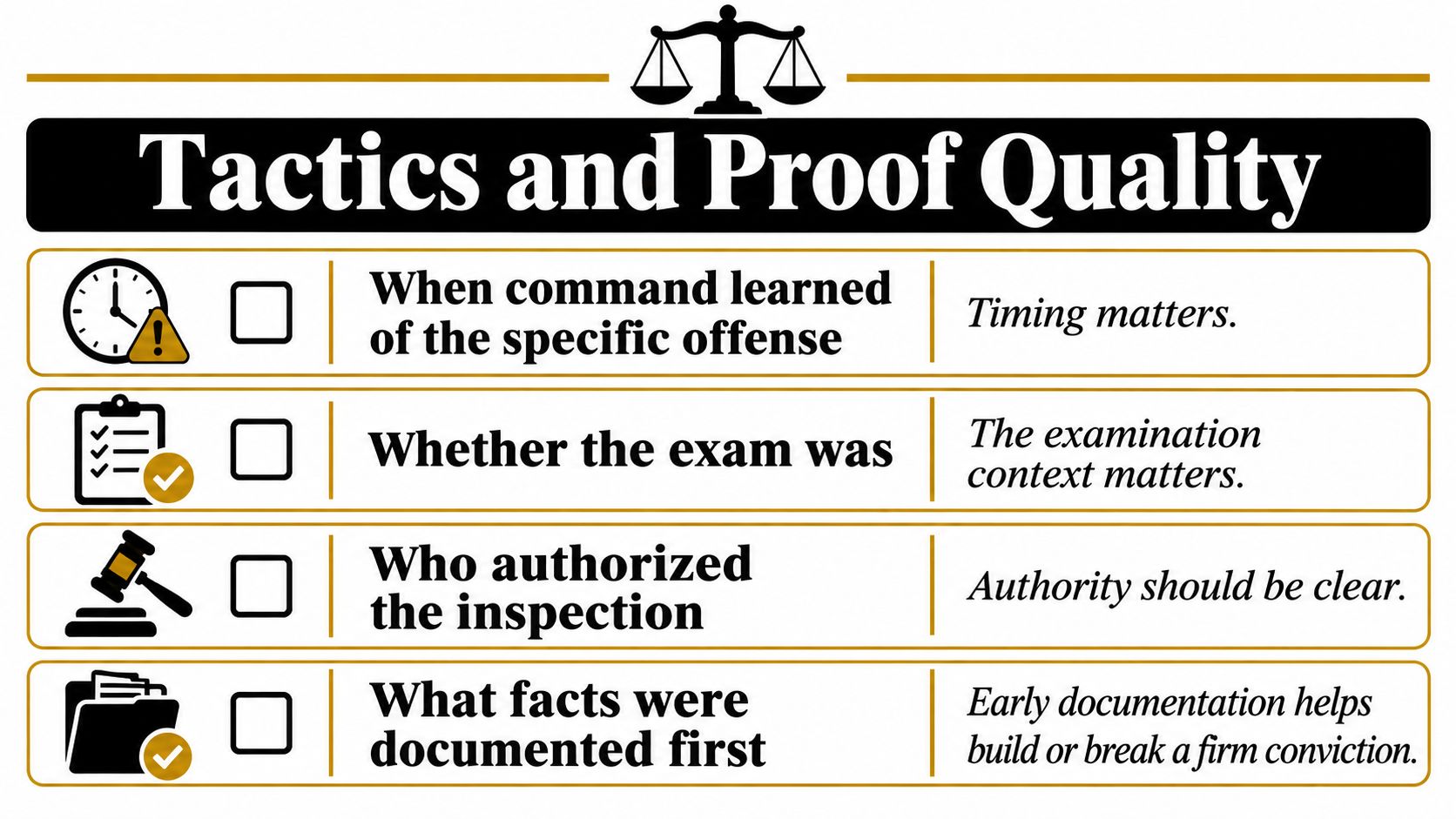
Lock Down Four Inspection Facts Early
- When command learned of the specific offense: Get the exact time, who reported it, and what was reported, because timing triggers the heightened burden.
- Whether the exam was already scheduled: Pull the training schedule, operations order, or calendar invite that existed before the report, not a memo written afterward.
- Who was selected and why: If specific individuals were picked out, demand the selection criteria in writing and compare it to who was examined.
- How intrusive the exam was for each person: Note whether some members faced room searches, phone seizures, or body examinations while others faced far less.
A stated good order purpose can be a subterfuge if timing and targeting show an evidence hunt. Cross examination should force the commander or first sergeant to reconcile the stated purpose with those four facts. If they can't, the government hasn't produced a firm belief, it's produced a label.
Mental Responsibility Requires a Date Specific Opinion
On Article 50a, one thing should be in place before the defense is raised at trial. A qualified expert who can state, for the charged date, both the qualifying condition and the required inability it caused, and who can explain the basis in records, testing, and contemporaneous observations.
Cross any government expert who concedes illness but denies the required inability. That concession helps on part one and isolates the actual dispute on part two. Don't let the fight blur into a general debate about whether the member "has issues." The statute doesn't ask that question.
The short briefing below reinforces how early investigation decisions shape these later burden fights.
Build a Proof Matrix, Not a Pile
Whether you're the government trying to save an inspection or the accused carrying Article 50a, use the same method. List each element or required fact in its own row. Give each row independent corroboration. Address bad facts early instead of hoping the other side misses them. Show why competing explanations are materially less probable, not merely possible.
Quality beats volume every time under this standard. The Congressional Research Service product on clear and convincing evidence notes that courts generally avoid assigning a fixed percentage and ask whether the evidence produces a firm conviction or establishes a high probability, and that an uncorroborated police report may be insufficient by itself.
That's the home for all corroboration advice in a military case. A small set of authenticated, internally consistent records with reliable witnesses can carry the burden. A large file of hearsay, investigative summaries, screenshots of digital messages, or shifting witness accounts often can't, because each inconsistency gives the factfinder a reason not to reach firm belief.
Uncertainty on one material element can stop a firm conviction even when the rest of the record looks strong. That's why experienced counsel win cases during the military investigation phase by identifying the weakest row in the matrix and attacking or fixing it before charges are preferred.
Mistakes That Hand the Other Side a Win
Most burden fights are lost before trial, in statements, delays, and assumptions. These mistakes recur across branches and installations.
- Treating clear and convincing evidence as a coin flip you already lost: You stop fighting once an allegation sounds plausible, and counsel never builds the record that could have defeated firm belief.
- Talking to CID, NCIS, OSI, or CGIS to "clear it up": You become the corroboration an otherwise thin investigative report lacked, and your own words help the factfinder believe the fact firmly.
- Assuming a diagnosis proves lack of mental responsibility: The defense fails because no expert proved the required inability on the charged date.
- Waiting to question a sweep or urinalysis until the result is in the file: Schedules get lost, memories align with the command story, and a suppression motion loses its best documents.
- Trusting command that a sudden search was routine: You accept the label "inspection" without testing timing, selection, or intrusion, and damaging evidence comes in unchallenged.
- Believing a thick file means a highly probable fact: Volume hides hearsay, summaries, and inconsistencies that a good cross examination would have exposed.
- Confusing forums and standards: You apply an Article 15 or administrative separation mindset to court-martial elements, or expect reasonable doubt protection on an issue where you bear a clear and convincing burden.
- Signing a statement because silence "looks guilty": Investigators get admissions they can use at every later stage, including sentencing and separation boards.
- Waiting until preferral to hire a court-martial attorney: The inspection facts and mental health narrative are already fixed, and counsel is left arguing from the government's record.
Stop giving statements. Write down timing, who ordered the exam, who was present, and exactly what was said, while your memory is fresh, and give that memo only to your lawyer.
Each mistake has the same consequence in different clothing. Lost suppression, a failed defense, or a record a judge or panel can believe firmly. None of them requires the government to be brilliant. They only require you to be passive while the record is built.
Frequently Asked Questions About Clear and Convincing Evidence
Is clear and convincing evidence the same as 75 or 90 percent certainty?
No. Courts ask whether the evidence produces a firm belief that the fact is highly probable, not whether it hits a prescribed number. If a lawyer sells you a percentage, press him on how a military judge would instruct a panel on that figure.
Is it the same as proof beyond a reasonable doubt?
No. It's a lower, intermediate burden. The government's criminal burden of proof beyond a reasonable doubt applies to each element of the charged offense, while clear and convincing evidence governs selected side issues like inspections and mental responsibility.
Who must prove lack of mental responsibility?
The accused, by clear and convincing evidence under Article 50a. The burden does not shift back to the government to prove sanity beyond a reasonable doubt, which is why expert proof on both statutory parts matters so much.
Can one well documented record meet the standard?
It can, if it's authenticated, consistent, and reliable on the disputed fact. A single contemporaneous schedule, order, or medical opinion tied to the right date can outweigh a pile of repetitive summaries.
Can an unscheduled search after a reported offense still be used against me?
Yes, if the government proves by clear and convincing evidence that it was a genuine inspection under Military Rule of Evidence 313(b). If the government misses that burden, the fruits of the examination may be excluded, which can gut the prosecution's best evidence.
Does clear and convincing evidence apply at an administrative separation board the same way?
Not automatically. Different forums use different burdens and rules, so don't import a court-martial standard into a board, or a board standard into a court-martial, without checking the governing regulation for that proceeding.
Choose Counsel Before This Burden Locks In
If investigators are calling, a urinalysis or sweep just happened, or mental responsibility may be your defense, the burden fight is already underway. Waiting isn't neutral. It's a choice to let command and law enforcement create the record a judge will later test for firm belief.
Military appointed counsel can be skilled and dedicated. They also work inside the service and often carry heavy caseloads with limited investigators and experts. Independent civilian counsel answer only to you and can challenge command purpose, selection decisions, and investigative methods without career pressure from that same command structure.
That independence matters most on inspection and mental responsibility issues, where counsel may need to accuse a commander of subterfuge or tell a family that a beloved treatment record won't prove a defense. You need a UCMJ lawyer who'll give you that assessment early, not after a motions hearing is lost.
Choose by fit, not by advertising. The best lawyer depends on the facts, charges, forum, and stage of the case, so a lawyer who's right for a contested general court-martial may not be right for an early investigation where the goal is preventing preferral.
When comparing court-martial lawyers, look for sustained military justice experience, a primary court-martial focus rather than general practice, teaching and writing that other lawyers rely on, leadership in defense organizations, and a track record handling similar cases. Ask about real trial and appellate experience across branches and overseas, because inspection and expert fights play differently in different services and jurisdictions.
Use the guide on how to choose a military defense lawyer to structure those questions, and take more than one consultation. Comparing multiple consultations helps you evaluate strategy, communication, relevant experience, and fit under pressure.
When you build a shortlist of civilian military defense lawyers, verify each lawyer’s record yourself rather than trusting any listing as a guarantee. Check credentials, ask who'll handle motions and cross examination, and confirm how experts and investigators get funded.
If you're under investigation or facing court-martial, don't wait for preferral to protect yourself. Contact experienced civilian military defense counsel now, bring every order, schedule, counseling, and medical record you have, and get a burden by burden assessment of your case before you give another statement. Your freedom, retirement, and name are already in the file, and the time to fight how firmly that file can be believed is today.