
The letter is on the kitchen table. Your separation paperwork still shows the characterization you’ve been fighting, your promotion history doesn’t match what happened, or your medical records raise questions about why you weren’t considered for retirement. Your family wants to know whether anything can be fixed. You want to know where to start.
Start with the evidence, not the appeal letter. Army correction of military records is a record-building project. Before you ask anyone to change the outcome, identify exactly what’s wrong, what should replace it, and which documents prove your position.
Table of Contents
- Why the Board Matters and How This Roadmap Helps
- Understanding the ABCMR’s Authority and Deadlines
- Drafting DD Form 149 With Surgical Precision
- Building the Administrative Record That Wins
- Why Win-Rate Comparisons Are the Wrong Benchmark
- Responding to the Staff Advisory Opinion and Escalating a Denial
- When and Why to Bring in Civilian Military Defense Counsel
Why the Board Matters and How This Roadmap Helps
The Army Board for Correction of Military Records, usually called the ABCMR, is the Army’s highest administrative review body for alleged errors or injustices in military records. Its work can reach matters that affect a soldier’s career long after the underlying decision.
That authority matters when the disputed entry isn’t merely embarrassing. A separation characterization, missing award, incorrect grade, or retirement determination can become the document you repeatedly have to explain.
But broad authority doesn’t mean the Board will reconstruct your case for you.
Change the assignment before you start writing
Your assignment isn’t to prove that your service mattered. It’s to demonstrate a specific defect in an official record and justify a specific remedy.
Start by answering these questions:
- What is disputed? Identify the actual entry, omission, or decision, not just the consequences you dislike.
- What correction would fix it? Describe the replacement entry or administrative action you’re seeking.
- What establishes the defect? Locate the documents that support your explanation.
- What cuts against you? Identify the evidence the Board could rely on to deny relief.
Families often focus first on benefits. That’s understandable, but don’t confuse a correction request with a complete benefits analysis. If discharge characterization is the immediate concern, review the separate issues surrounding other-than-honorable discharge benefits before assuming a particular correction guarantees a particular entitlement.
Practical rule: Make every requested correction traceable to evidence. If the Board has to guess what you want or why, revise the package.
This process isn’t a substitute for defending an active investigation, contesting current administrative action, or pursuing a court-martial appeal. Don’t surrender an available defense today because you hope a correction board will repair the record later.
Move promptly, but don’t confuse speed with readiness. A rushed application can leave the decisive medical record, witness statement, or command correspondence outside the submission. Build a file that answers the hard questions before you send it.
Understanding the ABCMR’s Authority and Deadlines
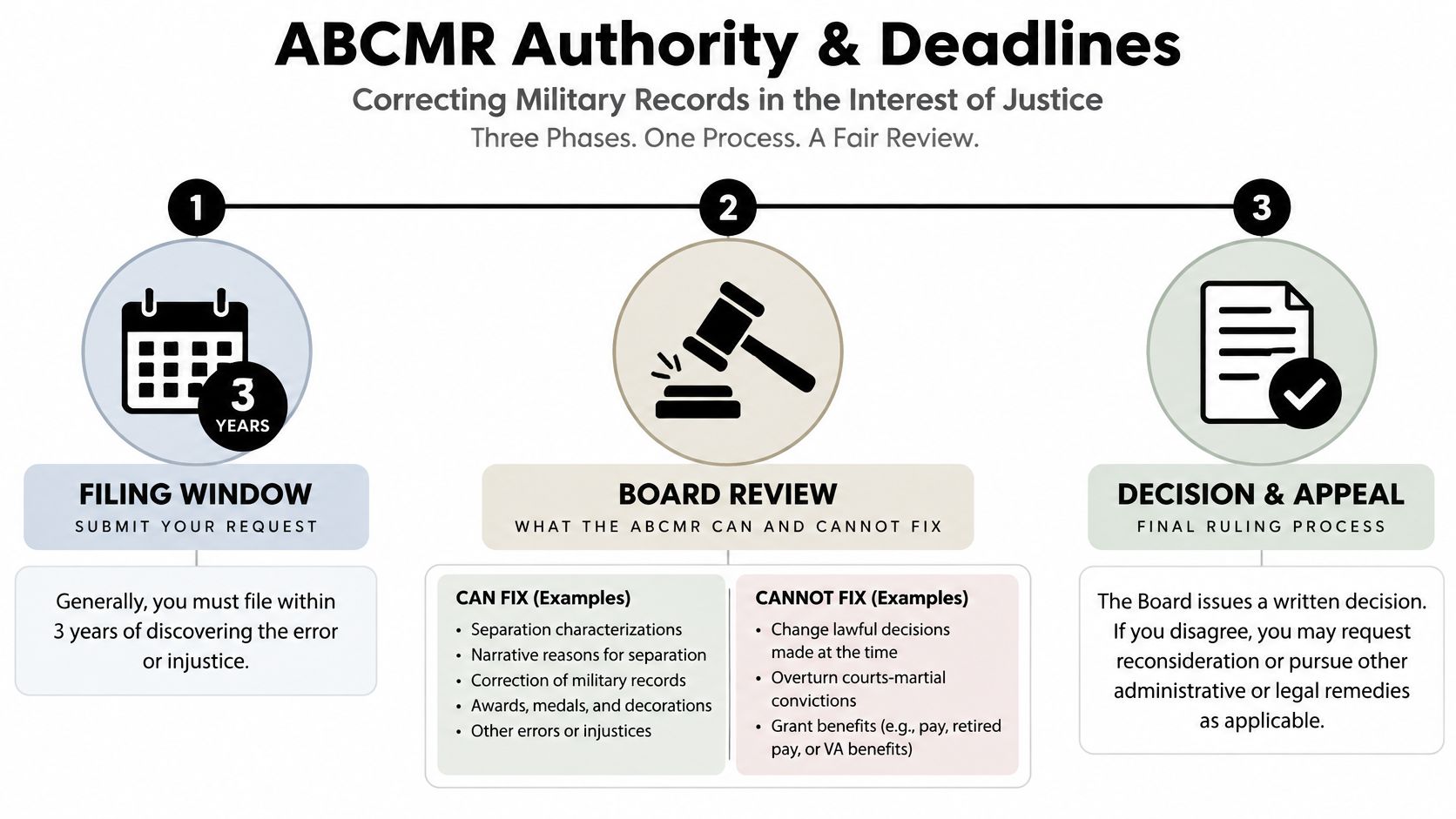
The ABCMR operates under Title 10 U.S.C. § 1552 and Army Regulation 15-185. The statutory correction framework authorizes civilian administrative review of military records, a durable remedy distinct from ordinary criminal proceedings and appeals. Its historical foundation appears in the statute authorizing military-record corrections through civilian boards.
The practical scope is substantial, but it isn’t unlimited.
| Record issue | What the application must address |
|---|---|
| Separation characterization | Why the existing characterization reflects error or injustice |
| Grade or date of rank | Which personnel action or entry requires correction |
| Awards | What documentation supports the requested recognition |
| Retired status | Why the existing status should be corrected |
| Pay-related consequences | How the requested record correction connects to the monetary claim |
The Board’s jurisdiction is remedial. It addresses the military record; it doesn’t conduct a new criminal trial. Court-martial-related requests require especially careful analysis because correction-board authority isn’t a direct substitute for appellate review.
The timeline below provides a general orientation, not a complete statement of appeal rights.
Treat timeliness as a separate issue
An applicant generally must file within three years after discovering the alleged error or injustice, including when it reasonably should have been discovered; the Board can excuse lateness in the interest of justice, but applicants shouldn’t assume it will, according to the Army’s ABCMR applicant guidance.
If your application is late, explain the delay with a chronology and corroboration where available. Identify when you learned the relevant facts, what prevented earlier action, and why the Board should still reach the merits. Don’t bury that explanation beneath your service history.
Understand who carries the burden
You must satisfy the Board that the record contains an error or injustice. This isn’t the criminal-law standard of proof beyond a reasonable doubt, and the government doesn’t have to retry the underlying matter.
The Army Retired Soldier Handbook explains that applicants must submit supporting evidence not already in the record. A signed form establishes what you’re asking for. It doesn’t establish that you deserve it.
Drafting DD Form 149 With Surgical Precision
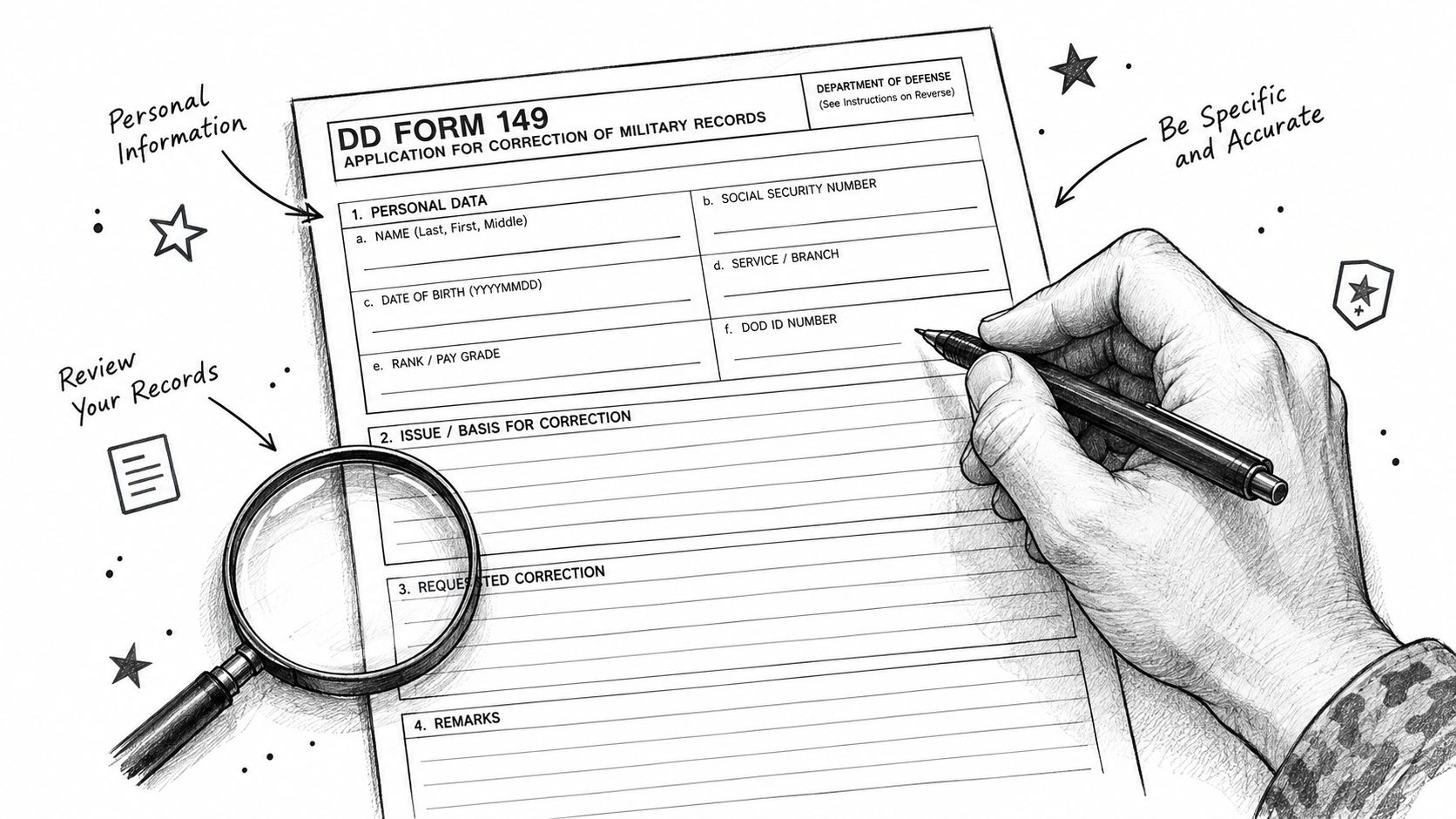
DD Form 149 is the application, not the entire case. Use it to give the reviewer a clean statement of the dispute, then support that statement with an organized brief and exhibits.
Treat the form as the front page of an administrative record.
Complete the form in a deliberate sequence
- Verify identifying information. Match your name, service information, and relevant dates to official documents. Explain discrepancies rather than leaving reviewers to reconcile them.
- State the requested correction. Name the disputed record and describe what should change. “Correct my records” isn’t usable relief.
- Separate distinct issues. A characterization dispute and a date-of-rank dispute need separate explanations, even when they share background facts.
- Summarize the grounds. State the alleged error or injustice briefly, then direct the reviewer to the supporting argument and exhibits.
- Check certification and attachments. Follow the current form’s signature instructions. Use separately signed or sworn supporting statements where appropriate, rather than treating every narrative attachment as an affidavit.
For example, in a hypothetical promotion dispute, don’t ask the Board to “restore the career command destroyed.” Identify the challenged personnel entry, explain the claimed defect, and specify the corrective action you want considered.
Keep the form, brief, and exhibit labels consistent. If the form requests one remedy while the brief requests another, you’ve introduced an avoidable ambiguity.
For additional orientation, the following video is available. Verify procedural details against current Army guidance.
Perform a final intake check
Confirm the application is legible, contact information is current, every referenced attachment is included, and dates agree throughout the package. Preserve a complete copy of exactly what you submit.
Don’t confuse a long submission with a complete submission. Delete repetitive accusations and unsupported conclusions. Keep the material that lets the Board identify the issue and evaluate the requested correction.
Building the Administrative Record That Wins
Consider a hypothetical soldier seeking correction of a separation after a medical condition went inadequately documented. The soldier remembers struggling at work, receiving treatment, and then facing misconduct allegations. Those memories identify an investigation path. They don’t yet establish the case.
Start with the complete official personnel file and medical record. Add the separation packet, relevant investigation materials, evaluations, command correspondence, disciplinary paperwork, and prior administrative decisions.
Then create a chronology with separate columns for the event, supporting exhibit, and significance. Mark missing records as missing. Don’t replace them with assumptions.
Match the evidence to the remedy
Different requests require different proof. Use the following distinctions to guide collection, not as a promise that a particular document guarantees relief.
| Case type | Evidence to prioritize | Argument to avoid |
|---|---|---|
| Discharge characterization | Separation documents, service history, relevant medical evidence, firsthand statements, rehabilitation material | “I served honorably before this, so the characterization must be wrong” |
| Medical retirement dispute | Contemporaneous treatment, duty limitations, evaluations, provider explanations tied to the relevant period | “My condition is serious now, so retirement was necessarily required then” |
| Promotion dispute | Personnel actions, evaluations, eligibility records, documented chronology | “I deserved promotion more than someone else” |
| Article 15 or court-martial-related record | Complete proceedings, findings, supporting evidence, prior review, precise requested remedy | “The correction board should simply retry everything” |
In the hypothetical medical case, a treating provider’s explanation should address the historical records and functional limitations. Ask the provider to distinguish documented facts from retrospective medical opinion.
A witness statement should explain what the witness personally observed and how the witness knows it. General praise won’t resolve a disputed event. The National Archives guidance on correcting service records specifically identifies signed witness statements and a brief of arguments as useful supporting material.
For separation disputes, compare your evidence against the underlying Army administrative discharge process. Identify what the decision-maker received, what was missing, and why the omission mattered.
Attack gaps without overstating them
Don’t treat an investigative summary as neutral merely because it appears in an official packet. Compare its assertions with underlying interviews, medical entries, attachments, and contemporaneous correspondence.
- Missing corroboration: Identify the unsupported assertion and explain its importance.
- Conflicting accounts: Compare actual statements rather than calling someone a liar.
- Adverse evidence: Address damaging facts directly and distinguish what you accept from what you dispute.
Credibility comes from accuracy under pressure, including accuracy about facts that hurt your case.
For document requests that an office accepts by fax, SendItFax’s guide for sending faxes online offers a practical transmission resource. Confirm the recipient’s accepted method and privacy requirements before transmitting sensitive records.
Why Win-Rate Comparisons Are the Wrong Benchmark
Stop looking for a percentage that tells you whether your application will succeed. A published decision may help identify an argument, but it can’t supply your personal odds, especially when the public collection is incomplete.
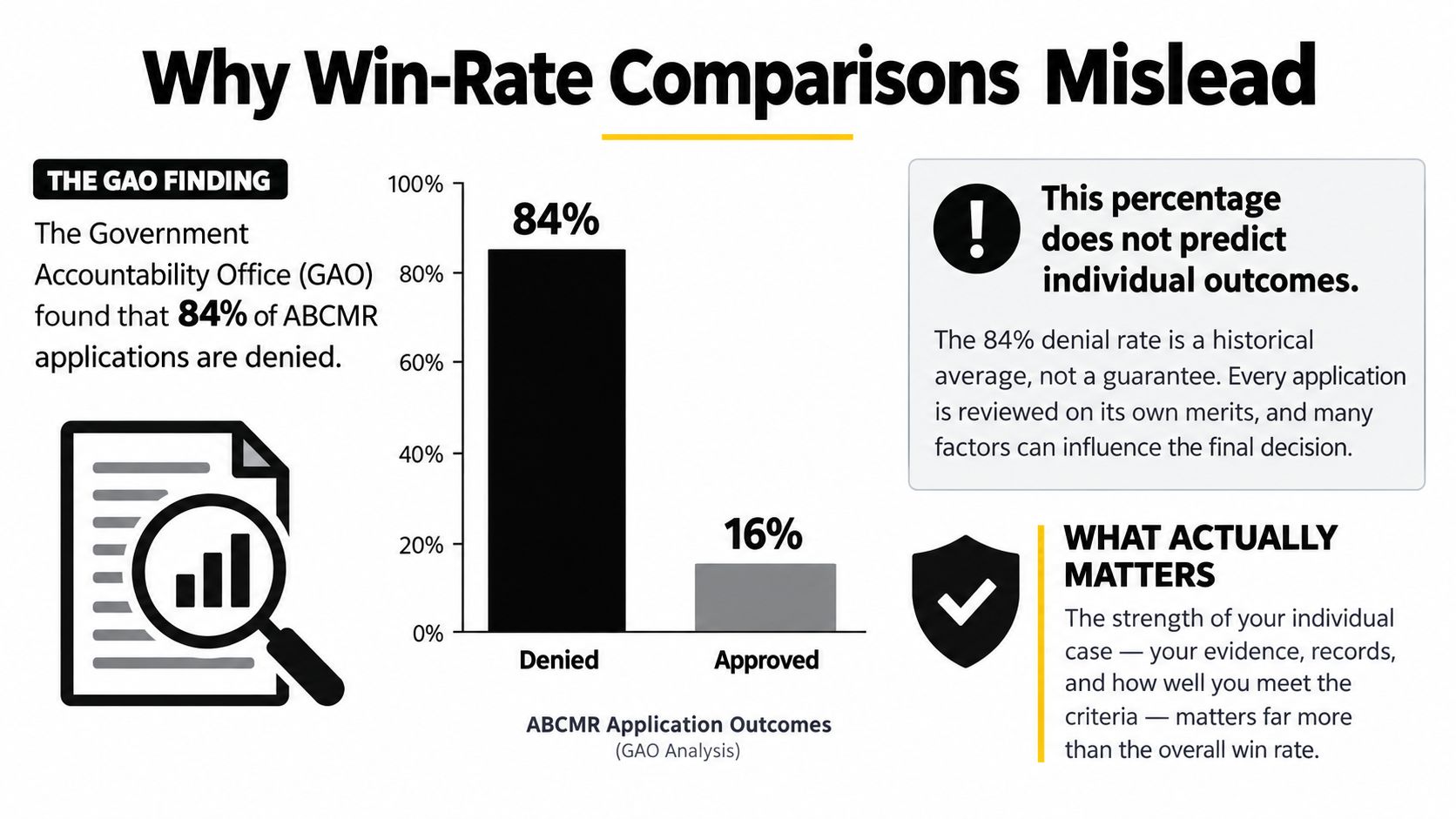
The Government Accountability Office found that 3,200 of the ABCMR’s 3,799 decisional documents for reviewed liberal-consideration cases, or 84 percent, were missing from the Department of Defense public reading room, as detailed in its review of military-board case records.
That is a publication gap, not a denial rate.
The graphic below contains unsupported approval-and-denial labeling. Don’t use those labels to assess ABCMR outcomes; the documented finding concerns missing public decisions.
Incomplete publication undermines easy comparisons
GAO also reported that discharge-upgrade rates ranged from 18 percent to 49 percent among the reviewed boards, while identifying inconsistent application of liberal-consideration guidance in its report on discharge-upgrade decision-making.
Those figures don’t establish the likelihood of success for an Army medical-retirement dispute, promotion correction, or disciplinary-record request. They concern different boards and reviewed case populations.
Even within a relevant category, a handful of favorable decisions can mislead. The published document may omit factual distinctions that matter to your case, and unpublished decisions prevent you from seeing the full comparison set. Legal eligibility and evidentiary strength are different questions.
Replace outcome folklore with a process audit
Measure what you can control:
- Forum confirmed: Have you checked whether the ABCMR or a discharge-review forum should address the requested remedy?
- Submission traceable: Can you establish what was filed and when?
- Issues answerable: Can a reviewer connect each requested correction to its supporting exhibit?
- Comparable decisions distinguished: Have you identified material differences rather than copying favorable language?
- Opposing analysis anticipated: Have you prepared to address an advisory opinion and the strongest reasons for denial?
Historical relief statistics create another trap. The GAO’s historical discharge-review analysis addressed discharge-review activity, not a modern personal success-rate calculator for ABCMR applicants.
Use prior decisions to sharpen questions. Don’t use them to sell yourself certainty that the available record can’t support.
Responding to the Staff Advisory Opinion and Escalating a Denial
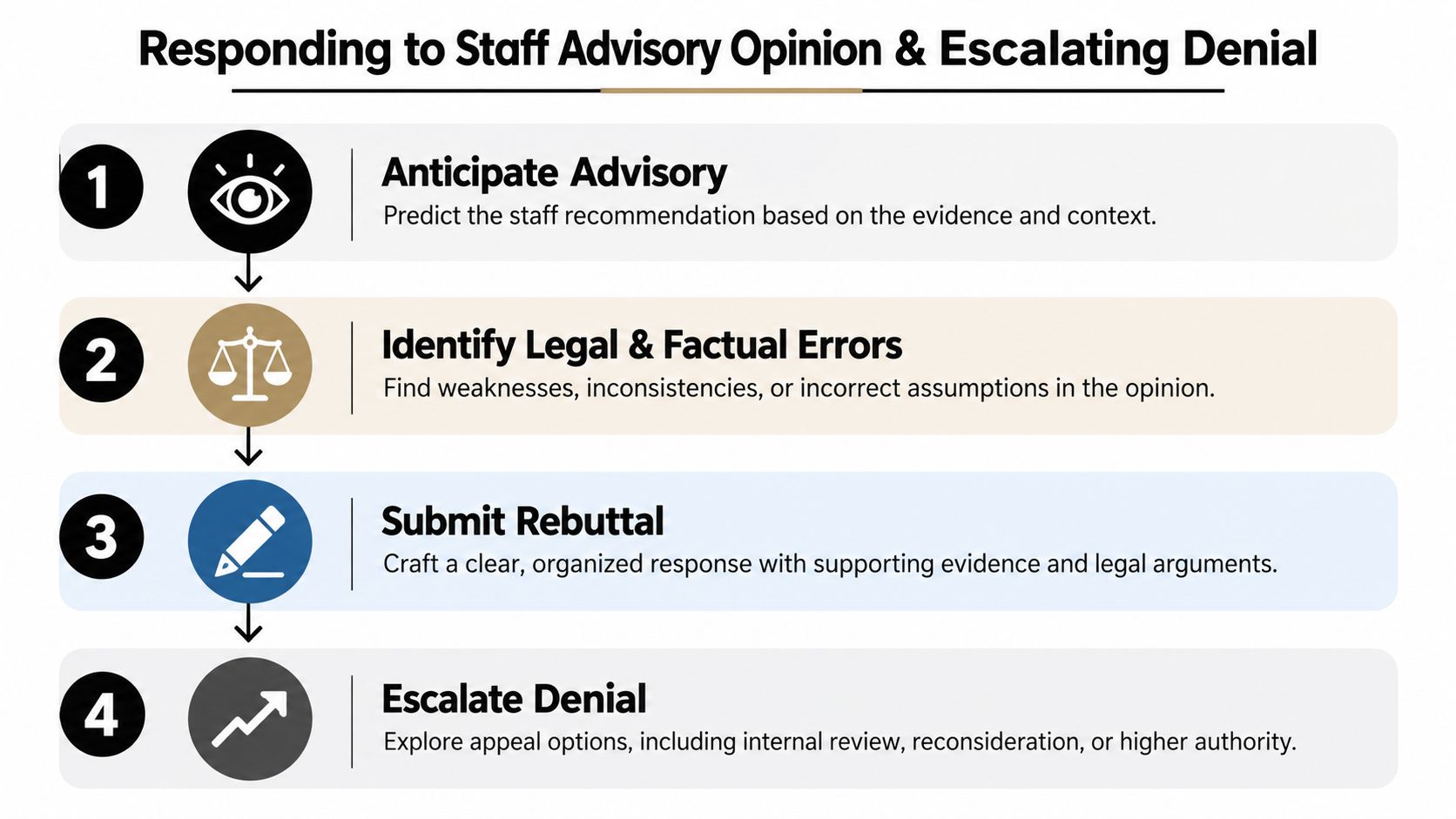
An advisory opinion can reveal the central obstacle to relief: a factual assumption, a medical interpretation, a personnel rule, or an explanation that the requested remedy isn’t supported. Don’t respond by resubmitting your original narrative with stronger adjectives.
Request any advisory opinion associated with your case and confirm the applicable response procedure. Don’t assume that every case follows an identical advisory process or that a particular recommendation determines the outcome.
The response sequence should remain disciplined.
Rebut the reasoning, not the reviewer
Use a short response table to identify the disputed proposition, your answer, and the supporting exhibit. Separate factual mistakes from disagreements about legal interpretation or discretionary judgment.
Watch for these problems:
- Wrong chronology: The opinion relies on evidence from a different period without explaining its relevance.
- Incomplete source material: The reviewer discusses a summary but overlooks the underlying record.
- Unanswered issue: The opinion addresses a requested correction but not the distinct injustice argument supporting it.
- Unsupported inference: The conclusion goes beyond what the cited document establishes.
Explain why each defect matters to the requested remedy. An immaterial mistake isn’t a winning rebuttal.
Preserve options after a denial
Read the decision and accompanying instructions before choosing reconsideration or litigation. Identify what the Board decided, what it didn’t address, and whether you have new evidence or a distinct basis for further review.
Don’t assume that sending another letter preserves a court deadline. Counsel should verify current reconsideration requirements, applicable filing limits, exhaustion questions, and the effect of any additional administrative submission.
Pay-related correction claims may raise jurisdictional questions involving the U.S. Court of Federal Claims, an Article I court. Other challenges may implicate a federal district court, which is an Article III court, not an Article I court. A constitutional label alone doesn’t establish jurisdiction.
Before escalating: Ask counsel to identify the available remedy, proper court, review standard, and procedural barriers in writing.
The litigation decision should follow a candid assessment of the administrative record. Filing somewhere else won’t automatically cure missing evidence or an unsupported theory.
When and Why to Bring in Civilian Military Defense Counsel
Bring in counsel when the stakes exceed your ability to diagnose the record: disputed medical retirement, consequential discharge characterization, interconnected personnel actions, or an earlier denial. Don’t wait until you need someone to rescue an argument you’ve already committed to writing.
A capable civilian lawyer should identify weaknesses before the Board does. Ask how the lawyer handles missing records, adverse evidence, advisory opinions, and litigation planning.
Choose relevant experience over a title
Military-appointed counsel and privately retained civilian counsel serve different roles. Don’t assume representation in an underlying military proceeding includes a later correction-board petition; confirm the scope of assistance available.
Civilian counsel works outside the command chain, but independence alone isn’t enough. Trial experience can help counsel test witness accounts and investigative assumptions. Administrative-record experience helps translate those weaknesses into a correction request.
Use the guide to selecting a military defense lawyer to structure consultations. Ask military defense lawyers and court-martial attorneys about actual ABCMR work, not merely general UCMJ experience.
Compare scope, communication, and strategy before choosing a UCMJ lawyer.
Questions applicants ask before hiring counsel
Can the ABCMR upgrade my discharge?
Separation characterization falls within its corrective authority, but the proper forum still requires review.
Which form starts an ABCMR application?
DD Form 149. Supporting documentation remains essential.
Is a late application automatically hopeless?
No. The timeliness analysis described above requires a separate, credible explanation.
Can the Board review disciplinary records?
Such records can be involved in correction requests, but the available remedy depends on the underlying action and legal limits.
What are my chances of winning?
No responsible assessment substitutes a public win rate for a review of your evidence.
Should I hire counsel immediately?
Seek an early assessment when the remedy is consequential, the record is complicated, or a deadline may be approaching.
Don’t file out of frustration. Get a case assessment, preserve your records, and identify the correct remedy now. Your career, retirement position, and permanent service record deserve a strategy, not another hopeful letter.