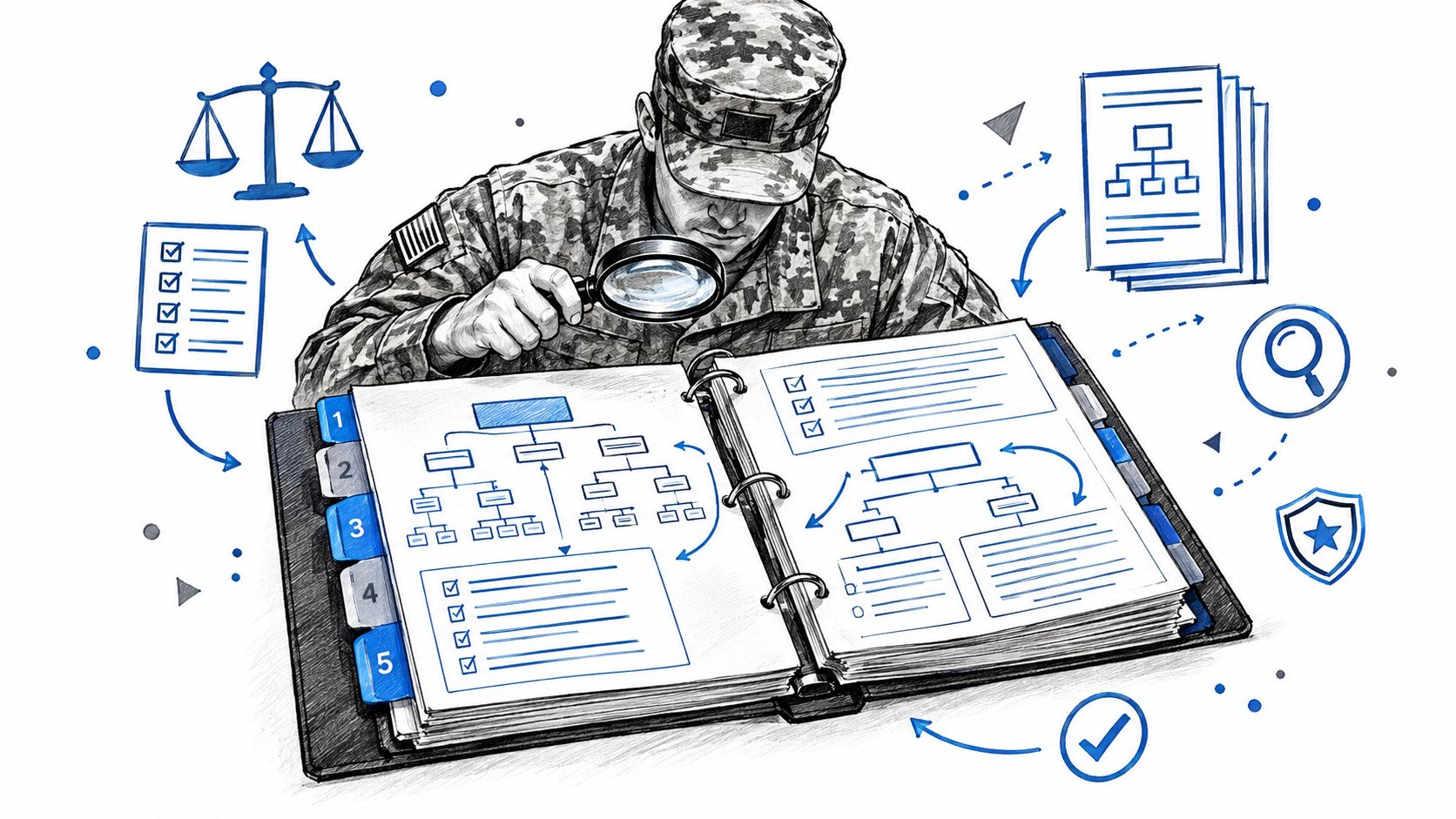
Article 92 UCMJ covers three forms of misconduct: failing to obey a lawful general order or regulation, knowingly disobeying another lawful order, and being derelict in assigned duties. Depending on the theory charged, the exposure can reach two years of confinement and a dishonorable discharge, or lesser but still career-ending punishment.
You may be reading this because a supervisor gave you unclear instructions during a deployment, a duty log shows a missed task, or CID, NCIS, OSI, or CGIS suddenly wants an interview. You thought the problem was a misunderstanding. Your command may now be treating it as criminal misconduct.
That change matters. Article 92 isn’t limited to a deliberate refusal to obey. It can involve a regulation, a direct order, or an alleged failure to perform a duty through neglect or culpable inefficiency. The government still has to prove the specific legal theory and every required element, but you shouldn’t expect investigators to resolve uncertainty in your favor.
A service member’s first statement, text message, or written response can shape the entire case. Get counsel before you explain anything, consent to searches, provide documents, or try to persuade your chain of command that this was “just a mistake.”
Table of Contents
- Understanding Article 92 UCMJ Violations
- The Three Distinct Theories of Liability
- Legal Nuances and Cross-References to Other Charges
- Challenging Lawful Orders and Regulations
- Punishments and Sentencing Guidelines
- Why Civilian Defense Counsel Is Essential
- Common Mistakes Service Members Make
- Real-World Defense Scenarios
- Frequently Asked Questions
- Can I refuse to talk to CID, NCIS, OSI, or CGIS?
- What must the government prove in an Article 92 case?
- Can an ambiguous order support an Article 92 conviction?
- What happens if the order was impossible to perform?
- Can a regulation violation be criminal if the regulation is administrative?
- Will I go to jail?
- Do I need a lawyer immediately?
Understanding Article 92 UCMJ Violations
A soldier on a high-stress deployment receives instructions from a supervisor. The order comes verbally, another leader gives different guidance, and operational conditions make the original task difficult to complete. The soldier follows what seems workable. Later, an investigation treats the deviation as disobedience or dereliction.
That scenario is common in substance, even when the details differ. Article 92 is a broad discipline provision, not a single rule against saying no. Article 92 of the Uniform Code of Military Justice, codified at 10 U.S.C. § 892, became part of the UCMJ in 1956 when Congress consolidated and modernized the military justice system. The statute applies to people subject to the UCMJ, including qualifying active-duty personnel, Space Force members on qualifying active duty, personnel ordered to military duty or training, and other specified categories. Read the statutory text of Article 92.

Why the label matters
The charge’s subsection affects the evidence, defenses, and punishment. A case alleging violation of a general regulation turns on the actual text, its legal status, and whether it was punitive and applicable. A direct-order case turns on lawfulness, knowledge, authority, and the accused’s duty to obey. A dereliction case focuses on the existence of a duty, the required standard of performance, and the mental state alleged.
That means “I didn’t follow an instruction” isn’t a legal conclusion. Counsel must ask:
- What was the source: Was it a statute, regulation, standing operating procedure, written order, verbal command, or informal guidance?
- What did it require: Did the language clearly mandate conduct, or did it merely express an expectation?
- Who issued it: Did the person have authority to give that order?
- What did you know: Were you informed of the operative text and any changes?
- Could you comply: Did conflicting instructions, safety conditions, or operational realities make compliance impossible?
Early legal intervention lets counsel preserve those questions before witnesses coordinate their accounts or records disappear. A practical overview of the larger justice process is available in this guide to the UCMJ system.
The Three Distinct Theories of Liability
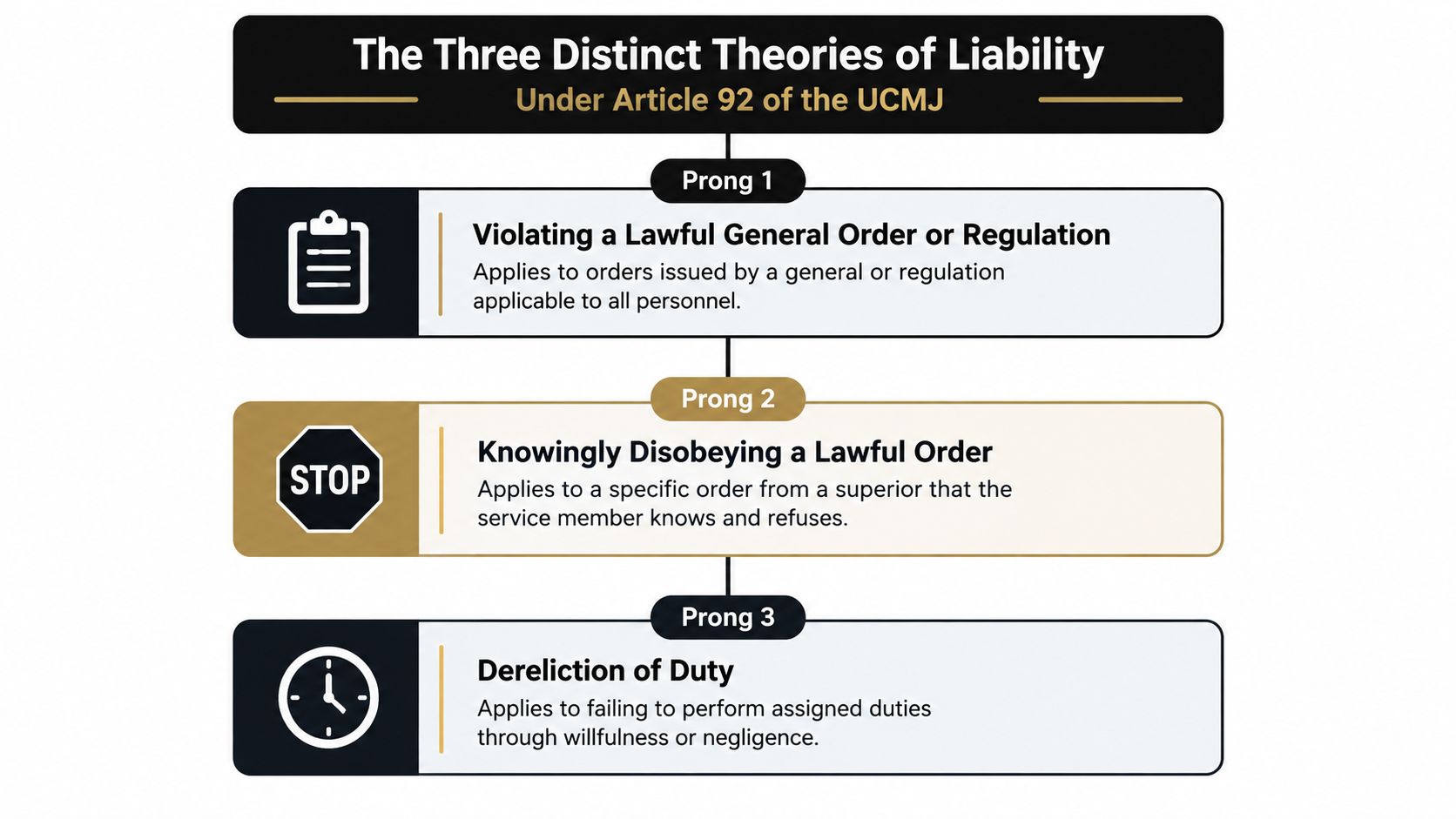
Article 92 contains three separate theories of liability. The government doesn’t get to blur them together. The specification should tell you which theory is charged, and the prosecution must prove the elements tied to that theory.
Article 92(1) and general orders or regulations
The first theory concerns violating or failing to obey a lawful general order or regulation. The government must identify the specific order or regulation, show that it was lawful and in effect, establish that you had a duty to obey it, and prove that you violated or failed to obey it.
The document matters. A citation to a broad policy isn’t enough. Counsel should obtain the complete operative version, effective date, issuing authority, dissemination history, and any exceptions or amendments. The Court of Appeals for the Armed Forces has recognized that a regulation lacking language making it punitive generally can’t support a criminal Article 92(1) conviction merely because someone violated it. Review the military appellate discussion of punitive regulations.
Article 92(2) and a specific lawful order
The second theory involves knowingly failing to obey another lawful order issued by a member of the armed forces when the accused had a duty to obey it. The prosecution must prove more than the order’s existence. It must establish that the order was lawful, that you knew about it, and that you had a duty to obey.
A supervisor’s instruction can fail as a criminal order if it was outside the issuer’s authority, insufficiently specific, unrelated to a legitimate military purpose, or impossible to perform. A direct-order charge also becomes vulnerable when two leaders gave conflicting directions and the government can’t show which instruction controlled.
For a broader discussion of disobedience allegations, compare the issues addressed in this resource on willfully disobeying a superior commissioned officer.
Article 92(3) and dereliction
The third theory is dereliction in the performance of assigned duties. It isn’t confined to an intentional refusal. The alleged failure may involve willfulness, neglect, or culpable inefficiency, and the charged mental state directly affects the defense and potential punishment.
The government must identify the duty, show that you knew or should have known what it required where applicable, and prove that your performance fell within the charged form of dereliction. A missed task caused by confusion, inadequate resources, or an impossible timeline isn’t automatically willful misconduct. The prosecution still has to prove the legal theory rather than rely on a supervisor’s conclusion.
Legal Nuances and Cross-References to Other Charges
Article 92 can be the principal charge, but it may also sit beside more serious allegations. When an alleged dereliction results in death, the governing punishment guidance recognizes that the conduct may also support charges under Article 119, including negligent homicide where the evidence establishes the required elements, or under Article 134. Review the Federal Register treatment of dereliction and death-related offenses.
That doesn’t mean a serious outcome automatically proves homicide or an Article 134 offense. Each charge has its own elements. The government must prove the additional offense instead of using the result alone as a substitute for proof.
Technical violation versus criminal negligence
The distinction between a technical violation and criminally blameworthy performance is where many cases are won. A regulation may describe an administrative standard without creating a punitive offense. An order may be valid in general but unclear in the circumstances presented. A duty may exist, yet the government may struggle to prove that the accused’s conduct reflected willfulness, neglect, or culpable inefficiency rather than ordinary human error.
Counsel should also examine whether prosecutors are charging alternative theories. If the evidence doesn’t support intentional disobedience, the government may rely on a negligence-based theory. That shift changes the proof and sentencing exposure, but it doesn’t eliminate the need to establish the underlying duty and the accused’s failure to perform it.
Watch for charge stacking
Review every related specification separately. A single event may generate allegations involving an order, a duty, a report, or a resulting injury. The defense should identify duplicative theories, unsupported additions, and factual assumptions that appear in one charge but not another.
Don’t concede the underlying narrative by focusing only on the label. The decisive dispute may be whether the regulation was punitive, whether the order was lawful, whether the accused knew the requirement, or whether the alleged result supports a separate offense at all.
Challenging Lawful Orders and Regulations
The government’s case often looks stronger than it is because investigators start with a supervisor’s description of the rule instead of the rule itself. That shortcut is dangerous. Defense counsel should build the challenge from the original documents and the conditions existing when the alleged violation occurred.

The lawfulness checklist
Start with the source. Obtain the complete order or regulation, not a screenshot, summary, or verbal paraphrase. Then test it against these questions:
- Was it issued by competent authority? Identify the issuer, position, delegation, and scope of command.
- Was it specific enough? A service member must be able to understand what conduct was required or forbidden.
- Did it serve a military purpose? The directive must connect to military duty, discipline, operations, safety, or another legitimate military function.
- Was it in effect? Check the effective date, rescission, amendments, local supplements, and exceptions.
- Was it properly communicated? Determine how the accused received it and whether the government can prove notice.
- Did the accused have a duty to obey? Rank, position, assignment, and circumstances can matter.
- Was performance feasible? Evaluate equipment, staffing, time, safety, access, weather, operational tempo, and conflicting orders.
- Was the regulation punitive? Administrative guidance doesn’t automatically become a criminal command.
The official preliminary edition of 10 U.S.C. § 892 identifies the statutory framework, but a defense investigation must go further. It must establish the specific wording of the order and how it applied to this accused, on this assignment, at that time.
The government may say an instruction was obvious. Don’t accept that conclusion without testing the words, delivery, and surrounding communications.
Ambiguity, conflict, and impossibility
An ambiguous order creates a notice problem. A conflicting order creates a duty and priority problem. An impossible order creates a feasibility problem. Those aren’t excuses invented after the fact. They are factual issues that can defeat an element or undermine witness credibility.
Preserve the context immediately. Save messages, duty schedules, rosters, briefing slides, maintenance records, watch logs, and names of people who heard the instruction. Don’t alter or delete anything. Give the material to counsel and let counsel decide how to use it.
Punishments and Sentencing Guidelines
Punishment under Article 92 depends on the specific theory charged and the manner of the alleged misconduct. The statute itself says an offender “shall be punished as a court-martial may direct.” The Manual for Courts-Martial and the facts of the offense control the available exposure.
| Theory | Max Confinement | Max Discharge |
|---|---|---|
| Article 92(1), violating a general regulation | Up to two years | Dishonorable discharge |
| Article 92(3), willful dereliction | Six months | Bad-conduct discharge |
| Article 92(3), neglect or culpable inefficiency | Three months | No punitive discharge authorized |
The punishment distinctions are documented in the Court of Appeals for the Armed Forces decision discussing Article 92 exposure. The same decision explains why counsel must examine the specification’s wording rather than rely on the generic phrase “Article 92 charge.”
What the matrix means in practice
A general-order or regulation charge can carry the harshest exposure in this comparison, even when the alleged conduct looks administrative at first glance. A willful dereliction charge carries a different ceiling. A dereliction allegation based on neglect or culpable inefficiency has a lower confinement limit and does not authorize a punitive discharge under the stated framework.
The mental state is not a minor detail. If the government alleges willfulness, it must prove intentional disregard of a known duty. If it alleges neglect or culpable inefficiency, the prosecution is pursuing a different theory with different proof and punishment consequences.
A charge can still damage your career before trial through command action, adverse records, or administrative proceedings. That is why sentencing analysis should begin as soon as you learn the exact specification. Counsel needs to know whether the government’s theory matches the available evidence and whether negotiations or litigation can prevent a more serious characterization.
Why Civilian Defense Counsel Is Essential
An Article 92 allegation isn’t a paperwork problem. It can become a court-martial, confinement, a punitive discharge, or a permanent professional crisis. You need counsel who will test the government’s theory instead of accepting the command’s description of events.
Military-appointed defense counsel can provide representation at no cost and may be highly capable. They also work inside a system shaped by military assignments and command structures. An experienced civilian military defense lawyer brings independence, specialized UCMJ practice, and the ability to focus entirely on the defense without treating the allegation as a routine unit matter.
What experienced counsel does differently
A strong defense team obtains the operative order, reconstructs the timeline, interviews witnesses before memories shift, and separates what someone expected from what the law required. Counsel also examines digital evidence, inconsistent statements, command bias, missing records, and whether investigators framed questions to produce a predetermined narrative.
Trial experience matters because Article 92 cases often turn on credibility. The supervisor may say the instruction was clear. The accused may remember a different order. The defense must expose contradictions without allowing the case to become a simple contest of rank.
You can also use structured legal research when comparing representation. Resources on legal SEO experts worth hiring illustrate how to evaluate professional information online, but credentials and direct consultations should control your decision.
If you want civilian representation, contact counsel before an interview or command-directed response. Use the court-martial defense lawyers resource to begin comparing attorneys, then ask direct questions about Article 92 litigation, courtroom experience, availability, fees, and who will personally handle your case.
Common Mistakes Service Members Make
The same errors appear repeatedly in Article 92 investigations. They usually come from trying to look cooperative or believing the command already knows the truth.
- Talking to investigators alone: CID, NCIS, OSI, and CGIS interviews can create admissions, contradictions, and damaging phrasing before you understand the allegation.
- Trusting command to fix it internally: Commanders may be fair, but they also have disciplinary responsibilities. Don’t confuse professional treatment with a defense strategy.
- Waiting for formal charges: Counsel can do important work before charges are preferred, including preserving records and identifying witnesses.
- Assuming there is no evidence: Informal conversations, messages, duty logs, and recorded statements may become the government’s timeline.
- Calling a technical violation harmless: A regulation or order issue can carry serious punishment if the government proves the correct legal theory.
- Deleting or editing messages: That can create a separate credibility problem and make innocent context look suspicious.
- Guessing in a written response: If you don’t remember, say nothing substantive until counsel helps you determine what must be addressed.
- Accepting the supervisor’s wording: “I failed to supervise” may be a conclusion, not a precise description of an assigned duty.
Practical rule: Don’t explain the facts to make the problem disappear. Preserve the facts and let counsel decide when and how to present them.
Real-World Defense Scenarios
Consider a soldier charged under Article 92(1) for violating a local regulation. The command relies on a policy memo, but the memo contains no language making it punitive. Defense counsel obtains the complete publication history and challenges the government’s attempt to convert administrative guidance into a criminal offense. The charge may fail because the prosecution chose the wrong legal vehicle.
A sailor faces Article 92(2) after failing to follow a verbal order during an operational disruption. The supervisor says the instruction was clear. Messages show another leader gave conflicting guidance, the task depended on unavailable equipment, and no witness can establish which instruction controlled. The defense attacks lawfulness, notice, duty, and feasibility instead of arguing only that the sailor meant well.
A supervisor is charged with willful dereliction after a subordinate misses a required task. The evidence shows the supervisor knew the duty existed but lacked the access and staffing needed to complete it, and the record supports at most neglect or culpable inefficiency. That distinction can change the available punishment and gives counsel a precise alternative theory.
These are hypothetical examples, but the method is real: identify the charged subsection, demand the source of the duty, test the evidence against each element, and challenge the government’s mental-state theory. Article 92 cases are not won by indignation. They’re won by forcing the prosecution to prove the law it charged.
Frequently Asked Questions
Can I refuse to talk to CID, NCIS, OSI, or CGIS?
You have the right to remain silent when questioning may expose you to criminal liability. State that you want counsel and won’t answer questions until you receive legal advice. Don’t argue with investigators or volunteer a “quick explanation.”
What must the government prove in an Article 92 case?
It must prove the elements of the specific theory charged. That may require proof of a lawful general order or regulation, a lawful specific order, knowledge, a duty to obey, or an assigned duty and dereliction. The government can’t rely on a vague allegation that you violated expectations.
Can an ambiguous order support an Article 92 conviction?
Ambiguity can undermine lawfulness, notice, knowledge, or proof of a violation. The answer depends on the order’s exact wording, the circumstances, the issuer’s authority, and the evidence showing what you understood. Preserve every version of the instruction.
What happens if the order was impossible to perform?
Impossibility can be a powerful factual defense, especially when equipment, safety, staffing, timing, or operational conditions prevented compliance. Counsel must prove the surrounding conditions rather than merely assert that the task was difficult.
Can a regulation violation be criminal if the regulation is administrative?
Not automatically. The prosecution must identify a lawful punitive regulation that supports Article 92(1). A regulation lacking punitive language generally cannot support a criminal conviction merely because the accused violated it.
Will I go to jail?
Possibly, but the answer depends on the subsection, mental state, facts, forum, and outcome. The identified maximums range from three months for dereliction through neglect or culpable inefficiency to two years for violating a general regulation, with different discharge consequences. Don’t make a personal prediction until counsel reviews the specification.
Do I need a lawyer immediately?
Yes, if investigators want to question you, command has accused you of misconduct, or you received written notice of possible action. Military defense counsel is available, and you may also consult civilian court-martial attorneys. Early advice protects your choices before the government fixes its narrative.
If you’re under investigation for an Article 92 UCMJ allegation, stop discussing the facts with coworkers and investigators, preserve your records, and contact a qualified UCMJ lawyer today. Don’t wait for charges, an Article 15, or a court-martial referral to begin building your defense. Your freedom, discharge, career, and reputation may depend on the decisions you make before the government finishes its investigation.