
You’ve just received separation paperwork, and the words “other than honorable” are staring back at you. You’re worried about your career, VA care, education benefits, security clearance, and what a future employer will see. Those concerns are justified, but panic leads people to make bad decisions.
An OTH discharge is serious. It isn’t the same as a criminal conviction, but it can damage your military record and force the VA to conduct a separate character-of-discharge review. The record and the benefits decision are related, but they aren’t the same fight. You need to protect both.
Table of Contents
- What an Other Than Honorable Discharge Actually Means
- How OTH Compares to Honorable and General Discharges
- Statutory and Administrative Grounds for an OTH
- Effects on VA Benefits, GI Bill, and Civilian Life
- The Discharge Upgrade Process from Start to Finish
- Evidence and Legal Strategies That Win Upgrades
- Common Mistakes and Why Civilian Defense Counsel Matters
- Your Next Steps if You Have or Face an OTH
What an Other Than Honorable Discharge Actually Means
An other than honorable discharge is an administrative characterization of service issued when the military concludes that a service member’s conduct fell substantially below the standards expected of military personnel. It’s generally the lowest administrative characterization and carries consequences that can follow you into civilian life.
The critical distinction is this: an OTH discharge isn’t itself a court-martial conviction. A punitive discharge, such as a bad-conduct or dishonorable discharge, ordinarily results from a court-martial sentence. An OTH usually comes through the administrative separation system, even when the allegations involve serious misconduct.
That distinction doesn’t make the practical consequences minor. Employers, licensing authorities, security managers, and government agencies may treat an OTH as a major negative factor. The discharge can affect:
- Federal employment: Agencies may examine the underlying conduct, separation documents, and overall suitability.
- Security clearances: The circumstances behind the separation can create serious clearance problems.
- Civilian employment: Background-check reviewers may see the characterization as a warning sign, even if they don’t understand the military process.
- Veterans’ benefits: The VA makes its own character-of-discharge determination before authorizing many benefits.
- Education benefits: Eligibility for programs such as the Post-9/11 GI Bill may be lost or restricted.
- Reputation: The label can affect how employers, peers, and even other veterans interpret your service.
Practical rule: Treat the OTH as both a record problem and a benefits problem. Solving only one leaves the other exposed.
The two-track system
Your military branch controls the discharge characterization. The VA doesn’t rewrite it. Instead, the VA separately evaluates whether the circumstances of your service permit access to particular VA programs under its own rules. The VA’s character of discharge guidance describes this separate review structure.
That creates two parallel tracks:
- Military-record track: You seek correction or upgrade through a Discharge Review Board or a Board for Correction of Military Records.
- VA-benefits track: You ask the VA to determine whether your service qualifies for specific benefits despite the OTH.
A successful VA determination doesn’t change the DD-214. A military upgrade doesn’t automatically resolve every statutory bar. Your evidence and legal strategy must account for both systems.
How OTH Compares to Honorable and General Discharges
The characterization matters because it communicates how the military judged your service. Honorable is the strongest characterization. General, Under Honorable Conditions reflects satisfactory service with significant negative issues. Other Than Honorable signals more serious misconduct or performance concerns. Bad-conduct and dishonorable discharges are punitive outcomes associated with the court-martial system.
The practical line between General and OTH can be decisive. An honorable characterization generally preserves the broadest access to military-related benefits. A General characterization can restrict some programs. An OTH creates a separate eligibility review and may block major benefits unless the VA finds that the circumstances of separation don’t bar access.
| Characterization | Issuing Authority | Typical Conduct | VA Benefits Impact | Civilian Stigma |
|---|---|---|---|---|
| Honorable | Military separation authority | Service meeting expected standards | Broadest eligibility, subject to program rules | Limited |
| General, Under Honorable Conditions | Administrative separation authority | Service with meaningful negative issues | Some programs may be restricted | Moderate |
| Other Than Honorable | Administrative separation authority | Serious misconduct or substantial performance concerns | Separate VA character-of-discharge review | Significant |
| Bad-Conduct or Dishonorable | Court-martial authority | Conduct resulting in punitive discharge | Major statutory restrictions may apply | Severe |
An OTH generally follows administrative action, not a criminal conviction. That gives you a different legal attack. You can challenge whether the separation was proper, whether it was equitable, whether the command considered mitigating evidence, and whether the characterization was disproportionate.
Review the administrative separation framework and potential remedies through this guide to administrative separation and military discharges. The key decision is whether the record supports a General characterization, an Honorable characterization, or correction of the separation basis itself.
Statutory and Administrative Grounds for an OTH
Commands usually reach an OTH through one of two theories. The first is accumulated misconduct. The second is one serious event that leadership considers incompatible with continued service.
Pattern misconduct
A pattern case may include repeated failures to obey orders under Article 92, conduct prejudicial to good order and discipline under Article 134, drug-related misconduct under Article 112a, or unauthorized absence under Article 86. The command doesn’t always need one dramatic incident if the record shows repeated violations, failed rehabilitation, and declining performance.
The government’s case often depends on paperwork. Counseling statements, nonjudicial punishment records, negative evaluations, drug-test documentation, emails, and witness statements may be assembled into a narrative of unreliability. Your defense must test whether those documents prove misconduct, whether they describe the same event consistently, and whether the command gave you a meaningful chance to respond.
A single serious incident
One event can produce an OTH recommendation. Examples may include a positive drug test, domestic violence allegations involving command action, or a serious security violation. The label alone doesn’t establish the case. The command still must connect reliable evidence to a valid separation basis and justify the proposed characterization.
Look closely at the source of the evidence. A positive test raises questions about collection, chain of custody, laboratory documentation, and the command’s interpretation. A domestic violence allegation raises questions about inconsistent accounts, photographs, medical records, messages, and whether investigators separated fact from accusation. A security allegation demands careful review of access records, training, intent, and actual harm.
Non-misconduct separation theories
Some cases involve substandard performance rather than intentional wrongdoing. Others involve medical or mental-health conditions that were poorly documented or misclassified. These cases can present stronger upgrade arguments when the record shows that the command treated symptoms as misconduct without adequately considering diagnosis, treatment, duty limitations, or the effect of service-related trauma.
JAG legal review doesn’t guarantee a strong record. Reviewers may confirm that the paperwork follows the required format without resolving credibility conflicts or investigating omitted mitigation. That’s why you need an independent review of the complete file, not just the separation notification.
Effects on VA Benefits, GI Bill, and Civilian Life
An OTH doesn’t automatically eliminate every form of VA assistance. The VA evaluates eligibility by benefit category and by the circumstances of separation. The agency’s current guidance identifies possible access to targeted care, including treatment for VA-rated service-connected disabilities, care related to military sexual assault or harassment, qualifying combat-related mental and behavioral health care, emergency mental health services in a crisis, and Vet Center counseling. The VA’s guidance on benefits available with an OTH discharge explains why you shouldn’t assume you’re disqualified before applying.
Congressional research also notes that the VA examines the circumstances of separation for OTH and bad-conduct cases rather than applying one blanket rule. That’s the operational point. Eligibility must be assessed program by program.
| Area | Automatic Consequence | Potential Remedy |
|---|---|---|
| VA compensation | Eligibility may require a VA character-of-discharge determination | Submit service records, medical evidence, and a legal explanation |
| VA health care | Some targeted care pathways may remain available | Apply directly and identify the qualifying condition or circumstance |
| GI Bill | OTH can prevent access to education benefits | Seek a military upgrade or pursue VA review where legally available |
| Home loan benefits | Eligibility may be restricted pending VA review | Request character-of-discharge consideration |
| Civilian employment | Background reviewers may treat OTH as adverse information | Provide accurate context and supporting records |
| Security clearance | Underlying conduct may trigger scrutiny | Address rehabilitation, reliability, and mitigating circumstances |
A careful explanation of other-than-honorable discharge benefits can help you identify the correct VA pathway. You should also understand how civilian reviewers interpret records. Resources on interpreting background check results can help you distinguish what a report says from what an employer may assume.
The VA decision is separate from the DD-214 and can be challenged through the VA process. Don’t wait for a discharge upgrade before seeking care or filing a benefits claim. If the facts support both actions, pursue them in parallel.
The Discharge Upgrade Process from Start to Finish
The first question is jurisdiction. Discharge review boards generally handle upgrade applications filed within 15 years of separation, while boards for correction of military records handle more complex matters, including cases outside that period and cases involving court-martial convictions, as described in Congressional Research Service materials summarized in this review of post-service military legal rights.
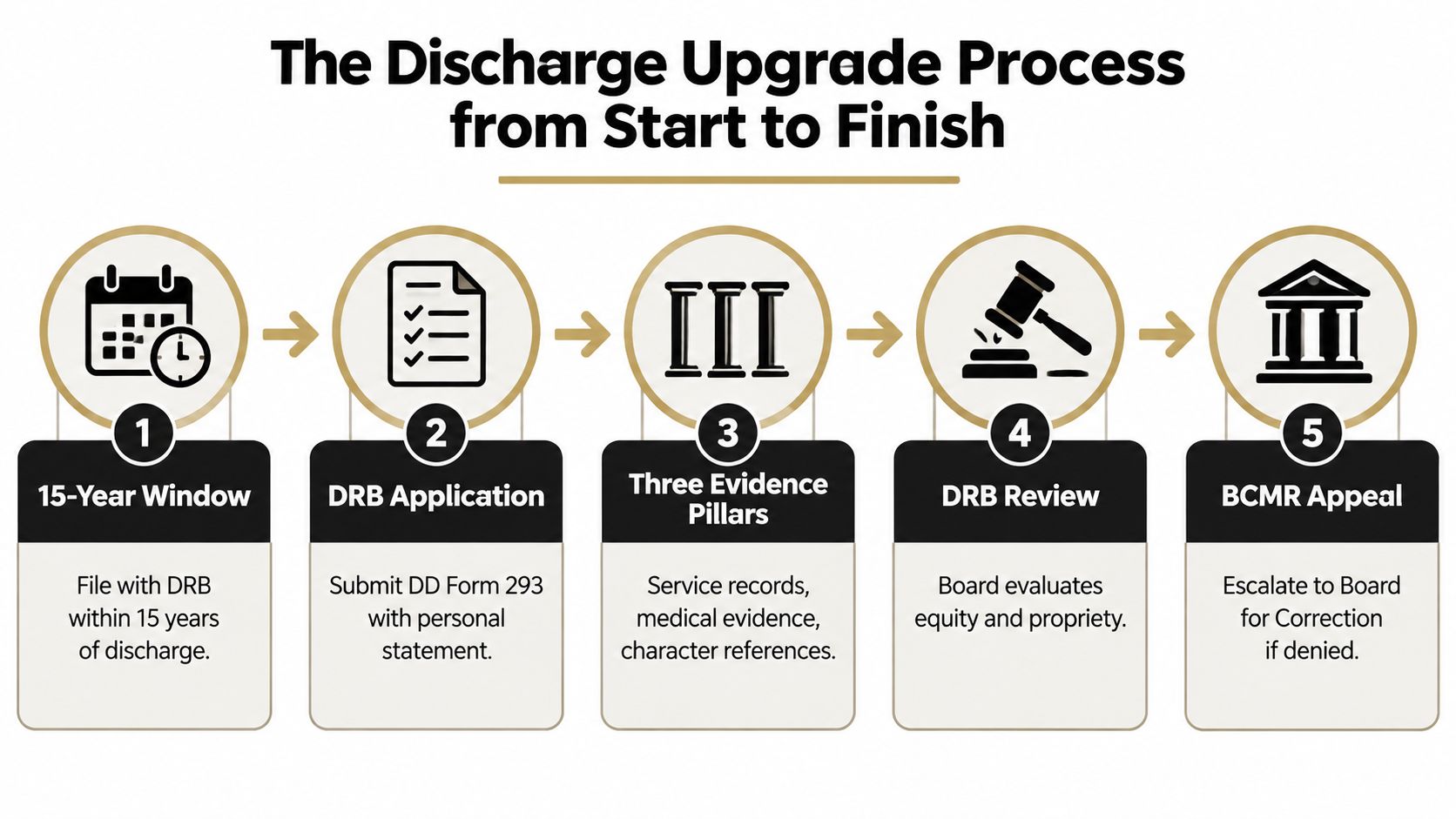
Step 1, identify the correct board
Within the review window, the Discharge Review Board is usually the first forum. You’ll typically prepare the application, identify the error or injustice, and submit supporting records. If the DRB denies relief, a petition to the BCMR may follow. Cases outside the DRB window generally require a BCMR petition, along with an explanation for any delay.
Step 2, build the record before writing the story
A persuasive application rests on evidence, not emotional force. Start with the personnel file, separation packet, service treatment records, NJP documents, evaluations, awards, investigative materials, and post-service records. Then organize the facts around the legal theories of propriety, equity, and, where applicable, mental-health or trauma-related mitigation.
Step 3, choose the review standard
Some applications require proof that the discharge process was legally defective. Others argue that the discharge was unjust or too harsh in light of the full record. Mental-health and trauma-related cases may receive liberal consideration under applicable policy, but that doesn’t mean the board will upgrade a discharge automatically.
A 2025 GAO report found wide variation in approval rates across discharge review boards and also identified inconsistent standards and uneven treatment of cases involving mental health or sexual assault considerations. By March 2025, the Discharge Appeal Review Board had adjudicated only one upgrade case, according to the same GAO report. That is not a reason to abandon a viable case. It is a reason to select the correct forum and develop the evidence carefully.
The process can be slow, and recent reporting has criticized delays in bad-paper upgrades. Don’t build your plan around an assumed approval rate or an informal promise from a representative. Build it around deadlines, jurisdiction, evidence, and a coherent legal theory.
For a practical filing overview, see this military discharge upgrade guide.
Evidence and Legal Strategies That Win Upgrades
Boards don’t upgrade discharges because an applicant feels misunderstood. They act when the record shows error, injustice, disproportion, or meaningful mitigation supported by credible evidence.
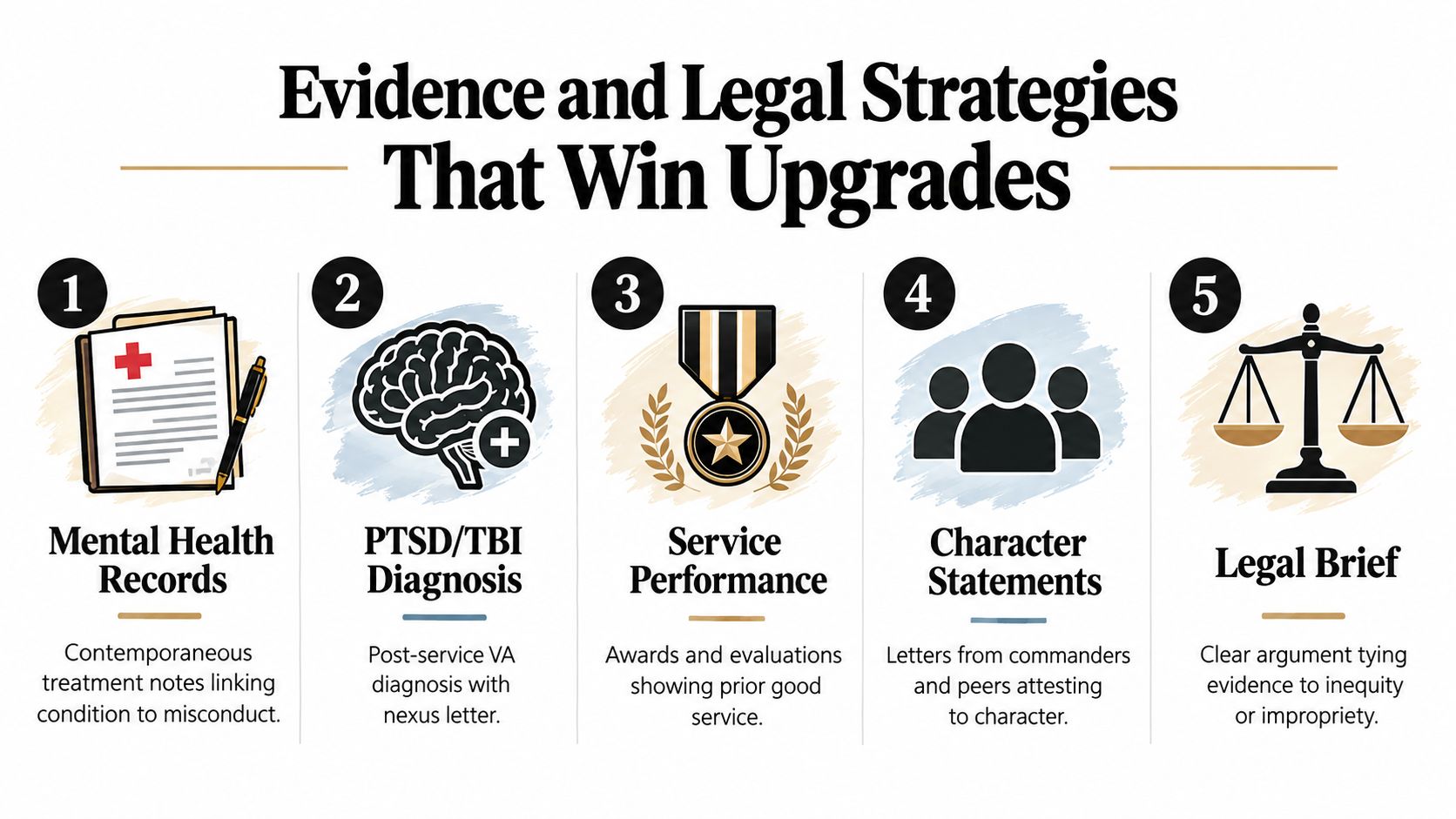
Medical evidence must connect to the conduct
A diagnosis by itself isn’t enough. The strongest mental-health cases connect symptoms, diagnosis, and behavior through contemporaneous treatment records, competent medical opinions, and a clear explanation of how the condition affected judgment, impulse control, attendance, substance use, or interactions with the command.
Post-service VA records can help, particularly when they clarify a condition that went undocumented during service. A clinician’s opinion should address the connection between the condition and the misconduct, not merely confirm that the condition exists.
Rehabilitation needs documentation
A general statement that you’ve changed is weak. Use employment records, education records, treatment completion, sobriety documentation where relevant, community involvement, and credible statements from people who know your conduct after service. The board needs a reason to believe the adverse conduct doesn’t define your entire record.
Prior good service matters too. Awards, evaluations, successful assignments, and favorable command statements can expose a disproportionate characterization. They won’t erase misconduct, but they can show that the command selected an unnecessarily harsh outcome.
Choose the right legal theory
Three arguments commonly deserve serious consideration:
- Undiagnosed-condition theory: A condition existed during service, affected the conduct, and wasn’t properly recognized or treated.
- Disproportionate-action theory: The command imposed an OTH despite a record supporting a less severe characterization.
- Post-service rehabilitation theory: The applicant has demonstrated sustained responsibility and reliability since separation.
A legal brief should tie every argument to a document. Don’t submit a narrative that asks the board to trust you while ignoring unfavorable evidence. Address the bad facts, explain them accurately, and show why the full record supports relief.
Common Mistakes and Why Civilian Defense Counsel Matters
The first mistake is believing an OTH is permanent. It isn’t necessarily permanent, but waiting can close the DRB route after the 15-year review period described earlier. Delay also makes witnesses harder to locate and memories less reliable.
The second mistake is assuming the board functions like a neutral trial court. Review boards evaluate a record created largely by the command. Institutional assumptions can favor official documents over unsupported personal statements. A sincere story matters, but it rarely carries a case without corroboration.
A board can’t fix evidence you never collect.
Errors that weaken otherwise viable cases
- Submitting the wrong application: A DRB application and a BCMR petition serve different purposes. Jurisdiction matters.
- Ignoring the separation packet: Applicants often focus on post-service hardship while failing to confront the documents that caused the OTH.
- Using generic character letters: Letters should provide specific observations, dates, responsibilities, and examples of rehabilitation.
- Failing to obtain medical records: If mental health or trauma played a role, undocumented mitigation is easy for a board to discount.
- Treating VA review as automatic: A military upgrade and a VA character determination are separate proceedings.
- Waiting for perfect evidence: Start requesting records and evaluations immediately. You can refine the legal presentation as the file develops.
Military-appointed defense counsel can be highly capable during the active-duty separation process. After separation, however, you need a lawyer focused on the record-correction problem, not a general explanation of military law. A dedicated civilian military defense lawyer can independently review the file, identify omissions, frame mitigation, prepare a legal brief, and handle communications without command pressure.
Speak with counsel promptly after separation, ideally within 90 days, while records, witnesses, and medical context remain accessible.
Your Next Steps if You Have or Face an OTH
You don’t need to solve the entire case this week. You do need to stop losing evidence and deadlines.
Preserve everything. Save the separation packet, personnel records, service treatment records, NJP paperwork, evaluations, awards, emails, text messages, and witness contact information. Request a complete copy of your military personnel file before records become harder to retrieve.
Find the VA decision. If you’ve applied for benefits, identify whether the VA issued a character-of-discharge determination. That decision is separate from the military record and may require its own appeal or supporting submission.
Calendar every deadline. Track the DRB’s 15-year window, any applicable BCMR filing requirements, and VA appeal deadlines stated in your decision notice. Don’t rely on a reminder from the government or a family member.
Interview civilian counsel. Speak with at least two military defense lawyers or court-martial attorneys who handle discharge upgrades and records correction. Ask who will personally review your file, what evidence they need, how they structure fees, and whether they’ve handled the forum relevant to your case. If you’re unsure which legal professional fits the problem, use a resource to browse legal specialties for your situation.
Build mitigation now. Obtain mental-health evaluations when appropriate, gather employment and education records, document treatment and rehabilitation, and request detailed character statements. Don’t exaggerate or conceal the adverse facts. Credibility is part of the case.
You may also qualify for targeted VA care even before the discharge issue is resolved. If you’re in crisis, seek emergency help immediately rather than waiting for a board decision.
If you have an other than honorable discharge, or your command is moving toward one, contact an experienced civilian military defense lawyer now. Bring your separation paperwork, VA correspondence, and complete service record if you have it. Don’t sign a final submission, miss a review deadline, or assume the VA and military will fix this automatically. Your record, benefits, and civilian future need a coordinated strategy, and the work should start before the evidence disappears.