
You've separated from the military, opened your DD Form 214, and found a short alphanumeric entry that looks meaningless. Then the questions start. Will it affect VA benefits? Can you reenlist? Will an employer, federal agency, or security-clearance reviewer treat it as a warning sign?
Those concerns are justified. A military separation code isn't decorative paperwork. It's a structured record of the authority and reason for your separation, and it can interact with reentry eligibility, discharge review, benefits administration, and future career decisions. The mistake is treating the code as a complete answer. It's one part of a larger record, and the surrounding fields often determine what it means in practice.
Table of Contents
- Why Your Separation Code Matters More Than You Think
- What a Military Separation Code Actually Is
- Where to Find Your Separation Code on Discharge Paperwork
- Common Military Separation Codes and What They Mean
- How Separation Codes Connect to Reentry Codes and Eligibility
- How to Dispute or Upgrade Your Separation Code Step by Step
- When to Hire Civilian Military Defense Counsel for Code Issues
- Frequently Asked Questions About Military Separation Codes
- What is a separation code on a DD Form 214?
- Is the SPD the same as the RE code?
- Where is the separation code on military discharge paperwork?
- Does MBK mean I'm barred from reenlistment?
- What does RE-4 mean?
- Can I challenge only the separation or reentry code?
- Do I need a lawyer to dispute a separation code?
- Will a separation code automatically eliminate VA benefits?
Why Your Separation Code Matters More Than You Think
A veteran may see a code such as MBK and assume the entry speaks for itself. It doesn't. The code identifies the separation program, but your character of service, narrative reason, separation authority, and RE code each answer different questions. Reading only one field can lead you to make a bad decision about reenlistment, a records-correction application, or a civilian job disclosure.
The modern system exists because the military needed separation reasons recorded consistently across branches. The DD Form 214 was standardized in 1950, replacing earlier service-specific discharge forms used before January 1, 1950. A June 1956 Department of Defense instruction required the services to use coded separation reasons instead of narrative descriptions, and by the early 1970s those separation program numbers had developed into SPD codes. The current title, Certificate of Release or Discharge from Active Duty, was adopted on July 1, 1979. The National Archives explanation of the DD Form 214 confirms that SPD codes were developed for placement on the form and intended to identify the type and reason for separation.
That history explains the practical danger. The code was built for administrative consistency and later personnel uses, including reenlistment decisions and record review. It wasn't designed as a plain-English explanation for a stressed veteran trying to understand a future application.
The same separation can create several consequences
Suppose your DD Form 214 reflects completion of service, but the RE code indicates a waiver is required. Your narrative reason may look neutral while your reenlistment path remains restricted. A different mismatch could affect how a reviewing authority evaluates whether the record is accurate, equitable, or supported by the governing regulation.
The code can also become relevant when you challenge an adverse discharge or seek correction of an administrative error. If the stated authority doesn't match the facts, the code may be evidence that the service recorded the separation under the wrong program. That's not a cosmetic defect. It can support a targeted correction request.
Practical rule: Never evaluate a separation code in isolation. Read the entire separation block and obtain the governing regulation before you decide what the entry means.
If your concern involves an other-than-honorable discharge, benefits analysis requires separate attention to the character of service and the facts behind the separation. Review the relationship between an other-than-honorable discharge and benefits before assuming the SPD alone controls the result.
What a Military Separation Code Actually Is
The military separation code is the Separation Program Designator, commonly called the SPD code. Official guidance identifies it as a four-character alphanumeric code reflecting the specific authority and type of separation, although some older or branch-specific references display shorter entries or historical code formats. The safe approach is to use the code printed on your form and interpret it under the regulation applicable to your branch and period of service.
Think of the DD Form 214 as a transaction record. The SPD is the transaction label. The separation authority is the legal or regulatory permission for the transaction. The narrative reason is the readable description. The character of service describes how the military characterized your performance and conduct. The RE code addresses whether you may return to service.
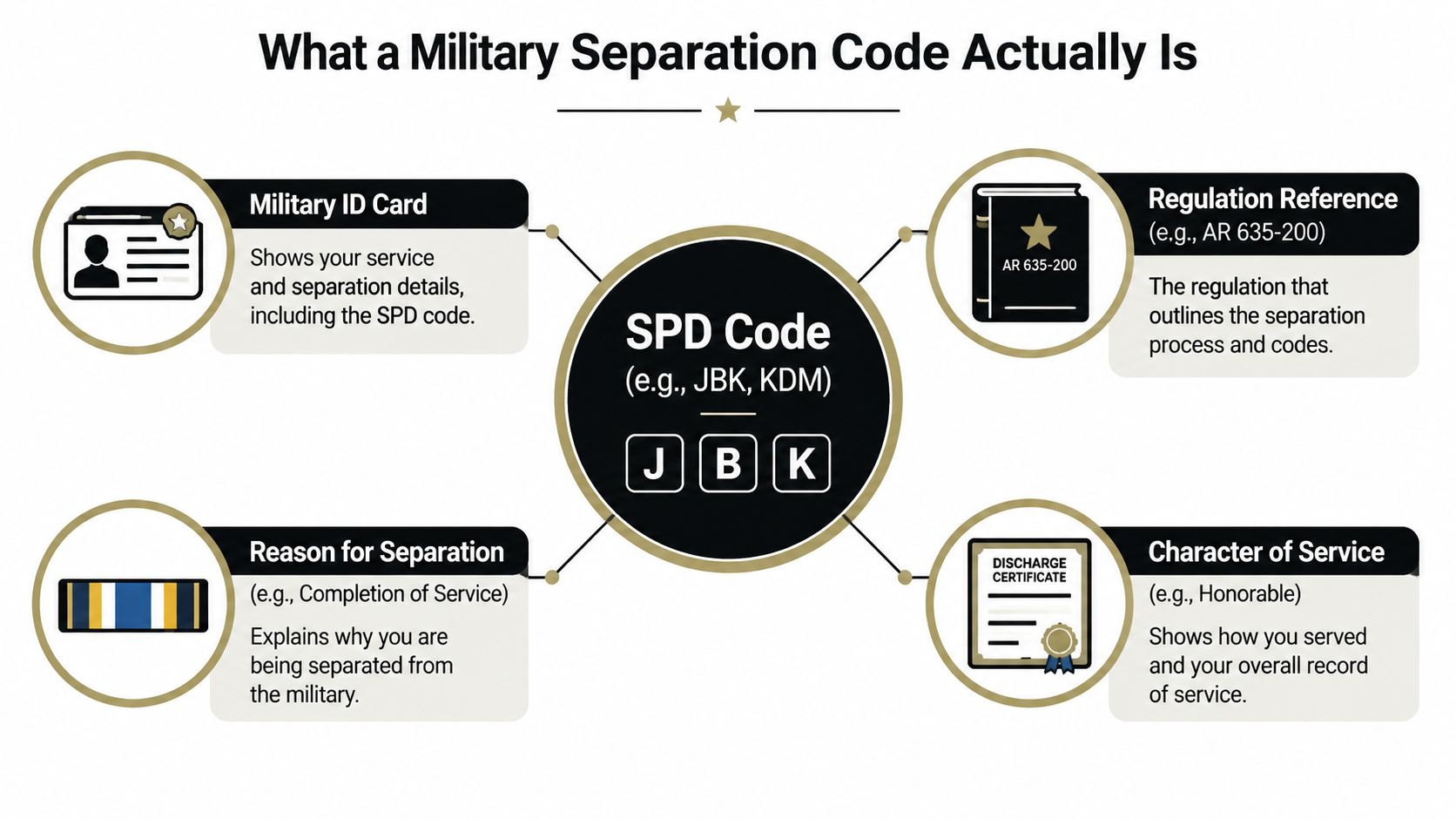
SPD, authority, narrative, and characterization are different
The governing Army regulation, Army Regulation 635-5-1, standardizes SPD codes and ties each code to a regulatory authority, separation reason, and code entry on the DD Form 214. The regulation's purpose is to identify the reasons and types of separation from active duty and prescribe the authorities used to separate Soldiers. The regulation is available through this copy of Army Regulation 635-5-1.
That distinction matters because a code can be accurate in one respect and wrong in another. A person may have completed the required service, received an unexpected RE code, and still have an honorable characterization. Those entries aren't interchangeable.
The Army's official processing guidance describes the SPD as the “3-character” entry used for the member's specific separation authority and explains that the code identifies the conditions under which the member is discharged. Because branch documents and historical forms can differ, don't rely on an internet list that ignores the form's date, service, and regulatory authority.
Treat the code as evidence, not a verdict
The SPD is a structured data point. It can help reveal whether the clerk used the correct separation program, whether the narrative reason matches the authority, and whether the RE code appears consistent with the underlying facts. It doesn't independently decide every VA benefit question, security-clearance issue, or employment consequence.
That's why a serious review starts with the complete record, including the separation packet, counseling statements, evaluations, medical documents, command recommendations, and any board findings. The code tells you where to look. It doesn't replace the investigation.
Where to Find Your Separation Code on Discharge Paperwork
Start with the DD Form 214 itself, not a third-party decoding website. On the modern form, the SPD appears in Block 26. Official military guidance places the separation code there and directs readers to consider it alongside Blocks 23, 24, and 28, which provide the administrative context for the separation. The Defense Department guidance on DD Form 214 separation entries identifies the code's location and function.
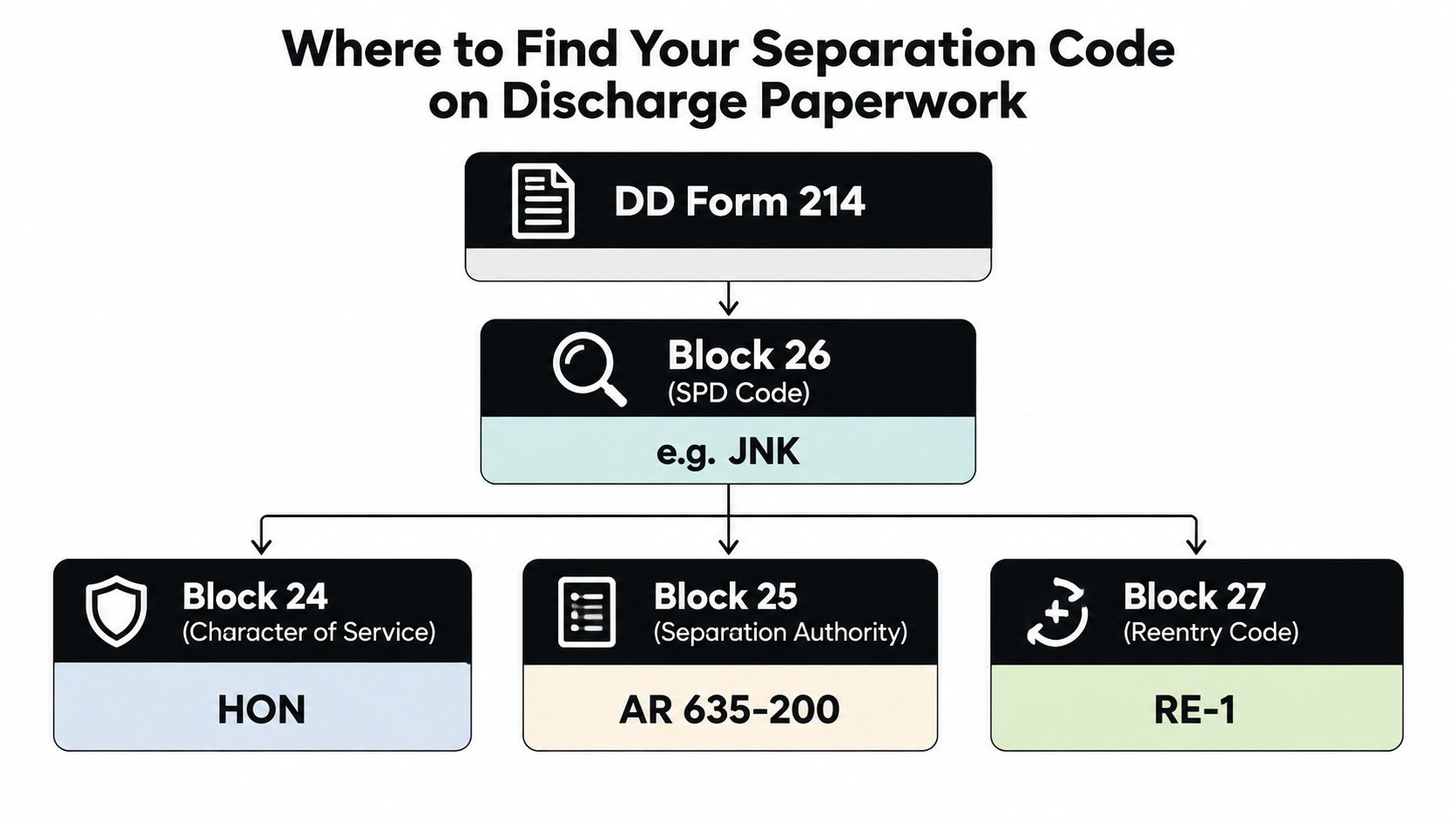
Read the blocks as a group
Use this sequence:
- Block 23 identifies the separation type. It helps establish how the service member left active duty.
- Block 24 records character of service. The characterization appears here, such as honorable or another authorized category.
- Block 25 identifies the separation authority. This should correspond to the regulation and authority used to process the separation.
- Block 26 contains the SPD code. This is the structured code for the specific separation program.
- Block 27 contains the RE code. This is separate from the SPD and addresses reenlistment eligibility.
- Block 28 states the narrative reason. It gives the plain-language explanation, but it doesn't replace the coded entry or the authority.
The most common error is confusing Block 26 with Block 27. The SPD explains the separation program. The RE code determines whether the service considers you eligible to return, eligible only with a waiver, or disqualified under the applicable rules.
Older forms require caution
The code system changed over time. The DD Form 214's standardization in 1950, the 1956 move toward coded separation reasons, the development of SPDs by the early 1970s, and the 1979 adoption of the current form title mean older records may not resemble current paperwork. Branch-specific practices and inactive entries can also complicate online searches.
If a code appears on an older form, preserve the original document and identify the service, separation date, and version of the form before relying on a current table. A code that appears familiar may have had a different meaning in a different era.
Common Military Separation Codes and What They Mean
A raw separation-code list is a trap. It gives you a label without telling you what to verify next. The same general category can lead to very different outcomes depending on the separation authority, characterization, RE code, underlying facts, and branch-specific rules.
The table below uses the verified examples available here and describes other categories qualitatively rather than inventing code meanings.
| Category | Example SPD | Plain language meaning | Typical impact |
|---|---|---|---|
| Completion of required service | MBK | Completion of required active service in the Army context | Usually calls for a review of the RE code and characterization, especially if the entries appear inconsistent |
| Voluntary or administrative separation | Varies by branch and authority | Separation under an elected, approved, or administrative program | The governing authority and narrative reason control the analysis |
| Misconduct-related separation | Varies by branch and authority | Separation tied to alleged or established misconduct | Can create serious reenlistment, records-review, and career concerns |
| Medical or condition-based separation | Varies by branch and authority | Separation connected to a medical condition or other qualifying condition | Requires comparison of the code, medical record, authority, and characterization |
| Other administrative separation | Varies by branch and authority | Separation processed under a specific administrative program | The complete packet matters more than a generic online description |
MBK is the concrete example. Army records describe MBK as the code for Regular Army Soldiers eligible to reenlist, or those with a declination of continued service statement in force, who are released from active duty at the end of their enlistment and transferred to the Reserve Components to complete their military service obligation. The same records show that an associated RE code can be RE-3 when a declination statement is present. Review the Army record describing the MBK separation code rather than relying on a generalized code chart.
Don't assume every online table is current
Official Air Force, Army, and Department of Defense guidance shows that SPDs are standardized and tied to regulatory bases, narrative reasons, and reenlistment outcomes. But public tables may include inactive or branch-specific entries. Cross-branch interpretation is especially risky when the table doesn't identify the regulation or period that controlled the original separation.
If the code suggests misconduct, a medical basis, or another adverse program, obtain the underlying separation authority before drawing conclusions about benefits or clearance consequences. For a pending or completed administrative separation, a military administrative separation board lawyer can evaluate whether the recorded program matches the evidence and procedure.
How Separation Codes Connect to Reentry Codes and Eligibility
The SPD and RE code are a pair, but they do different jobs. The SPD identifies the separation program. The RE code addresses reenlistment eligibility. Looking at the SPD alone is like reading the reason a vehicle left a dealership without checking whether the financing application was approved.
Army records provide a clear example. MBK reflects completion of required active service in the circumstances described above, yet the associated RE code can be RE-3 when a declination statement is present. That means the person's separation reason and future eligibility can't be determined from “completed service” alone.
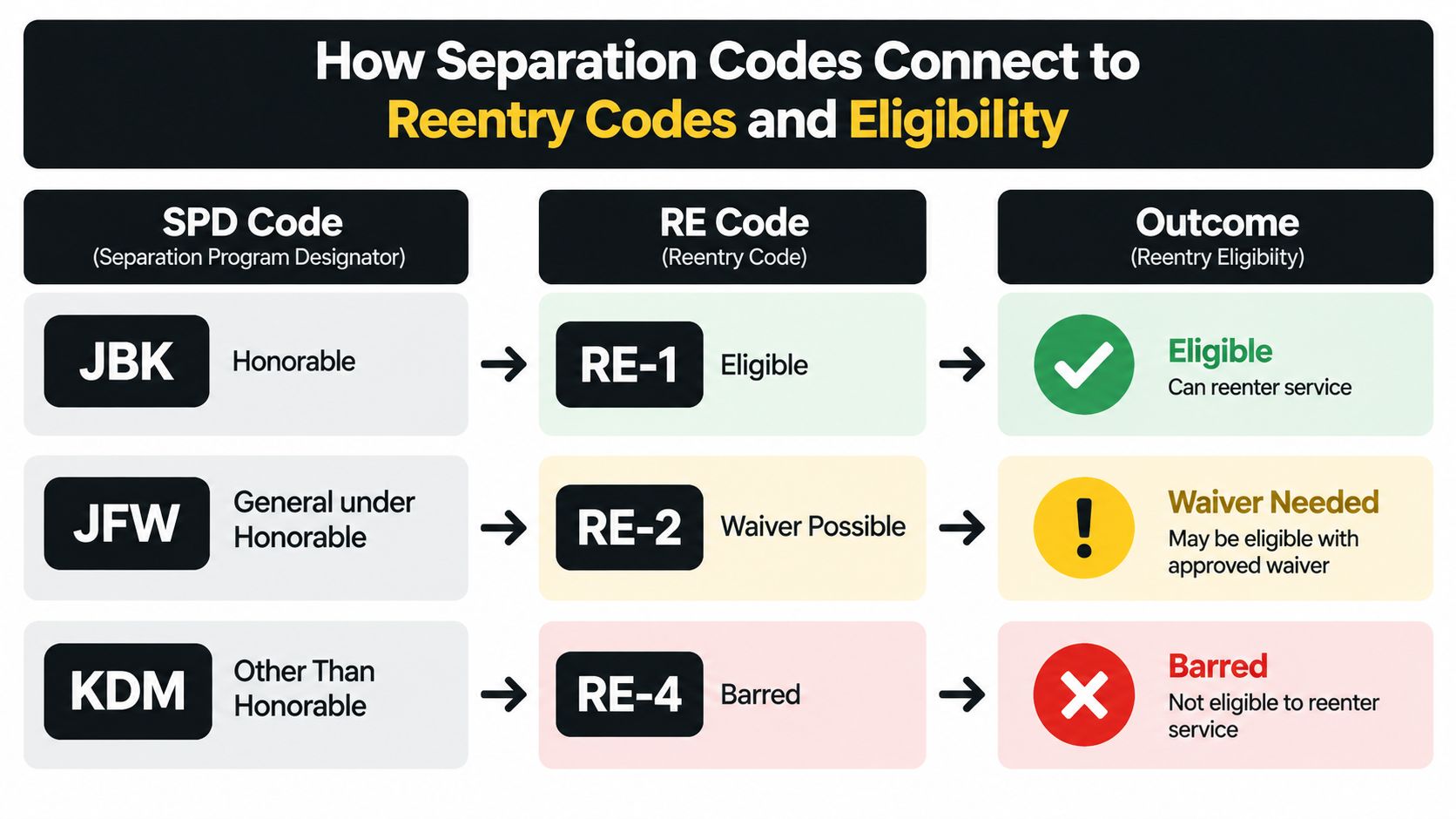
The RE code changes the practical answer
The verified Army materials distinguish the common outcomes this way:
- RE-1 means fully qualified to reenter. This is the favorable eligibility category.
- RE-3 means a waivable disqualification. Reenlistment may remain possible, but the applicant must address the condition and obtain the required waiver.
- RE-4 means a nonwaivable disqualification. The cited Army record identifies an SPD-to-RE pairing in which RE-4 makes the Soldier ineligible for enlistment.
The Army Board for Correction of Military Records records that JGH maps to RE-4 in the cited case, while RE-1 is reserved for those fully qualified and RE-3 represents a waivable disqualification. Read the Army record discussing the JGH and RE-code relationship for the specific administrative context.
Decode both fields before taking action
Pull the DD Form 214 and write down:
- The SPD in Block 26.
- The RE code in Block 27.
- The separation authority in Block 25.
- The characterization in Block 24.
- The narrative reason in Block 28.
Then compare the combination to the regulation and branch table that applied when you separated. If the RE code appears harsher than the reason, or if the authority doesn't support the code, that discrepancy deserves legal review. A restrictive RE code can affect future military service and may matter in federal employment or clearance-related opportunities, but an RE-code challenge can be distinct from a challenge to the discharge characterization.
How to Dispute or Upgrade Your Separation Code Step by Step
You don't fix a questionable separation code by sending an angry letter to your former command. You build a record showing that the entry is erroneous, unjust, inequitable, or unsupported by the governing authority.
Step 1, audit the complete record
Collect every version of the DD Form 214, separation orders, notification documents, election-of-rights paperwork, board findings, counseling records, evaluations, medical evidence, and relevant correspondence. Compare the SPD, authority, narrative reason, characterization, and RE code against each other.
Look for concrete defects:
- The narrative reason doesn't match the separation authority.
- The SPD doesn't correspond to the facts.
- The RE code conflicts with the documented separation basis.
- The command omitted favorable evidence.
- The separation process used the wrong procedure.
- The record contains a clerical error.
Step 2, choose the correct forum
A DD Form 293 is generally associated with an application to a Discharge Review Board for a discharge review or upgrade. A DD Form 149 is used to request correction of military records through the applicable Board for Correction of Military Records.
Those routes aren't interchangeable. The correct forum depends on what you're challenging, the service involved, the age and nature of the record, and the relief available. Ask for the precise correction you need. “Please fix my discharge” is weaker than identifying the incorrect SPD, the correct authority, and the evidence proving the mismatch.
Step 3, build an evidence-based argument
Boards need more than hardship. Explain the regulatory error or inequity, then support it with documents. If the issue is an incorrect completion-of-service code, enlistment records, service evaluations, separation orders, and command documents may matter. If the issue involves misconduct, credibility and procedural fairness become central.
Step 4, file a focused application
Keep the narrative organized. State the requested correction, identify the exact entries, explain why they're wrong, and attach evidence in a logical order. Don't bury the strongest document beneath emotional history. A reviewer should understand the theory of correction quickly.
Step 5, prepare for the decision and any next review
Policy and separation processing continue to evolve. The UK amended its 2025 discharge regulations, while U.S. Army and Coast Guard guidance updates issued in 2026 show that separation administration remains active rather than frozen in an old code list. The 2026 Army commanders' separation guidance is a reminder to confirm the rules relevant to your record instead of relying on outdated advice.
Use the following video as a general orientation, not as a substitute for reviewing your actual file.
Evidence beats outrage: A board can sympathize with your situation and still deny relief if you don't connect the requested correction to the record and the governing authority.
When to Hire Civilian Military Defense Counsel for Code Issues
A routine, internally consistent DD Form 214 may not require a lawyer. A code tied to misconduct, a restrictive RE code, a pending administrative board, or a mismatch between the narrative reason and the authority does.
Military-appointed counsel can provide valuable advice, but that attorney's role may be limited by the stage of the case, available resources, and the scope of the assigned representation. An independent civilian defense lawyer works for you, not the command. Experienced military defense lawyers, court-martial attorneys, and a qualified UCMJ lawyer can examine the separation record with the same discipline used in a contested investigation or trial.
Civilian counsel can also separate the issues. You may not need to challenge the entire characterization if the problem is the SPD or RE code. Conversely, a favorable code won't cure a damaging narrative reason or an unsupported separation process.
For an Army-specific administrative discharge problem, review Army administrative discharge representation and then speak directly with counsel about the documents, deadlines, and relief available.
The UCMJ Lawyer Directory is one option for locating civilian military defense attorneys and reviewing firm profiles, professional credentials, and practice information. Use it as a starting point, then compare lawyers based on direct experience with separations, records correction, reenlistment issues, and high-stakes military defense.
Frequently Asked Questions About Military Separation Codes
What is a separation code on a DD Form 214?
It's the Separation Program Designator, or SPD code. It identifies the type and reason for separation under the applicable service regulation. On the modern DD Form 214, it appears in Block 26.
Is the SPD the same as the RE code?
No. The SPD identifies the separation program. The RE code addresses reenlistment eligibility. You need both fields, plus the authority, characterization, and narrative reason, to understand the record.
Where is the separation code on military discharge paperwork?
Look in Block 26 of the DD Form 214. Check Block 25 for the separation authority, Block 24 for characterization, Block 27 for the RE code, and Block 28 for the narrative reason.
Does MBK mean I'm barred from reenlistment?
Not by itself. Army records identify MBK as completion of required active service in specified circumstances, but the RE code controls the practical reenlistment question. An RE-1 indicates full qualification, while an RE-3 requires a waiver.
What does RE-4 mean?
In the cited Army guidance, RE-4 is a nonwaivable disqualification from enlistment. If your record contains RE-4, don't assume the matter is hopeless, but don't assume a recruiter can override it either. Review the SPD-to-RE pairing and consider a records-correction strategy.
Can I challenge only the separation or reentry code?
Potentially, yes. A restrictive RE code may be challenged separately from the characterization of service, depending on the service, forum, record, and requested relief. The application should identify exactly what you want corrected and why the evidence supports that correction.
Do I need a lawyer to dispute a separation code?
You can submit an application without counsel. You shouldn't handle a complicated or adverse record casually, especially where misconduct, an RE-4, a pending board, or an apparent regulatory mismatch is involved. Counsel can identify the proper forum, frame the legal theory, and prevent you from damaging your position with an incomplete submission.
Will a separation code automatically eliminate VA benefits?
No single SPD entry answers every benefits question. Eligibility can depend on the characterization of service, the benefit involved, statutory requirements, and the facts of the separation. Don't rely on a code list as a benefits determination.
If your DD Form 214 contains a separation code you don't understand, pull the complete document today and review Blocks 24 through 28 together. If the code is tied to misconduct, an RE-4, an administrative board, or a possible error, contact an experienced civilian military defense lawyer before you submit an application, speak with a recruiter, or let a correction deadline pass. Your record is already influencing future decisions, and early strategy gives you the best chance to control what it says.