You’re probably reading this right after a first sergeant, chief, platoon sergeant, or supervisor told you that you’re “being offered NJP,” “going to mast,” or “getting an Article 15.” Your stomach dropped for a reason. This is one of those moments in military life where people make bad decisions fast, usually because command wants a clean answer before you’ve had time to think.
Here’s the blunt truth. If you’re asking what is an njp in the military, you’re already in a fight. Not a court-martial yet, maybe. But a fight over your rank, your pay, your record, your promotion future, and in many cases your ability to stay in uniform. The worst move is treating this like a paperwork issue instead of a defense problem.
A lot of service members walk into this process thinking, “I’ll just explain what happened and take my lumps.” That mindset gets people buried. NJP is often the first battle in a much bigger war for your career. How you handle the next decision matters.
Table of Contents
- Your Career Is On the Line The Moment You Hear NJP
- What Is Non-Judicial Punishment or Article 15
- The NJP Process From Notification to Punishment
- Your Three Critical Choices Accept Refuse or Appeal
- NJP vs Court-Martial A Head-to-Head Comparison
- Common Mistakes That Can Destroy Your Case
- Why You Need an Experienced Civilian Defense Lawyer for NJP
- Frequently Asked Questions About NJP
Your Career Is On the Line The Moment You Hear NJP
You get called in. Somebody reads allegations. Maybe it’s disrespect. Maybe late reporting. Maybe a false statement allegation, missing gear, minor property damage, or disobeying an order. Then comes the pressure. “If you accept this, we can handle it at the command level.” That sounds manageable. It usually isn’t.

The reason people freeze is simple. NJP is sold as the “better than court-martial” option. Sometimes it is. Sometimes it’s a trap dressed up as mercy. An administrative action can still crush a military career. If you need a broader look at the downstream damage, review how Article 15 and nonjudicial punishment affect a military career.
The pressure starts before you understand the case
Most clients come in with the same problem. They’ve already started talking. They’ve tried to sound respectful, cooperative, and mature. In reality, they’ve helped the command tighten the file against them.
That’s why the first rule is simple:
Practical rule: The moment NJP is mentioned, stop explaining and start assessing.
NJP is not a harmless counseling session. It is a formal disciplinary event under military law. It creates a record. It provides commanders with an advantage. It can feed later administrative separation action, damage evaluations, and poison future opportunities.
What you should do in the first day
Your job right now isn’t to win an argument in the hallway. Your job is to avoid making your position worse.
- Get the allegation clearly identified. You need to know what conduct they claim happened.
- Ask to see the evidence. Don’t guess what they have.
- Use your right to consult counsel. Do this before choosing a path.
- Stop informal statements. Your supervisor is not your defense team.
- Think beyond today. Rank, clearance, retention, and promotion matter more than short-term embarrassment.
If you remember one thing, remember this. The first NJP conversation is often where the defense either starts correctly or gets crippled.
What Is Non-Judicial Punishment or Article 15
Non-Judicial Punishment, or NJP, is a commander’s power under Article 15 of the Uniform Code of Military Justice to punish alleged minor misconduct without a court-martial. The name changes by branch. The Army and Air Force usually call it Article 15. The Navy and Coast Guard use Captain’s Mast or Admiral’s Mast. The Marine Corps commonly calls it Office Hours.
Here is what matters to you. NJP is not just discipline. It is command’s first real opportunity to put a permanent mark on your record while keeping the process inside the unit and heavily tilted in its favor.
That is why it helps to stop asking whether the offense sounds minor and start asking a better question. Is this a case you can afford to absorb, or is this the first fight in a larger battle over your rank, pay, clearance, evaluation, retention, or promotion?
What NJP really is in practice
Command uses NJP because it is fast, controlled, and efficient. They can act without the delay, rules, and exposure that come with a court-martial. For the service member, that means less procedural protection and a decision point that arrives early.
Do not let the phrase “non-judicial” fool you; a bad NJP result can strip money, reduce rank, damage your standing with leadership, and hand the command a cleaner path to later administrative action.
What conduct usually ends up at NJP
Commands often reserve NJP for misconduct they classify as minor. That label is misleading. “Minor” under military discipline can still do major damage to your career.
Common allegations include:
- Late reporting
- Disobeying orders
- Petty theft
- Failure to follow instructions
- Other misconduct command believes disrupts good order and discipline
In many cases, the charge sheet is only part of the problem. The primary issue is that command may already view the allegation as proof that you are unreliable, disrespectful, or not worth future investment. That broader command narrative is what you have to fight.
What punishment can look like
NJP punishments are limited compared with a court-martial, but they still hit hard and fast.
| Possible NJP punishment | What it means |
|---|---|
| Restriction | Limits where you can go |
| Extra duties | Adds work after normal duties |
| Forfeiture or detention of pay | Cuts into your paycheck |
| Reduction in rank | Costs authority, status, and money |
| Correctional custody or arrest in quarters | Imposes restrictive discipline in some cases |
Depending on your rank and the commander’s authority, NJP can mean weeks of restriction or extra duty, loss of pay, reduction in grade, correctional custody, or arrest in quarters. In practical terms, that can turn one allegation into lower income, worse evaluations, and a much weaker position if the command later tries to separate you.
If you are asking what an NJP is in the military, use this definition. It is a command-controlled punishment process that forces you to make a career-level decision early, often before you have the full picture. Treat it that way.
The NJP Process From Notification to Punishment
You get called in, the command says NJP is on the table, and the clock starts running before you have the full story. That is the first fight. If you treat that moment like routine paperwork, command gets the advantage and you spend the rest of the case trying to recover.
Speed is part of the pressure. Command wants a quick answer. You need a smart one.
What happens first
The process begins when command notifies you of the alleged misconduct and tells you it intends to handle the matter through NJP. From that point on, every step matters because you are not just responding to discipline. You are deciding how hard to contest the case and how much risk to take with your career.
Your first job is to pin down four things:
- What, exactly, are they accusing you of
- What evidence do they possess
- What election do you have to make, and by when
- Have you talked to counsel before saying a word
Your rights at this stage are the parts that give you room to fight. You may be able to refuse NJP and demand court-martial, consult with counsel, present matters in defense, extenuation, or mitigation, and appeal the punishment within the applicable service deadline, including deadlines as short as 5 to 15 days depending on rank and branch as noted earlier.
Do not answer the strategic question too fast. The command’s version of events is usually cleaner than the actual one. Missing witnesses, bad timelines, and assumptions dressed up as facts are common.
What notice really means
Notice is not a courtesy. It is command telling you they believe they have enough to act, or at least enough to pressure you into folding.
That is why you need to examine the packet like a defense lawyer, not like a service member hoping this will blow over. Read the wording carefully. Compare the allegation to the actual facts. Look for what is missing, not just what is included. A weak NJP case often hides inside vague language and confidence from command.
Ask hard questions early:
- Who witnessed the event
- What statements were taken, and when
- What records or messages support the accusation
- What facts are being guessed at instead of proven
- What has command left out because it helps you
What the hearing usually looks like
If you accept NJP, the matter goes to the commander for a hearing. The commander reviews the accusation, considers the available evidence, hears what you choose to present, and decides whether punishment will be imposed.
That process is fast, command-driven, and tilted in favor of the government. The commander is not a neutral judge. The commander is evaluating credibility, deciding whether the allegation is supported, and selecting punishment in the same proceeding. If your case theory is weak, disorganized, or unsupported by documents, the result is usually predictable.
Do not walk into that room planning to explain things off the cuff. Build your presentation before the hearing. Get your documents together. Line up witnesses if they help. Decide whether you will make a statement or stay disciplined and let the paper speak for you. People damage their own cases by talking too much, admitting facts they did not need to admit, or arguing emotion instead of evidence.
Command also tends to move NJP quickly because it is far easier and faster than sending a case to trial. That speed helps command. It hurts you if you confuse urgency with strength.
What happens after punishment
If the commander imposes punishment, the problem does not end when the extra duty, restriction, forfeiture, or reduction is over. The record can follow you into evaluations, promotion decisions, reenlistment decisions, and separation action. It can also shape how your chain of command treats the next allegation, even a minor one.
That is the point many service members miss. The hearing is only one event. The key question is what this result does to your record and whether you are making the next fight harder.
Treat the full NJP process as a decision sequence. First, get the facts. Next, choose whether to accept or refuse. Then, if punishment is imposed, decide immediately whether an appeal is worth filing. Each step affects the next one. Each step also affects how much of your career you can still protect.
Your Three Critical Choices Accept Refuse or Appeal
You get told NJP is on the table. Right then, your case stops being about hurt feelings, office politics, or whether command seems reasonable. It becomes a career defense problem. Your next decision can limit the damage, force the government to prove its case, or lock a bad result into your record.
Those are your three choices. Accept the NJP. Refuse it and demand trial. Accept it and appeal afterward. Treat each one like a tactical decision in the first battle for your military career, not a formality you need to get through.
When accepting may be the least bad option
Accept NJP when the evidence is solid, the misconduct is easy to prove, and the risk of a court-martial is worse than taking the hit in a smaller forum. That is not surrender. That is containment.
Accept NJP only when the math makes sense. If the facts are largely locked down, the witnesses will hold up, and command appears willing to keep the matter at NJP, taking the shorter fight can protect you from a much bigger one. If you need a fuller explanation of what a trial exposure can look like, review these court-martial basics for service members and families.
Accepting may be the right call when:
- The facts are not seriously disputed
- A court-martial would create broader punishment risk
- Command appears willing to keep the case contained
- Your objective is damage control, not total vindication
Do not confuse acceptance with agreement. You can believe the process is unfair and still decide that NJP is the better battlefield.
When refusal becomes the smart move
Refusal matters when command has a weak file and expects you to fold. That happens more than people think.
If the allegation is inflated, the statements conflict, key facts are missing, or the charge does not match what happened, refusing NJP can force command to confront its proof problems. Once the government has to carry the case in a more formal forum, weak cases often look a lot weaker.
Use refusal seriously when the record risk from NJP is high and the evidence against you is shaky. Do not refuse out of pride. Refuse because the case has real flaws and you are prepared for the possibility that command may push forward.
| Sign | Why it matters |
|---|---|
| Witness credibility is shaky | Weak testimony breaks down when details matter |
| The allegation is exaggerated | Command may be stretching facts to get a quick result |
| The record consequences are severe | A bad NJP can affect promotions, reenlistment, and separation risk |
| Important evidence is missing | You should not accept punishment on an incomplete file |
When an appeal should happen immediately
If punishment gets imposed, the clock starts fast. Waiting to see if things calm down is how service members lose appeal rights and give bad decisions time to harden into official history.
Appeal when the finding is wrong, the punishment is excessive, or the hearing process was defective. Appeal when you were blocked from presenting evidence. Appeal when the commander relied on bad facts. Appeal when the paperwork is sloppy enough to matter.
File the appeal with a reason, not a complaint. Point to the factual error, the unfair procedure, the disproportionate punishment, or the preparation problem that tainted the result.
If the command got the facts wrong, challenge it before that version of the story becomes your record.
The right question is simple. Which option gives you the best chance to protect your rank, your record, and your future in uniform. Answer that question early, and answer it like your career depends on it, because it does.
NJP vs Court-Martial A Head-to-Head Comparison
You are not choosing between a small problem and a big one. You are choosing which battlefield gives you the better chance to protect your rank, your record, and your future.
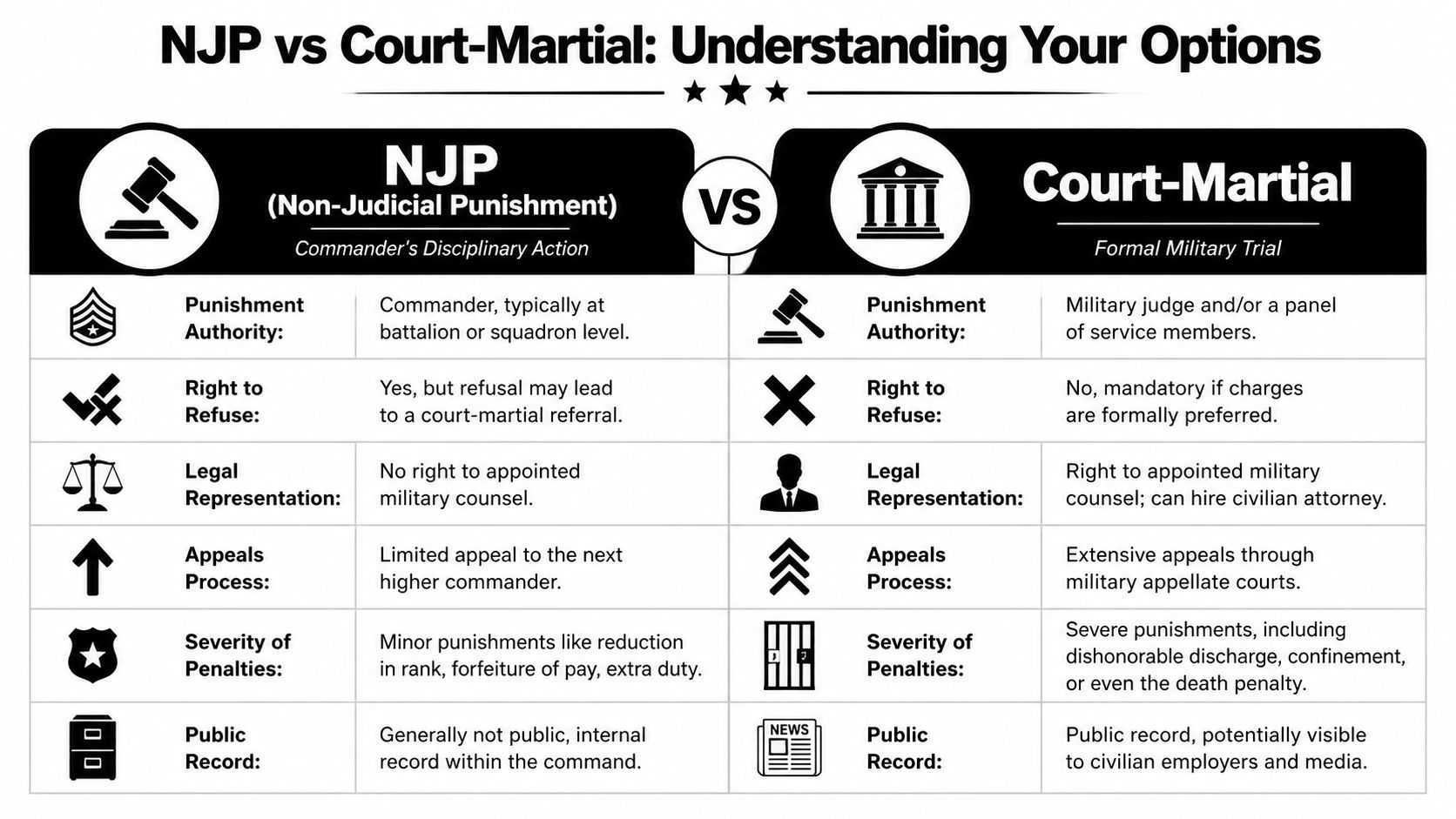
If you need a broader primer on formal military prosecutions, review court-martial basics for service members and families.
The key difference in power and protection
NJP puts your commander in charge of the fact-finding, the decision, and the punishment. Court-martial forces the government into a formal prosecution where rules matter, evidence gets tested harder, and the accused has stronger procedural rights.
That does not mean court-martial is automatically the better option. It means the decision must be strategic.
If the case against you is weak, refusing NJP may force command to prove something they cannot prove well. If the allegation is strong and the likely punishment at NJP is limited, accepting NJP may contain the blast radius. If command imposes an unfair result at NJP, an appeal may be the fastest way to stop bad facts from becoming permanent paperwork.
Here is the practical split:
- NJP gives command speed and control
- Court-martial gives the accused more legal protection
- NJP usually limits punishment compared with trial
- Court-martial raises the stakes, but it also raises the government’s burden
Side-by-side comparison
| Issue | NJP | Court-martial |
|---|---|---|
| Who decides | Commander | Military judge and possibly a panel |
| Nature of proceeding | Administrative discipline | Formal military trial |
| Ability to turn it down | Often yes, depending on status and assignment | No once charges are referred |
| Punishment range | Restricted by rank and forum | Can include far harsher penalties |
| Rules and protections | Fewer procedural safeguards | Stronger evidentiary and trial protections |
| Record impact | Administrative record that can hurt your career | Criminal consequences may follow |
| Visibility | Usually handled inside the command | More formal and often more exposed |
The smart question is not which forum sounds less scary. The smart question is which forum helps you most. A weak case may belong in a courtroom where the government has to prove it. A manageable case may be better contained at NJP before it grows teeth.
One point trips up a lot of service members. NJP is not a criminal conviction, but it can still stain evaluations, promotions, retention, and clearance decisions, as noted earlier. Court-martial carries more danger on paper, but NJP can still do serious career damage in practice.
So do not use this lazy rule: “Take the Article 15 and move on.” Sometimes that is the right call. Sometimes it is an avoidable surrender that hands command a win they did not earn.
Common Mistakes That Can Destroy Your Case
You get called in, told NJP is on the table, and your first instinct is to explain yourself, calm the room down, and show command you are still a good service member. That instinct loses cases.
An NJP is not just punishment. It is the opening fight over your record, your promotion path, your retention, and sometimes your clearance. If you make bad decisions in the first 24 to 72 hours, you hand command a cleaner win than they may deserve.
The mistakes that wreck good defenses
Talking to “clear things up”
This is the most common mistake. Service members talk because they want to look cooperative. What they usually do is supply missing details, lock themselves into a version of events, and make the command’s job easier.Treating the NJP decision like a paperwork drill instead of a strategy choice
Accepting, refusing, or later appealing an NJP is not a box-checking exercise. It is a career decision. If you choose too fast, without testing the evidence and the command’s real objective, you can trap yourself in the wrong forum.Assuming “minor misconduct” means minor consequences
The hearing may be informal. The record impact is not. One NJP can follow you into evaluations, promotion reviews, reenlistment decisions, and clearance scrutiny.Waiting until after punishment to fight
That is backward. The best chance to shape the facts, challenge weak proof, and present mitigation is before the commander makes a decision, not after the paperwork is signed.Relying on hallway advice
“Just take it.” “Don’t make waves.” “If you refuse, they’ll hammer you.” Some of that advice is lazy. Some of it is flat wrong. None of it is specific to your facts, your status, or your long-term risk. If you need help evaluating that risk, read this guide on how to choose the right military defense lawyer.- Ignoring how ugly the record can look later
Whether your command says this is “career ending” or not does not matter. Future decision-makers may read it that way.
The real mistake is reacting instead of deciding
Good service members get in trouble here because they approach NJP like a character test. It is a decision test.
You need to answer hard questions early. How strong is the evidence? Is command bluffing? Does refusal improve your position or expose you to a worse fight? If you accept, what do you need in the record to protect yourself later? If punishment is imposed, do you have grounds to appeal based on unfairness, disproportionality, or bad procedure?
Those are legal and strategic questions. They deserve legal and strategic answers.
Why record damage keeps hurting after the hearing
Rank loss and extra duty hit now. Record damage keeps showing up later, often when you are trying to recover.
A future rater may read the NJP before reading anything good about you. A promotion board may treat it as a judgment problem, not a one-time incident. A retention or clearance review may see “pattern,” “reliability,” or “trustworthiness” concerns where you see one bad allegation handled badly.
Here’s a short briefing that tracks some of the same pitfalls in practice:
The service member who wins this stage is usually the one who slows down, shuts up, gets the facts, and makes a deliberate choice before command locks the story in place.
If command says this is “just paperwork,” treat that as a warning. Paperwork is how careers get buried.
Why You Need an Experienced Civilian Defense Lawyer for NJP
A military defense counsel can be valuable. Many are hardworking and capable. But if your career matters, you should understand the limits of relying only on appointed counsel.
Independence matters
A civilian military defense lawyer works for one person. You. Not the installation. Not the chain of command. Not the broader system.
That independence matters when the case requires hard conversations with command, aggressive review of investigative shortcuts, and a strategy that looks beyond the immediate hearing. NJP often connects to future administrative separation, evaluation damage, and clearance trouble. A civilian lawyer can build for all of that from day one.
If you’re comparing options, review how to choose the right military defense lawyer.
Experience changes outcomes
An experienced civilian UCMJ lawyer or court-martial attorney usually brings one thing that changes everything. Pattern recognition. They’ve seen weak witness statements, inflated command narratives, bad paperwork, and overcharged misconduct before. They know where NJP cases break.
That matters because strategy wins these cases. Not hope. Not politeness. Not “being squared away.”
Look for counsel who can do the following:
- Evaluate whether accepting NJP makes sense
- Assess whether refusal provides an advantage
- Build a focused defense package
- Prepare appeal arguments if punishment is imposed
- Protect the case from spilling into bigger damage later
If you’re facing NJP, hiring experienced civilian counsel is not overreacting. It’s acting like your career is worth defending.
Frequently Asked Questions About NJP
Can I get NJP for something off duty or off base
Yes, conduct outside the workplace can still trigger military discipline if command claims it falls under the UCMJ and military jurisdiction.
Is NJP a criminal conviction
No. Verified data states NJP is not a criminal conviction. But it still affects service records and can damage promotions, evaluations, retention, and security clearances.
Can I talk my way out of it
Usually not. Talking early often makes the case easier for command. Get the allegation, review the evidence, and speak with counsel before making statements.
Should I refuse NJP automatically
No. Refusal can be smart when the case is weak. It can also create bigger risk if the government is prepared to push the matter to court-martial. This is a strategy call, not a pride contest.
Can I appeal
Yes. Verified data states service members have appeal rights, with timelines that can run within 5 to 15 days depending on rank and branch under the NJP framework described earlier.
Do I need a lawyer now
Yes. If you’re still deciding whether to accept or refuse NJP, this is when legal advice matters most. After punishment, your options narrow.
If you’re facing NJP, Article 15, Captain’s Mast, or Office Hours, act now. Don’t wait for the command to define the case for you. Don’t assume a “minor” action stays minor. Your rank, record, and future may turn on decisions you make in the next day or two.
Speak with qualified civilian military defense counsel immediately. The right strategy early can be the difference between limited damage and a career that never recovers.