
Three days after a court-martial conviction, most service members aren’t thinking like lawyers. They’re trying to understand whether they’ll remain free, whether a punitive discharge will end their career, and whether a conviction will follow them into civilian life. The sentence may have been announced only recently, but the decisions made now can shape confinement, discharge characterization, military records, retired pay eligibility, and future employment.
A court-martial appeal attorney doesn’t treat an appeal as a second trial. The work is more exacting. Counsel must find preserved legal errors, identify defects in the trial record, frame factual-sufficiency arguments under the current law, protect post-trial rights, and control deadlines that can close the appellate door. The sections below explain the appellate pipeline, what a specialist does, how the 2025 NDAA’s automatic appellate defense appointment changes the decision to hire civilian counsel, and how to vet the lawyer handling the next stage of your case.
Table of Contents
- When the Verdict Comes Down and the Appeal Clock Starts
- How the Court Martial Appeal Process Works
- Critical Deadlines and Timelines You Can’t Afford to Miss
- What an Appellate Attorney Does With Your Trial Record
- Choosing and Vetting the Right Court Martial Appeal Attorney
- Why Civilian Appellate Counsel Changes the Outcome
- Your Next Steps and Questions to Ask Right Now
When the Verdict Comes Down and the Appeal Clock Starts
The courtroom has emptied. Your family is waiting for answers. Your trial lawyer may have explained that review is available, but “you can appeal” isn’t a strategy. A bad-conduct discharge, dishonorable discharge, confinement, or adverse finding can affect your freedom, career, benefits, security-clearance prospects, and reputation long after the military case ends.
The first instruction is simple: don’t wait for the paperwork to feel final. The post-trial period is active legal work. You may have matters to submit, records to obtain, deadlines to calendar, and errors to preserve. The court-martial appeal attorney you retain should begin by determining the approved sentence, the court-martial forum, the post-trial status, and the exact date each deadline began running.
Four risks require immediate attention
- Liberty: If confinement is part of the approved sentence, post-trial delay, sentence relief, and credit issues may matter immediately.
- Discharge characterization: A punitive discharge can affect civilian employment, veterans’ benefits, professional licensing, and the way future institutions view your service.
- Retirement and long-term military consequences: A conviction and separation can alter the practical value of years spent in uniform, including eligibility questions that require separate legal analysis.
- The permanent record: The trial record can become the foundation for appellate litigation, records correction, discharge review, and later civilian explanations of what happened.
The modern appellate system traces back to the Uniform Code of Military Justice, enacted by Congress in 1950 and effective on May 31, 1951. The UCMJ created direct civilian judicial review of courts-martial through the United States Court of Military Appeals and recognized qualified attorney representation in general courts-martial. Congress later renamed the service review bodies the Courts of Criminal Appeals in 1994, formalizing the tiered structure that still controls military appeals. The historical development is documented in this judicial review history of courts-martial.
Practical rule: Treat the day of conviction as the beginning of appellate preparation, not the end of the case.
The appeal clock isn’t paused because you’re looking for a lawyer, your family is gathering money, or the command hasn’t explained the next step. Call counsel immediately, preserve every document, and don’t sign post-trial statements without advice.
How the Court Martial Appeal Process Works
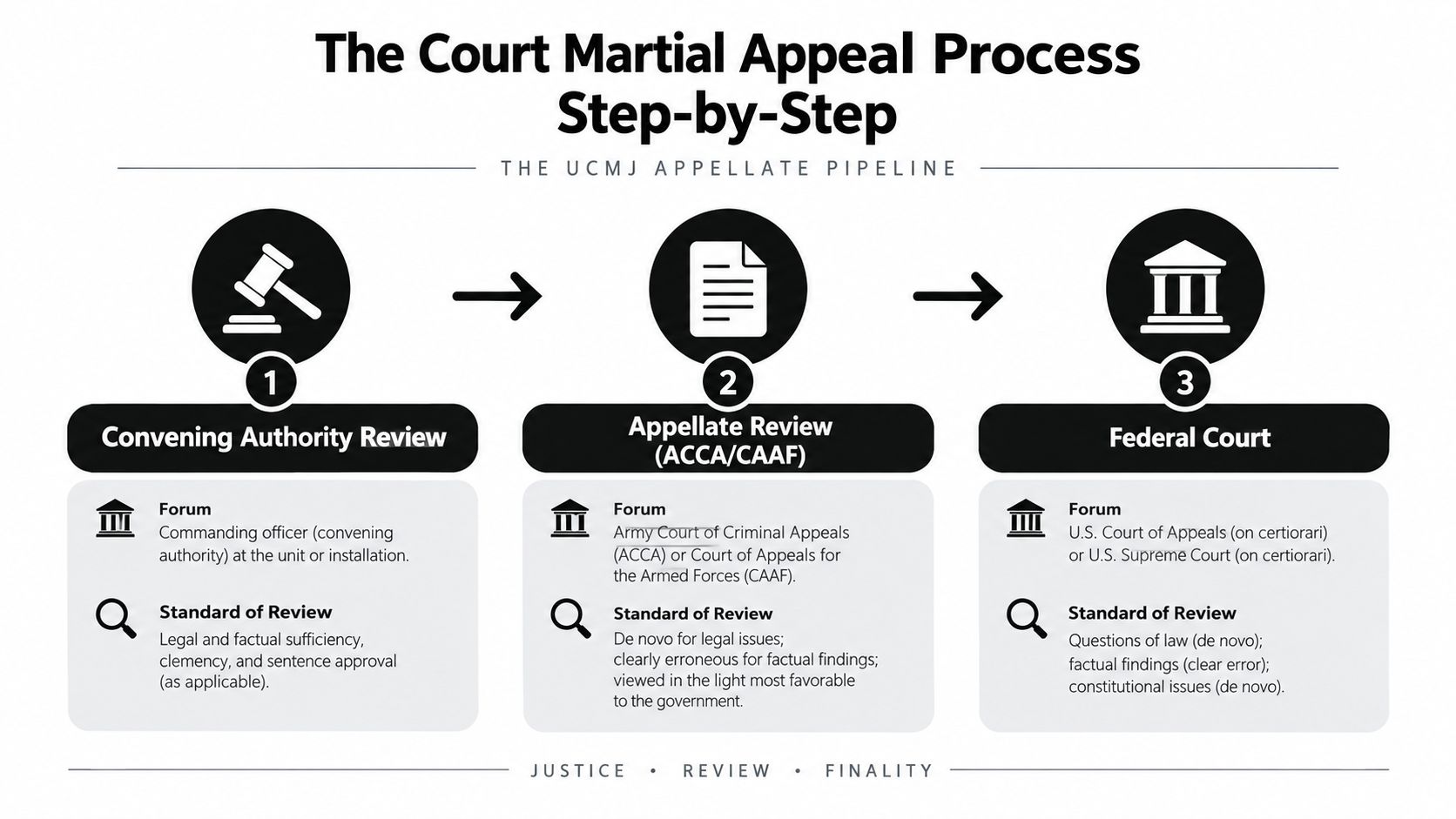
Three questions control the route after a court-martial conviction: what sentence was approved, which legal errors appear in the record, and whether counsel preserved those errors for review. Cases generally reach a service Court of Criminal Appeals when the approved sentence includes death, dismissal, a dishonorable or bad-conduct discharge, or confinement for one year or more. Counsel must verify that threshold and the governing jurisdiction from the actual record, because the route can change with the sentence and procedural posture.
The process usually begins with post-trial review by the convening authority. Under Article 60b and the applicable rules, the defense may submit matters addressing the sentence and other authorized post-trial issues. This stage is not a second guilt hearing, and the convening authority cannot erase the entire case because the result seems unfair. A focused submission can still seek sentence relief, identify defects, and preserve a clear post-trial record.
The service Courts of Criminal Appeals
Under Article 66, the Army Court of Criminal Appeals, Navy-Marine Corps Court of Criminal Appeals, Air Force Court of Criminal Appeals, or Coast Guard Court of Criminal Appeals reviews eligible cases. These courts can examine legal sufficiency, sentence appropriateness, and, when the statutory requirements are met, factual sufficiency.
The 2021 amendment changed factual-sufficiency review. The accused must request that review and make a specific showing of a deficiency in the proof before the court weighs the evidence. The CCA must also give deference to the trial court’s ability to see and hear witnesses. A brief that merely says “the members got it wrong” gives the court little to work with. Stronger briefing isolates contradictions, missing proof, credibility problems, or evidentiary gaps shown by the record.
That record is the battlefield. Appellate counsel reviews rulings, objections, instructions, exhibits, witness testimony, and the parties’ theories to determine which issues survived preservation, which require plain-error analysis, and how each error affected the result.
CAAF and the Supreme Court
Article 67 governs review by the Court of Appeals for the Armed Forces, commonly called CAAF. CAAF review is generally discretionary, although certified issues and other statutory routes can bring a case before the court. The focus is usually a significant legal, constitutional, or procedural question, rather than a wholesale reweighing of every factual dispute.
Article 67a provides a limited path to the United States Supreme Court. Supreme Court review is not a routine next step. Issues therefore must be preserved and framed with possible higher review in mind.
Collateral remedies sit beside direct appeal rather than replacing it. Depending on the case, counsel may evaluate extraordinary-relief petitions, habeas corpus, discharge review, or a petition to a Board for Correction of Military Records. Each remedy has its own purpose, eligibility rules, and limits. For a broader explanation, consult this guide to the UCMJ system and military justice.
Critical Deadlines and Timelines You Can’t Afford to Miss
Three days after a bad verdict, build a deadline map before debating the appeal’s strongest issue. Do not rely on memory or assume appointed counsel is tracking every clock. Military post-trial processing has several deadlines, and missing one can end review before counsel reaches the merits.
Build the map immediately
Start with the date the sentence was announced, then confirm these dates from the record and the applicable rules:
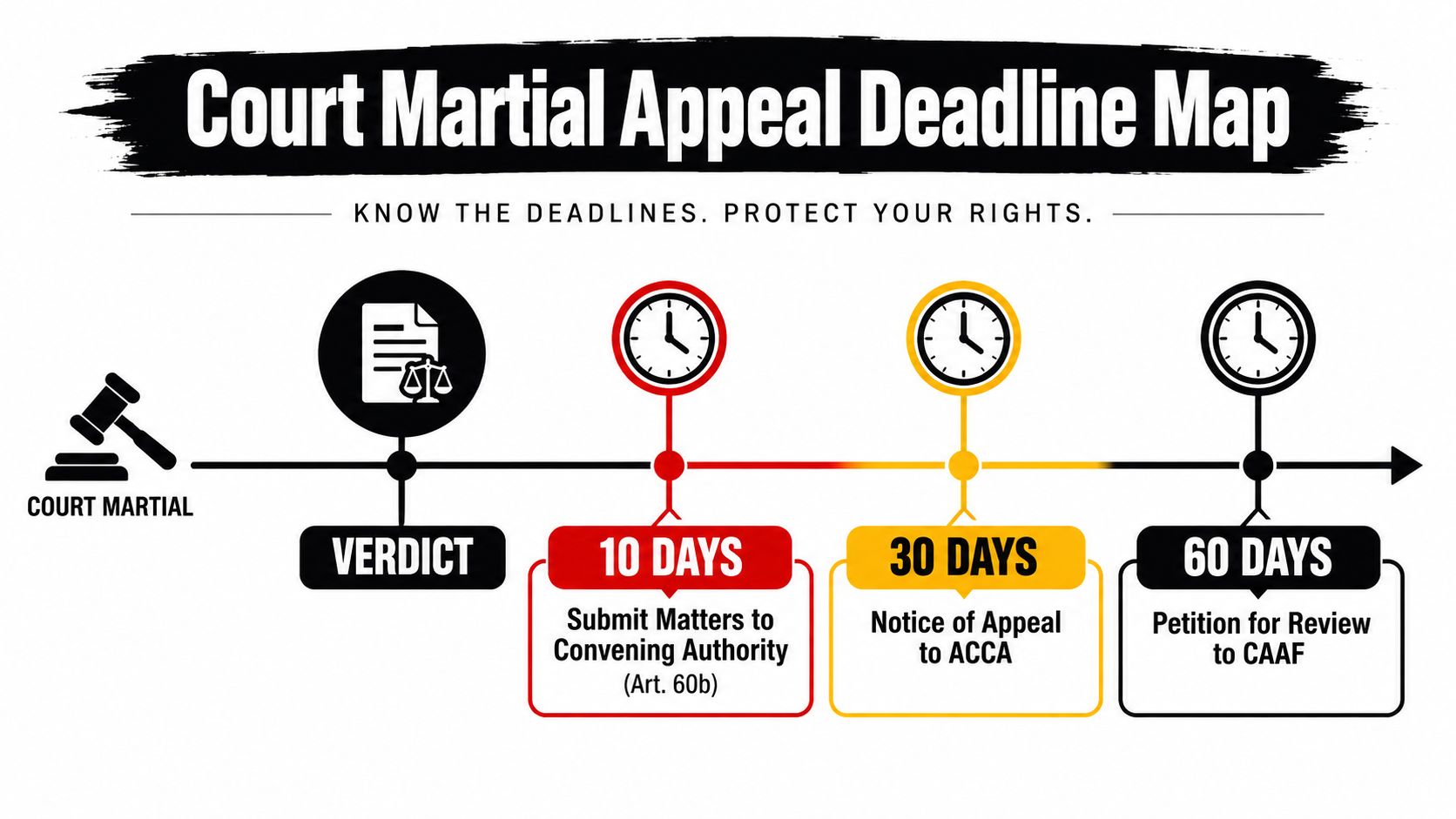
- The post-trial submission window: The defense must act promptly to submit authorized matters to the convening authority. The commonly used period is 10 days under applicable post-trial rules, with additional time potentially available under the governing procedures. Counsel should calculate the deadline for the specific case, not copy a standard calendar.
- The convening-authority window: Under the Moreno framework, action delayed beyond 120 days after completion of trial can trigger due-process review. The CAAF digest describing Moreno delay principles explains when post-trial delay may become an appellate issue.
- CCA filing and docketing deadlines: Confirm the notice and docketing requirements from the record, service rules, and procedural posture. Some materials refer to a 30-day docketing window, but the filing required in a particular case controls.
- The CAAF petition deadline: A petition seeking CAAF review generally must be filed within 60 days of the earlier of notification of the CCA decision or mailing that decision to the accused at the provided address. The governing statute is 10 U.S.C. § 867.
A separate delay benchmark applies at the service-court level. Under Moreno, CCA review lasting more than 18 months from docketing can create a presumption of unreasonable delay. That presumption does not automatically produce relief. It gives counsel a basis to examine prejudice, confinement, sentence credit, and how the record was handled.
The timing problem also reflects how few cases reach the higher military court. The FY18 Article 146a report found that only 16.3% of CCA-reviewed cases were forwarded to CAAF. The same report recorded 655 petitions denied compared with 66 granted, and reported that the combined 150-day trial-to-docket standard was met in only about 48% of cases. These figures appear in the Article 146a military justice reports.
The 2025 NDAA changes the starting point by providing automatic access to military appellate defense counsel instead of requiring the accused to request appointment. That access helps, but it does not answer whether appointed counsel has the right experience for the record, whether a civilian specialist should work alongside that counsel, or who is responsible for each deadline. Get those answers in writing.
What an Appellate Attorney Does With Your Trial Record
A trial lawyer works with witnesses, exhibits, objections, motions, and the factfinder in real time. An appellate lawyer works primarily with the record, which includes the transcript, admitted exhibits, rulings, motions, sentencing material, post-trial submissions, and the court’s orders. The appeal isn’t a chance to add testimony because the trial presentation now feels incomplete.
The first review is preservation analysis
Counsel compares the transcript against every contested ruling and objection. Was the issue raised clearly? Did the military judge rule on it? Did the defense object to the instruction, admission of evidence, government argument, or sentencing material? If the issue wasn’t preserved, counsel must evaluate plain-error or other available standards instead of presenting the claim as though it were preserved.
The second review asks whether the factual-sufficiency issue can meet the amended Article 66 standard. The question isn’t whether counsel can retell the defense theory more persuasively. The brief must identify a concrete deficiency in proof and account for the required deference to the trial judge’s ability to observe witnesses. That demands careful comparison of testimony, exhibits, stipulations, instructions, and the government’s theory.
The brief must make the error easy to find
A strong assignment of error has a defined legal question, accurate facts, controlling authority, and pinpoint citations to the record. It doesn’t bury the strongest issue under a list of every complaint made at trial. Appellate judges need to understand what happened, why the ruling was wrong, how the error affected the case, and what remedy the law permits.
Counsel also works on post-trial matters in parallel. An Article 39(a) session, record corrections, clemency submissions, and confinement-related requests may affect the posture of the case. A mistake in a findings worksheet, missing exhibit, incomplete transcript, or inaccurate post-trial action can matter as much as a dramatic trial objection.
The appellate question isn’t “What feels unfair?” It is “What does the record prove, what did the court get wrong, and what relief can this court legally grant?”
Oral argument is another distinct skill. Counsel must anticipate questions from the CCA or CAAF, conduct moot courts, narrow the theory to the strongest points, and reserve time for rebuttal. Someone can be a capable trial advocate and still lack the writing, record-control, and argument discipline required for military appellate practice.
The volume of this work is substantial. During fiscal years 1998 through 2002, the three service Courts of Criminal Appeals reviewed almost 17,750 cases, according to the Military Law Review workload discussion. A 2025 report also recorded 169 opinions and orders issued by the Air Force Court of Criminal Appeals in FY 2025, showing continuing activity in the appellate pipeline. Appellate counsel must therefore do more than file a notice. The lawyer must select issues that can survive a crowded, highly technical review process.
Choosing and Vetting the Right Court Martial Appeal Attorney
A panicked family often chooses the first lawyer who promises confidence. That is understandable, but confidence isn’t a credential. Before retaining a court martial appeal attorney, ask who will read the record, who will write the brief, which court experience the lawyer has, and what happens if the case moves from a service CCA to CAAF.
Credentials that have practical value
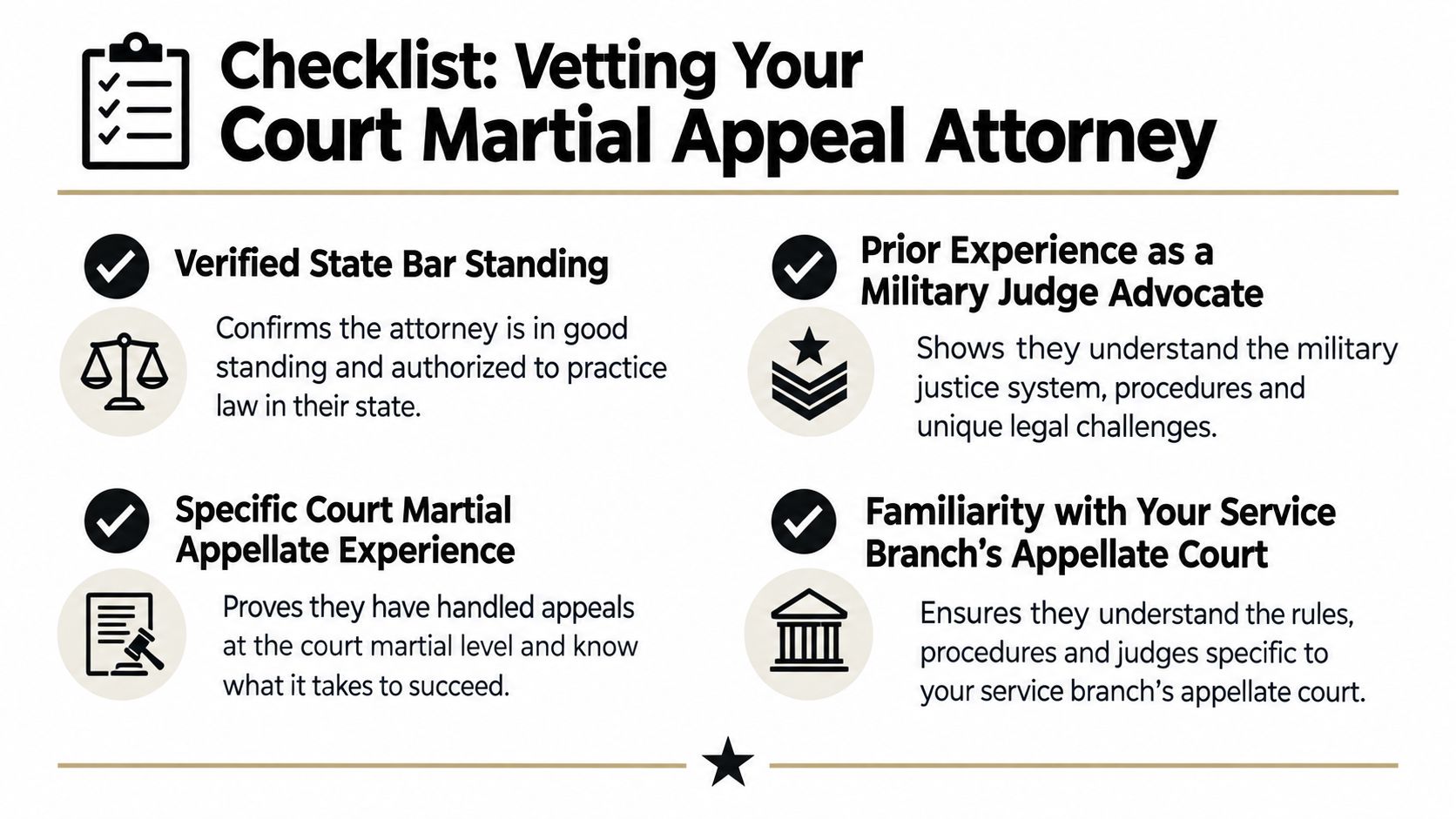
Look for verified bar standing and actual military appellate experience. Prior service as a military judge advocate, trial counsel, or military defense counsel can signal familiarity with the system, but it isn’t enough by itself. Ask whether the lawyer has prepared and filed briefs in the relevant service court and CAAF, and whether the attorney understands your branch’s procedures.
Published opinions aren’t the only measure of ability, but they can show whether counsel has handled issues such as factual sufficiency, unlawful command influence, sentencing, discovery, record defects, or post-trial delay. A lawyer who mainly handles civilian criminal appeals may be excellent in that field and still lack the military-specific knowledge your record requires.
Use this first-call script:
- “How many court-martial appeals have you handled in the last two years?” Ask for a direct answer and distinguish appeals personally handled from matters the firm merely reviewed.
- “Who will do the record review and actual writing?” The person selling the engagement may not be the person drafting the brief.
- “What is your preliminary timeline under my facts?” The answer should identify missing documents and filing dates, not promise an outcome.
- “Is the fee flat, hourly, or hybrid?” Get the scope, exclusions, travel terms, and appellate-stage triggers in writing.
- “Have you checked for conflicts with my trial counsel and the government lawyers?” A careful conflict review is essential when ineffective assistance or trial errors may become issues.
- “How will you coordinate with automatically appointed military appellate defense counsel?” The civilian lawyer should explain division of labor, communication, and control of filings.
Fees and scope
For 2026, a typical CCA-only engagement may range from $7,500 to $25,000, while a matter reaching CAAF may range from $20,000 to $60,000. These ranges are practical market guidance for comparing proposals, not guaranteed prices or a substitute for a written agreement. Clemency, discharge upgrades, and records-correction work are usually priced separately.
The agreement should identify whether it includes the initial record review, post-trial submissions, CCA brief, reply brief, oral argument, rehearing work, CAAF petition, and coordination with appointed counsel. Ask what happens if the transcript is incomplete or the case requires extraordinary relief.
Red flags deserve blunt treatment:
- Outcome guarantees: No responsible appellate lawyer can promise reversal, sentence relief, or a particular discharge result.
- No transcript review: Anyone selling a theory before reading the record is guessing.
- Unclear scope: Refusal to sign a scope-of-engagement letter creates avoidable disputes.
- Generic civilian language: If the lawyer can’t explain preservation, standards of review, Article 66, and the relevant service court, keep looking.
You can use this guide to court-martial defense lawyers as one comparison resource, then interview counsel directly about experience, strategy, fees, and communication.
Why Civilian Appellate Counsel Changes the Outcome
Automatic military appellate defense counsel is an important access point, especially for a service member who has just received a conviction and doesn’t know where to turn. But automatic appointment doesn’t mean the assigned lawyer has unlimited time, a private budget, or a customized relationship with your family. The military appellate system carries a substantial caseload, and appointed counsel must manage that institutional workload.
A retained civilian appellate lawyer can add independence and attention. That may mean reading every page of the record, comparing the transcript with exhibits line by line, interviewing trial counsel about unclear events, and developing a brief around the strongest legally supportable issue rather than the loudest grievance.
Different courts require different fights
Trial counsel persuades the factfinder. Appellate counsel persuades judges through standards of review, record citations, statutory interpretation, and carefully limited remedies. The best appellate argument may concern a sentencing error, Article 13 issue, post-trial delay, constitutional defect, ineffective assistance, or a factual-sufficiency problem that trial counsel couldn’t fully develop in the courtroom.
A civilian specialist can also serve as a second set of eyes when the appointed lawyer and trial counsel have different assessments of the case. Coordination matters. Two lawyers should not duplicate work, contradict one another, or file inconsistent positions without a deliberate strategy.
Hiring civilian counsel isn’t a vote against appointed counsel. It is a decision to add independent review where the consequences justify it.
The case for civilian representation is strongest when confinement, a punitive discharge, complex evidentiary issues, serious credibility disputes, or a potentially outcome-determinative record defect is involved. Appellate relief may mean a reversal, a remand, sentence reduction, correction of the record, or a stronger foundation for later administrative relief. It may not produce a complete victory, but a focused brief can protect options that a rushed or generic filing leaves behind.
Reviewing a lawyer’s background matters more than relying on marketing. A profile such as this military appellate defense lawyer overview can help you identify the kinds of appellate experience to investigate, but you still need a direct consultation and a written engagement plan.
Your Next Steps and Questions to Ask Right Now
The first 72 hours after a court-martial conviction should produce a paper trail, not arguments with command or an attempt to rebuild the trial from memory. Ask a family member to maintain the calendar while you collect documents and communicate with counsel.
- Preserve every trial document. Store the charges, motions, rulings, exhibits, findings, sentencing materials, agreements, and correspondence in one secure folder.
- Request the Record of Trial. Ask counsel when and how to obtain the official record. Compare it with the materials already in your possession and flag anything missing.
- Calendar the CAAF deadline. The petition period is generally 60 days from the earlier of notification of the CCA decision or mailing to the provided address, under 10 U.S.C. § 867(d). Put the date on multiple calendars and confirm the calculation with counsel.
- Track convening-authority issues. Record the 120-day Moreno benchmark and each post-trial submission date.
- Stop casual communications. Do not sign statements, answer command questions, or send a detailed explanation of the verdict until counsel reviews it.
- Schedule an appellate consultation. Send the sentence, findings, docket information, and any transcript or record materials before the call.
Questions families ask after conviction
When should clemency be filed?
As soon as the applicable post-trial schedule permits, after counsel identifies the strongest sentence-focused arguments and supporting materials. Waiting for the appeal to finish can forfeit a useful opportunity to address punishment.
Can a discharge upgrade run alongside the appeal?
Potentially, but discharge review and records-correction remedies are separate from direct appellate review. Counsel must assess timing, jurisdiction, exhaustion, and whether parallel action supports the case or creates complications.
How long will CCA review take?
The timing varies. Monitor delay rather than treating the case as dormant. The Moreno framework treats more than 18 months from docketing as a benchmark that can raise a presumption of unreasonable delay, as discussed earlier.
Does a guilty plea eliminate all appeal options?
No. A guilty plea can narrow factual and legal challenges, yet the record may still contain issues involving the plea inquiry, jurisdiction, sentencing, post-trial processing, ineffective assistance, or unlawful conditions. The transcript and documents determine which issues remain viable.
Military appellate practice is recurring and substantial, not a one-off administrative formality. A Defense Advisory Committee study of 262 appellate decisions found that 175 cases, or 67%, affirmed the findings and sentence, while 20 cases, or 8%, produced another appellate outcome, as reported in the appellate review study. The figures do not make an appeal pointless. They show why issue selection, preservation, record accuracy, and deadline control deserve focused attention.
If you were convicted at a court-martial, contact a qualified court martial appeal attorney today, not next week. Send counsel the sentence, findings, docket information, and every post-trial document you have. Ask for a same-day deadline review. Your liberty, discharge, records, and future options may depend on work that begins before the government’s file is complete.