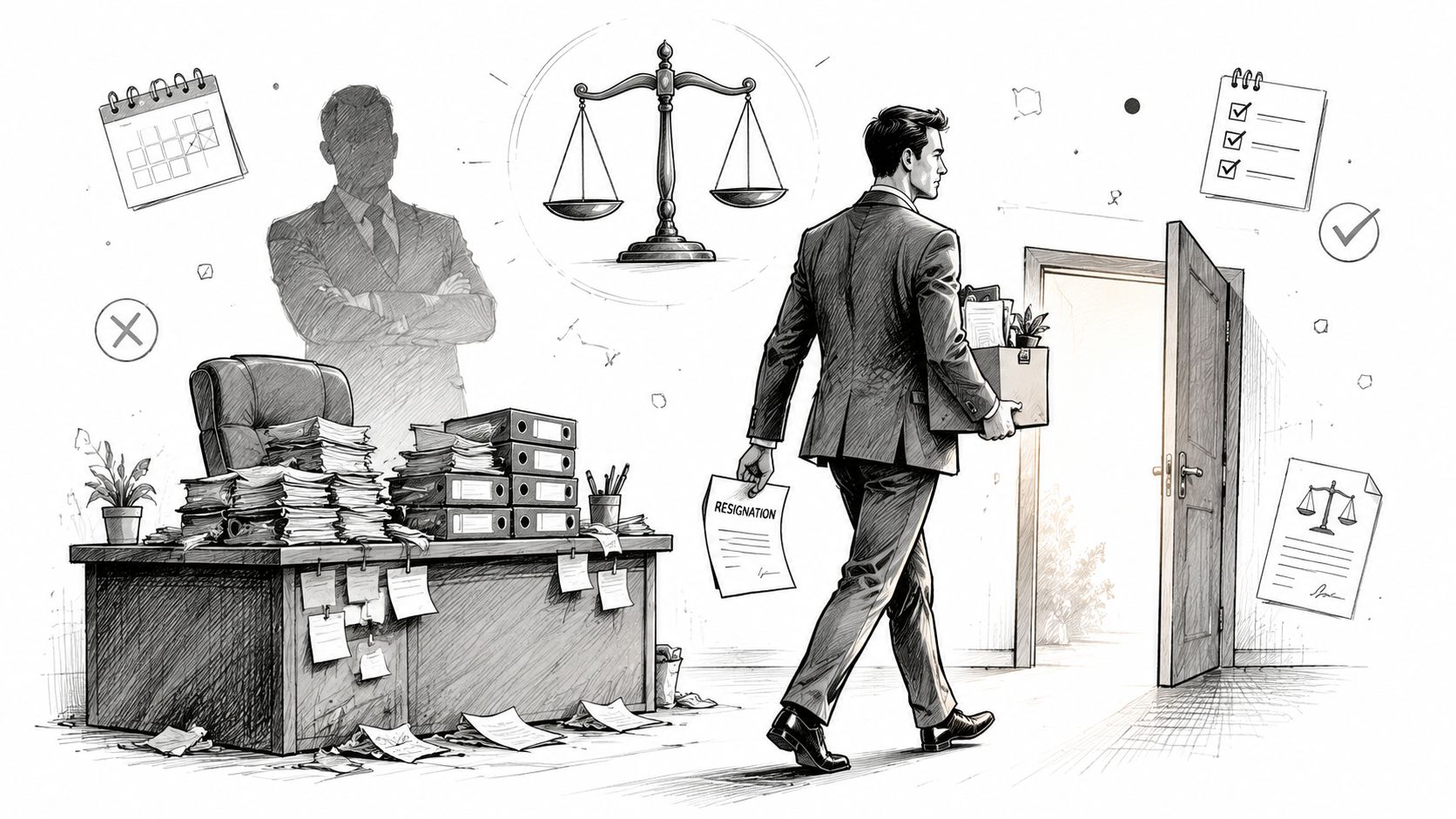
In California, a resignation can count as a firing only when a reasonable person would have felt compelled to quit because the employer intentionally created or knowingly permitted intolerable conditions. That is the Turner v. Anheuser-Busch objective test, and it is the line between a lost resignation and a real claim.
If you quit because the workplace got unbearable after you complained, you may already be in constructive discharge California territory. The most common mistake is simple, but costly. People assume that because they said, “I quit,” the law is over. It isn’t. Under California law, a forced resignation can still preserve wrongful-termination, discrimination, and retaliation remedies when the facts support it, but only if you move fast and prove the right things.
Table of Contents
- When a Resignation Becomes a Firing in California
- The California Legal Standard Explained
- Three Elements You Must Prove
- Constructive Discharge vs Wrongful Termination
- Filing Deadlines and Procedural Options
- Remedies and the Evidence Checklist
- Practical Steps for Employees and Employers
When a Resignation Becomes a Firing in California
A warehouse supervisor gets pushed out after complaining about race discrimination. A healthcare worker keeps reporting harassment, then gets stripped of meaningful shifts. A tech employee raises retaliation concerns and suddenly finds the pressure unbearable. In each version of that story, the employer may never hand over a termination letter, but the law may still treat the exit as a firing if the working conditions were intolerable.
That is the practical meaning of constructive discharge. It is not a separate, standalone grievance you file in a vacuum. It is the bridge that lets a resignation become a legally actionable termination when the employer’s conduct forced the exit.
What that means in real life
A lot of employees wait too long because they are still trying to decide whether the treatment is “bad enough.” That delay can wreck the case. California constructive-discharge disputes turn on three things right away, the conditions, the timing, and the paper trail.
Practical rule: If the employer knew about the problem and nothing changed, document everything before you resign or the defense will argue you walked away from a fixable situation.
The reason this doctrine matters is simple. Without it, many employees lose the chance to pursue wrongful termination, FEHA discrimination, or FEHA retaliation claims because they technically resigned instead of being fired. With it, the resignation can carry the legal weight of a discharge, but only if the facts cross a high threshold and the claim stays inside the deadline window.
A client in this position should stop asking, “Did I quit?” and start asking, “Can I prove I was pushed out?” That question changes everything, including which documents matter, which deadlines apply, and whether the employer’s conduct can still be challenged effectively.
The California Legal Standard Explained
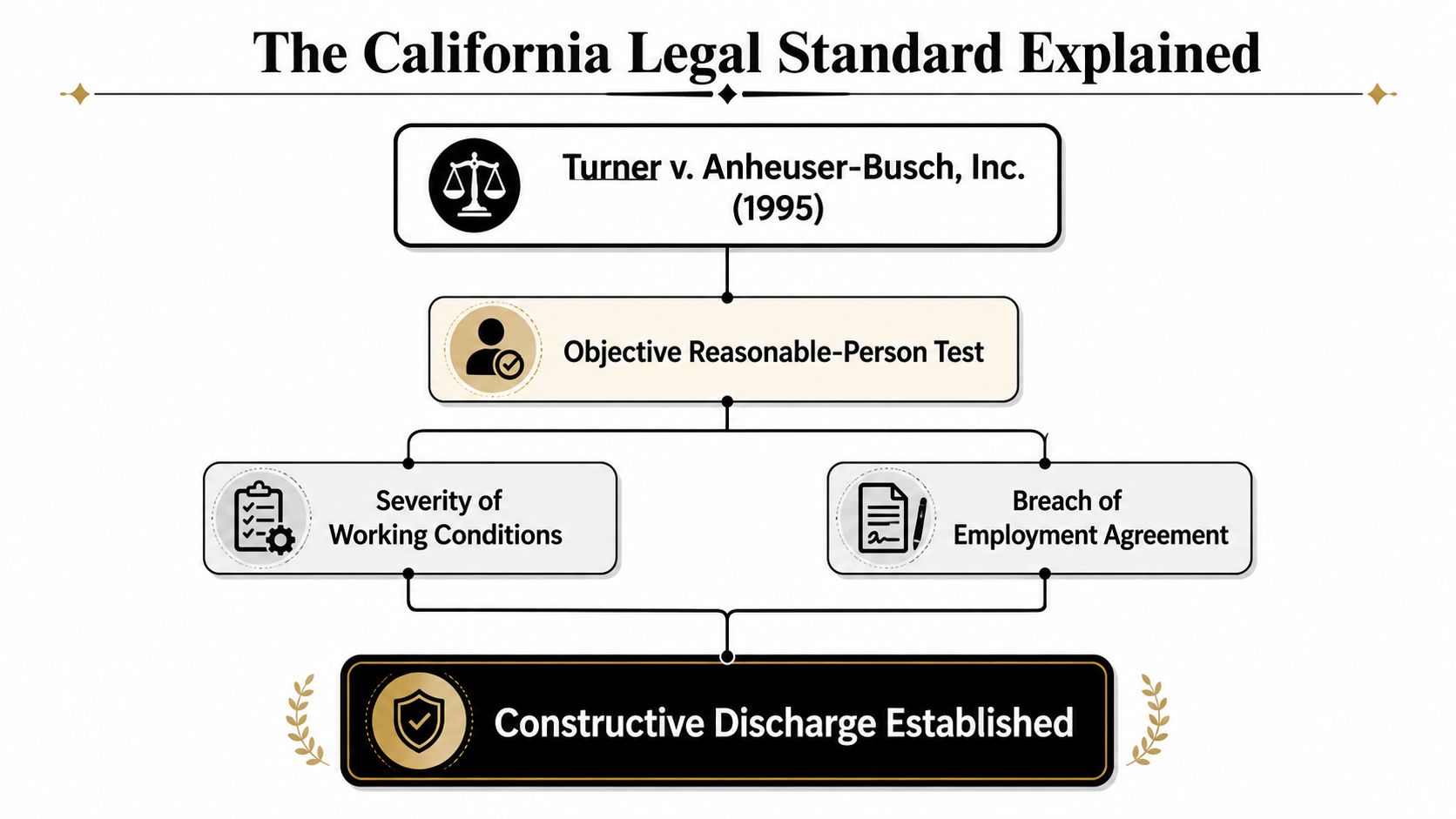
California’s modern standard comes from Turner v. Anheuser-Busch, Inc. (1995), and it is objective, not emotional. The question is whether the employer intentionally created or knowingly permitted conditions so intolerable that a reasonable person in the employee’s position would feel compelled to resign. California jury instructions also emphasize that the conditions must be “unusually aggravated” or show a “continuous pattern” before they qualify as intolerable, and the employee must prove the claim by a preponderance of the evidence. See the California jury instruction framework in CACI 2510.
Why the objective test is the real battleground
Your own stress matters, but it does not control the outcome. Judges and juries are asked to decide whether a reasonable employee in your shoes would have felt forced out. That is a much tougher standard than proving the workplace was unpleasant, unfair, or frustrating.
The defense will always try to reframe a forced resignation as a personal choice. The only reliable answer is evidence that the conditions were severe enough that staying was not realistic.
The employer’s knowledge also matters. If management didn’t know, or can credibly argue it didn’t know, the claim gets weaker fast. That is why written complaints, HR notices, and clear reports to supervisors are not optional side issues. They are core proof.
The practical takeaway is blunt. Constructive discharge California cases are won by showing a pattern of coercive conditions, not by telling a sad story about a bad manager. If the facts are thin, the claim will usually collapse under the objective standard. If the facts are documented and severe, the resignation can become a legally equivalent firing.
Three Elements You Must Prove
California employment-law analysis usually boils this claim down to three practical elements: the employer intentionally and knowingly created an intolerable environment, the conditions left the employee no real choice but to resign, and the employer’s conduct was tied to illegal retaliation or discrimination. That three-part frame lines up with how courts and practitioners evaluate whether a resignation can be treated as a discharge, and it matches the practical explanation of the claim in California constructive discharge litigation guidance.
Element one is intent and knowledge
You need proof that the employer either caused the conditions or knowingly let them continue. That usually means more than one complaint, more than one bad incident, or a documented pattern of inaction. Emails to HR, supervisor responses, witness accounts, and internal investigation records matter here because they show the employer knew what was happening.
Element two is compulsion
The working conditions must have left you with no real choice. Not “I was unhappy.” Not “I wanted a better job.” The question is whether the pressure got so severe that a reasonable person would have felt forced out. Courts care about the full setting, not one isolated disagreement.
Element three is unlawful motive
Discrimination and retaliation enter the picture here. If the intolerable conditions followed a protected complaint, or if the mistreatment tied back to a protected characteristic, the claim has real force. If the resignation came from a normal career move or ordinary workplace frustration, it usually won’t qualify.
Evidence rule: The strongest constructive-discharge file is built before the resignation, not after it. Contemporaneous complaints beat cleaned-up narratives every time.
Here’s the cleanest way to evaluate your facts:
- Employer knew and ignored it: Stronger, because knowledge is easier to prove.
- Conditions kept escalating: Stronger, because a pattern is easier to show than a one-off event.
- Resignation followed protected activity: Stronger, because retaliation and discrimination connect the facts to a legal theory.
- You left for a better opportunity: Weakens the claim, because causation becomes the employer’s best defense.
That is the proof structure. If one element is missing, the case gets harder. If all three line up, the resignation starts to look like a termination in legal terms.
Constructive Discharge vs Wrongful Termination
A resignation can end a case fast if the employee left for personal reasons, a better offer, or a general career move. California law does not treat every bad workplace as a firing. Constructive discharge is the legal mechanism that changes that result when the employer’s conduct pushed conditions past the lawful limit and forced the resignation.
The three categories that matter
A straightforward resignation is the cleanest category. The employee walks away for reasons that have nothing to do with illegal conduct, and that usually leaves no wrongful-termination claim.
A merely difficult workplace does not create liability on its own. The supervisor may be abrasive, the workload may be punishing, or the culture may be miserable, but unless the pressure ties back to discrimination, retaliation, harassment, or another protected wrong, the law usually stops there. Constructive discharge occupies the middle ground where conditions cross the legal threshold.
A constructive discharge is the third category. The conditions become intolerable, the employee resigns because of those conditions, and the resignation can support an underlying claim such as FEHA discrimination, harassment, or retaliation. That is the decisive battleground, because the employer will attack the resignation itself and argue that no termination ever happened.
Why the doctrinal pathway matters strategically
Without constructive discharge, an employer will argue there was no firing, so the employee cannot pursue a termination claim. With constructive discharge, the resignation can be treated as a discharge and keep remedies alive that would otherwise disappear. Timing and proof control that outcome. A weak forced-resignation theory can sink a strong discrimination or retaliation case.
For related separation issues in another legal setting, some readers also review administrative separation and military discharge guidance. The label changes from one system to another, but the same basic point holds, facts control the result.
The practical line is simple. If the workplace was just unpleasant, the law usually treats the resignation as voluntary. If the employer knowingly or intentionally drove conditions to the point of compulsion, the resignation can function as a termination for legal purposes. That distinction decides whether a case lives or dies.
Filing Deadlines and Procedural Options
Deadlines kill strong cases when employees miss them. For FEHA-based claims involving harassment, discrimination, or retaliation, the Civil Rights Department window is generally 3 years from the last harmful act as described in California constructive-discharge deadline guidance. For wrongful-termination claims based on public policy, the usual period is 2 years from the resignation date. California also recognizes a 1-year statute of limitations for tort-based constructive-discharge claims measured from the date of termination, as noted in California appellate analysis summarized by 1000Attorneys.
Where to file the claim
The usual first stop is an administrative charge with the Civil Rights Department, formerly the DFEH, and sometimes the EEOC as well. That filing preserves the path to a civil case when the underlying claim involves discrimination, harassment, or retaliation.
The next route is a civil lawsuit in California superior court or, in the right case, federal court. That is where the resignation gets litigated as a legally equivalent firing, and where damages become real.
Cross-filing can preserve both state and federal remedies when the facts support them. That is often the cleanest route when the case involves overlapping FEHA and federal issues.
The date that controls everything
The hard part is that the clock often starts running before the employee understands the legal risk. The last harmful act, the resignation date, and the filing date are not paperwork details. They decide whether the court ever reaches the merits.
Deadline advice: If you are still deciding whether to quit, talk to counsel before you resign. Once the date is fixed, the clock is moving.
For readers dealing with a board or separation process in another employment setting, administrative separation board procedures show the same lesson, timing and record preservation matter from day one. In California constructive-discharge cases, they matter just as much.
The bottom line is direct. If you wait too long, the law will not care how bad the workplace was. The deadline will end the case before a judge looks at the facts.
Remedies and the Evidence Checklist
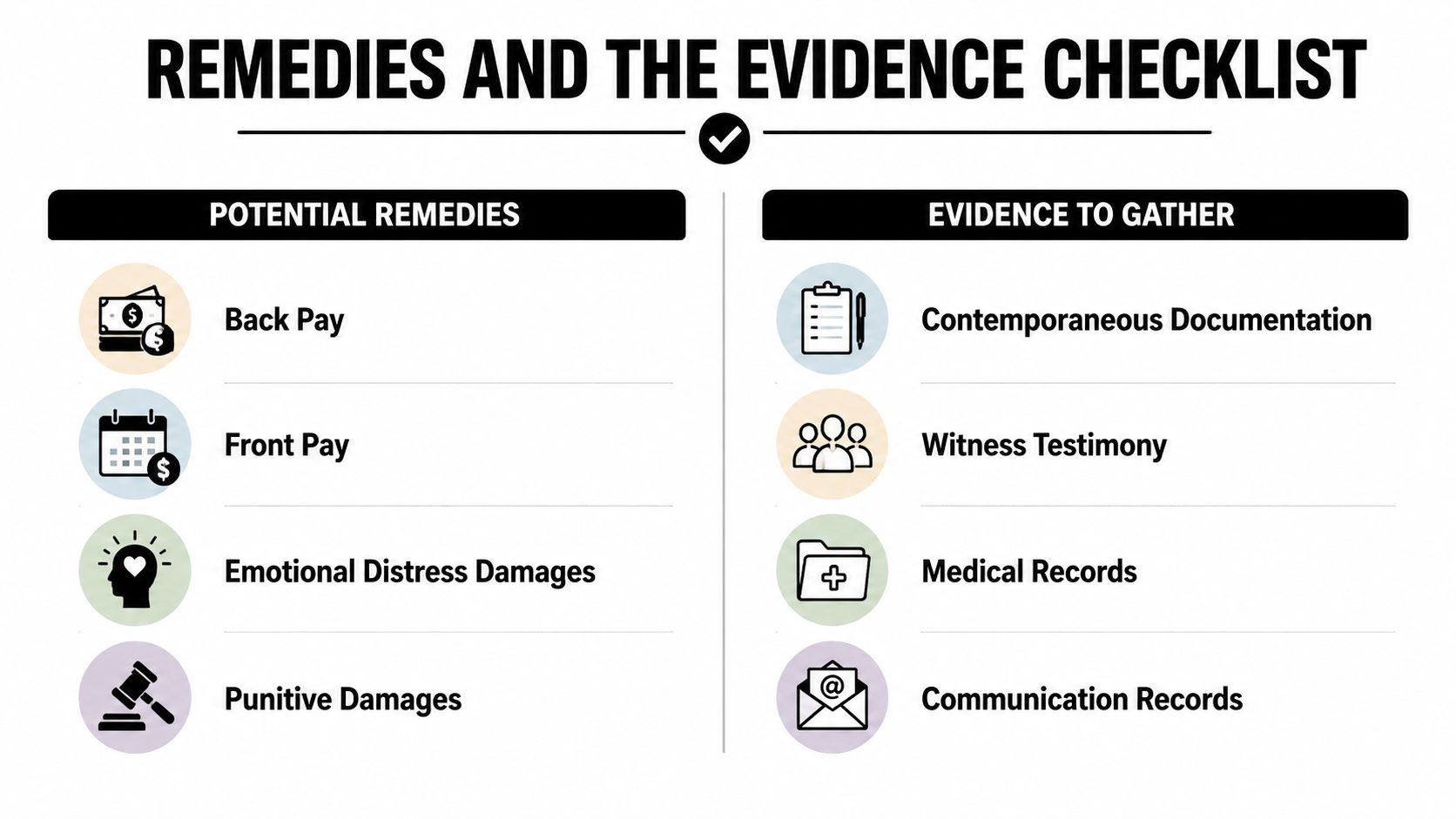
When a constructive-discharge claim is strong, the remedies can include back pay, front pay, emotional distress damages, punitive damages where allowed, and attorney’s fees in FEHA and certain statutory claims. The value of the case rises or falls with the quality of the proof, not with how outraged the employee feels. Strong documents create advantage. Weak documents create denial.
What counsel wants to see first
The first documents to gather are the ones created in real time. Not polished summaries. Not after-the-fact explanations. Gather the emails, the texts, the HR complaints, the calendar entries, and the responses that show the problem was ongoing and ignored.
- Contemporaneous documentation: Save emails, texts, memos, and screenshots that show what happened while it was happening.
- Witness testimony: Identify coworkers who saw the conduct or heard the complaints.
- Medical records: If the workplace affected your health, those records can support emotional-distress and causation issues.
- Communication records: Keep HR messages, supervisor replies, and any admissions that help prove knowledge.
What makes the damages credible
Back pay and front pay depend on the employment loss. Emotional-distress damages depend on the effect the conduct had on you. Punitive damages depend on the employer’s level of wrongdoing where they are available. Attorney’s fees matter because they can make a case worth pursuing even when the client can’t fund a full-blown fight alone.
The evidence checklist below usually separates a case worth pushing from one that needs more work:
| What helps | Why it matters |
|---|---|
| Written complaints | Proves notice |
| Silent HR responses | Helps show inaction |
| Performance reviews | Shows whether the employer changed its story |
| Witness names | Supports the pattern |
| Personnel records | Helps test credibility |
That’s the strategic truth. The law gives you remedies, but the file you build determines whether those remedies are real or theoretical.
Practical Steps for Employees and Employers
An employee who is being pushed out needs to stop treating the situation like it might fix itself. Put the problem in writing, save every email, text, and HR response, and use the internal complaint process before the employer rewrites the record. If the mistreatment is tied to discrimination, retaliation, or harassment, file with the proper agency on time and speak to counsel before you resign if you still have that choice.
The timing matters because constructive discharge is the bridge that can turn a resignation into a fully litigable wrongful-termination, FEHA discrimination, or retaliation claim. If you wait too long, or resign without building the record, you hand the employer the clean exit story it wants.
If you are trying to understand how strong litigation support is built, the founder’s guide to paralegal hiring shows why sharp document handling and deadline control matter. In a forced-resignation case, those two skills often decide whether the claim survives the first challenge.
What employers should do
Employers reduce exposure by moving quickly and documenting neutrally. That means a real investigation, not a box-checking exercise, and it means the company should separate facts from conclusions in every note, email, and memo. Supervisors should not retaliate with shift changes, schedule cuts, or sudden discipline that makes the exit look engineered.
A bad separation memo can do more damage than the original complaint if it reads like the company was building a defense instead of fixing the problem.
For employers handling separation issues across different legal frameworks, see our guide to administrative discharge in the army for additional context on documentation standards. The point is simple. If the record shows a push-out, the employer has created the plaintiff’s best exhibit.
Employees should do the same kind of disciplined work on their side. Preserve the evidence, track the dates, keep the complaint trail intact, and get legal advice before the resignation becomes final. That is how you protect the claim while the facts are still fresh.
If you believe you were forced out in California, do not sit on it. Talk to a California employment lawyer now, compare the facts against the objective standard, and move before the deadlines close the door.